

Why Does Berlin Repeat the Failure of Paris and London? Look for the Answer at “OCHA”!
By: Khalid Al-Tijani Al-Nour

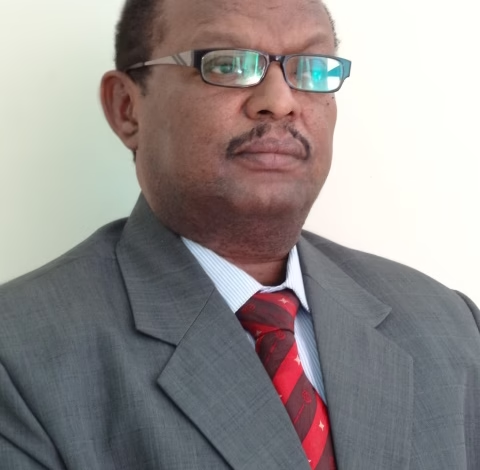
By: Khalid Al-Tijani Al-Nour
Elaph Newspaper – April 9, 2026
1
For the third consecutive year, a European capital “celebrates” the third anniversary of the foreign aggression against Sudan and its people, employing local proxies. Just as happened with the Paris meeting on April 15, 2024, and the London meeting on April 15, 2025, Berlin now enters the arena of “aggressive New Year” celebrations on April 15, 2026. What, then, was the benefit of the first two, for failure to be repeated in the third?
The declared agendas of the three meetings have remained the same each time: “mobilizing international support to confront the largest humanitarian catastrophe the world has witnessed in the 21st century, facilitating the delivery of humanitarian aid, coordinating and strengthening political and peace initiatives in Sudan, and focusing international efforts so that Sudan’s war does not become a forgotten crisis.”
2
This is what the French Foreign Minister at the time, Stéphane Séjourné, announced during a hearing at the French National Assembly on April 15, 2024. It is also what the German Foreign Minister, Annalena Baerbock, said in her speech at the Paris conference: “The international community must not turn its gaze away from the war in Sudan, which has caused a catastrophic humanitarian crisis,” speaking of the “indescribable suffering” of Sudanese people and their feeling that “the world has abandoned them.”
It is also what the former British Foreign Secretary David Lammy echoed ahead of the London meeting, and what his successor Yvette Cooper reaffirmed before the British House of Commons on February 5, noting in an article marking 1,000 days of war that “the world is catastrophically failing the Sudanese people.”
3
“All of this is commendable, ministers,” and these agendas appear sound on the surface, beyond reproach—if actions were to match declared intentions. But reality contradicts these good wishes. To avoid seeming overly sarcastic in a serious context by describing these annual meetings as “celebrations of the tragedy’s anniversary,” the contradiction between words and actions must be acknowledged.
It is unreasonable that over the past three years the situation in Sudan continues to be described as “the worst humanitarian crisis in the world this century,” accompanied by calls for urgent action to prevent it from becoming forgotten—yet without the necessary swift response. Instead, a year passes each time before repeating what should be done immediately and continuously. This makes the gatherings resemble annual commemorations rather than an ongoing urgent concern.
4
Another contradiction regarding the humanitarian agenda raised in these European capital meetings is that the crisis does not need what might be called unnecessary formalities—such as conferences held under the pretext of mobilizing resources—when they add no real value.
This is evident in the reports of the United Nations Office for the Coordination of Humanitarian Affairs (OCHA), which annually issues the “Humanitarian Needs Response Plan for Sudan.” This plan details requirements across sectors such as food security, health, education, and water, along with specific budgets, and calls on donors to fund the annual response plan.
5
Thus, what is required from donor countries is not to hold an annual “memorial ceremony,” nor to restate what is already known, but to directly provide the necessary funding to implement the response plan without delay or procrastination—especially given their expressed concern over the deteriorating humanitarian situation.
Instead, they avoid fulfilling their financial commitments while holding diversionary conferences that claim concern and express alarm over the “worst global humanitarian crisis,” only to display stinginess when it comes time to meet funding obligations.
6
To avoid making unfounded claims, let us examine OCHA’s analysis in its latest report (April 7), comparing international donor responses to UN humanitarian plans in Sudan over the past decade (2016–2025).
The highest average response rate was 59% during the final three years of the former regime (2016–2018), declining to 48% during the transitional period (2019–2021), rising again to 58% in 2022, and reaching 54% during the three years of war. Given these modest response rates—despite repeated warnings that Sudan faces the world’s worst humanitarian crisis—why has this alarm not translated into adequate funding?
7
In reality, the contributions of the three capitals—London, Berlin, and Paris—which enthusiastically call for annual conferences under the banner of mobilizing humanitarian support, are extremely modest. In the 2023 plan, which required $2.6 billion and was only 51% funded, OCHA reported that Germany contributed 5.1%, France 4.7%, and the United Kingdom 4.4%.
8
For comparison, the United States alone contributed 47.9%—more than three times the combined contributions of the three European capitals. Yet Washington, despite contributing significantly more and being less vocal in expressing alarm, has not turned the humanitarian situation into an annual commemorative event marked by statements of limited substance and impact.
9
This is only a fraction of the broader picture. Detailed analysis of OCHA reports shows a consistent decline in actual funding responses each year. Last year recorded the lowest funding response in the history of Sudan’s humanitarian plans—only 40%—despite intense campaigns calling for a humanitarian ceasefire.
Meanwhile, UN agencies complained of insufficient funding to deliver aid, due to donor shortages—even among those most vocal in warning about the worsening crisis. Attention is often diverted by discussions of ceasefires to deliver aid that does not exist, or by claims that government procedures obstruct relief workers.
10
The question remains: why do European capitals, in particular, persist in exploiting the humanitarian tragedy of victims of foreign aggression in Sudan, showing exaggerated concern and organizing annual “events” under the banner of humanitarian support—while failing to match their claims with action when it comes time to fund actual humanitarian needs?
Why are these victims made to suffer twice—once from militias backed by foreign actors, and once from those who trade in their suffering in major capitals?