
Modern European history is full of gaps that have swallowed entire stories, and perhaps one of the most surprising and thought-provoking of these stories is that of the Black presence in Germany. When we talk about the history of the African diaspora in the Old Continent, the classic colonial capitals immediately spring to mind; London, with its fog, which welcomed generations of Caribbean and African immigrants, and Paris, which embraced the thinkers of the “Négritude” movement, jazz musicians, and liberation movements. However, attention is rarely directed towards Berlin or Hamburg. Here, the book Black Germany: The Making and Unmaking of a Diaspora Community by researchers Robbie Aitken and Eve Rosenhaft steps in to turn these concepts upside down and illuminate a dark and marginalized corner of modern European history.
This book goes beyond traditional narratives that treat the Black presence in Germany as incidental events, or as a phenomenon exclusively linked to military occupation (such as the children of French occupation soldiers after World War I, or American occupation soldiers after World War II). Instead, the authors weave with journalistic brilliance and rigorous academic precision a continuous, living, and highly complex story that begins in the late nineteenth century, continues through the fluctuations of the German Empire, then the boiling years of the Weimar Republic, leading up to the catastrophic Nazi Holocaust and its aftermath. It is not merely a dry history book; rather, it is a dramatic biography of a community that was formed from the womb of colonial contradictions, and attempted to survive and create a meaningful life in the heart of one of the fiercest racist machines of the twentieth century.
The Seeds of the Diaspora: From the Halls of the Berlin Conference to the Streets of the Capital
In 1884, while European powers were scrambling to divide the continent of Africa and tear it apart with the ruler of the famous Berlin Conference, Germany was quietly and bloodily establishing its colonial empire in Cameroon, Togo, and East and Southwest Africa. With the raising of the German flag over these distant lands, an unanticipated reverse journey began. The first Africans did not come to Germany as chained slaves, which is the common pattern in the historical imagination of the transatlantic movement of Black people; instead, many of them arrived as members of ambitious elites.
The coastal elite in Cameroon, specifically from the “Duala” people, are concentrated at the focal point of this scene. This elite possessed a long history of diplomatic and commercial interaction with Europeans long before the Germans arrived. They were a cosmopolitan class of commercial middlemen; many of them were fluent in English and interacted with European missionaries with astonishing parity. When the German Empire asserted its dominance, the leaders of these families decided—with political pragmatism—to send their sons to the heart of the new empire; to cities like Berlin and Hamburg, to learn the language of the “new masters,” train in their techniques, and acquire the knowledge that would enable them to maintain their influence in their homelands.
In April 1885, local newspapers in Berlin picked up the news of the arrival of the German consul in Cameroon, accompanied by a striking figure: the young Prince “Ebobse Dido”. The prince roamed the streets of Berlin in an open carriage, arousing the curiosity and admiration of passersby. That was just the beginning of the influx of hundreds of young Africans. The book recounts amazing details about these early pioneers, such as “Alfred Bell,” who arrived in 1887 to train in the metal and construction factories in Hamburg and Bremen.
Alfred was not merely a silent trainee grateful for the colonial scholarship; rather, he was an intelligent observer and a scathing critic of the society that hosted him. The letters he sent to his brother in Cameroon—which were intercepted and read with apprehension by the German authorities—reveal an early political and class consciousness. He mocked the glaring contradiction between the claims of European civilization and the crude racism he faced in the streets. More importantly, he perceived with a keen eye the fragility of the class situation in industrial Europe; he recorded his observations on how poor white workers were exploited and worked under conditions that did not differ much from slavery. This penetrating awareness and early insight made Alfred and his peers “troublesome subjects” for the colonial administration, which expected blind obedience and eternal amazement at the greatness of the “White man.”
The Clash of Expectations: The Myth of the “Trouser-Wearing Negro”
The German authorities in Berlin and Cameroon hoped, with classic colonial naivety, to form a “Germanized” and loyal African vanguard that would return to the colonies to be a compliant cog in the machine of the colonial administration and infrastructure projects. However, the magic quickly turned against the magician.
The young Africans who were educated in German schools, lived with German families, and received promises of enlightenment and religious brotherhood (especially within Baptist churches that opened their doors and their pastors’ homes to them), began demanding their full rights. These youths, who began wearing elegant European suits, carrying personal identification cards, and taking professional studio photographs of themselves, disrupted the strict hierarchy upon which colonialism was based.
When they attempted to return to Cameroon or integrate into their societies, they collided with the reality of a racial hierarchy that refused to equate them with whites or grant them the jobs and salaries commensurate with their European experiences. The initial admiration for African “progress” turned into mockery and hostility. In this context, the satirical colonial literature and press coined a malicious racist term: “Hosenneger” (the Trouser-wearing Negro). This term was used to mock the “half-Europeanized” African who was seen as having lost his “primitive” authenticity and had not reached (and in their eyes, would never reach) the ranks of the civilized white man. In its essence, this mockery reflected a deep terror on the part of the colonizer over the blurring of the dividing lines between white and Black, and over the idea that the African could master the tools of modernity to a degree that threatened the legitimacy of colonialism itself.
The Trap of the Metropolitan Center and the Transformation into a Community
By the mid-1890s, with the increase in rebellions and complaints led by these youths returning with European ideas about justice and law, colonial authorities began to realize that the policy of education in the center (the Metropole) carried the seeds of its own destruction. The policy of encouragement was replaced by imposing strict administrative restrictions to prevent Cameroonians from traveling to Germany. The new laws required obtaining direct permission from the colonial governor and paying exorbitant financial bail as a guarantee.
Despite this restriction, the influx continued in other forms. Missionary expeditions stepped in to provide alternative pathways for educating Africans in Germany. Another, darker and more controversial path emerged: “Human Zoos” (Völkerschauen). Show organizers, such as “Carl Hagenbeck,” would bring groups of Africans to present performative shows embodying their “primitive lives” to a German audience thirsty for the exotic. The peak of this spectacle was at the Colonial Exhibition in Berlin in 1916, where dozens of Cameroonians and Togolese were brought in to be exhibited. What the authorities did not expect was that a not insignificant number of these performers, after the end of their degrading show contracts, refused to return to the colonies. They asked to remain in Germany and sought jobs as mechanics, shoemakers, cooks, and musicians, integrating into the bottom of the German working class.
With the outbreak of World War I in 1914, the trap closed on everyone. The Africans who came for education, for work, or to visit, found themselves trapped in Germany, completely cut off from their families in Africa, and unable to return. With Germany’s resounding defeat and the loss of its colonial empire to France and Britain under the Treaty of Versailles, everything changed. The immigrants ceased to be “German subjects,” transforming overnight into people with a highly ambiguous legal status; they became “dependents” of the mandate countries (France and Britain), yet they did not obtain their citizenship, and at the same time, they lost the protection previously provided by their former colonial status in Germany.
Here, in the heart of this isolation and legal limbo, the astonishing transformation began. These men (and a few women) who were left to face their fate in a society undergoing crushing economic and political crises after the war, realized that their survival depended on their solidarity. From the heart of this diaspora, and in cities like Berlin and Hamburg, the features of an actual “community” began to form. They were no longer merely foreign visitors waiting for the next steamboat to return home; rather, they became neighbors, workers, husbands, and fathers, creating bonds of solidarity that transcended original tribal affiliations, to build a new diasporic identity that celebrated and defended their being “Black” in the heart of Europe.
The Maze of Identity Papers: Refugees in Their New Homeland
As the cannons fell silent and the dust of World War I cleared, the Africans residing in Germany awoke to a suffocating bureaucratic nightmare. The Germans had lost their colonies, and under the Treaty of Versailles and the League of Nations’ mandate system, sovereignty over Cameroon and Togo was transferred to France and Britain. Overnight, these young men who had come to Germany as “subjects of the German Empire” (Schutzgebietsangehörige) turned into people with no clear identity; they were no longer Germans, and at the same time, French and British authorities refused to grant them their citizenships and contented themselves with classifying them as “Protected Persons.”
The book Black Germany brilliantly observes how identity papers and the passport transformed into tools of daily oppression. In the Weimar Republic, Africans had to carry an alien identification document (Personalausweis) that was renewed periodically, placing them at the mercy of police officers in every movement. When some of them attempted to return to Africa to escape the stifling economic crises in post-war Germany, they clashed with a categorical refusal from the French administration in Cameroon. The French authorities feared these returnees, considering them “spies” sympathetic to Germany, or politicized radical elements that might transmit the contagion of rebellion and the demand for rights to the local population in the colony. Thus, the door of return was closed, and remaining in Germany became an inevitable fate.
Love Across the “Color Line”: Mixed Families and Establishing Roots
Under this geographical and legal siege, the first generation of African immigrants had no choice but to build their lives in Germany. Given that the overwhelming majority of the Cameroonian arrivals were men (as only very rare cases of African women arriving in Germany were recorded during that period), marrying German women was inevitable.
The authors Aitken and Rosenhaft dive into family archives and civil registry records to reveal the dynamics of these mixed marriages. These relationships were not merely passing whims, but were serious and desperate attempts to settle down and establish ties of kinship and affinity that would protect the African in a white society. For example, the Cameroonian merchant “Mandenga Diek” met and married his first German wife, then later married a second German woman and built a stable family in the city of Danzig. Similarly, the mechanic and ticket collector “Martin Dibobe” connected with and married into working-class Berlin families.
But this emotional stability was met with fierce societal and institutional hostility. These marriages coincided with a rabid racist propaganda campaign that swept Germany in the early 1920s known as the “Black Horror” (Schwarze Schmach). This campaign erupted in response to France’s use of African soldiers (from Senegal and Morocco) in the occupation of the German Rhineland, where the right-wing press depicted the Black man as a predatory monster targeting white German women. Africans residing in Germany were deeply affected by this poisonous atmosphere; some were beaten and spat upon in the streets, and their German wives suffered from social ostracism and reprimands for betraying the white “race.” Despite this, the book proves that many of these marriages endured, producing a second generation of “Afro-Germans” who would grow up in the shadow of the rise of Nazism.
The Theater as a Battlefield: Exploiting “Exoticism” for Survival
How do you earn a living in a country economically torn apart, where employers refuse to hire you because of your skin color or lack of citizenship? The book answers this tragic question by reviewing the survival strategies devised by Africans in Germany.
Although most of these men descended from educated elites and had received advanced vocational training in Germany as artisans, mechanics, and shoemakers, they found the doors closed in their faces after the war. Here, they discovered a cruel paradox: the German society that refused to employ them as equal workers was willing to pay large sums of money to watch them as “exotic beings.”
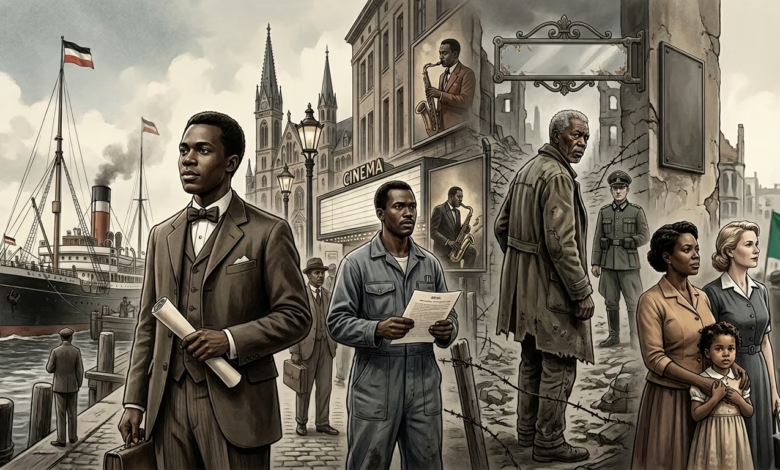
And so, a large segment of the African diaspora community turned to working in the fields of entertainment, theater, the circus, and cinema. They exploited the Weimar society’s infatuation with American jazz culture and exoticism to present musical and dance performances. Taverns such as the “Indian Bar” in Hamburg emerged as gathering places where Black musicians played. As for Berlin, some of them broke into the nascent film industry, such as the Cameroonian actor “Louis Brody,” who became a familiar face in the films of the famous director “Fritz Lang,” where he was called upon to play any role requiring non-European features, whether the role was for an African chief, a Moroccan prince, or even an Asian servant!
In a dramatic manifestation of the “exoticism strategy,” the book tells the story of the two young Cameroonians, “Wilhelm Munumé” and “Peter Makembe,” who decided to circumvent economic marginalization by executing a Hollywood-style scam. In 1926, they disguised themselves as official envoys of a fictional West African king named “Bondo Ngolo”, and convinced German paper merchants and printers—thanks to their elegant aristocratic attire and by playing on European ignorance of Africa—to supply them with equipment to print counterfeit British pounds, claiming it would be used in a political campaign against British colonialism. Despite being arrested and imprisoned, their trial turned into a display of elegance and defiance, as the courtroom filled with their African friends wearing the finest suits, in a visual message of defiance against degrading stereotypes.
The Birth of Political Consciousness: From Petitioning to the “Black International”
The diaspora community’s reaction was not limited to attempts at economic survival; rather, a political consciousness rooted in the diasporic experience gradually crystallized. Initially, the Africans founded a mutual aid association in Hamburg in 1918 known as the “African Relief Association” (Afrikanischer Hilfsverein), aimed at providing financial, legal, and social support to the isolated immigrants.
As tension escalated, they moved from charitable work to direct political engagement. In 1919, Martin Dibobe submitted a bold and detailed 32-point petition to the National Assembly in Weimar, demanding equal rights for Africans, the legalization of mixed marriages without harassment, and the appointment of a permanent political representative for their “race” in the German parliament. This petition served as a foundational manifesto demanding their recognition as part of the future German political fabric.
By the late 1920s, and with doors closing before them, the younger generation turned towards the Communist International and Afro-American and Francophone liberation movements. Here emerges the star of “Joseph Bilé,” the Cameroonian engineer who became politically radicalized and joined the communist-backed “League Against Imperialism” in Berlin. Bilé co-founded the Berlin branch of the “League for the Defense of the Negro Race” (LzVN), and became a prominent face in political gatherings.
Bilé traveled to Moscow to study at the “Communist University of the Toilers of the East” alongside figures who would become historical, such as the Kenyan Jomo Kenyatta. There, he engaged in fierce debates with the leaders of the Comintern (Communist International), adopting a highly specific diasporic vision. In contrast to the European communists who wanted to confine the struggle of Africans to class conflict, Bilé and his comrades cried out about the importance of “racial consciousness,” demanding an understanding of the specificity of racial oppression as an independent tool of subjugation no less dangerous than capitalist exploitation. Bilé also later contributed to promoting the cause of the American “Scottsboro Boys” in Germany, linking for the first time the violence of colonialism in Africa with the brutality of arbitrary lynchings of Black people in the United States, thereby establishing a transcontinental discourse of solidarity.
Under the Shadow of the “Swastika”: The Systematic Unmaking of the Berlin Diaspora
When Adolf Hitler rose to power in 1933, the Black community in Germany entered the phase of “The Unmaking,” which the book’s title bears. The Nazi regime did not need to enact laws specific to Black people at first; the racial doctrine formulated by Hitler in his book Mein Kampf was enough to make their lives a living hell. Black people were viewed as “tools of the Jews” aimed at polluting “Aryan racial purity.”
Aitken and Rosenhaft paint a painful picture of this era, where extermination was not always swift or via gas chambers as happened with the Jews, but rather it was an extermination by social and biological strangulation. It began with stripping them of their livelihoods; Africans were fired from their jobs in factories and railways, and were banned from joining the “German Labour Front,” which left them vulnerable to hunger and homelessness. By 1935, and with the issuance of the “Nuremberg Laws,” citizenship was revoked from those who had obtained it, and they were deprived of the right to marry or have relations with “those of German blood.”
However, in the midst of this terror, the book reveals a surreal paradox lived by the diaspora community. The Nazi regime possessed colonial ambitions to reclaim Cameroon and Togo, and to propagandize these ambitions, the Ministry of Propaganda, headed by Goebbels, needed Black actors to participate in “colonial films” portraying “Germany’s greatness in Africa.” Thus, some Africans, like the actor “Louis Brody,” found themselves in a strange situation; in the morning they acted as heroes or tribal chiefs in luxurious clothes in the “UFA” studios, and in the evening they returned to their homes trembling in fear of Gestapo patrols. Cinema was for them a “golden cage” and the only means to secure a livelihood and avoid immediate arrest, but it did not protect them from a tragic fate in the end.
The Open Wound: Forced Sterilization and Concentration Camps
The book moves to one of the darkest pages of German history: the forced sterilization program. Under the guise of “preventing hereditarily diseased offspring,” Nazi authorities targeted the second generation of “Black Germans,” particularly those known as the “Children of the Rhine” (the children of African soldiers in the French occupation army and German mothers). The authors document horrific cases of Black teenagers who were kidnapped from the streets or schools and taken to hospitals to undergo forced sterilization procedures to prevent “polluting German blood.”
The matter did not stop at sterilization; with the outbreak of World War II, the persecution of Africans began on charges of “espionage” or “anti-state activity.” The book excavates the records of Nazi concentration camps such as “Dachau,” “Buchenwald,” and “Sachsenhausen,” to find the names of Africans from the early diaspora community. Among them was “Joseph Bilé,” whose traces disappeared under mysterious circumstances, and others who perished due to starvation, torture, and hard labor. This phase was the “final dissolution” of the social ties that had been painstakingly built over decades; families were scattered, fathers were imprisoned, and children lived in constant fear of deportation or murder.
Beyond the Ruins: The Struggle for Recognition and the Suppressed Memory (1945-1960)
In 1945, the Third Reich fell, but for the survivors of the Black community, “Zero Hour” (Stunde Null) was not the beginning of an era of justice. The final section of the book sheds light on the compounded tragedy of these survivors; they found themselves in a Germany occupied by Allied forces, who brought with them thousands of Black (American) soldiers. Suddenly, the new presence of African-American soldiers and their children (who were called “Brown Babies”) overshadowed the history of the old presence of Black Germans from the colonial era.
The survivors of the older generation, such as “Theodor Wonja Michael,” fought a bitter battle to obtain compensation as victims of Nazism. However, the post-war German bureaucracy frequently rejected their claims, arguing that they had not been persecuted for “political” reasons but for “racial” reasons not covered by the law at the time, or because they did not officially hold German citizenship.
The book continues tracing these threads up until 1960, the year that witnessed the independence of many African nations, including Cameroon. Here, the book closes the circle; some of the children of the diaspora who were born in Berlin and had never seen Africa decided to “return” to the homelands of their ancestors, carrying European disappointments and German technical expertise, to participate in building their independent states. As for those who remained in Germany, they lived as “silent witnesses” to a history that everyone tried to forget.