
The Night Port-au-Prince Fell
In the pre-dawn quiet, specifically on July 7, 2021, the sky over the Haitian capital, Port-au-Prince, gave no indication of anything other than the usual Caribbean stillness. However, in the affluent neighborhood of Pèlerin 5, where the private residence of President Jovenel Moïse was located, the clock was ticking down to the start of one of the most bloody and mysterious political operations of the 21st century. The assassination was not merely about bullets piercing the body of a controversial president; it was a geopolitical earthquake that shook the intelligence corridors of the Western Hemisphere.
A heavily armed group of men, speaking Spanish with a distinct Colombian accent, breached the president’s security fortifications, which later proved to be suspiciously fragile. They faced negligible resistance from the presidential guard. Within minutes, Jovenel Moïse was a lifeless body lying in a pool of his own blood, while his wife, Martine, was transferred to the hospital after sustaining severe injuries. The following morning, the world woke up to breaking news headlines: “Assassination of the President of Haiti at the Hands of Foreign Mercenaries.”
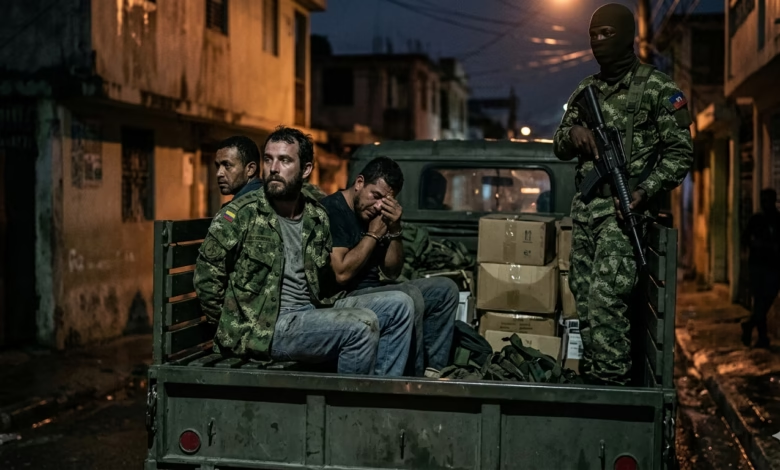
Swiftly, the attackers were apprehended. The photographs taken of them bound, with faces bearing bruises and signs of exhaustion and shock, were enough to cement the official narrative in the minds of the global public: ruthless hitmen, who came from Colombia to sell their rifles to the highest bidder, and executed their mission in cold blood. The case was closed in the court of public opinion before the actual investigations even began.
But, was this the complete truth? Were these men truly “mercenaries” in the classical sense of the word, or were there layers of deception and misinformation that the fast-paced news cameras did not uncover?
Here steps in the investigative journalist and author Luis Carlos Vélez to turn the tables on the official narrative, through his recently published book by “Planeta” (Editorial Planeta) under the title: Mercenarios: La historia no contada del asesinato del presidente de Haití (Mercenaries: The Untold Story of the Assassination of the President of Haiti). This book is not merely a compilation of news clippings; it is a deep and tightly constructed dive into one of the most complex conspiracies in the history of Latin America and the Caribbean region.
The Counter-Narrative: The “Hitmen” Lie
Vélez’s style in this book is characterized by the nature of rigorous investigative journalism that does not settle for the surface of matters, but digs into the motives, the back-channel communications, and the shell security companies operating in the shadow zones between the law and organized crime. The book boldly posits its central thesis from the early chapters: these former Colombian military men, who were demonized globally, were unaware of the true nature of the mission for which they were brought to Haiti.
Through years of tireless research, access to exclusive documents, and interviews with figures close to the file, Vélez builds a terrifying mural of how “scapegoats” are manufactured in the world of international politics. The author clarifies how these retired soldiers—who served long years in counter-insurgency and guerrilla warfare in Colombia—were contacted by security companies registered in the United States (specifically in Florida). The offer presented to them was lucrative and simple at the same time: to provide security protection for VIPs in Haiti, and assist in routine missions to secure infrastructure, in exchange for monthly salaries to feed their families left behind in their motherland, where veterans suffer from a stifling economic and social marginalization.
Vélez describes how the promises of honorable work transformed into a terrifying nightmare. These men were not “dogs of war” looking for blood, but rather men deceived by the bureaucracy of ambiguous security companies. The book narrates how they did not discover the truly horrific plan until a few hours before the execution, when they found themselves trapped in an irreversible snare. They were used as a military front to execute a complex political agenda engineered by influential Haitian politicians, greedy businessmen, and perhaps regional intelligence entities that wanted to get rid of Moïse without leaving their own fingerprints.
Dissecting the Concept of “Mercenaries” in the Modern Era
The book goes beyond merely narrating the facts of the night of the assassination, to raise philosophical and ethical questions about the nature of privatized warfare. Vélez pauses at the term “mercenary,” pointing out that the indiscriminate application of this word sometimes serves the true perpetrators. For once a person is branded with the title of “mercenary,” they are automatically stripped of their humanity, and with it, the desire to listen to their story or understand their motives is stripped away.
Vélez dives into the psychological and social backgrounds of the Colombian soldiers. How does a state like Colombia turn into a primary “exporter” of military expertise? And how is the need of these men for money and dignity after their retirement exploited, to thrust them into conflicts in which they have no stake? By presenting their text messages to their families days before the incident, the book shows them as people who truly believed they were performing a legal security job, with no difference between it and guarding a bank or a vital facility.
It is this paradox between the demonic image painted for them in the media, and the naivety of some of them and their falling victim to a systematic brainwashing and entrapment operation, that gives the book Mercenaries its massive narrative power. The author does not entirely absolve them of criminal responsibility or of the naivety of engaging in a mined political environment without sufficient scrutiny, but he fairly redistributes the percentages of condemnation, shining the spotlight on the “true engineers” in the closed rooms, those who rented these men and then left them to their inevitable fate in the angry streets of Port-au-Prince.
Shadow Networks, Institutional Collapse, and the Betrayal of the Temple Guards
The Conspiracy’s Threads Extend to Florida: The Privatization of Violence
The book explains how the actual planning did not begin in the dark alleys of Port-au-Prince, but in the air-conditioned offices in the US state of Florida, specifically through a security company called “CTU Security” (Counter Terrorist Unit Federal Academy), managed by the Venezuelan immigrant Antonio Intriago. Here, Vélez raises an issue of profound importance in the structure of contemporary international relations: how shadow wars and political interventions have come to be managed via legally registered “security contracting” companies, operating in the backyard of the American superpower, and exploiting the loopholes of the financial and legal system to fund, recruit, and arm paramilitary forces.
The recruitment was done under a completely legitimate cover. The Colombians were persuaded that they were part of a major investment operation led by an American-Haitian doctor and pastor named Christian Emmanuel Sanon, who dreamed of becoming president of Haiti through an ambitious developmental plan. The soldiers believed that their mission was to protect this “potential president” and secure fictitious infrastructure projects. The author presents how the economic need of these soldiers was exploited, and how the international system that produced the phenomenon of “security privatization” leaves these individuals without a legal cover once things deviate from their course. It is a miniature picture of the collapse of the state’s monopoly on violence, where a small group of investors and shell companies can engineer the change of entire ruling regimes at a cost not exceeding a few million dollars.
Haiti: The Play of the Fragile State and the Geopolitical Vacuum
Perhaps one of the most thrilling and suspenseful chapters of the book is that panoramic analysis Vélez provides of the internal situation in Haiti. It is impossible to understand the ease of breaching a republic president’s bedroom without understanding the structural context of the collapse of the Haitian state. The author describes Haiti as a living embodiment of the “failed state”; where institutions erode, armed gangs control the joints of the capital, and a stifling political vacuum prevails.
Jovenel Moïse was an isolated president, living in a palace surrounded by enemies from every side. He faced fierce opposition from the financial oligarchy in Haiti, a disintegration in his political alliances, and a loss of popular legitimacy. Vélez depicts how this institutional dissolution created an ideal environment for the conspiracy to grow. In this context, the assassination operation did not need a massive army to execute it, but only needed to exploit the state of disintegration and paralysis suffered by the state’s security apparatuses. Haiti, which stands on the geopolitical fault lines in the Caribbean, was left to eat itself from the inside, making the head of the state a ripe fruit ready for the picking by any faction possessing the audacity and sufficient money to buy consciences.
The Night of Betrayal: When the State Conspires Against its Head
Vélez’s journalistic narrative reaches its dramatic peak upon reconstructing the chronological sequence of the night of July 7. Here the book unveils the “internal betrayal” without which the mercenaries would not have bypassed the outer door of the residence. The author asks in a scathing, interrogative style: How could a group of foreigners, who do not know the geography of the place and do not speak French or Creole, breach three security cordons guarded by dozens of heavily armed Haitian police and presidential guard personnel, without a single bullet of resistance being fired?
The answer, as Vélez documents with evidence and testimonies, lies in the complete complicity of Moïse’s own men. Dimitri Hérard, the head of the Presidential Guard, and Jean Laguel Civil, the president’s security coordinator, were an integral part of the plot. Orders were issued to the guard to step down and not intervene.
The shocking surprise that the book throws here is that the Colombians were given the illusion on the night of the execution that they were executing a legal “arrest warrant” issued by a Haitian judge, supported by an alleged coordination with the US Drug Enforcement Administration (DEA). The Colombians entered shouting through megaphones: “DEA operation, stay in your places.” They believed they were on a mission to extract the president alive. But upon storming the room, they found—according to the testimonies of some of them—that the president had already been killed or was executed in those moments by a specialized assassination squad that preceded them to the target.
The Colombians were introduced to the crime scene to be mere bloody décor, “smoke” to cover for the real killers. And when they realized the trap, it was too late. The companies that rented them abandoned them, and they found themselves chased in the streets of the capital like predators, with some of them brutally liquidated, and the others captured to be thrown into the worst prisons in the world, as perfect scapegoats that turn the page on the crime and close its file quickly.
In the Labyrinth of Investigations, the Struggle of Loyalties, and the Justice Lost Between Continents
Washington and Bogotá: The Diplomatic Tug-of-War Game
While the streets of Port-au-Prince were boiling with anger and demanding the heads of the “foreigners” who invaded the presidential palace, there was another war being managed in secret; a cross-border legal and intelligence war, the complex details of which Luis Carlos Vélez narrates in the middle section of his book with a brilliance that rivals the most exciting espionage novels, but here it is cloaked in the bitterness of reality and the cruelty of facts that do not accept interpretation.
Vélez transitions in this chapter from the crime scene in Haiti to the corridors of power in Washington and Bogotá. The book clarifies how the Colombian government found itself in an extremely critical position; on one hand, these “killers” are former soldiers in its army, and on the other hand, international pressure demands their swift condemnation. The author reveals how Colombian intelligence initially tried to defend the rights of its citizens, pointing to the “misinformation” they were subjected to, but it collided with the wall of Haitian silence and American coldness.
In Washington, the Department of Justice, the FBI, and the DEA were monitoring the situation with extreme caution. Vélez raises a pivotal question: How did this conspiracy manage to pass under the radar of the American intelligence apparatuses, despite the fact that the planning, funding, and recruitment took place on its soil? The book sheds light on the legal loopholes that allow private security companies to operate with absolute freedom in Florida, and how their activities are sometimes overlooked if they serve undeclared political interests, or if they are simply “small” to the point of not arousing suspicion, until the catastrophe occurs.
The American Judiciary against the Haitian Judiciary: The Paradox of Justice
One of the most shocking aspects in Vélez’s review is the comparison between the judicial paths in Miami and Port-au-Prince. The author describes the Haitian judicial system as a “graveyard for justice”; where investigating judges resigned one after the other after receiving death threats, vital evidence disappeared from the crime scene, and a suspicious silence prevailed around the major figures involved inside the state.
In return, Vélez analyzes the “American path” with penetrating journalistic intelligence. Why did the United States insist on trying the main planners (such as Rodolphe Jaar, Germán Rivera, and Joseph Vincent) on its territory? The author views that Washington wanted to control the narrative to ensure no secrets touching “national security” leaked out or revealed the depth of the involvement of informants affiliated with its agencies in the operation. The book describes the trials in Miami as “surgical”; aiming to reach swift conviction sentences without diving deeply into the “entity” that gave the final green light, or the real “financier” who disappeared behind layers of shell companies.
Voices from Under the Rubble: The Tragedy of the Soldiers’ Families
Vélez does not settle for political analysis, but grants his book a “soul” by dedicating a wide space to the suffering of the families of the detained Colombian soldiers in the horrific prisons of Haiti. The book describes the “Port-au-Prince Civil Prison” as a piece of hell on earth, where these soldiers live in overcrowded cells, without medical care, and under a continuous threat of liquidation by the gangs that effectively manage the prison.
Vélez relays testimonies from wives and mothers in Bogotá, screaming that their sons “are not monsters.” These women, who found themselves suddenly in the heart of an international crisis, represent the forgotten human side in this conspiracy. The book documents how these soldiers, who were deceived by the promises of rewarding salaries, did not receive a single cent in the end, but left their families in extreme poverty added to the shame of the “assassination” that haunts their names. This human angle reinforces Vélez’s fundamental thesis: that these men were mere “fuel” for a massive political engine that did not have mercy on them when it broke down.
The Enigma of “Informants” and the Shadows of the DEA
The book singles out a complete chapter for what it calls the “game of informants.” It became apparent that many of the masterminds of the assassination, including some Colombians and Haitians residing in America, were working as former or current informants for American agencies. Vélez analyzes how these individuals used their previous connections to impart a “veneer of legitimacy” to the operation in front of the Colombian soldiers.
The magic sentence that opened all the doors was: “Washington wants this.” The book portrays how the Colombian military culture, which was accustomed to working closely with American advisors in the drug war, made it easy for these soldiers to believe they were on a secret mission supported by “Uncle Sam.” This illusion, as Vélez reveals, was the strongest weapon in the hand of the conspirators, and it is what made these veteran warriors walk towards their doom with their full will, believing they are saving Haiti from a dictator, while they were in reality assassinating what remained of its stability.
The Psychology of the Soldiers: Falling into the Trap of “False Legitimacy”
Vélez dedicates extremely important pages to analyzing the military mentality of the Colombians who became involved in this operation. The author clarifies how the military upbringing they received in their country, which relies on blind obedience to orders and the firm belief that any mission carrying an American blessing is necessarily a “noble act,” was the fatal weak point.
The author accurately analyzes how the language of “professionalism,” “order,” and “law” was used to seduce these warriors. They were not offered murder; they were offered “restoring order.” They were not asked to assassinate a president; they were asked to “execute a judicial warrant.” This manipulation of words is what enabled the real conspirators to turn soldiers into an executive tool without them realizing they are committing a crime against history. Vélez reveals that many of these soldiers, even while they are inside the Haitian cells, are still unable to comprehend how the mission they believed would guarantee their financial future turned into an eternal nightmare. They are victims of a professional “identity crisis,” where they were stripped of their military doctrine and turned into “merchandise” in the market of privatized violence.
Haiti After Moïse: The Vacuum That Devours Everything
The book does not stop at the moment of the assassination, but draws the features of “post-Moïse Haiti.” Vélez describes how the absence of the president—in whatever manner it was—did not solve any crisis, but exacerbated them terrifyingly. The state turned into “fiefdoms” managed by armed gangs (such as the G9 alliance), and the presidential palace became a symbol of the vacuum, not of authority.
Vélez sees that the assassination was a “political abortion operation” that was not aimed at improving governance as much as it was aimed at getting rid of a “nuisance” to the owners of interests. The author analyzes how this incident contributed to fragmenting the Haitian social fabric, where the ordinary citizen lost the lowest belief in the state’s ability to protect him. The book in this part rings a bell of real danger: Haiti is no longer merely a poor state, but has become a “laboratory for the dark future” for the states that relinquish their sovereignty in favor of transcontinental security companies and secret alliances between corrupt elites.
Lessons Learned: When Sovereignty Becomes a “Commodity”
In the chapters that precede the conclusion, Vélez raises fundamental questions to the international community:
-
The Responsibility of Security Companies: The author clearly demands setting strict international legal frameworks that regulate the work of private security companies. “Security contractors” cannot remain operating without censorship, while they possess the ability to decide the fate of entire states.
-
Intelligence Bankruptcy: The book points out that the assassination was a dismal failure for regional intelligence, which was busy monitoring the “drug trade” and overlooked the “coup trade” that occurs via shell companies.
-
The Crisis of Collective Memory: Vélez warns that the “untold story” he tries to uncover might be folded quickly under the pressure of new news, allowing the real conspirators—who still walk in the corridors of power—to escape punishment.
Vélez concludes this part of his book by asserting that writing this work was a “moral duty.” Not only to defend the truth, but to prevent the “assassination of Haiti” from turning into a model followed by other powers in different parts of the world, where undesirable leaders are eliminated via “mercenaries” who are disowned the moment the mission ends.