

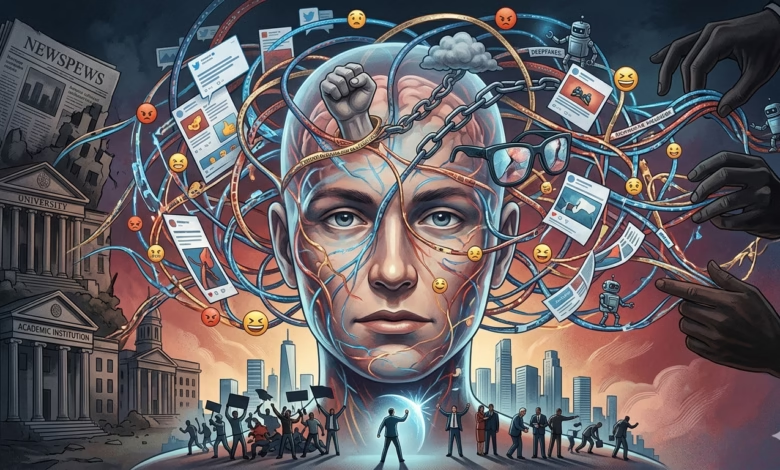
In our contemporary world, which has come to be characterized by a complex intersection of globalization, privatization, and media hegemony, wars are no longer necessarily fought with tanks, artillery, and massive armies. Instead, the battlefield has shifted to our minds and smartphones, where “stories” or “narratives” have become the most lethal weapon. In this context, academic Andreas Krieg, an Associate Professor at King’s College London, presents a precise and alarming anatomy of how information has transformed into a tool of domination in his prominent book, “Subversion: The Strategic Weaponization of Narratives,” published by Georgetown University Press.
We must begin by deconstructing the fundamental concept proposed by the author. Krieg is not merely speaking here about fleeting media disinformation campaigns or fake news; rather, he delves into something much deeper. He defines “subversion” as the strategic exploitation of psychological, social, infrastructural, and physical vulnerabilities within the information environment by an external adversary, with the aim of eroding consensus or the social and political status quo. In other words, it is a process of precise narrative engineering designed to exploit the emotional state of the public, with the goal of pushing them to make predetermined decisions that serve the attacker’s interest, all while believing they are doing so out of their own free will.
Truth as a Social Construct and the Hacking of the Human Mind
Krieg begins his investigative journey in the first chapter by posing an existential philosophical question: What is truth? In the era of “alternative facts,” the author takes us back to the roots of Western philosophy, from Plato’s Allegory of the Cave, which symbolizes liberation from the sensory world to attain objective truth through reason, all the way to the Enlightenment philosophers and the construction of the scientific method based on experimentation and critical review.
However, the author delivers a fatal blow to our intellectual vanity when he proves that the greatest obstacle to “objective truth” is not a lack of knowledge, but rather the human brain itself and the way it is designed. We, as humans, are considered “cognitive misers.” Faced with the overwhelming flood of information in the digital age, our brains resort to adopting shortcuts and practical solutions known as “heuristics” to deal with this burden. These shortcuts provide us with “good enough” and rapid answers, but they are not necessarily “accurate” answers.
Herein lies the fatal vulnerability targeted by systematic subversion operations. We are biologically and socially programmed to seek out information that confirms our preexisting beliefs, which is known as “confirmation bias.” This bias causes us to reject logical facts if they contradict our biases, and conversely, we tend to believe lies if they reinforce what we already believe. The attempt to avoid “cognitive dissonance” drives individuals—and even journalists and academics—to retreat into echo chambers that surround them only with people and information that confirm their viewpoints.
The Age of Anger and the Weaponization of Emotion
The most fascinating aspect of Krieg’s proposition is his focus on the emotional dimension in shaping our convictions. Human cognition does not operate in isolation from emotion. The author cites the description of our current era as the “age of anger,” where many feel marginalized and powerless in the face of the complexities of globalization and economic and social inequality.
These negative emotions, primarily fear and anger, are transformed into highly effective strategic weapons. Fear generates a state of paralysis and a search for certainty amidst chaos, making the masses more susceptible to accepting conspiracy theories or naive, simplistic narratives that explain complex problems in black and white. Anger, on the other hand, is the emotion that possesses a massive capacity for “mobilization” and pushing individuals to take action. Information packaged with feelings of anger and provocation spreads like wildfire and becomes “viral” on social media much faster than sober and neutral news.
Thus, warriors in the contemporary information environment are not necessarily concerned with spreading outright lies; rather, they sometimes take abstract facts and package them in emotionally charged narratives, specifically designed to fit the tribal and ideological biases of the target audience. They construct narratives that clearly define who the “victim” is and who the “executioner” is, providing a comforting explanatory framework that spares the individual from complex critical thinking.
Understanding this psychological and social fragility represents the first step in comprehending how countries like Russia and others have managed to infiltrate democratic societies and manipulate their choices. However, this psychological penetration would not have achieved overwhelming success were it not for the radical changes in the information “infrastructure,” namely the collapse of traditional gatekeepers (such as the media and academia) and the rise of social media.
The Fourth Estate and the Crisis of Trust
For centuries, traditional media played the role of the “gatekeeper” who decides what information reaches the public and how it is framed. These institutions served as the Fourth Estate, filtering the news and shaping the “public sphere” spoken of by the philosopher Jürgen Habermas as an arena for rational debate among citizens. Alongside the media, academia and experts stood as additional guardians to ensure “objective truth” based on the rigorous scientific method and critical scrutiny.
But Krieg argues that public trust in these gatekeepers did not collapse suddenly; rather, it eroded gradually due to deep structural biases. First, ideological bias; the mainstream media is often accused of adopting liberal and elitist leanings that ignore the opinions and vast margins of society. Second, “access bias,” which refers to the symbiotic relationship that has developed between journalists and political elites; the journalist needs political sources to do their job, and the politician needs the media to pass their agenda, which has weakened the media’s capacity for independent criticism and holding power accountable. Finally, the commercial bias that chases sensationalism and profit; major media institutions, under the pressure of competition, have come to adopt the motto “if it bleeds, it leads,” exploiting negative emotions like anger and fear to increase sales and reach at the expense of sober and neutral coverage.
Academia as an Infiltrated Arena
The academic “ivory tower” was not immune to this erosion. The scientific “truth system” has been penetrated through the rise of predatory scientific journals and pseudoscience, which are not subject to rigorous peer review and rely on biases instead of refuting them. Worse still is the commodification and politicization of expertise; external powers and authoritarian regimes have begun funding think tanks in Western capitals to push them toward adopting narratives that serve the interests of those powers. This financial backing buys “experts” who lend academic legitimacy and false credibility to politicized narratives, rendering academia a pliable tool in information wars.
The Rise of “Insurgency Media” and Echo Chambers
In light of this vacuum and the worsening crisis of trust in traditional institutions, social media emerged to play the role of “insurgency media.” These technological platforms destroyed the traditional media hierarchy and replaced it with decentralized networks, enabling ordinary individuals to entirely bypass traditional gatekeepers and speak directly to power or to millions of followers. Although this development initially seemed like a victory for “liberation technology” and democracy, it actually provided a free, uncensored platform for spreading extremist opinions, misinformation, and conspiracy theories at minimal costs and without any commitment to journalistic standards.
Here, the hidden and most dangerous actor intervenes: algorithms. This software that runs platforms like YouTube, Facebook, and Twitter does not care about accuracy or truth, but rather about the extent of user “engagement” to ensure they stay as long as possible. This purely commercial goal drives algorithms to create “echo chambers” that isolate individuals in ideological and emotional bubbles; where they are shown nothing but content that confirms their preexisting biases and fears.
And inside these closed rooms, a dangerous psychological phenomenon known as the “repetition-induced truth effect” is exploited. As the author points out, referring to George Orwell’s quote in his novel 1984: “If all records told the same tale—then the lie passed into history and became truth.” The continuous repetition of a narrative, even if it is false or misleading, makes its cognitive processing easier for the brain, pushing users to accept it as an undeniable fact based on a false sense of consensus.
Trolls and Bots: The Armies of Digital Subversion
In this fertile environment for manipulation, completely devoid of any real gatekeepers, “cyber armies” composed of trolls and bots have found an ideal battlefield. These fake and programmed accounts are used as “discourse saboteurs” with the aim of pumping negative emotions and distorting public debate.
Krieg explains how authoritarian states have established massive “troll farms,” such as the Russian “Internet Research Agency” (IRA) which sought to hack Western minds, and the electronic committees in Saudi Arabia that were used to intimidate dissidents and blackmail critics. These armies rely on vast networks of automated bots (botnets) to amplify specific messages, create fake consensus through likes and retweets (follower bots), or even flood platforms with noise messages to prevent certain trends from surfacing (roadblock bots), and finally, propaganda bots that disseminate political messages on behalf of foreign governments.
Social media tools have transformed from an infrastructure for sharing grievances and coordinating civic engagement into computational tools for social control and systemic subversion. In light of this collapse of the information infrastructure, the path has been paved for attackers to begin engineering their subversive narratives and transferring them from the virtual space to the streets and decision-making centers.
Subversion as an Alternative to Traditional Warfare
Krieg departs from a classic but updated strategic vision; war, in its essence, as defined by Clausewitz, is an act of force to compel our enemy to do our will. However, in the era of nuclear balance and economic interdependence, all-out wars have become costly and destructive for everyone. Here, “subversion” emerges as an ideal solution for aspiring powers; it allows the achievement of major strategic objectives without firing a single bullet, and without the need to bear the consequences of direct military intervention.
The goal of the “strategic weaponization of narratives” is not to convince the adversary of the correctness of your viewpoint, but rather to “paralyze their will.” The saboteur seeks to create a state of mental inertia and constant doubt among the public and the ruling elites in the targeted state, to the point where the state becomes incapable of making decisive decisions, or is dragged into making decisions that serve the attacker’s interests, mistakenly believing it is protecting its national security.
The Stages of Engineering Collapse: From Infiltration to Explosion
In his book, Krieg details the stages of the subversion process, clarifying that it is not a random act, but an engineering process that requires long-term patience and extreme precision:
-
Preparation: At this stage, the saboteur does not spread any lies; rather, they study the “social fabric” of the adversary. They look for already existing “fault lines,” whether ethnic, religious, class, or political. The goal is to identify the pain points that can be pressed to generate anger and fear.
-
Seeding: Here begins the pumping of narratives specifically tailored to fit those fault lines. Local “proxies” or “ambassadors” (often unaware that they are tools in the hands of a foreign power) are used to spread ideas that intensify polarization. At this stage, the focus is on narratives that reinforce the “us versus them” sentiment, leading to the erosion of mutual trust among the components of society and between the citizen and the state.
-
Amplification: Using the cyber armies and bots discussed in the previous section, these narratives are transformed from marginal opinions into a “fake consensus.” The average individual feels that “everyone is talking about this,” which pushes them to adopt it out of fear of social isolation, a psychological phenomenon known as the “bandwagon effect.”
-
Transition to Action: This is the most dangerous stage, where subversion moves from the realm of “information” to the realm of “reality.” Emotionally charged online sentiments transform into street protests, riots, pressure on parliaments to enact specific legislation, or even influencing election results by directing an angry voting bloc based on misleading information.
Strategic Ambiguity and Plausible Deniability
One of the smartest aspects of subversion that Krieg highlights is “ambiguity.” While a military attack leaves clear fingerprints, a narrative attack is characterized by “plausible deniability.” If a state is accused of subverting another society, it can simply claim that what is happening is a natural expression of the citizens’ opinions, or that digital platforms are responsible.
This ambiguity makes responding to subversion extremely difficult. Democratic states find themselves facing a dilemma: Should they restrict freedom of expression to confront subversive narratives, thereby destroying their core values and serving the saboteur’s goal of portraying them as oppressive states? Or should they leave the arena open for saboteurs to mess with their citizens’ minds? This is what Krieg calls the “democratic dilemma in the face of subversion.”
The “Enlightened Authoritarianism” Narrative as a Model of Subversion
Krieg provides vivid examples from our contemporary reality, pointing to how regional and international powers have managed to market specific narratives within Western societies and beyond. For example, how the narrative that “authoritarianism brings stability” as opposed to the “chaos of democracy” in the Middle East was promoted, and how think tanks and the media were used to pass this idea on to decision-makers in Washington and London, radically affecting the foreign policies of these countries toward the region.
Subversion, in this sense, is “poisoned soft power”; it does not seek to attract or inspire, but rather seeks to penetrate and control from within. It is a process of falsifying collective consciousness that makes the victim a partner in their own destruction.
The Russian Model: The Legacy of “Active Measures” in the Digital Age
Krieg views Russia as the “prime master” in the art of subversion, as its contemporary strategy relies on a deep legacy of Soviet intelligence work known as “active measures” (Aktivnyye Meropriyatiya). For the Kremlin, information wars do not aim to make people believe a specific lie as much as they aim to make them “believe nothing at all.”
Russia relies on what is called the “Gerasimov Doctrine” (despite academic debate over its naming), which is based on blurring the lines between war and peace. Russian subversion at its core is “destructive subversion”; it seeks to deepen divisions within Western societies (such as exploiting issues of race in America or immigration in Europe) to create a state of political paralysis. The ultimate goal is to weaken the cohesion of NATO and the European Union from within, making these powers incapable of opposing Russian ambitions in its vital sphere. The author explains how the Russian “Internet Research Agency” was used as a tool to hack American minds in the 2016 elections, not necessarily to support one candidate over another, but to tear the social fabric apart and make democracy look like a failed system.
The Emirati Model: Subversion via Weaponized Soft Power
In stark contrast to the Russian model, which is characterized by hostility and clash, Krieg offers a striking and controversial analysis of what he calls “Emirati subversion.” The author argues that Abu Dhabi has developed a unique model that he describes as “strategic and institutional subversion” or “commercial subversion.”
Here, cyber armies are not solely used for destruction; rather, the very “infrastructure of democracy” is used against democracy. This strategy relies on hiring massive public relations firms in London and Washington, funding prestigious think tanks, and employing former Western intelligence and diplomatic officials as “consultants.”
The goal of this subversion is not to create chaos, but rather the “engineering of consent.” This model seeks to convince Western elites and decision-makers that the interests of this state are identical to the interests of the West, especially regarding the fight against political Islam and the support for “stability” (even if authoritarian) in the Middle East. It is a process of “soft infiltration” into decision-making centers to steer Western foreign policies in ways that serve the regional agenda of this state, while packaging all of this in narratives about “tolerance” and “modernity.”
Subcontractors: The Privatization of Subversion
Krieg points to a dangerous phenomenon evident in both models, which is the “privatization of subversion.” National intelligence agencies are no longer the only ones carrying out these tasks; there is now a global market for subcontractors—private technology and security firms that offer disinformation, hacking, and narrative engineering services to the highest bidder.
This shift has made subversion accessible not only to superpowers but even to small states and non-governmental actors. Any entity can now purchase a complete “subversion package” that includes cyber armies, paid op-eds in global newspapers, and smear campaigns against opponents, all under a commercial and legal cover that is difficult to trace or hold accountable.
The Clash of Norms and Truth
At the end of this applied chapter, Krieg concludes that we live in a world characterized by “narrative multipolarity.” While “truth” in the past was determined by the center (the West and its institutions), it has now become an arena for conflict among various international powers, each trying to impose its own version of reality. This conflict is not about who possesses the most accurate information, but rather about who possesses the narrative most capable of penetrating the emotional biases of both the masses and the elites.
This difference between “subversion for destruction” (Russian) and “subversion for building and influence” (Emirati) reveals the extreme complexity of the modern information environment, where the enemy is no longer necessarily the one who attacks you openly, but may be the one whispering a seemingly logical and comforting narrative into your ear, one that is actually designed to serve goals far removed from your own interests.
The Artificial Intelligence Dilemma: Subversion at the Speed of Light
Krieg believes that we stand on the threshold of a new and more dangerous phase of information warfare. If human “troll farms” and primitive cyber armies have caused all this destruction over the past decade, generative artificial intelligence will make the subversion process entirely “automated.” Today, large language models can produce millions of tweets, articles, and comments that look as if they were written by real humans, in precise local dialects, and in fractions of a second.
Even more dangerous are “Deepfakes”; subversion is no longer limited to words but has extended to encompass audio and video. Saboteurs can now create videos of political leaders making statements they never made, or fabricate field events that never happened. This development does not merely aim to make people believe falsehoods, but serves the ultimate goal of the Russian subversion we discussed: “believing nothing.” When everything becomes falsifiable, the citizen loses trust in their own senses and in official sources, leading to “informational nihilism” and the collapse of the social contract.
Why Have Traditional Solutions Failed?
Krieg harshly criticizes the solutions adopted so far to counter disinformation. He views “fact-checking” as a futile effort akin to trying to put out a burning forest with a spoonful of water. The truth is often boring and complex, whereas subversive lies are designed to be “viral” and emotionally charged. By the time a lie is debunked, the subversive narrative has already settled into the subconscious of the public, and due to “confirmation bias,” people may reject the correction even if it is supported by evidence.
As for the other solution represented by “Media Literacy,” the author sees it as insufficient on its own; because the problem lies not so much in a lack of educational skills as in the “biological design” of the human brain. Humans, as previously mentioned, are emotional beings before they are rational, and relying on pure rationality in the face of narratives that appeal to instincts and fear is a losing bet.
Cognitive Immunity: A Comprehensive Defense Strategy
Andreas Krieg proposes a new concept known as “Cognitive Immunity.” This strategy is not based on censorship or blocking information, but rather on “immunizing” society from within across several axes:
-
Pre-bunking: Instead of waiting for a lie and then responding to it, states and institutions must be proactive in exposing the “mechanisms” of subversion. Teaching people “how” they are manipulated, and not just “what” they are manipulated with, provides them with a psychological shield that makes them more skeptical when encountering suspicious narratives.
-
Restoring Trust in Institutions: Krieg argues that the biggest loophole through which saboteurs penetrate is the “loss of trust.” Therefore, countering subversion begins with an internal reform of democratic institutions, ensuring that the media and academia represent all segments of society, not just the elites. When the citizen feels their voice is heard and that the state works for their benefit, they become less susceptible to adopting subversive narratives that sow discord.
-
Regulating Digital Platforms: Tech giants must be forced to change their algorithms that promote provocative content and echo chambers. Subversion thrives in an environment that seeks profit through blind “engagement,” so the legal and moral responsibility of these companies must be part of national defense.
Conclusion: Truth as a Collective Responsibility
Andreas Krieg concludes his book with a cautionary message wrapped in hope; the war on minds is an existential war for open societies. Narrative subversion is not merely a “technical problem,” but rather a philosophical and moral challenge that touches the essence of what we consider “human.”
The book “Subversion: The Strategic Weaponization of Narratives” is not just a sober academic work; it is a “manifesto” for vigilance in the age of falsity. It calls on us to stop being passive consumers of information and to begin practicing critical thinking as an act of resistance. Ultimately, the strongest weapon against subversion is not technology, but human consciousness that refuses to be dragged behind instincts and insists on searching for the truth, no matter how difficult or uncomfortable it may be.
With this book, Krieg holds a mirror up to our societies, revealing to us that the enemy is not always beyond the borders; rather, they may be lurking in our phones, in our biases, and in our innate desire to hear what pleases us instead of what is true. Reading this book is the first step in building that necessary immunity to survive in a century where the conflict will not be fought over land, but over what goes on inside our heads.