
A Cry in Bogotá and Silence in Khartoum
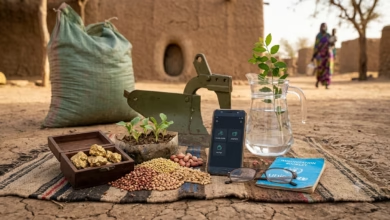
In a modest apartment on the outskirts of the Colombian capital, Bogotá, Maria—the widow of a former Colombian army soldier—sits holding her phone, staring at the last voice message she received from her husband, Jaime. Jaime wasn’t talking about guarding oil facilities in the Gulf as he had told his family before leaving; the whistling of bullets and the roar of shells in the background told a completely different story. He spoke in a trembling voice: “We are in a hell we don’t recognize; the ground here is burning, and the promises they made to us at the office were just a big trap.”
Jaime is one of hundreds, perhaps thousands, of Colombian mercenaries who left their country in search of the “green dollar,” only to find themselves as fuel in the Sudan War (2024–2026). This war, which began as an internal power struggle between two generals, quickly became a global magnet for transnational “killing contracts.” But why Colombians specifically? And how did combat experience gained from fighting drug cartels and leftist FARC groups become a popular commodity in African arms markets?
The Roots: The Colombian Military “Product”
To understand the reasons for the Colombian presence in Sudan, one must look back at the nature of military formation in Colombia. For six decades, Colombia fought a fierce civil war, producing an army that is among the most trained and experienced in “guerrilla warfare” and fighting in rugged environments. With the signing of peace agreements and the dissolution of some armed groups, thousands of retired officers and soldiers found themselves out of service with meager pensions insufficient to make a living.
Here, the “war merchants” appeared. Colombia turned into a human “reservoir” for mercenaries. These men are not just ordinary fighters; they are professionals in setting ambushes, sniping, and using advanced military technology. They have been seen previously in Yemen, Ukraine, and even in the assassination of the President of Haiti. Today, their fingerprints are clearly visible in Sudan, specifically within the ranks of the Rapid Support Forces (RSF), where they act as “technical minds” behind the scenes.
Recruitment Engineering: Front Agencies
The journey begins with a vague “job advertisement” on WhatsApp groups for veterans. A company named “A4SI,” or other names that constantly change to evade oversight, offers an irresistible deal: “Security contractors wanted to work in Dubai; protection of VIPs and securing sensitive sites; salary starting from $4,500 per month, with housing and subsistence provided.”
The mastermind behind these operations, as later revealed by intelligence and journalistic reports, is retired Colonel Álvaro Quijano Becerra. Quijano is not just a broker, but a logistical engineer with extensive relationships linking Latin America and the Middle East. The office in Bogotá worked as a sieve; the most efficient were selected, especially those with specialties in “drones” and “electronic warfare.” Vague contracts are signed that do not mention Sudan by name but speak of “consultancy tasks in international operational zones.”
The Great Deception: From “Civil Security” to “Combat Operations”
Once the fighter boards the plane heading east, the process of “de-identification” begins. Passports are seized immediately upon arrival at the first transit station, and civilian clothes are replaced with camouflage gear bearing no clear military ranks. The Colombian fighter gradually discovers that he is not in Dubai to protect a skyscraper or a diplomatic convoy, but is about to move to the “Al-Khadim Base” in Libya, and from there to unknown airports in the heart of the Great Sahara.
These networks rely on “information deception” not only toward the international community but toward the mercenaries themselves. They are initially told they will perform training tasks only, but once they arrive in “Nyala” or “Ad Du’ayn” in Sudan, retreat becomes impossible. Financial pressures, the threat of legal prosecution, and the loss of official documents make the Colombian mercenary a prisoner to the entity paying for his bullets.
The Secret Airbridge: The Engineering of “The Crossing” from Dubai to Darfur
1. The Transit Station: Dubai and the “Field Sorting” Room
When the plane from Bogotá lands at Dubai International Airport, the Colombian fighters are not just ordinary passengers. They are received by representatives of mysterious security companies, managed away from official eyes, often based in free zones. At this stage, the “field sorting” process begins; the military records of each fighter are examined meticulously.
Experts in operating drones (Zala and Orlan) and specialists in heavy artillery maintenance are sorted into “elite” groups. As for former infantry and sniping experts, they are directed toward direct combat missions. Here, in remote residential complexes, they are stripped of their personal cell phones and provided with encrypted devices, and “contract supplements” are signed with them that raise salaries in exchange for “consultancy tasks in high-risk areas.” This is the moment the mercenary realizes he is no longer a guard in a shopping mall, but a “combat element” in a proxy war.
2. The “Al-Khadim” Station: The Libyan Base as a Launchpad
Flights do not head directly from the UAE to Sudan to avoid radar detection and diplomatic embarrassment. Instead, Libya is used as a “laundering” platform for flights. Intelligence reports and satellite imagery indicate that cargo planes of the type (Ilyushin Il-76), belonging to cargo companies registered in Kyrgyzstan or small African countries, transport these fighters to the Al-Khadim Air Base in eastern Libya, or Al-Kufra Airport.
In Libya, Colombian mercenaries meet elements of the Russian “Wagner” or local fighters acting as intermediaries. There, heavy military equipment is loaded alongside the fighters. The Libyan route provides a perfect cover; the security chaos in Libya allows for unmonitored air movement, making it difficult for UN expert panels to track the ultimate source of these forces.
3. Infiltration into Darfur: “Shadow” Airports
Once arrangements in Libya mature, the final chapter of the arrival journey begins. Planes cross the Sudanese-Libyan border under the cover of darkness and land at airports controlled by the “Rapid Support Forces” rebels in the Darfur region.
The most prominent of these stations are Nyala International Airport (after it went out of civil service) and Ad Du’ayn Airport. Sometimes, unpaved dirt strips deep in the desert, specifically prepared to receive medium cargo planes, are used. Upon landing, the Colombians are greeted by field commanders from the RSF, accompanied by Spanish-speaking interpreters (often Colombian mercenaries who arrived in previous batches). From this moment, the status of “Colombian citizen” disappears, to be replaced by a code name within the “Desert Wolves” battalion.
Supply Logistics: Food and Weapons for “Dollars”
The continued presence of hundreds of foreign fighters in a harsh desert environment like Darfur requires a powerful logistical supply network. Investigations indicate the existence of a continuous “supply line” that provides Colombian mercenaries with special meals, medicine, and even ammunition compatible with the Western weapons they prefer to use.
The money paid to this network does not pass through traditional banks; instead, digital currencies (USDT) and the traditional “Hawala system” are used to deliver salaries to the families of the fighters in Colombia. This marriage between modern financial technology and traditional financing methods is what has made the “international recruitment network” resistant to penetration or disruption for a long time. The route (Bogotá – Dubai – Benghazi – Nyala) has turned into a new “Silk Road,” but it is a road that does not transport goods; it transports lethal combat expertise to the heart of Africa.
“Desert Wolves”: Technical Minds in the Heart of the Battle
The Birth of the Battalion: Why “Desert Wolves”?
Choosing the name “Desert Wolves” for this combat unit was not a random choice for intimidation; it reflected the nature of the tasks assigned to it. In Colombia, these elements trained in the “Jungla” unit, elite forces specialized in rapid surgical operations and quick withdrawal. In Sudan, this experience was adapted to suit the desert environment and urban warfare in Khartoum and El Fasher.
The battalion consists of a solid core of about 400 to 600 Colombian fighters, distributed into small “cells.” These men do not fight on the front lines as ordinary infantry; instead, they act as “force multipliers.” The presence of one Colombian among a hundred RSF fighters means transforming that group from an armed mob into an organized unit possessing strategic vision and technical coverage.
Drone Warfare: Superiority from Latin America
The qualitative shift brought by the Colombians was in the field of unmanned aerial vehicles (kamikaze and reconnaissance drones). Before their arrival, the RSF relied on human wave attacks and fast technical vehicles. With the arrival of “Colombian experts,” the battle turned into a “push-button war.”
Colombian mercenaries supervised the operation of advanced drones (such as those smuggled via the Libyan route). They excelled at modifying simple commercial drones to carry mortar shells or grenades, a technique they learned from cartel wars in Colombia. In the “Al-Shajara Armored Corps” battles in Khartoum, the Colombian fingerprint was clear in targeting Sudanese army command rooms with extreme precision via “Kamikaze” drones, leading to a paralysis in armed forces communications at critical moments.
Professional Sniping and Urban Ambushes
Beyond technology, the Colombians brought with them the “art of sniping.” In the narrow streets of Khartoum and abandoned buildings, Colombian snipers positioned themselves, equipped with long-range rifles and advanced night-vision devices. They did not just target ordinary soldiers; they focused on liquidating field officers and medics to create a state of psychological terror (Psychological Warfare).
They applied the strategy of “forbidden zones,” making large areas of the Sudanese capital death zones where movement was impossible during the day. Testimonies from fleeing Sudanese soldiers confirmed that the sniping was not random; it was done with cold nerves and professionalism available only to fighters who spent decades in mountain guerrilla wars.
Training and Involving Minors: The Dark Side
More dangerous than direct combat was the educational role. The Colombians established “mini combat academies” on the outskirts of Ad Du’ayn and Nyala. There, thousands of new recruits were trained, including minors who were kidnapped or forcibly recruited.
The Colombians took over training these children on assembling and disassembling weapons, planting landmines, and using encrypted wireless devices. This role transformed the mercenaries from “hired fighters” into “founders of a parallel army,” prolonging the war and complicating the process of reaching a peaceful solution, as the local fighter now possesses the skills of an “international mercenary.”
Operation Rooms and Field Intelligence
The “Desert Wolves” operations are managed from mobile operation rooms inside Land Cruiser vehicles equipped with Starlink satellite systems to provide high-speed internet in the heart of the desert. This connection allowed them to communicate directly with “control rooms” abroad (perhaps in Libya or the UAE) to receive satellite images and analyze Sudanese army movements in real-time. This intelligence superiority always kept the RSF a step ahead of the army in surprise attacks.
International Reckoning: Chasing the “Octopus” of Money and Blood
December 2025: The “US Treasury” Earthquake
As battles intensified around the city of El Fasher, a decision from Washington shook the foundations of international recruitment networks. In late 2025, the US Treasury Department blacklisted (OFAC) the “A4SI” office and a number of Colombian figures, led by retired Colonel Álvaro Quijano Becerra.
The decision was not merely a symbolic sanction; it was an attempt to dry up financing sources. US investigations revealed that this network used the traditional “Hawala” system mixed with digital currencies (USDT) to launder hundreds of millions of dollars flowing from accounts linked to entities in the Gulf and gold mining companies in Sudan. The sanctions froze assets in international banks and exposed a “spider web” of more than 15 front companies, some registered as “food import and export” firms in Dubai and Colombia.
Diplomatic Embarrassment: Bogotá’s Historical Apology
In an unprecedented move in the history of Latin American-African diplomacy, the Colombian Ministry of Foreign Affairs issued an official apology to the Sudanese government (Port Sudan). Colombian President Gustavo Petro stated bitterly: “Our youth, who were trained to defend the homeland, are now being sold in international slave markets as killing machines.”
Under international pressure, Colombian authorities began raiding security recruitment offices in Bogotá and Medellín. Investigators discovered “waiting lists” containing thousands of retired soldiers wishing to go to Sudan. The Colombian government found itself in a dilemma; the Colombian constitution did not explicitly criminalize working as an “overseas security contractor,” prompting parliament to begin legislating a “ban on foreign mercenarism” to close the legal loopholes exploited by Quijano and his associates.
The “Gold Laundering” File: The Bloody Barter
Leaked intelligence reports revealed that the salaries of Colombian mercenaries were not always paid in cash. A major “barter” took place behind the scenes; the RSF controlled strategic gold mines in Darfur and Jebel Amer, and gold was smuggled across the Libyan border and from there to global markets.
Part of the proceeds from this gold went directly to finance the “Desert Wolves” contracts. The Colombians were not just fighters; they were “guardians of wealth,” supervising the security of gold smuggling routes and ensuring shipments reached planes bound for abroad. This link between “the yellow metal” and “the Latin mercenary” made the Sudanese war a self-sustaining economy, difficult to dismantle through mere political ceasefire agreements.
The United Nations and Testimonies of “Deception”
In its report submitted to the Security Council, the Panel of Experts on Sudan documented testimonies from Colombian mercenaries who were captured or fled the fronts. One of them, named “Carlos,” gave a shocking testimony: “They told us we would protect presidential palaces in a stable country. When we landed in Darfur, we were handed sniper rifles and told: ‘Kill everyone wearing official Sudanese military uniforms, or go die in the desert.’”
These testimonies embarrassed international intermediaries and exposed the “human trafficking” aspect of this operation. The Colombian mercenaries, despite their professionalism, eventually turned into “slaves in military suits,” trapped between the fire of the Sudanese army on one side and their bosses who threatened their families in Bogotá on the other.
Digital Stealth Techniques
To evade international monitoring, the Colombian network used advanced communication techniques. They used encrypted applications such as Signal and Threema with self-destructing message features. They also avoided using local Sudanese communication networks, relying entirely on Starlink devices brought in illegally across the Chadian and Libyan borders. This “digital isolation” made it difficult for Sudanese military intelligence to intercept their calls or precisely locate their operation rooms before launching airstrikes.
Forgotten Graves: Human Tragedy and Testimonies of “Deception”
Funerals without Identity: Darfur Sands Swallow the “Strangers”
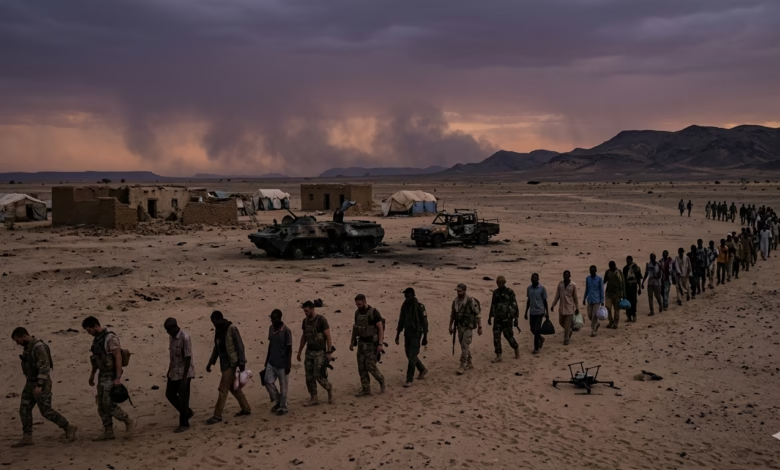
On the outskirts of Nyala and near Ad Du’ayn Airport, there are fenced areas that locals call “the cemeteries of foreigners.” These graves bear no headstones with names, just numbers or code symbols. Here lie dozens of Colombian fighters killed in Sudanese army airstrikes or in ambushes set by tribal fighters.
The tragedy lies in the fact that recruitment companies, such as “A4SI,” disown these dead immediately upon the incident. There are no official channels to return the bodies to Colombia because admitting their existence means a legal admission of mercenarism. For their families in Medellín or Cali, these men remain among the “missing”; salaries stop suddenly, and the phone numbers they used to communicate through disappear, beginning a painful and endless journey of waiting.
Jaime’s Testimony: When the Mercenary Breaks
In a leaked recording obtained by international investigators, a Colombian fighter named “Jaime” (a pseudonym) speaks while crying: “They cheated us, mother. They said we would guard oil wells in Dubai, but now we are in a place called El Fasher. Colleagues are falling around me because of planes we cannot see. There isn’t enough food, and the water is salty like blood. The Sudanese commanders here treat us like aiming machines, and if we object, they threaten to leave us in the desert without a compass.”
This testimony reflects the scale of “systematic deception.” The Colombian mercenaries, despite their high training, found themselves in a geographical and climatic environment they were not familiar with. Temperatures reaching 45 degrees Celsius, sandstorms disabling their technical equipment, and a long war of attrition that does not resemble the rapid guerrilla wars they trained for in the Latin American jungles.
Human Trafficking under the Cover of “Security Contracting”
International human rights organizations have begun classifying the transport of Colombians to Sudan as a form of human trafficking. The network exploits the “economic deprivation” of veterans and uses fake legal contracts as a cover to kidnap them and place them on international battlefronts. Once the fighter arrives in Darfur, his identification documents (passport and Colombian military ID) are confiscated, and he becomes completely isolated from the outside world, making him a “slave of the field” with no option to withdraw.
Social Impact in Colombia: Villages without Men
In some Colombian villages famous for their military tradition, such as Tunja, an entire generation of retired men has disappeared. These villages have turned into gatherings of women, children, and the elderly living on intermittent and mysteriously sourced financial transfers. The local priest in one of these villages says: “The youth leave dreaming of wealth, but they return in secret wooden boxes if they are lucky, or they disappear completely. The ‘War in Sudan’ has become a ghost haunting every house here.”
Mental Breakdown and PTSD
The few returnees from Sudan arrived with devastating psychological effects. The atrocities they witnessed—burning of villages and displacement of civilians at the hands of the militias they were training—left indelible scars on their souls. Some speak of “desert nightmares,” where the echoes of the cries of Sudanese victims resonate in their imaginations. These mercenaries, who considered themselves “professionals,” discovered that they contributed to destroying the social fabric of a country they had never heard of before signing the contract, leading to cases of suicide and addiction among survivors after returning to their country.
The End of the Road: Lessons from the Ash and the Future of “War Privatization”
The Bitter Harvest: How Will History Remember the “Strangers”?
As the conflict in Sudan approaches its end or turns into a long-term conflict of attrition, the fingerprint of Colombian mercenaries remains a stain on the forehead of international justice. These fighters did not come for a cause, nor did they defend a land; they were “technical gears” in a destruction machine that claimed the lives of hundreds of thousands of Sudanese. History will remember that the internationalization of the war was not only through direct military intervention by states, but through the “privatization of killing” and the import of combat expertise from another continent to settle local and regional scores.
The Moral Collapse of the “Military Doctrine”
This experience created a crack in the Colombian military doctrine. The army, which was viewed as a strategic ally of the West in fighting terrorism and drugs, found its reputation tarnished in the sands of Darfur. This phenomenon prompted international military organizations to reconsider “post-retirement” programs for soldiers. It is no longer enough to train a soldier to fight; it has become necessary to fortify him legally and morally against the “temptations of mercenarism” led by security companies operating in the gray areas of international law.
The Future of International Laws: Are Sanctions Enough?
The case of “Colombian Mercenaries in Sudan” proved that current laws (such as the 1989 UN International Convention against the Recruitment, Use, Financing and Training of Mercenaries) suffer from fatal loopholes. Modern security companies hide behind titles like “consultancy,” “logistical support,” and “technical training,” activities that international law does not explicitly criminalize as it does with direct combat.
The international community is now moving toward enacting a “protocol in light of the Sudan case” or similar legislation that obligates states to track their citizens working in private security companies in conflict zones, and imposing strict oversight on fund flows through digital currencies that were the “lifeline” for recruitment networks between Bogotá, Dubai, and Khartoum.
Sudan after the Mercenaries: Wounds that Will Not Heal
For the Sudanese, the departure of Colombian mercenaries—whether by being killed, fleeing, or the end of contracts—does not mean the end of the tragedy. The expertise they transferred to local militias, the drone technologies they indigenized, and the combat methods they planted will remain tools of destruction used by local fighters for years to come. The Colombians left behind “death technology” and took with them “blood dollars,” leaving behind a homeland trying to gather its fragments.
A Final Word: The “Mercenary” as Victim and Perpetrator
At the end of this investigation, a complex image of the Colombian mercenary emerges; he is a perpetrator who participated in destroying a country to which he has no connection, and he is simultaneously a victim of international criminal networks that exploited his poverty and training to turn him into a “commodity” in the conflict market. The stories of the “Desert Wolves” in Sudan are a stark reminder that war in the twenty-first century is no longer fought by national armies alone, but by “shadow forces” that have no face, no homeland, and no conscience, except for the entity that pays more.