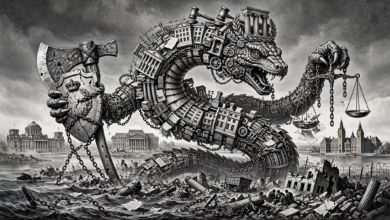


The Mirage of Granted Freedom
In the structure of the modern international system, centers of power rarely concede their spaces and branches voluntarily. The narrative that promotes the idea of freedom as a favor granted through the moral awakening of the dominant, or through a top-down trickle from the peak of the pyramid to its base, is nothing but a comforting myth carefully designed to maintain the stability of existing structures. In this complex geopolitical and intellectual context, the book *”Nobody Can Give You Freedom: The Real Mission of Malcolm X”* by researcher and academic Kehinde Andrews arrives to pierce this myth with a precise surgical scalpel, offering a radical and profound rereading of one of the twentieth century’s most misunderstood, reductively simplified, and deliberately distorted thinkers.
This book is not merely a traditional biography; rather, it is a document of political and philosophical engagement that reads the past through the eyes of the present, dismantling the mechanisms of power that continue to govern the world today.
The Engaged Philosopher: Transcending Stereotypes
For decades, Malcolm X has been reduced to a one-dimensional caricature: merely the “violent” and angry antithesis to the peaceful reformism represented by Martin Luther King Jr. In the opening chapters of his book, Andrews brilliantly dismantles this artificial binary, demonstrating that this reductive simplification serves a specific ideological purpose: neutralizing the rigorous structural critique Malcolm directed at the architecture of global hegemony. The Malcolm X presented here by Andrews is not just an eloquent orator or an activist consumed by his anger, but a strategic thinker and a field sociologist who forged his liberation philosophy from the womb of direct engagement with the mechanisms of systematic subjugation.
While many modernist philosophers were theorizing about concepts of communicative action, manifestations of the secular age, and crises of the self from within the safe walls of academia, Malcolm was theorizing freedom as an act of structural seizure on the ground. His theorization was not an intellectual luxury open to linguistic interpretations, but an existential necessity to dismantle networks of power that transcend national borders. Malcolm realized early on that the Black struggle in America was not an isolated local issue that could be solved with minor legal amendments, but an integral part of global anti-imperialist liberation movements. This realization is what made him a direct philosophical and political challenge to the foundations upon which the “Pax Americana” era was built, along with its accompanying international arrangements designed to ensure unilateral supremacy.
Structural Freedom, Not Begging for Crumbs
Andrews builds his book on a central thesis: true freedom cannot be begged for, or granted from within the very system that engineered the oppression in the first place. Attempts to integrate into structures pre-designed to exclude the “other” and control their resources are doomed to reproduce dependency in more modern, softer, yet infinitely more lethal forms.
Here, the book elevates its analytical style, bypassing superficial and exhausted debates about social acceptance and formal integration, to dive deep into the analysis of hard power, political economy, and transcontinental strategic alliances. Malcolm X, as analyzed by Andrews, never sought to find a comfortable seat for the oppressed at the table of the existing global order; instead, his project revolved around entirely reshaping that table, or smashing it if necessary, to build an alternative system. The Organization of Afro-American Unity (OAAU), which he founded in 1964 after splitting from the Nation of Islam, was a practical and visionary embodiment of this cross-border philosophy. The goal was to build a global bloc transcending geography—a bloc with its own weight, capable of negotiating and demanding its rights from a position of strategic strength and parity, not from a position of weakness and political supplication.
The Strategic Methodology in Reading Power
In this foundational part of our comprehensive review of this exceptional work, we must pause to consider the rigorous methodology employed by Kehinde Andrews. The author did not rely solely on narrative historical analysis to fill pages; he delved into speeches, texts, documents, and field movements to extract the coherent philosophical framework that governed Malcolm’s actions. The book provides intensive insights that clearly highlight how Malcolm read the major shifts in global balances of power.
He was fully aware that hegemony relies for its survival on fragmenting issues, isolating liberation movements from one another, and preventing the formation of any collective strategic consciousness. Therefore, his true mission—which Andrews rediscovers and highlights in this book—was to link the local struggle to global dynamics and major power conflicts. This strategic awareness, vastly ahead of its time, is what made Malcolm an inevitable target, not only for physical elimination and assassination, but for the cognitive exclusion that persisted for decades. His true legacy was marginalized by governments, academic institutions, and even by some political currents that found his radical ideas to be a heavy burden that spoiled their tactical compromises and temporary gains.
Andrews’ Philosophical Dimension of Liberation
Andrews’ reading of Malcolm intersects stunningly and deeply with questions of modern and political philosophy regarding the essence of freedom. Freedom here, in Malcolm’s paradigm and in Andrews’ analysis, is not an abstract metaphysical state, nor is it texts read in constitutions; it is a structural capacity to act, impose one’s will, and determine one’s destiny on an unforgiving international stage that recognizes only the language of power and interests.
The book explains with astonishing fluidity how Malcolm’s concept of freedom bypassed traditional philosophical debate, grounding itself in the necessity of a complete exit from the equation of dependency, and building a parallel, independent international reality. This exit, as the book details, requires solid organization, a historical consciousness that cannot be falsified, and a free will that refuses to submit to pre-imposed rules of the game.
This book was published at a highly significant time, coinciding with the centenary of Malcolm X’s birth. It does not settle for emotional eulogies or historical glorification, but offers a rigorous kinetic and philosophical guide for understanding contemporary mechanisms of hegemony. It poses an intellectual challenge to the modern strategic mind: how can the current international scene, with its complex variables, be read through an analytical lens that does not compromise on the principles of liberation?
Shattering the Liberal Idol: How Was Radicalism Tamed?
In this part of our reading of *”Nobody Can Give You Freedom”*, we move to one of the most important theses the author tackles with rare audacity: the process of “ideological recycling” that Malcolm X was subjected to after his assassination. Andrews argues that the dominant Western establishment, upon realizing the impossibility of erasing Malcolm X’s name from collective memory, resorted to a far more cunning strategy: assimilation and domestication.
Malcolm was stripped of his structural radicalism and transformed in mainstream popular culture into a hybridized, diluted version, standing closely alongside the moderate civil rights movements he had long fiercely criticized. Andrews dismantles this comforting narrative, affirming that Malcolm, in his later life, was not on a path to becoming a liberal reformer seeking peaceful integration into the white capitalist system. On the contrary, he was developing a more comprehensive and globalized radical vision—a vision that posed an existential threat to the foundations of exploitation upon which the international system rests.
The Mecca Journey: Strategic Openness, Not Ideological Surrender
One of the most prominent stops in the book is the common interpretation of Malcolm X’s famous journey to Mecca (Hajj). The dominant liberal narrative promotes that this journey was an “awakening” that caused Malcolm to abandon his Black nationalism and radicalism to adopt a colorblind, comprehensive reformist approach. Andrews intervenes here with his analytical scalpel to reject this naive oversimplification.
Andrews reads Malcolm’s letters from Mecca and his subsequent statements within their correct geopolitical and intellectual context. Yes, Malcolm shed the reverse racism adopted by the Nation of Islam and recognized the universality of Islamic brotherhood, but this spiritual evolution did not negate his material and political analysis of the reality of Black people in America and the world. The pilgrimage did not turn Malcolm X into someone who believed that racist American institutions would fix themselves simply by Black and white people embracing each other. Rather, it granted him new intellectual tools to broaden the front of confrontation. He transformed from the leader of a closed local religious movement into an internationalist leader who recognized that the Black struggle is part of a broader global struggle against Western imperialism and its allies. The openness Malcolm experienced was a strategic openness to build transcontinental alliances, not an ideological surrender to cold liberalism.
The Illusion of Integration in a “Burning House”
Andrews dedicates a large portion of his book to analyzing Malcolm X’s scathing critique of the civil rights movement and demands for integration. At a time when traditional Black leadership was celebrating legislative victories like the Civil Rights Act and the Voting Rights Act, Malcolm was looking at the bigger picture. He saw, as the book explains, that demanding integration into a system fundamentally built on economic exploitation and racial marginalization was akin to trying to integrate into a “burning house.”
Integration, in the analysis Andrews adopts based on Malcolm’s philosophy, does not solve the structural problem; it merely absorbs a small Black elite into the middle class that benefits from the system, while the vast majority remains languishing at the bottom of the economic and social pyramid. Freedom does not lie in sitting next to your oppressor in a restaurant or on a bus; it lies in owning the restaurant and the bus, and in having independent control over the economy, politics, and education within your community. This drive toward “structural independence” and self-determination is what makes Malcolm X’s true message alive and disruptive to the system to this day, and it is what Andrews seeks to re-highlight as the only alternative to disguised slavery.
Internationalizing the Cause: Putting the Global System on Trial at the UN
The analytical narrative in the book reaches its climax when the author discusses Malcolm X’s most ambitious and important project: internationalizing the African American struggle. Andrews highlights how Malcolm worked seriously and rigorously to elevate the Black cause in America from a local American issue (a civil rights matter) to an international issue (a human rights matter) placed on the table of the United Nations.
This conceptual and legal shift was not a mere play on words; it was a brilliant strategic strike to turn the tables on Washington during the Cold War. Malcolm sought to link the Black struggle in America with national liberation struggles in Africa, Asia, and Latin America. He conducted shuttle tours in Africa and met with the continent’s state leaders, attempting to secure a UN resolution condemning the United States for committing crimes against humanity against its Black citizens. Andrews believes that this specific international move, and the founding of the Organization of Afro-American Unity, is what transformed Malcolm from a mere “local nuisance” into a “national and international security threat,” hastening the decision for his physical elimination.
Radicalism as a Rational Necessity
Andrews concludes in this section of his analysis that Malcolm X’s radicalism was not recklessness or unbridled emotion, but rather the utmost political rationality in the face of an inherently irrational system. If the system uses structural and material violence to maintain its sovereignty, then any purely peaceful resistance begging for change from within the system’s own channels will merely be an exercise in futility. The book restores radicalism as an indispensable tool of analysis and resistance for understanding and dismantling hegemony.
The Dilemma of “Representation” and the Mirage of Neoliberal Pluralism
In this chapter of our journey with Kehinde Andrews’ thesis, we arrive at one of the most vital and contemporary points in his book: the critique of “Representation Politics.” Andrews brilliantly argues that the contemporary global system, in its attempt to absorb popular anger, has replaced radical structural change with the “aesthetics of diversity.” We now see brown and Black faces at the top of the pyramid of power, on the boards of transnational corporations, and even in the corridors of security and intelligence institutions.
Drawing inspiration from the “real mission of Malcolm X,” Andrews views this not as a victory for justice, but as the peak of “racial neoliberalism.” The presence of individuals from minority groups in centers of power does not change the nature of these colonial or exploitative institutions; rather, it provides them with a “moral cover” to continue practicing the exact same policies of hegemony. Malcolm X, as the book explains, realized that the “White House” would not change its true color just because a Black resident entered it, as long as the economic and geopolitical policies of the house remained faithful to the principles of expansion and dominance. This analysis confronts the reader with an existential question regarding the utility of social movements that settle for demanding a “seat at the table” instead of entirely redesigning the room.
Internationalism: The Spirit of “Bandung” in Malcolm’s Thought
Andrews moves us to the deep geopolitical dimension of Malcolm X’s final moves. The book highlights Malcolm’s early realization of the spirit of the “Bandung Conference” (1955) and the necessity of forming a united “Third World” front against imperialist powers. Malcolm did not view the Black cause in Detroit or New York in isolation from the Algerian people’s struggle against French colonialism, the Vietnamese fight, or the liberation movements in the Congo.
Andrews analyzes how Malcolm tried to build an “epistemological and political bridge” between the African continent and the diaspora in the Americas. His vision transcended “racial sentiment” to reach “strategic necessity.” He believed that true power lies in the “critical mass” formed by the globally oppressed if they united economically and politically. In this context, the book offers a critical reading of the concept of “world peace” promoted by major powers, demonstrating that it is often an imposed peace serving the *status quo* and preventing any genuine shift in international power balances.
Critiquing Capitalism: Racism’s Siamese Twin
One of the major intellectual contributions Kehinde Andrews makes in this book is reconnecting Malcolm X’s thought to the radical critique of capitalism. Andrews rejects the narrative that tries to portray Malcolm as a “Black capitalist” merely seeking to empower Black businessmen. Instead, the book reviews how Malcolm, at the end of his life, reached the conviction that “you cannot have capitalism without racism.”
Andrews explains that the global capitalist system always needs an “other” to exploit, and a marginalized group, to accumulate capital in specific centers. Capitalism, at its core, is the engineering of classism and inequality, and racism is the ideological tool that justifies this inequality and makes it seem “natural” or “fated.” Therefore, the “real mission,” as Andrews sees it through Malcolm’s lens, is to destroy this unholy marriage between economic exploitation and racial discrimination. This chapter of the book is an explicit call to reconsider contemporary political alliances and search for economic alternatives that prioritize human beings over profits.
Dismantling the “Colonial University”: Malcolm as a Teacher Beyond the Walls
As a radical academic, Andrews does not overlook critiquing the educational institution to which he belongs. The book points out that Malcolm X achieved his cognitive depth and exceptional analytical prowess “outside” the walls of traditional universities, and even in opposition to them. The “liberation knowledge” Malcolm presented was a product of the prison experience, self-taught reading, and field engagement.
Andrews uses this example to critique what he calls the “knowledge industry” in the West, which works to domesticate minds and direct scientific research to serve the goals of the existing paradigm. The author sees Malcolm as a model of the “organic intellectual” who does not seek academic promotion, but rather the truth that serves the cause of liberation. This section of the book represents a positive shock for every researcher and student, pushing them to question the utility of knowledge if it is not a tool to break intellectual and material chains.
Will and Action: Beyond Words
Andrews concludes this section of his analysis by emphasizing that Malcolm X was not merely a man of theories, but a man of “strategic action.” Freedom, in Malcolm’s paradigm, is not text written in book reviews, but a “daily practice” that requires immense courage and a readiness to sacrifice. The book confronts us with the bitter truth: the powers that benefit from the enslavement and marginalization of others will not surrender their privileges simply through rational dialogue or moral pleading.
The “real mission” requires building parallel institutions, societal safety nets, self-sustaining economic power, and a solid historical consciousness that accepts no falsification. Andrews here is not writing about a person who died decades ago; he is writing about an “urgent necessity” in a world still plagued by conflicts over influence, unipolar hegemony, and grinding economic wars.
Parallel Institutions: The Dilemma of Building Under Siege
In this section of his book, Kehinde Andrews transitions to the practical organizational aspect of Malcolm X’s life, specifically the experience of the Organization of Afro-American Unity (OAAU). Andrews argues that the true value of this organization was not in its membership numbers, but in its “foundational philosophy,” which sought to create full Black sovereignty independent of American institutions. The organization was an attempt to translate radical ideas into political and social “infrastructure.”
The book explains how Malcolm planned to establish schools, health centers, and self-sufficient economic support systems so that a Black individual would not have to beg for services from a system that oppresses them. Andrews analyzes this direction as a “strategic exit” from dependency. However, he also does not ignore the massive difficulties this project faced; building parallel institutions within the heart of the empire is considered a “hostile” act from the state’s perspective. The book details how the organization was subjected to intelligence infiltration and financial strangulation, leading us to a profound lesson: the system may allow you to protest and demand rights, but it will fight you fiercely if you try to “dispense” with it and build you