
On a morning in late March 2025, Lieutenant General Abdel Fattah al-Burhan stood before the microphones at the Republican Palace in Khartoum, announcing to the world what millions of Sudanese had dreamt of for two hellish years: the liberation of the capital from the grip of the Rapid Support Forces. It was not merely a military victory; it was the herald of the longest and most arduous phase of the struggle: rebuilding a city turned to ruins by war, and reviving the lives of a people robbed of everything—electricity, water, schools, markets, hospitals, and the sense of safety.
From the very first day of the liberation announcement, the army launched extensive combing operations in the areas it regained control over in Khartoum. Meanwhile, dozens of Sudanese prisoners were released from RSF prisons in the Jebel Aulia area south of Khartoum. Most of the freed captives suffered from severe malnutrition after being deprived of food and water for many days. These initial scenes were a true reflection of the magnitude of the catastrophe left behind by two years of occupation.
On May 20, 2025, the Sudanese army officially declared Khartoum State free of the Rapid Support Forces, following more than two years of their control over the majority of the state. That announcement marked the official turning point that launched the journey of reconstruction and recovery with all its complexities and challenges.
What Did the Janjaweed Leave Behind?
Before speaking of the return to life, one must grasp the depth of the destruction left by the occupation. The Rapid Support Forces were not just a military force that occupied land and then withdrew; they were a systematic machine of destruction that targeted every joint of the city.
Electricity distribution and transformation stations suffered extensive destruction during the RSF’s control over Khartoum, with most of the copper in the transformers looted, while other stations were bombed by drones. As for the water infrastructure, officials described it as being in a disastrous state; water pumps and pipelines were damaged across vast areas of the capital in its three cities: Khartoum, Bahri (Khartoum North), and Omdurman.
Amidst the rubble of the commercial market in the capital, merchants were trying to rearrange the remains of their shops consumed by the war; shop walls still bore graffiti glorifying the Rapid Support Forces, while darkness loomed due to power outages. This image encapsulated the scene of the entire capital: the traces of the occupier had not been erased, and life had not yet returned.
Hospitals, supposed to be places of healing, were turned into targets by the occupying forces. Schools, supposed to be places of learning, were used as military barracks. Homes that sheltered millions were looted and vandalized. The roads connecting the city became a theater for sabotage and armed checkpoints.
The state of destruction raised a fundamental question about the possibility of a swift return for the residents. One resident of central Khartoum expressed his fears, saying: “In the absence of electricity and water services, there will be no hope for an imminent return.” This anxiety was entirely legitimate; a city normally inhabited by over seven million people cannot be rebuilt in mere weeks.
Another security challenge added to the complexities of the scene: the remnants of war. Just days before writing this report, authorities temporarily closed the eastern Khartoum area and deployed technical teams to search for unexploded ordnance, following a shell explosion after citizens lit a fire in a nearby waste dump. Major General Khaled Hamdan, Director of Mine Action, explained that field investigations suggested the explosion was caused by an old 130 or 155 mm rocket or shell. He urged residents not to burn waste inside neighborhoods previously occupied by the RSF due to the potential presence of explosive objects.
Infrastructure: Another Battle with Different Tools
The Sudanese government realized from the beginning that restoring life to Khartoum passes through one gateway: electricity and water. Without them, no hospital operates, no school opens its doors, no factory produces, and no life returns.
In July 2025, a government committee promised to restore electricity to Khartoum State by the end of September, just one day after the Central Bank announced the provision of foreign currency for electricity and water needs. The committee’s tasks included clearing combat forces and armed entities from Khartoum, taking measures to establish security, in addition to restoring electricity, water, health, education, and market services, and rehabilitating infrastructure.
However, the road was not paved with roses. Restoring electricity to a city the size of Khartoum meant providing massive electrical transformers, entirely stolen copper wires, exorbitant spare parts, and scarce foreign dollar funding amid an exhausted economy. In August 2025, the Supreme Committee for Emergencies and Crisis Management in Khartoum State expressed its appreciation for the efforts made by the electricity and water administrations in restoring power to the central Khartoum area and connecting it to all water stations, namely the stations of Bahri, Al-Mogran, Soba, Al-Shajara, and Jebel Aulia.
This was a fundamental step, because the arrival of electricity to water pumping stations meant that water would return to homes, opening the door for a genuine return of the population. The Governor of Khartoum stressed that restoring electricity and water services represents a major entry point for preparing the general environment for the citizens’ return, confirming that the transformer distribution committee would continue its meetings and field and technical work to monitor the implementation phases and overcome obstacles.
In November 2025, batches of new electrical transformers arrived from abroad, reviving residents’ hopes. The committee confirmed that priority would be given to hospitals and health facilities, followed by feeding main water sources and high-density residential areas, and then security service centers. This prioritization was both logical and humane: humans before industry, and health before luxury.
In late October 2025, the technical committees of the ministerial sectors at the Council of Ministers confirmed the resupply of fuel to all power stations in Khartoum State, with ongoing technical treatments to ensure the stability of the electrical supply amid current challenges. The supply was not perfectly stable, but it was the beginning of the road.
The Health Sector: From Remains to Hope
Perhaps nothing reflects the scale of the destruction more than what befell Khartoum’s health system. After two years of war, there were hospitals stripped of their equipment and machinery destroyed, health centers turned into barracks, and medical staff displaced far from the capital.
The Minister of Health revealed that the Omdurman sector, which did not witness a massive incursion by the Rapid Support Forces during the two years of occupation, had its health sector rehabilitated and introduced specialized services that did not exist before the war. The Bahri and Khartoum sectors, however, face a more difficult situation, with hospital operational capacity not exceeding 60% and 45%, respectively.
These numbers expose the massive gap that must be bridged. A hospital operating at half capacity or less means patients dying while waiting, postponed surgeries, children deprived of vaccines, and women giving birth in dangerous conditions.
In terms of field efforts to rehabilitate the health system, Al-Thoura Hospital returned to service and received 40 cases on its first day. Maintenance work was also carried out in the Dental, Al-Shaab, and Children’s hospitals, preceded by Al-Tamayuz Hospital in Al-Imtidad, the Emergency Hospital in Jabra, and Ibrahim Malik Hospital in Al-Sahafa, in addition to Ibn Sina in Al-Amarat and the Heart Center in Arkawit.
But health challenges do not stop at the borders of reopening facilities. Cholera swept the capital early last year, peaking in May with the return of citizens, placing immense pressure on the health sector and exposing the shortfalls in basic services. Residents struggled to access clean water, while health institutions suffered from power outages that continue to strike across Khartoum.
It is a painful vicious cycle: the return of citizens increases pressure on the dilapidated health system, and the dilapidated system cannot accommodate these numbers without massive and sustainable external support. Nevertheless, the government’s will is clear. Thirteen projects have been proposed to rehabilitate the health sector and provide medical devices, equipment, and qualified personnel.
Education: The Return of Generations to Classrooms
Perhaps no indicator reflects the return to normal life more than the sound of children’s laughter in schoolyards. For two years and more, the children of Khartoum were deprived of this basic right. Schools destroyed by the occupation or turned into military headquarters have become the priority in reconstruction plans.
The Khartoum State government approved the academic calendar for the year 2024-2025 based on a proposal submitted by the Director General of the Ministry of Education. The calendar stipulates that teachers’ attendance at schools begins on August 24, aimed at preparing the school environment and addressing shortcomings, with classes commencing for the final grades of primary, middle, and secondary stages on September 7.
The Governor of Khartoum affirmed that preparations are well underway to resume the educational process and fully open schools across all localities of the state, paving the way for school life to return to normal after a prolonged interruption.
Coinciding with the beginning of 2026 and the approach of the month of Ramadan, Khartoum witnessed an accelerated return to normal life in the state’s localities, in a scene reflecting the capital’s recovery and the restoration of its usual rhythm, alongside the start of a new school year carrying broad hopes for a more stable and secure future.
But reopening schools is not merely an administrative decision. It is a battle against the school dropout rate that worsened during the war years, and against a generation that lost years of education amidst barricades and bunkers. Many children who were in primary school when the war broke out now find themselves of middle-school age without having completed their first educational stage. This is an educational gap that will take years to address.
The Return of Citizens: Between Longing and Caution
At train stations and on the main roads leading to Khartoum, convoys of returnees were making their way. Millions who were forcibly displaced from their homes fled to safe cities like Port Sudan and Kassala, and cities outside Sudan such as Cairo and Asmara, carrying whatever memories, identification papers, and fears they could.
The Voluntary Return Committee in the Defense Industries System ran eight trains up to mid-August 2025, each carrying about 1,200 citizens from Cairo to Aswan before being distributed via buses to various states.
Egypt tops the list of host countries for Sudanese since the outbreak of the war, but indicators of return from there to Sudan are increasing. The Khartoum State government has prepared a three-month emergency plan targeting vulnerable segments and poor families as the pace of return accelerates.
The returnee to Khartoum faces a dual scene: on one hand, the joy of return, family reunification, and seeing familiar alleys and the old neighborhood. On the other hand, the shock of what the war did to the home they left behind: they might find its walls covered in militia slogans, its roof pierced by shelling, or its furniture completely looted. Field accounts reveal that the most visible movement of returnees is concentrated in the western and far-eastern neighborhoods of Khartoum, particularly Al-Shajara, Al-Azouzab, Al-Rumaila, Al-Quz, Al-Daim, and Al-Sajjana, as well as limited blocks in Al-Sahafa, Al-Imtidad, Arkawit, East Gireif, Burri, and Nasser.
This non-random geographical distribution of return reflects the logic of safety and services: people first return to neighborhoods with water, electricity, and security, while the most severely damaged neighborhoods remain abandoned until rehabilitation is complete.
Markets and the Economy: The Returning Pulse of Life
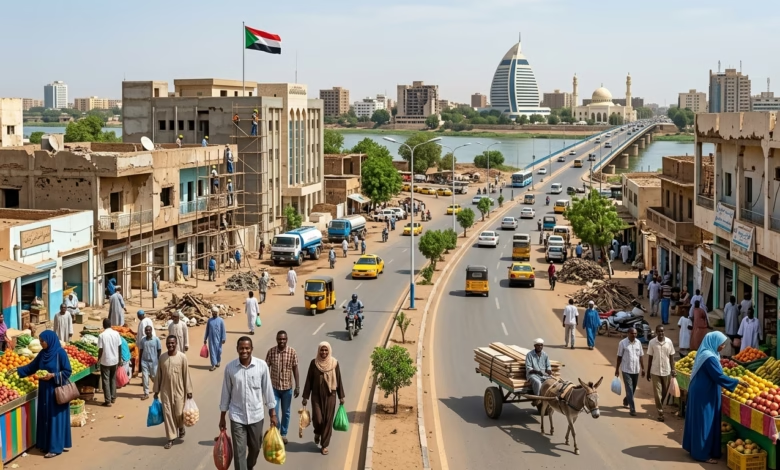
The market is not just a place for buying and selling. It is the scale of social life in the Arab city. When the market returns, life returns with it. In the streets of Khartoum, which were desolate and bleak during the two years of occupation, signs of economic recovery have gradually begun to emerge.
Accounts indicate that not a day passes in Khartoum’s neighborhoods without the doors opening to a grocery store, a pharmacy, a restaurant, or commercial shops. The Khartoum locality also announced the reopening of the Abu Hamama reduced-price market as the first market to resume operations within the system of discounted markets that existed before the war, with the approval of previous merchants, the setting of clear fixed prices, and the attraction of companies and producers to provide goods directly to citizens.
A number of merchants confirmed that the improvement in commercial traffic is driven by the return of citizens as well as the gradual restoration of basic services.
This complementary relationship between services, commerce, and population is the axis of the recovery process. The more residents return, the higher the demand for goods and services; the higher the demand, the more merchants move to open their shops; and whenever shops open, life and hope return to the neighborhoods.
However, the picture is not entirely rosy on the economic front. The war left severe inflation and a massive spike in prices that burdens the returning citizen after exhausting their resources during the years of displacement. A wave of high costs began hitting Sudanese markets following increased transportation costs due to unprecedented hikes in fuel and bread prices. This reality places the ordinary citizen facing multi-faceted pressures: the cost of refurnishing a looted home, the high cost of groceries, and the lack of a regular source of income.
The Return of the Government: The State Reclaims Its Throne
Restoring services was not merely a technical matter; it was also profoundly symbolic. The return of the state and its institutions to the capital is a declaration to the world that Sudan has not collapsed, and that the state endures.
In January 2026, Prime Minister Kamel Idris announced his return to work from Khartoum, and days later the first meeting of the new Council of Ministers was held in the capital, putting the ministries’ return plan into effect.
The second phase of the government’s return plan included the return of governmental bodies, spearheaded by the Mineral Resources Company in December 2025, which is considered one of the most important executive sectors in the state, as the state treasury currently relies heavily on gold revenues.
A government decree mandated the relocation of government headquarters and ministries located between Nile Street to the north up to the railway to the south, and from Al-Mogran in the west to the General Command in the east, effective August 2025, as they were relocated to alternative sites in eastern and southeastern Khartoum, Khartoum North (Bahri), and Omdurman.
In a move of significant international implication, the United Nations officially announced its return to operate from the Sudanese capital, Khartoum, from its headquarters in the city center, three years after the outbreak of the war. The UN emphasized that it continues its support for the state and individuals to end the war and rebuild Sudan.
This UN presence carries two meanings: first, the recognition of sufficiently improved security conditions to reopen offices, and second, ensuring the continued flow of humanitarian aid and coordinated reconstruction efforts.
On the security front, the capital is witnessing widespread stability with a heavy deployment of police forces across various localities following a comprehensive security sweep that contributed to lowering crime rates. Several citizens expressed their satisfaction with the spread of patrols, affirming the return of a sense of safety to neighborhoods and markets.
Future Strategy: The 2026-2036 Plan
Officials did not merely address immediate wounds; their vision extended to the far horizon. In early 2026, officials received the reconstruction and recovery strategy for Khartoum State for the period 2026-2036, which includes boosting public transport, education, health, and environmental financing.
This ten-year strategy is not just a government document; it is a promise of a different future. A city the size, history, and location of Khartoum cannot be rebuilt in a single season. The matter requires an extended vision, sustainable financing, solid political will, and genuine international partnership.
Observers pointed out that the return of government institutions to their headquarters in the capital carries important connotations reflecting stability and the return of life to normalcy.
The Broader Picture: Khartoum and Its Three Cities
The return of Khartoum cannot be understood without grasping the deep disparities between its three cities. Omdurman, which was relatively less damaged by the occupation, was the fastest to recover. Meanwhile, Khartoum and Bahri, being the primary theaters of confrontation, require more effort and time.
The Minister points out that the Omdurman sector, which did not witness a large incursion by the RSF, saw its health sector rehabilitated and qualitative services introduced that were non-existent before the war. In contrast, the situation in the Bahri and Khartoum sectors is more difficult, as the operational capacity of hospitals there has not exceeded 60% and 45% respectively, compounded by delays in the restoration of water and electricity.
This gap between the different parts of the single capital presents a social and political challenge, as it may generate a feeling among residents of the most affected areas of marginalization or delays in addressing their plight.
Voices from the Wounded City
Ultimately, the numbers, plans, and official announcements are nothing but a crust over the core of the true story: the stories of humans who lived through hell and are now trying to rebuild their lives.
One passenger in the departure lounge of the reopened Khartoum Airport says: “The return of Sudan Airways flights taking off from Khartoum restores our feeling that the city is reclaiming its former status.”
The sixty-something fabric merchant who returned to find his shop surrounded by the occupying forces’ graffiti is still, weeks later, trying to muster his resolve to resume work. Many like him stand on the threshold of hope and fear simultaneously: the hope that what once was will return, and the fear that what was lost is gone forever.
The children born to the sound of bullets, the students whose years of study were lost, the doctors who treated patients in near-nonexistent conditions, and the teachers who never stopped educating even in the darkest of times—all of these are the true fuel for Khartoum’s renaissance.
Between Challenges and Criticisms
The picture is incomplete without mentioning the challenges and criticisms noted by observers and the opposition. There are voices arguing that the pace of reconstruction is slow compared to the urgent need, and that scarce government resources are distributed unfairly.
And while officials assert that the government’s return plan is centered around citizens’ needs, a former official believes the move might drain the state’s scarce resources away from infrastructure and basic services in favor of preparing government headquarters.
This tension between institutional state priorities and the priorities of the individual citizen reflects a difficult equation: the government returning to its headquarters in Khartoum needs infrastructure to support it, but does this come at the expense of public services?
There is also the challenge of financial sustainability. Sudan is passing through one of its most difficult economic phases, and the gold revenues that form the backbone of the treasury are sufficient to run the state but not enough on their own to rebuild an entire capital. International support is a necessity, not a luxury.
Conclusion: Khartoum is Not Dead
In the midst of all this, one thing remains as constant as the immortal Nile that slices the capital from south to north: the will to live among the inhabitants of this city. Khartoum, which has thrived for centuries at the confluence of the two Niles, and which has seen occupations, revolutions, and rebuilding throughout its history, will not be an exception to its historical rule of resilience this time.
The scene may seem grim when you look at the numbers: millions of displaced people who have not yet returned, hundreds of hospitals and schools needing restoration, and systematically destroyed infrastructure. But when you look at the old merchant wiping dust from his store’s shelves, the teacher reorganizing her classroom before the students return, and the doctor returning from exile to practice his profession in a dilapidated hospital—you realize that this city is not dead.
The Supreme Committee for Preparing the Environment for the Return of Citizens approved an integrated program to reconstruct the capital, including the restoration of electricity and water services and the resumption of operations for hospitals, universities, and all vital facilities. This program is not just a document; it is a roadmap for a city that insists on existing.
Khartoum bleeds, but it rises. It groans under the weight of destruction, but it lifts its head. Its services return very slowly, but they do return. And from the womb of this deep suffering, perhaps a fairer and more humane capital than before will be born.