
Scholars’ Ink: A Deconstructive Reading of the Roots of African Philosophy and the Struggle for Intellectual Hegemony

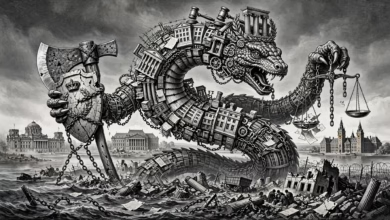
In a world where global power struggles intersect with cultural hegemony, the book The Ink of the Scholars: Reflections on Philosophy in Africa by Senegalese philosopher Souleymane Bachir Diagne emerges as a crucial intellectual document that redraws the maps of knowledge. This work, translated into English by Jonathan Adjemian, is not merely a review of the history of ideas on the African continent; rather, it is a systematic deconstruction of the Eurocentrism that has long monopolized the concept of “reason” and relegated the Other to the margins of oblivion. By integrating profound philosophical analysis with historical critique, the book dismantles classical theses regarding the alleged rationality of the West versus African “orality” or “tribalism,” presenting a coherent argument that rehabilitates accurate translation, the history of intellectual empires, and language as a tool of liberation rather than a colonial fetter.
Prologue: From the Blood of Martyrs to the Ink of Recording
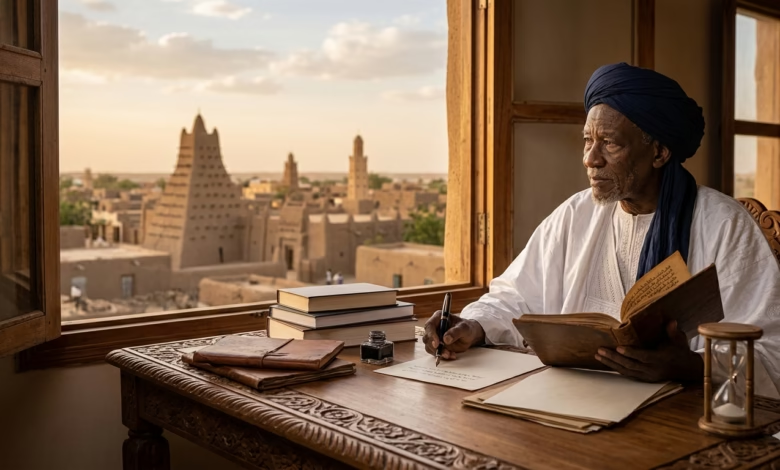
The book derives its title from the proverb, “The ink of the scholars is heavier than the blood of the martyrs.” This title is not merely a rhetorical choice but an invocation of the spirit of the legendary city of Timbuktu, which historically served as an intellectual beacon and a vital center for learning and written scholarship. Diagne borrows this concept from the renowned Malian scholar Ahmad Baba al-Timbukti, who made this hadith the core of his work in highlighting the virtue of scholars and the importance of transmitting knowledge.
The strategic objective of this title is to effect a methodological shift in how African heritage is perceived. It redirects the focus from the exhausted, customary debate over “orality” and narrated traditions to a serious consideration of a deeply rooted tradition of recorded knowledge. This shift strikes at the heart of the Orientalist structure that has long viewed Africa—as philosopher G.W.F. Hegel once described it—as a closed mass trapped in the “night of the spirit,” isolated from the movement of history and the making of civilization. This proposition gains compounded significance in light of contemporary geopolitical contexts, wherein institutions of knowledge and ancient Timbuktu manuscripts face attacks from extremist groups that despise the tolerance and love for humanity these artifacts represent. Diagne reminds us that the religion in whose name these follies are committed is the very same religion that exalts knowledge, considering the written word and the ink of philosophers more sacred than the battlefields.
Deconstructing “Zero-Point Centrism” and the Spirit of Descartes
Diagne opens his reflections with a highly revealing anecdote dating back to 1996, during the Twenty-Sixth International Congress of Philosophy held at the Sorbonne to mark the fourth centenary of René Descartes’s birth. After presenting his paper, which addressed Cartesian algebra and the logic of Leibniz and Boole, Diagne faced a question from Beninese philosopher Paulin Hountondji, who asked whether he would have approached the same subject in the same manner had he been speaking at his university in Dakar.
This inquiry was not an accusation of ignoring his identity, but rather an invitation to contemplate the position of the African philosopher within a universal philosophical narrative where the “Other” is regarded as a mere “zero point.” Western philosophical discourse, which for decades guarded major divisions between “us” and “them” (between rational humanity and barbarians), grew accustomed to closing its doors to a diverse world, much as Descartes closed the door of his heated stove-room to meditate on his abstract truths. Diagne rejects this colonial division that transforms philosophy into the exclusive property of Europe, recalling that Descartes himself acknowledged that algebra, with all it offered to human thought, originated from Arabic-speaking strangers.
Bantu Philosophy: Vital Force and the Question of Translation
The book deftly transitions to dissect one of the most controversial texts in the history of African philosophy: Bantu Philosophy by Father Placide Tempels, published in 1949. This book represents the academic starting point for what came to be known as African philosophy, arousing the enthusiasm of major thinkers like Léopold Sédar Senghor and Alioune Diop, as it dispelled the notion that “African philosophy” is a mere oxymoron.
However, this work did not escape scathing criticism, particularly from Aimé Césaire, who viewed it as a thinly veiled neocolonial endeavor. Diagne addresses this epistemological paradox with a precise critical sense, demonstrating how Tempels, despite his colonial intentions to “understand the Bantu” to prevent uprisings, inadvertently identified a vital ontological concept: the philosophy of vital forces. This ontological system relies on foundational principles positing that the existence of any entity lies in its being a “force,” and the essence of anything is its “force.” Consequently, the universe operates as a hierarchical system of forces graded by their strength, wherein every force is radically interconnected and interactive with others.
The text subsequently dives into the complexities of translation and the transfer of philosophical terminology between languages—such as English, French, German, and African languages like Swahili and Wolof. Diagne points out that the greatest dilemma in understanding African philosophies is what he terms the “illusion of natural abstraction.” Some believe that African languages are naturally concrete and unsuited for philosophy, whereas European languages are deemed the inherent languages of concepts. Diagne refutes this by citing the origins of European words themselves, such as the months of March or August, which trace back to purely sensory and historical roots. The issue of languages and translation intersects here with theories of deconstruction, where philosophy, as Barbara Cassin views it, becomes radically linked to languages and plurality. The words employed by philosophy are words before they are concepts, and African existence cannot be understood except by deconstructing the “bad” colonial translations that presumed the inability of the African mind to comprehend logic.
The Prison of Time: Does the African Truly Live in the Past?
Souleymane Bachir Diagne borrows the concept of “prospective anthropology” from philosopher Gaston Berger, who advocates shedding “retrospective obstinacy” and the infatuation with the past. This entry point is not innocent; it paves the way for dismantling a long-standing political and Orientalist discourse, vividly manifested in former French President Nicolas Sarkozy’s 2007 speech at the University of Dakar, where he declared that “the African man has not sufficiently entered history.” Diagne argues that this discourse recycles antiquated anthropological clichés that support what is known as “Afropessimism,” which is the view attributing the continent’s developmental lag to its culture and worldview, as if Africa inherently rejects development.
This Orientalist perspective rests on academic theses, most notably the framework presented by Kenyan philosopher John Mbiti regarding the “African concept of time.” Mbiti posits a shocking thesis comprising several principles, the most dangerous being that time in Africa is “two-dimensional,” consisting of a long past and a present, while the future is virtually nonexistent. Mbiti believes that time for the African is merely “events,” a river flowing backward from the present to empty into the past. Consequently, he concludes that African societies lack long-term planning, and that the concept of the future was forcefully imposed upon them from the outside through colonialism or Christian missionary work.
Here, Diagne’s critical scalpel emerges to dissect this narrative, attacking the “linguistic evidence” Mbiti relied upon. Mbiti used the terms Sasa to express the near present and Zamani to express the distant past in Swahili. Yet, Diagne draws attention to a stunning paradox Mbiti entirely ignored: these two terms have clear Arabic roots, deriving from Al-Saa (the hour/time) and Zaman (time). If the word Zaman in its original language carries futuristic and eschatological dimensions—such as the end of time—how can the dimension of the future be denied to its users in Africa? Diagne concludes that languages do not inherently possess “concrete” and abstract meanings; rather, usage and history endow words with their significance. The absence of a complex grammatical tense for the future in a given language by no means implies that its speakers suffer from temporal “myopia” preventing them from planning for their future. The future is not merely something we “see” through language, but rather, as Cameroonian philosopher Engelbert Mveng asserts, it is something we “make”; humans always “create the time they need.”
The Illusion of Pure Orality: When Libraries Burn
From the problem of time, the book transitions smoothly to another equally complex issue: the dichotomy of orality and recording. The famous quote by Malian thinker Amadou Hampâté Bâ has long echoed: “In Africa, every old man who dies is a library burning.” Although this aphorism reflects a captivating eloquence and a sense of the urgency to document heritage before its extinction, Diagne perceives a hidden trap within it.
This trap manifests in confining African culture to the corner of the “oral mind” and ignoring the long history of textual recording. Western anthropology has treated Africa as a continent that neither reads nor writes, leading to what Diagne calls the “griot paradigm”—the griot being the traditional storyteller—which obscures the traditions of writing and scholarship in intellectual centers such as Timbuktu and Djenné. Furthermore, the book dismantles the idea that recording oral heritage is merely a process of “embalming.” Diagne argues that transforming oral tales into written texts, as writers like Birago Diop have done, is not an act of mourning a dying era, but rather granting this heritage “another life” and opening it up to new intellectual and literary adventures. Translation and recording carry a degree of betrayal toward the living original text (traduttore traditore), yet it is a legitimate betrayal that recreates the text with an artistic pleasure that refuses to remain captive to a nostalgia for the past.
Philosophical Critique within the Oral Text: Intertextuality and Parody
Some philosophers, including Paulin Hountondji, raised the problematic notion that true philosophy requires writing, asserting that oral cultures are entirely preoccupied with “preserving” and transmitting knowledge, leaving no room or critical distance to question it. In other words, orality supposedly produces “consensual” thinking that does not permit Socratic philosophical rebellion.
Diagne strongly rejects this conclusion, employing the concept of “intertextuality” to prove that African oral cultures practiced self-critique masterfully. Critique in these societies is not conducted through dry academic treatises, but through the production of new texts and “tales” that mimic sacred original narratives, subverting their prestige in a parodic manner. Diagne provides the example of the classic myth of the “suitors,” which reflects society’s stringent values and criteria for marriage, and illustrates how opposing tales emerged presenting absurd competitions to select a groom, serving as a veiled mockery of those rigid social norms. Similarly, in the story “Binda” by Senegalese writer Ousmane Socé Diop, the oral heroine rebels against the militaristic patriarchal values of her society, expressing the individual’s will against the authority of the collective. This oral rebellion is, in its essence, a critical philosophical practice proving that “tradition” itself is capable of self-interrogation.
Islam in Africa: “Philosophy” as an Act of Rooting, Not Alienation
Diagne argues that the arbitrary separation between “Islamic Studies” and “African Studies” is the product of a colonial vision that sought to divide the continent into “White Africa” (the North) and “Black Africa” (Sub-Saharan). Diagne rejects this division, affirming that Islam in Africa, particularly in the western regions of the continent and the Western Sudan, produced what might be termed a “self-reconciled African Islam,” where the Arabic language became a vessel not only for religion but also for philosophy, logic, and the sciences.
The book revisits the experience of Ahmad Baba al-Timbukti, who represents the zenith of Timbuktu’s “Golden Age.” Ahmad Baba was not merely a jurist; he was a strategic thinker who rejected race-based slavery, arguing through jurisprudential and philosophical logic that freedom is the fundamental human condition. Diagne indicates that the manuscripts left by the scholars of Timbuktu, Djenné, Mauritania, and Senegal are not merely rigid religious texts, but rather a genuine engagement with questions of existence, justice, and societal organization. What distinguishes Diagne’s thesis here is his profound discussion of “vernacularization.” Islam did not erase local identities; instead, it entered into a deep dialogue with them. He cites Sufi orders, such as the Tijaniyya and Muridiyya, which developed a specific philosophy concerning “work” and “vital force.” Here, the concept of “vital force” discussed by Tempels in Bantu Philosophy converges seamlessly with the concept of Barakah (blessing) or Fayd (emanation) in Sufi philosophy. This epistemological convergence proves that the African mind was always an arena of profound acculturation, far removed from the insularity that colonialism attempted to portray.
African Socialism: The Utopia of the Philosopher and the President
Diagne transitions from the realm of the spirit to the realm of the state, analyzing the phenomenon of “African socialism” that characterized the independence generation, embodied by figures such as Senghor in Senegal, Nyerere in Tanzania, and Nkrumah in Ghana. For Diagne, this socialism was not a mere imitation of Marxism-Leninism, but rather a philosophical attempt to find a “third way” that rehabilitated collective African values.
At the heart of this analysis emerges Léopold Sédar Senghor. Diagne, considered one of the foremost expositors of Senghor’s thought, explains how the latter fused the élan vital (vital impetus) of French philosopher Henri Bergson with African traditions of solidarity. Senghor’s socialism was a “humanistic socialism” that rejected violent class struggle, believing that African society is inherently “communitarian.” As for Julius Nyerere in Tanzania, he introduced the concept of Ujamaa, or “familyhood.” Diagne analyzes this concept philosophically as a rejection of capitalist individualism and, simultaneously, a rejection of Marxist totalitarianism. Ujamaa meant that the state is an extension of the extended family, where work is a duty and justice is the ultimate goal. However, Diagne does not stop at description; he actively critiques these experiments. He asks whether these philosophies truly succeeded in building the “nation-state,” or if they fell into the trap of political romanticism. Diagne argues that the fundamental problem did not lie in the African values themselves, but in the attempt to impose the Western “national state” model—with its rigid borders, armies, and bureaucracy—onto a social and cultural reality that operates according to an entirely different logic.
Democracy and Human Rights: Are They Exclusively “Western” Values?
In his work, Diagne confronts the difficult question of whether democracy and human rights are universal concepts, or if they are “poisoned gifts” from the West. Diagne rejects the idea of “African exceptionalism” promoted by certain authoritarian rulers to justify their repression under the pretext that “democracy does not suit African culture.” Instead, Diagne searches within African heritage for what he calls the “origins of deliberative democracy.”
He evokes the concept of Palaver, or the “African consultative assembly.” In these councils, decisions were not made by a simple numerical majority that might oppress a minority, but through “consensus” resulting from a long, arduous debate in which everyone participated. This type of democracy, in Diagne’s view, is the essence of what the world needs today: a democracy based not on conflict but on “building the commons.” Regarding human rights, Diagne references the “Manden Charter” originating from the thirteenth-century Mali Empire, which stipulated the sanctity of human life and individual freedom centuries before the French “Declaration of the Rights of Man and of the Citizen.” Diagne’s aim in these historical citations is not to conjure a “hollow pride” in the past, but rather to prove that the values of freedom and dignity are universal human values, possessing deep and solid roots within the “ink of the scholars” of Africa.
The Logic of Existence and the Mathematics of Reason: Philosophy as an Exact Science
One of the unique features of Souleymane Bachir Diagne’s thought, which he highlights clearly in The Ink of the Scholars, is his robust background in the history of logic and mathematics. Diagne, a specialist in the logic of George Boole and Leibniz, sees no separation between mathematical symbols and African philosophical contemplation. He argues that restoring “African rationality” is not achieved merely through emotion or the glorification of the oral past, but by proving the African mind’s capacity to engage with the most abstract sciences.
The book notes that the traditional Western view confined the African to “emotion” and the French to “reason.” Diagne dismantles this fatal binary, demonstrating that African epistemological systems—such as the complex divination systems in West Africa or the advanced architecture in the empires of Benin and Mali—fundamentally rely on a probabilistic mathematical logic that was ahead of its time. Re-reading African heritage from the perspective of “symbolic logic” opens the door to a deeper understanding of how African societies organized their relationships with the cosmos and nature, entirely refuting the accusations of “magic” and “superstition” that the colonizer attached to this knowledge.
The Ethics of Translation: Philosophy as a Bridge Between Languages
The concept of “translation” represents the cornerstone of Diagne’s philosophical project. For him, philosophy in Africa is necessarily an “act of translation.” The contemporary African philosopher finds himself compelled to navigate between his mother tongues—such as Wolof, Swahili, and Yoruba—and the languages of his academic formation, namely French, English, and Arabic.
Diagne sees this condition not as a cognitive “disability,” but as a highly strategic advantage. Translation for him is not a mere transfer of words; it is a profound “confrontation” between worldviews. Here, he cites Barbara Cassin’s concept of “untranslatables,” considering that the words most difficult to translate are precisely those that provoke us to philosophize. When we translate a philosophical concept from Aristotle to Arabic and then to Wolof, we do not merely transfer meaning; we “vernacularize” reason and enrich it with new connotations that were absent in the original text. This ethical framework rejects linguistic hegemony and advocates for a world where everyone speaks with everyone without anyone dissolving into the other. African philosophy, in this sense, is an enduring philosophy of “mediation” and perpetual “crossing” between diverse cultural shores.
Hybrid Identity: A Critique of “Authenticity” and Openness to the Universal
In one of the strongest chapters of the book, Diagne engages deeply with the question of identity. He warns against the trap of “illusory authenticity” or “identity closure,” rejecting the notion that there is a fixed, rigid “African essence” to which one must return in order to purify the self from the impact of colonialism.
Instead, Diagne adopts the concept of “identity as a process.” He draws inspiration from Édouard Glissant’s idea of “relation-identity” or “hybrid identity.” The African today is the product of major historical interactions, encompassing local heritage, Islam, Western colonialism, and technological modernity. The attempt to amputate any part of this composition under the pretext of searching for a “pure Africa” is an act of intellectual suicide. African philosophy, as envisioned in The Ink of the Scholars, is a “Humanism of the Open.” It is not content with solely speaking about Africa for Africans; rather, it seeks to offer a robust African contribution to solving major human dilemmas, ranging from climate change to crises of democracy. It is a philosophy that refuses to be a “peripheral philosophy” or an insular “ethno-philosophy,” aspiring instead to be an authentic and driving part of the dialogue of universal reason.
The African University and the Future of Knowledge
Diagne concludes his reflections in this context by discussing the critical role of the “academic institution.” He asks bitterly how African universities can successfully transition from centers for the “consumption” of Western knowledge to laboratories for the “production” of universal knowledge.
The solution, in his view, lies in the complete “decentralization of knowledge.” Philosophy must emerge from the ivory towers of universities in Paris and London to engage with complex, lived African realities. Diagne calls for building “knowledge networks” that actively link universities in Dakar, Cairo, Johannesburg, Beijing, and New York. The future of the “ink of the scholars” depends heavily on the ability of the new generation of African researchers to utilize modern critical tools, including artificial intelligence and digital analysis, to reread ancient manuscripts while simultaneously formulating future visions commensurate with the coming “African century.”
The Philosophy of “Ubuntu” and the Human Alternative for the World
A comprehensive discussion of African philosophy is incomplete without pausing at the concept of Ubuntu, which Diagne treats with a scholarly rigor that transcends the popular consumption of the term. Ubuntu, often translated as “I am because we are,” is not merely a moral feeling of empathy, but a profound, alternative “political ontology.”
Diagne argues that this concept offers a radical critique of the Cartesian Cogito (“I think, therefore I am”). While Descartes places the isolated individual as the foundation of truth, African philosophy posits the “relationship” as the absolute foundation of existence. In The Ink of the Scholars, it becomes clear that a person only becomes “human” through their connection to others. This proposition acquires paramount importance amidst contemporary capitalist savagery, which has increasingly reduced the individual to an isolated consumer unit. Here, Ubuntu stands as a “philosophy of resistance” against reification, serving as an urgent call to rebuild the social contract on the foundations of “shared dignity” rather than “individual self-interest.”
The Dialectic of the “Ink” and the “Sword”: Knowledge Confronting Violence
Diagne returns to affirm the central metaphor threading through his book: “The ink of the scholars is heavier than the blood of the martyrs.” This adage is not a call for passivity or surrender, but a forceful elevation of the “authority of reason” over the “power of brutality.” The book analyzes how the African continent throughout its history was subjected to systematic attempts at “induced ignorance,” where the destruction of libraries and the burning of manuscripts—as occurred in Timbuktu, both in the past and in recent memory—was the optimal means employed to break the will of the peoples.
Diagne indicates that the “scholar” (Alim) in the Islamic-African heritage played the crucial role of “mediator” and “reformer.” Philosophy here is not an intellectual luxury, but a vital tool to resolve conflicts and prevent bloodshed. Through “translation” and “dialogue,” ink transforms into an impenetrable shield protecting society from sliding into blind extremism. Today’s struggle for hegemony is not only military; it is a fundamental struggle over “who owns the narrative.” Hence lies the profound danger and the utmost importance of recovering the “ink of the scholars” to root an African narrative capable of confronting the intellectual violence perpetrated against it.
A Critique of Extreme “Afrocentrism”
As vehemently as Diagne attacks Eurocentrism, he does not hesitate to rigorously critique certain currents of “Afrocentrism” that fall into the trap of reverse racism or the blind veneration of the past. Diagne argues that some thinkers, in their fervent attempt to prove the greatness of Africa, may fabricate a mythical history that cannot withstand rigorous scientific scrutiny.
Diagne’s stance remains one of unyielding “critical rationality.” He desires an Africa that takes genuine pride in its past through verifying and scrutinizing it, not by turning it into an unassailable fetish. The Ink of the Scholars is a book that calls for rigorous examination; there is no inherent sanctity in a text merely because it is African; rather, its true value lies in the extent of its ability to withstand intense philosophical questioning. This inclination toward constant “self-critique” is precisely what distinguishes Diagne as a universal philosopher; he does not desire an intellectual “ghetto” for Africans, but resolutely seeks a commanding seat for Africans in the “parliament of global reason.”
The Future of African Philosophy in the “Posthuman” Era
Diagne concludes these sweeping reflections with a forward-looking perspective focused on the horizon of technology. He poses a critical question: How can the values of the “ink of the scholars” survive in an age dominated by algorithms and artificial intelligence? The primary danger Diagne perceives is not embedded in the technology itself, but in the terrifying potential of these technologies to blindly replicate old “colonial biases.” If artificial intelligence is trained on data that views Africa merely as a “source of raw materials” or a “theater of war,” humanity will be facing a far more insidious and devastating “digital colonialism.”
Therefore, Diagne calls for the absolute necessity of an “African contribution” to the ethics of technology. The concept of “vital force” and human interconnectedness embodied in Ubuntu can provide an indispensable ethical framework for dealing with the machine, ensuring that technology remains steadfastly in the service of “life” rather than merely in the service of “profit” or “domination.” African philosophy, with its profound focus on the delicate balance between human and nature, and between the individual and the collective, holds the essential keys to survival in a world that is becoming increasingly alienated.