

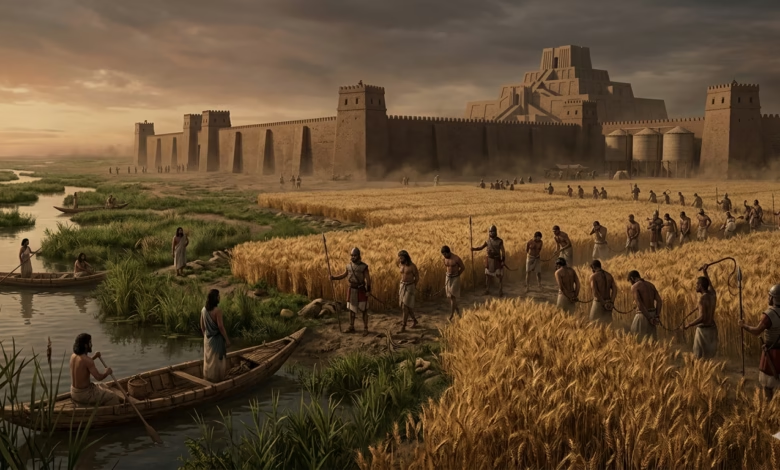
In the corridors of political thought and strategic studies, we often treat the “state” as an inevitable entity, or as a natural and commendable culmination of human evolution. However, the book Against the Grain: A Deep History of the Earliest States by researcher James C. Scott, published by Yale University Press, turns these assumptions upside down. In this work, Scott presents an anatomical, and at times even subversive, reading of the classical narrative that has long been taught in schools and universities about humanity’s transition from the savagery of hunting and gathering to the bliss of agriculture and settlement, and subsequently to the expanse of the state and law.
This article dives deep into this exceptional book to explore how the first structures of power were formed, and how geography and the environment were the primary players in the engineering of early human societies.
The Shredding of the Traditional Narrative of Civilization
The story of the “ascent of man” has dominated our minds—a narrative presuming that agriculture was a voluntary and joyous step toward prosperity, better nutrition, and leisure time. According to this story, the transition from hunting and gathering to settled agriculture was a quantum leap in human welfare. However, recent archaeological and historical evidence, as Scott illustrates, shreds this narrative and leaves it in tatters.
In its beginnings, agriculture was not a pure blessing; rather, it brought continuous drudgery, diseases caused by overcrowding, and malnutrition compared to the lives of hunter-gatherers who enjoyed better health and more leisure time. Even worse for theorists who link settlement to the emergence of the state is the fact that the first true, small states did not appear in Mesopotamia until around 3100 BC—more than four thousand years after the emergence of the first domesticated crops and settled communities. This massive temporal gap raises a fundamental question: If agriculture and settlement were sufficient conditions for the birth of the state, why was the emergence of political authority delayed for so long?
Fire as the First Landscape Architect
Before we reach the concept of the state, the book takes us back to the deep roots of human impact on the environment. Scott suggests that we should date the beginning of the human geological epoch (the Anthropocene) not to the Industrial Revolution or nuclear bombs, but to the discovery and use of fire.
Fire was the greatest and oldest tool used to reshape landscapes. Our ancestors (even prior to the emergence of Homo sapiens) used fire to engineer the environment around them. They burned vegetation to encourage the growth of seed- and berry-bearing shrubs, and to attract game that fed on these new plants.
More importantly, the impact of fire was realized in the process of “cooking.” Cooking served as an external digestive process that allowed humans to extract more calories with less effort from a vast array of previously indigestible plants and meats. This immense dietary shift significantly contributed to the evolution of the human brain’s size while reducing the size of the digestive tract compared to other mammals. In short, we domesticated and tamed fire, but in return, fire domesticated us and altered our physiological anatomy to the point where our survival as a species became impossible without it.
The Wetlands Thesis: A Hunter’s Paradise
One of the most prominent surprises Scott drops in his book is the dismantling of the myth of “making the desert bloom” through irrigation as the catalyst for civilization. We have long assumed that the earliest settled human communities arose in arid environments, forcing inhabitants to invent complex irrigation systems, which in turn required a central authority (a state) to manage this collective effort.
However, the reality—as revealed by archaeological and geological surveys—is that southern Mesopotamia (the cradle of the first states) was, at the time, a paradise of wetlands and marshes resulting from rising sea levels and the Persian Gulf. This astonishing abundance of aquatic resources—fish, turtles, migratory birds, mollusks, and small mammals—allowed populations to settle and form villages and towns (some reaching populations of five thousand) without a dire need for intensive agriculture or complex irrigation systems.
These populations lived at the intersection of multiple environments, which provided them with a flexible and stable food safety net. Settlement was a reality long before agriculture was adopted as a permanent endeavor. In other words, the state did not invent irrigation to gather populations; rather, settlement occurred thanks to natural abundance. This leads us to wonder: Why would a human living in such abundance abandon their dietary diversity and freedom to commit to the slavery of arduous agriculture unless forced to do so?
The “Domus” Complex and the Perfect Epidemiological Storm
With the slow transition toward grain cultivation and animal husbandry, what the book terms the “Domus” (the agricultural domestic complex) was formed. Scott argues that the domestication of plants and animals was not merely a technical event, but a total re-engineering of a new, artificial world.
Domestication did not stop at making crops and livestock entirely dependent on humans for their survival; rather, Homo sapiens themselves were domesticated through this system. The farmer became bound and enslaved to the rhythm of the crops—plowing, sowing, weeding, and harvesting—just as they became a servant to the needs of their livestock.
This forced settlement, the narrowing of dietary diversity, and the unprecedented crowding of humans and domesticated animals (along with the rodents and insects that parasitized this gathering) created what could be called a “perfect epidemiological storm.” Most of the acute infectious diseases humanity later came to know—such as measles, smallpox, and influenza—are zoonotic diseases that jumped the species barrier to infect humans as a result of this crowding. The book suggests that many of the mysterious “collapses” of early settlements were simply the result of lethal epidemics that wiped out populations or forced them to disperse.
The Grain Hypothesis: The Secret Alliance Between Power and Wheat Sheaves
In the fourth chapter of his book, Scott posits what he calls the “Grain Hypothesis,” which is one of the most thought-provoking ideas in our understanding of the formation of the ancient international system and classical political organization. The book points out a glaring historical fact: all classical states relied exclusively on grains, whether wheat, barley, rice, or millet. History records absolutely no “cassava states,” “sweet potato states,” or “banana states.”
One might ask: Why didn’t major empires emerge relying on legumes or tubers, even though some provide more calories per unit of land than wheat and barley? The answer lies in the unique compatibility between the biological characteristics of grains and the administrative requirements of the “state” as a taxation machine. For a state to emerge and endure, it requires wealth that can be confiscated, assessed, measured, stored, and distributed. Grains alone possess this combination of characteristics that qualify them to be the economic “backbone” for building political power.
The Tax Collector’s Dream: Visibility and Ease of Confiscation
To understand this close alliance between grains and the state, Scott suggests we put ourselves in the shoes of an ancient “tax collector,” who seeks, above all else, efficiency and ease in confiscating the surplus.
Grains grow above ground, require a specific agricultural cycle, and all ripen at roughly the same time. This simultaneous ripening means that an army or tax officials can arrive at the right moment to cut, thresh, and confiscate the crop in one swift and decisive operation. Furthermore, in times of war, grains make a “scorched earth” policy effortless; a hostile army can burn ripe grain fields and force the farmers to flee or surrender.
Let us compare this to tuber crops like cassava or potatoes. These crops grow underground, require less care, and can be easily hidden. Most importantly, they do not require a simultaneous harvest; rather, they can be left safely in the ground as a “natural storehouse” for up to two years. If a central authority wanted to confiscate cassava, its soldiers or tax collectors would have to dig up the earth and extract the tubers one by one, ultimately ending up with a heavy, low-value cartload that spoils quickly if transported over long distances.
Even nutritious legumes like chickpeas, lentils, and beans, which the Middle East was familiar with, were unsuitable as tax crops. The obstacle here is that most legumes produce their yields continuously over a long period and can be picked sequentially; they do not have a decisive, final harvest date like wheat, which is the fundamental condition demanded by the tax collector.
Additionally, grains are characterized by their infinite divisibility and precise measurement by weight and volume, making them ideal for accounting operations, standardization of metrics, dispensing food rations for workers, slaves, and soldiers, and even for use as a standard of value and commercial exchange. Grains made the process of assessing land and determining taxes “visible” and legible to the authority, unlike trade or tuber cultivation, which are characterized by concealment and the ability to evade.
Geopolitics: The Inevitability of Plains and the Monopoly on Water Transport
State formation is not solely dependent on the availability of grains; it requires a specific geographical theater. The agro-ecology favorable to state-making requires a concentration of resources, which is only found in alluvial lands with rich soil and abundant water, such as the valleys of the Tigris and Euphrates, or loess soil as in the Yellow River basin in China. In China, for example, the rise and authority of early states were confined to arable basins with abundant irrigation and easy soil, bypassing mountainous and marshy areas that were described as “barbarian” zones.
However, soil alone is not enough. Scott emphasizes a harsh logistical reality of the ancient world: overland transport of heavy goods (like grain and timber) was prohibitively expensive and virtually impossible over long distances. Water transport radically reduces friction, making it exponentially more efficient and economical. Therefore, no early state of consequence arose without relying on navigable waterways. It was the navigable river that allowed these small states to expand their zone of control, import scarce resources, and bring agricultural surplus to the center.
Walls: To Protect Wealth or to Confine Taxpayers?
With the accumulation of wealth in the form of grain-filled silos and dense human populations, an urgent need for defense emerged. It was no coincidence that the most prominent foundational act characterizing the political entity in Sumer was the building of the city wall. The walls of the city of Uruk, constructed between 3300 and 3000 BC, enclosed an area of 250 hectares, which is twice the size of classical Athens that appeared three thousand years later.
Traditionally, it is understood that these walls were built to protect farmers, their crops, and their properties from the invasions of external raiders. But from the perspective of power, there was a deeper and far more cunning purpose. The ancient state acted as a “population machine,” and its primary concern was retaining the workforce that produced the surplus. In this context, Scott—inspired by Owen Lattimore’s thesis on the Great Wall of China—points out that walls were built just as much to keep tax-paying farmers “in” and prevent them from fleeing, as they were to keep barbarians “out.”
Fleeing from taxes, slavery, forced labor, conscription, and plagues was a common and continuous occurrence. Therefore, city walls and ramparts, and even regional walls like the “Wall Against the Amorites” built between the Tigris and Euphrates, were aimed in large part at restricting the movement of the population and confining them within the domain subject to political and fiscal control.
The Invention of Writing: The Ledger of Power
To manage this massive complex of grains, humans, and taxes, the state needed a new technology for control. Here, the invention of writing steps in—not as a medium for recording myths or poetry, but as a strict bureaucratic tool.
Scott strongly asserts that writing was invented in Mesopotamia, and was used for more than half a millennium exclusively for bookkeeping and accounting purposes, before it was ever used to record literature or religious hymns. The great Epic of Gilgamesh, for example, dates back to the Third Dynasty of Ur, a full thousand years after cuneiform was used for commercial purposes and state accounts.
The early clay tablets in Uruk were endless lists and tables: lists of grains, rations, taxes, prisoners of war, and male and female slaves. Writing was the technology that enabled the authority to make society “legible” and comprehensible. Through writing and the standardization of weights and measures, it became possible to organize labor teams, distribute barley rations accurately in bevel-rimmed bowls, register lands, and conduct censuses. It is no wonder, then, that the symbol of kingship in Sumer was the “rod and ring”—the tools of the land surveyor.
The State as a Population Machine: Replicating “Domestication” on Humans
Scott argues that the state in its infancy was not searching for “land” as much as it was searching for “hands.” In an ancient world characterized by abundant land and scarce populations, controlling vast territories meant nothing unless there was sufficient manpower to cultivate grain and produce a surplus.
Here, the book posits a shocking idea: the state is an extension of the domestication process that began with crops and animals, but this time it targeted Homo sapiens itself. The state sought to concentrate the population in the “Grain Core” to ensure ease of surveillance, enumeration, conscription, and most importantly, the extraction of their surplus labor. The early state was akin to a “multispecies resettlement camp,” where humans, livestock, and crops were crammed into a tight and controlled space.
Slavery: The “Battery” Powering Civilization
With blunt frankness, Scott asserts that “there is no early state without slavery.” Slavery in Mesopotamia, ancient Egypt, or China was not merely a “moral aberration,” but the economic pillar that allowed elites to free themselves from agricultural toil to dedicate their time to building temples, managing armies, and keeping records.
However, the slavery Scott speaks of is not always the cinematic depiction of shackles and chains, but rather a broad spectrum of coercion starting from “corvée labor” (forced labor for specified periods for the state) all the way to the absolute slavery of captives. The state constantly needed to compensate for the “population drain” caused by plagues and flight, and there was no way to make up for this shortage except through coercion. Cuneiform records dating back to the Third Dynasty of Ur overflow with lists of “slaves” and “semi-slaves” who were distributed to weaving workshops and mills, revealing a society where a large portion of the productive force labored under the weight of coercion.
War as “Harvesting Humans”
Scott redefines the concept of war in ancient times. Wars were not aimed at drawing geographical borders or seizing cities to destroy them; at their core, they were “human hunting expeditions.” The goal of attacking a neighboring village or a “barbarian” tribe was not to kill its inhabitants, but to “drive” them like a herd of human cattle into the heart of the state to become tax-paying farmers or palace servants.
This explains why military victories were measured by the number of captives recorded on tablets, not by the area of conquered lands. War was the tool by which the state addressed the problem of “labor scarcity.” Ironically, the state, through its need for captives, created a slave market that incentivized surrounding tribes (the barbarians) to practice piracy and abduct humans to sell to the state, creating an entire ecosystem based on human trafficking.
The Fragility of the “Grain Core”: The State on the Edge of the Abyss
After reviewing the repressive power of the state, Scott moves on to describe its flip side: “absolute fragility.” Early states were highly weak and disorganized entities. Concentrating all resources in one spot (grains, humans, livestock) made them vulnerable to a series of cascading disasters that Scott calls “collapse syndrome.”
-
Epidemiological Disasters: As mentioned, overcrowding was an open invitation to infectious diseases. A single epidemic was capable of wiping out half a city’s population, immediately leading to the collapse of the fiscal and productive systems.
-
Ecological Failure: Continuous, intensive irrigation in regions like southern Iraq led to soil salinization and silt accumulation in canals, gradually turning productive lands into uncultivatable salt flats. Furthermore, deforestation for fuel and building materials led to soil erosion and intensified destructive floods.
-
Political Disorganization and Flight: The ancient citizen felt no loyalty to the state. Taxes, corvée labor, and plagues were strong repelling factors. As soon as the central grip weakened or an external threat loomed, the population practiced what Scott calls “de-stating”; fleeing to the mountains or marshes and returning to a life of hunting and herding far from the eyes of tax collectors.
Redefining “Collapse”: Was it Really a Disaster?
Here, Scott arrives at one of his most profoundly philosophical points. When archaeologists read about the “collapse of a civilization” or the “end of a dynasty,” they portray the matter as a major human tragedy and a return to the “Dark Ages.” But Scott asks: Dark for whom?
Collapse, from the perspective of the state and the elite who write history, is a disaster because records cease, palaces are abandoned, and taxes go uncollected. But for the average farmer or the slave toiling in the fields, the collapse might be a “moment of emancipation.” Collapse means the disappearance of corvée labor, the abolition of taxes, and the dismantling of the restrictions that prevented movement.
Often, “collapse” simply meant the dispersal of populations into smaller, more flexible, and healthier units, where the risk of epidemics decreased and dietary diversity increased. In this sense, the “Dark Ages” in historical records might actually be “Golden Ages” for human freedom, where humans regained their autonomy from the grip of the state’s population machine.
The Golden Age of the Barbarians: The Bright Side of “Outside the State”
The traditional narrative has long portrayed “barbarians” as a looming threat to civilization, and as beings living in misery and deficiency compared to city dwellers. But Scott flips this image completely; barbarians in the eras of early states enjoyed a standard of living and health that vastly surpassed that of urban populations.
The “barbarian”—whether a herder, a hunter, or a shifting cultivator—enjoyed astonishing dietary diversity that kept him safe from the vitamin deficiency diseases that plagued wheat farmers. Furthermore, his continuous mobility made him less susceptible to the endemic diseases of the cities. Most importantly, the barbarian was a “tax-free person”; he did not toil to fill the king’s silos, rather his production was his own.
Scott goes even further, suggesting that the term “barbarian” is fundamentally a political term, not an ethnic or civilizational one. A barbarian is simply someone who lives “outside the state’s fiscal line of sight.” Often, barbarians were “political refugees” who fled state oppression and chose to live in rugged geographic peripheries that armies could not easily reach.
The “Noble” Parasites: The Symbiotic Relationship Between the State and Barbarians
The relationship between the state and barbarians was not one of permanent conflict as we imagine, but rather a complex “parasitic symbiotic relationship.”
On the one hand, barbarians practiced “extortion” or “protection rackets”; instead of destroying a city, they contented themselves with taking “tribute” in exchange for leaving it in peace. For the barbarian, this process was more efficient than agriculture; it granted him a surplus of grain, metals, and textiles with minimal military effort.
On the other hand, the state relied on barbarians as suppliers of resources it lacked in its alluvial plains: timber, metals, precious stones, and most importantly… slaves. Yes, the barbarians were the primary supplier of the “human fuel” needed by the state. In later stages, barbarians became the “mercenaries” protecting the state from other barbarians, and it even culminated in many barbarian leaders seizing the throne of the state itself to become kings, as occurred in several Chinese dynasties and at the end of the Roman Empire.
The “Age of the Barbarians” was a period when humans enjoyed the best of both worlds: access to the advanced products of the state via trade or plunder, while retaining their freedom and health far from its constraints.
The Anthropocene: When Did We Start Changing the Face of the Planet?
Scott sparks a vital debate regarding the term “Anthropocene” (the geological epoch of human impact). While many argue this epoch began with the Industrial Revolution, Scott insists its first seeds were planted thousands of years prior, with the “domestication of fire” and then the “domestication of grain.”
The state-building process was fundamentally a process of forced “ecological simplification.” In order for the state to be able to read society and collect taxes, it transformed the rich biodiversity of marshes and forests into a monoculture of grains. This simplification did not merely alter the landscape, it altered the trajectory of human evolution itself. We created an entirely artificial environment where very specific types of plants and animals live under our surveillance, ultimately leading to the “impoverishment” of human experience with the broader natural world.
The Enigma of the Final Victory: Why Did the “State” Prevail?
The central question remains: If living in the peripheries as a “barbarian” was healthier and freer, why do we live today in a world completely covered by states? Scott acknowledges that the state, despite its fragility, possessed one strategic advantage: the ability to concentrate resources and energy.
Over time, and with the development of “legibility” technologies—from precise maps to national identification numbers and birth records—the “non-state” spaces eroded. Modern military technology, rapid transportation routes, and digital communications eliminated the geographical barriers (mountains, swamps, forests) that once formed a sanctuary for those fleeing authority.
The state triumphed not because it is necessarily “better” for individual welfare, but because it was the most efficient machine for “collective survival” and military competition. The state has become a “cage” we built ourselves, and over the passing centuries, we have forgotten that there was once a world outside these bars.