
Humans without masters
How are David Graeber and David Wingro rewriting the story of humanity?

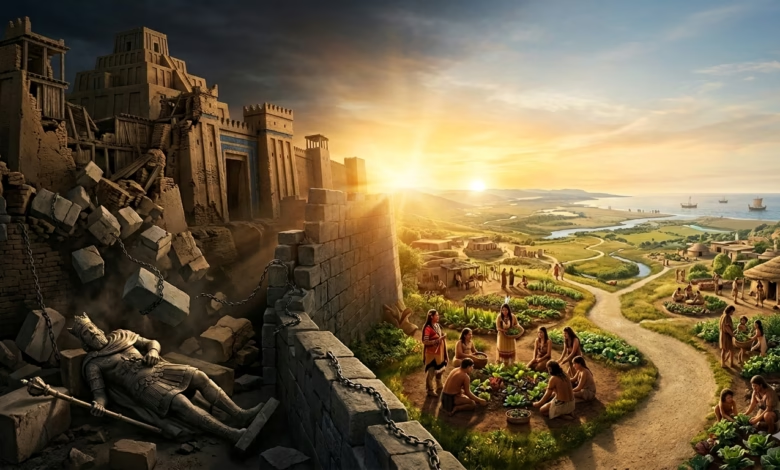
Ever since we took our first seats in school, we have been spoon-fed a single, unchanging story about our human history—a story that seems so coherent, logical, and inevitable that it prevents us from questioning it. This story begins with the “childhood of humanity,” where our early ancestors lived in small bands of hunter-gatherers, roaming the earth in innocent simplicity or primitive savagery. Then came the “discovery” of agriculture, and with it, the birth of private property, the swelling of societies, and the inevitable need for administration and bureaucracy. This ultimately led to the emergence of the state, social classes, and the stratification we experience today.
According to this narrative, inequality, wars, and stifling bureaucracy are merely the “tax of civilization” that we must pay in exchange for smartphones, modern medicine, and the relative safety provided by modern states. We either live in a state of the war of all against all, as imagined by the English philosopher Thomas Hobbes, or we are “noble savages,” as envisioned by the French philosopher Jean-Jacques Rousseau.
But what if this entire story… is just a myth?
Here enters “The Dawn of Everything: A New History of Humanity”, the fruit of an extraordinary ten-year collaboration between the late anthropologist David Graeber (one of the most prominent radical thinkers of our time and a founding mind behind the “Occupy Wall Street” movement) and the renowned archaeologist David Wengrow. This book is not just a new addition to the history shelves; it is a true intellectual earthquake and a bold, rigorous attempt to dismantle the traditional narrative that has shackled our political and social imagination for centuries.
Demolishing the Idol of “Historical Determinism”
Graeber and Wengrow begin with a direct assault on the grand narratives presented by contemporary thinkers like Yuval Noah Harari in “Sapiens” or Jared Diamond in “Guns, Germs, and Steel.” The authors argue that these books, despite their overwhelming popularity, merely reproduce the same old myth, albeit in a modern scientific wrapper. They tell us that humanity’s path was linear and inevitable: from small bands, to tribes, then chiefdoms, and finally complex imperial states.
With strict academic rigor, the authors present a flood of modern archaeological and anthropological evidence that has been deliberately or inadvertently ignored simply because it does not fit the “official story.” The reader discovers that early humans were not merely biological machines reacting to their environment in search of calories; rather, they were deeply political beings with profound self-awareness, constantly experimenting with different forms of social organization.
The Indigenous Critique: How Native Americans Inspired the European Enlightenment?
One of the most astonishing chapters in the book—which could serve as an independent piece of investigative journalism—is the one concerning “The Indigenous Critique.” Graeber and Wengrow flip the script on the Eurocentric narrative that claims concepts like “freedom” and “equality” are purely European inventions that sprang from the minds of Enlightenment philosophers in the salons of Paris and London.
Instead, the book reveals through historical documents profound and genuine dialogues that took place in the 17th century between French missionaries and officials on one side, and Native North American thinkers and leaders on the other. Here, the name “Kandiaronk” emerges—a leader and thinker from the Wendat nation, who was a brilliant conversationalist and a fierce critic of European society.
Kandiaronk harshly criticized the inequality in France, the savagery of its judicial system, the blind reliance on money, the lack of individual freedoms, and the Europeans’ blind submission to authority. The book argues, with compelling textual evidence, that these scathing critiques leveled by Indigenous people against European society are what shocked the European mind and forced Western thinkers to contemplate concepts of equality and freedom, serving as the true spark that ignited the Enlightenment. In other words, Enlightenment philosophers were not inventing concepts of equality out of thin air; they were responding to the “Indigenous Critique” coming from across the ocean.
Countless Social Experiments
What keeps you glued to reading this massive tome is the way the authors narrate the diversity of human life in prehistoric times. The book tells us that hunter-gatherer societies were not all simple egalitarian communities. Some built complex hierarchical structures, lavish tombs, and perhaps even practiced slavery, but—and here lies the genius—they did so “seasonally.”
In parts of North America and Europe, societies alternated between entirely different social systems based on the seasons. In the summer, they dispersed into small, egalitarian groups. In the winter, they gathered in large settlements and built hierarchical power structures, police forces, and kingships, only to dismantle it all once spring arrived. This alternation proves that our ancestors possessed an active political imagination and were fully aware of the dangers of power; therefore, they made it temporary and a role-playing game, not an inescapable destiny.
Perhaps one of the most entrenched convictions in our educational curricula and historical consciousness is that defining moment we call the “Agricultural Revolution.” The classical narrative tells us that the discovery of agriculture was the point of no return; once the first human scattered seeds and settled down to wait for the harvest, they fell into an inescapable trap. Suddenly, concepts of private land ownership emerged, protecting crops required building armies, and storing the agricultural surplus necessitated the rise of a class of administrators and bureaucrats. Thus, inevitably, social stratification was born and the state emerged. Thinkers like Jared Diamond have portrayed agriculture as “the worst mistake in the history of the human race.”
However, delving into the latest archaeological discoveries, David Graeber and David Wengrow turn this narrative upside down. In “The Dawn of Everything,” the authors argue that the term “revolution” itself is highly misleading; it implies a sudden event and a dramatic, rapid transition that changed the face of history overnight. In reality, modern archaeological evidence tells us that the transition to agriculture was a slow, intermittent process that took thousands of years.
“Play Farming”: A Choice, Not a Destiny
Instead of blindly leaping into the agricultural trap, our ancestors practiced what the authors call “Play Farming.” For long periods spanning thousands of years, humans cultivated certain crops but did not rely on them entirely. They would plant them and then leave to embark on hunting and gathering expeditions. They knew about agriculture and understood its mechanisms, but they consciously refused to become slaves to the fields.
The book presents a stunning, revolutionary idea: the rejection of intensive agriculture did not stem from ignorance or backwardness, but was a conscious political and social decision. Many societies realized that total reliance on agriculture required hard, tedious labor and created social hierarchies, so they willingly chose to maintain their more diverse and free lifestyle. Graeber and Wengrow use the concept of “Schismogenesis” to explain how some societies lived side by side with agricultural communities but deliberately chose not to farm, simply to distinguish themselves from their neighbors and preserve their own values, just as modern nations choose their political and economic systems to differentiate themselves from their rivals.
Megacities… But Without Masters
If we get past the shock that agriculture was not an inevitable trap, we collide with the second cornerstone of the traditional narrative: “the inevitability of the state with population growth.” The sociological rule we accepted as an axiom states: if the population of a settlement exceeds a few thousand, it becomes impossible to manage without a hierarchy, a police force, a class system, and a central ruler. “You cannot run a modern city with a tribal council system,” determinists tell us.
Here, “The Dawn of Everything” opens the files of forgotten and marginalized archaeology to present conclusive evidence refuting this rule. The book takes us on an illustrated journalistic journey to the massive Trypillia sites in Ukraine and Eastern Europe, dating back to the Chalcolithic period (around 4000 BC). These sites were enormous cities, larger than any city in Mesopotamia at the time, housing tens of thousands of residents.
The shocking surprise that traditional history has kept silent about? Archaeologists found no traces of palaces, massive temples, central administrative buildings, or lavish tombs indicating the presence of a king or ruling class in these megacities. The cities were designed in concentric circles, consisting of equally sized houses, centered around large gathering squares. They were complex, thriving urban metropolises that lived for centuries in relative peace and managed their own affairs without the need for an oppressive bureaucracy or a class of aristocrats.
And it doesn’t stop at Eastern Europe. The book moves us to the breathtaking city of Teotihuacan in Mesoamerica, which rivaled Rome in size during its glory days. Excavations reveal that this city had indeed begun to build an authoritarian hierarchy, but at some point in history, a popular revolution occurred. The construction of temples for god-kings was halted, and the city’s resources were redirected toward building a high-quality, comfortable social housing system that included almost all of the city’s residents. The people of Teotihuacan decided to live in an egalitarian city and successfully managed it for centuries without kings.
Even in the Indus Valley Civilization (in present-day Pakistan and India), in cities like Harappa and Mohenjo-Daro, we find highly precise urban planning, sewage systems superior to some found in 19th-century European capitals, standardized weights and measures, and widespread trade… all without any trace of statues of kings, ruling palaces, or centralized armies.
What Does All This Mean?
Reviewing this evidence in “The Dawn of Everything” deals a fatal blow to contemporary political despair. If the traditional narrative tells us that social inequality is the inevitable tax for living in large, complex societies, Graeber and Wengrow prove with material evidence that our ancestors managed to build massive cities, flourishing civilizations, and complex trade networks while maintaining social organizations based on equality and voluntary cooperation. They possessed a political flexibility that we lack today.
After David Graeber and David Wengrow demolish the myths surrounding agriculture and cities in the early parts of their book, they move us to the most complex and pressing question in the history of the social sciences: What is the “state”? And how did we end up prisoners within its walls? In this section of their epic review, the authors practice a kind of “political anatomy” of this entity that we now consider an inevitable destiny. The traditional narrative tells us that the “state” emerged as a single, complete package: a king, an army, a bureaucracy, and a law. But Graeber and Wengrow, with their investigative journalistic style, dismantle this package to show that it was never a single monolith; rather, it consisted of stumbling human experiments in control, the merging of which into a single entity took thousands of years.
The Three Pillars of Control: The Damned Triangle
The book posits a revolutionary vision: what we call the “modern state” is actually an amalgamation of three independent types of power, which did not necessarily converge in ancient societies. The authors call them the “three principles of domination”:
-
Sovereignty (Control of Violence): The ability to exercise absolute and arbitrary physical violence, as seen in human sacrifice rituals in ancient kingdoms or the divine right of kings to kill.
-
Administration (Control of Information): Bureaucracy, the ability to inventory, census, tax, and control resources through records.
-
Charisma (Heroic Politics): Control through persuasion, individual competition, oratory, and political duels seen in “heroic” societies like Homeric Greece.
The authors argue that ancient history is full of societies that possessed one or two of these pillars but consciously rejected the third. For example, the Inca civilization possessed a stunning administrative and bureaucratic system (the second pillar) and absolute sovereignty for the ruler (the first pillar), but they did not have “politics” in the charismatic, competitive sense. Conversely, some societies had raucous heroic politics and charismatic competitions but entirely lacked bureaucracy or the right to arbitrary killing.
The great deception in our modern history is that we delusionally believed these three elements must come together to form a “successful state.” Graeber and Wengrow prove that the “state” in this sense is not a natural evolution, but a bizarre historical accident where these three forces merged to create a comprehensive, oppressive system from which it is difficult to escape.
The Three Lost Freedoms
If the book seeks to understand how we got “stuck” in this system, it begins by defining what we have actually lost. The authors suggest that humans, for most of their history, enjoyed three basic freedoms that we today consider “science fiction”:
-
The Freedom to Move: The ability to leave your community and go elsewhere, with the certainty that you will be received and welcomed in a new community. This freedom was the safety valve against tyranny; if a leader tried to impose their will, people would simply leave.
-
The Freedom to Disobey Orders: Orders in ancient societies were not compulsory in the modern sense. A leader could suggest, but did not possess a coercive mechanism to force others to execute them.
-
The Freedom to Change the Social System: This is the most important freedom and the ultimate goal of the book. Humans moved between different political systems seasonally or as needed. They understood that the social system is not “nature,” but a “construct” that can be dismantled and rebuilt.
The book argues that the true tragedy of humanity is not the emergence of the state, but the “loss of the ability to imagine an alternative to it.” We have lost the flexibility that allowed our ancestors to experience freedom and equality for thousands of years.
How Did We Get “Stuck”? From Rituals to Laws
Graeber and Wengrow present a controversial hypothesis about how power transformed from a “game” or “temporary ritual” into a “permanent reality.” The authors note that many tools of control began as games or religious rituals. Human sacrifices, ritual violence, and early bureaucracy were initially practiced at specific times of the year or in narrow funerary contexts.
The disaster occurred when these “ritual exceptions” began to turn into “permanent rules.” When the guard who protected the temple for a single season turned into a permanent policeman, and when the census necessary for distributing food during a famine turned into an endless tax system.
The authors use the term “political arteriosclerosis” to describe the process in which societies lost their flexibility. Instead of humans being the creators of the system, the system became the creator of humans, restricting their movement and confiscating their imagination.
Reviewing the Concept of “Civilization”
In this part of the book, the authors launch an attack on the way we use the word “civilization.” We often associate civilization with grandiose architecture, writing, and bureaucracy. But Graeber and Wengrow suggest a different definition: true civilization is the ability to create a society that respects the fundamental freedoms of human beings.
They give the example of “rebellious zones” in history, such as the highland peoples of Southeast Asia or pre-colonial North American societies, who deliberately rejected writing because they associated it with tax collection and slavery. These people were not “primitives” incapable of invention; they were “political radicals” who rejected the technology of control to preserve their freedom.
Property is Not a Relationship Between “A Person and a Thing,” But Between “People”
The authors present an idea that might seem strange at first: private property at its core is not a relationship between a person and a piece of land or a tool; rather, it is a relationship between the owner of the land and the rest of humanity, fundamentally based on the “right to exclude,” backed by violence. In direct journalistic terms: property is your right to say to others, “You cannot enter this place,” and if you try, I have the right to use force against you.
But where did this idea come from? The book goes on a fascinating anthropological journey connecting property with the “sacred.” The authors note that ancient societies designated certain objects (ritual tools, statues of gods, ancestral remains) as “sacred” items that no one was allowed to touch or approach. This “exclusion” was initially religious and symbolic, aimed at protecting the spirit of the community.
The political disaster happened when this ritual concept was “secularized.” Exclusion transformed from protecting the “sacred” for the benefit of all, to protecting “property” for the benefit of the individual. Kings and the wealthy borrowed the prestige of the “gods” to surround their possessions with the same halo of prohibition, turning the right to exclude from a religious ritual into a civil law backed by weapons.
The Forgotten Role of Women: A Revolution of “Care,” Not “Production”
Graeber and Wengrow move us to an area often marginalized in traditional history books: the role of women. The classical narrative always focuses on “Man the Hunter” or “Man the Warrior” as the primary agent of change. But “The Dawn of Everything” offers a completely different vision, placing women at the heart of human innovation.
The authors argue that most of the innovations we consider the foundation of civilization—from pottery making, to weaving, to botany (which paved the way for agriculture)—were largely the product of women’s work within the context of “domestic care.” These innovations were not aimed at control or imperial expansion, but at improving the quality of life and developing social tools.
The book draws us into an exciting journalistic discussion about how these innovations were “hijacked” and turned into tools of power. Agriculture, which started as a “feminist botany” based on diversity and freedom, was transformed by patriarchal systems into a system of mass production aimed at collecting taxes and feeding armies. Here, the question arises: was the state, at its core, a male attempt to control the networks of care and production created by women?
Schismogenesis: Why Do Neighbors Insist on Being Different?
The authors return to clarify the concept of “Schismogenesis” with deeper examples. They take us to the west coast of North America, where two groups of indigenous people lived side by side: the northern tribes and the southern tribes.
The northern tribes had an aristocratic system, practiced slavery, and held lavish “potlatch” feasts to destroy property as a show of power. In contrast, the southern tribes (in present-day California) entirely rejected slavery, considered the flaunting of wealth shameful, and adopted an ascetic work ethic.
This stark contrast was not an environmental accident, but a conscious political decision. The “journalistic takeaway” here is that humans do not develop their cultures in a vacuum, but often choose to be the “opposite” of their neighbors whose systems they loathe. Ancient California did not lack the “development” to become like the aristocratic north; it chose “not to be” so. This proves once again that political freedom—the ability to reject a specific social model—was the true engine of human diversity.
The Trap of the First “Bureaucracy”
The book addresses how bureaucracy began in sites like Çatalhöyük in Turkey or Mesopotamia. The authors argue that the first clay seals were not used to organize global trade as we were told, but were initially used to organize household stores and ensure the distribution of rations within the small community.
The problem started when this technical tool (the seal and the register) was separated from its human purpose (care and fair distribution) and became a tool in the hands of a separate class of “scribes” who began to view humans as numbers in their ledgers. It is the moment when “justice” transformed from a living social concept into a rigid “law” written on clay tablets.
Are We Really “Stuck”?
At the end of this section, Graeber and Wengrow pose a haunting question: if our ancestors succeeded for thousands of years in avoiding authoritarian traps and in changing their social systems as easily as they change their clothes, why do we feel today that we are stuck in a single, unchangeable system?
Why do we find it easier to imagine the end of the world (via climate disaster or nuclear war) than to imagine the end of capitalism or the nation-state? The authors argue that the problem is not with “reality,” but with our “imagination,” which has been domesticated and diminished over centuries of misleading historical narratives that tell us we have “come of age” and can never return to playing the “games” of freedom that our ancestors played.