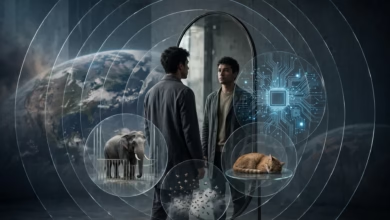


In the midst of the successive environmental crises ravaging our planet, from raging wildfires to devastating floods and extreme climate changes, the world’s attention usually turns toward technical solutions, economic policies, and international agreements. We seek salvation in solar panels, electric cars, and the reduction of carbon emissions. However, the renowned historian and author Karen Armstrong, in her inspiring book *Sacred Nature: How We Can Recover Our Bond with the Natural World*, invites us to pause for a moment to contemplate the crisis from a deeper and more radical perspective—a purely spiritual and philosophical angle.
Armstrong presents a bold thesis, shocking in its simplicity: the systematic destruction we inflict upon planet Earth is not merely a political or technological failure, but at its core, a spiritual and cultural failure. We have lost our profound connection with nature, no longer seeing it as a living entity carrying an intrinsic sacred value. Instead, in our eyes, it has been reduced to a mere repository of inert resources that we plunder to satisfy our endless consumerist desires.
The Illusion of Control in the Secular Age
To understand the magnitude of the disaster, the author takes us on a deconstructive journey of the modern cognitive paradigm. In our secular age, long viewed as the pinnacle of rational liberation and the purging of myths and superstitions from the world, a massive fracture occurred in the way humanity interacts with its environment. The natural world was emptied of any transcendent meaning or inherent sacredness.
Forests, seas, and mountains are no longer spaces for contemplation or epiphany; they have become merely “dead matter” subject to calculations of profit and loss. This profound philosophical shift severed the bonds of communicative action between humanity and its environment. Instead of dialogue and harmony with nature, a logic of domination, control, and unilateral exploitation prevailed. Modern humanity has become an isolated entity within its technological shell, looking down at the world from an overly narcissistic height, believing itself to be the absolute master of this planet.
The Myth of “Logos” and the Forgetting of “Mythos
Armstrong builds a significant part of her intellectual analysis on the precise distinction between two fundamental modes of knowledge known to humanity since antiquity: Logos and Mythos.
Logos:is practical reason, logic, and empirical science. It is the tool we use to understand the mechanisms of how things work, to invent technologies, and to organize societies. Logos is essential for survival and material progress.
Mythos: is intuitive, spiritual, and mythical knowledge. It is not the fabrication of lies, as it is erroneously understood today; rather, it is the way we impart meaning to our existence and deal with the great existential questions that Logos cannot answer (such as death, pain, and the meaning of life).
Armstrong argues that the true tragedy of modernity lies in the encroachment of “Logos” at the expense of “Mythos.” We have relied entirely and unilaterally on instrumental rationality and scientific logic, marginalizing everything related to emotion and the spirit. As a result, we have become incredibly smart at extracting oil from the depths of the earth (Logos), but we have lost the wisdom that tells us this earth is our sacred home whose balance must be respected and preserved (Mythos).
Restoring the Ancient Vision: Nature as a Sacred Book
In the face of this spiritual desertification, Armstrong does not call for abandoning science or returning to the Stone Age. Instead, she calls for the rediscovery of the ancient wisdom shared by all major religious and philosophical traditions, both in the East and the West.
In ancient times, nature was not separate from the sacred; it was a manifestation of it. Through a smooth and engaging review of traditions such as Taoism in China, the Upanishads in India, all the way to monotheistic religions, the author illustrates how our ancestors viewed nature as a sacred text to be read and contemplated. Every tree, every drop of water, and every living creature carried a breath of divinity or an absolute cosmic power.
This perspective was not mere naive romanticism; it established strict ethics for interacting with the environment—ethics built on reverence, a profound sense of gratitude, and the realization that the human being is but a small fragment in a vast and complex cosmic web, dependent for its survival on the balance of the entire web.
The Doctrine of Kenosis: Self-Emptying
One of the most important concepts Armstrong introduces in this context—which represents the cornerstone of our review of this intellectual masterpiece—is the concept of relinquishment or self-emptying (Kenosis). The author believes that our environmental arrogance stems from the inflation of the human “ego.” To be able to save the planet, we must practice a kind of deep spiritual humility; we must relinquish our anthropocentrism and stop considering ourselves the masters and center of the universe.
True contemplation of nature requires us to be silent, to quiet the noise of our consumerist desires and selfish demands, so we can listen to the rhythm of the natural world. This internal silence, or “self-emptying,” is the necessary first step to rebuilding the broken bridges between us and the earth that embraces us.
Disenchantment of the World: Nature as an Inert Machine
Armstrong takes us into a sharp critical reading of the radical shift that occurred in human consciousness with the dawn of the Scientific Revolution in the West. Amidst what can be described as the crystallization of the “Secular Age,” a structural change occurred in the philosophical view of existence. The natural world was no longer understood as a living, interconnected, and spiritually pulsating web; it was gradually stripped of any intrinsic value to become mere raw material.
This shift cemented a dangerous vision assuming that nature is nothing but a massive “reserve repository” existing specifically to satisfy endless human consumption desires. Here, the tragedy of instrumental rationality manifests in its clearest form: we replaced a deep existential understanding of the world, and communicative action based on dialogue and harmony with the environment, with a cold technical approach that measures everything by its utility and material returns. The “disenchantment of the world” took place, and burning forests and polluted oceans became mere “collateral damage” in the wheel of relentless industrial and technological progress.
The Complicity of Religious Interpretations: A God Detached from His Universe
One of the boldest chapters in Armstrong’s journalistic and intellectual inquiry is her scathing critique of the way certain theological interpretations were co-opted to justify this ruin. As a seasoned scholar in the history of religions, Armstrong does not hesitate to point the finger at the distorted understanding of certain religious texts, specifically in the Western monotheistic heritage, which promoted the idea of humanity’s “absolute dominion” over the earth.
The human being was portrayed as a domineering viceroy, endowed with the right to master nature and subjugate it by force. Worse still, later religious thought began to imagine God as an entity entirely separate from the natural world, standing outside it and managing it from afar. This sharp division between “Creator” and “creation” made nature appear mundane, devoid of sanctity, and open to exploitation. Armstrong bitterly asks: How can we defend an environment that we, deep down, believe is merely a temporary waiting station with no connection to the Absolute?
In contrast, the author invokes ancient visions from Eastern philosophies and authentic spiritualities that saw the transcendent manifested within the heart of the tangible. Divinity, according to this authentic understanding, breathes in the leaves of trees, flows in rivers, and lives in every atom of existence.
Expanding the “Golden Rule”: A New Cosmic Ethic
Perhaps the most distinguishing feature of Armstrong’s approach is that it does not stop at diagnosis but attempts to offer a philosophical and spiritual way out. To do this, she summons a universal moral concept deeply rooted in all cultures: the “Golden Rule” (treat others as you would like to be treated). However, the challenge the author poses is expanding the scope of this rule beyond the boundaries of the human species.
Why do we limit our empathy and compassion to humans alone? Armstrong suggests the necessity of extending this moral principle to encompass our entire biosphere. It is a call to adopt the ancient Indian principle of “Ahimsa,” which means absolute “non-violence” toward all that is alive. This shift requires a deep realization that our survival as humans is organically linked to the dignity and integrity of nature. Cutting down a tree unjustly, or polluting a river, is not merely an administrative error or a legal violation; at its core, it is a “moral sin” and an assault on the sacred web of life.
Spiritual Awakening in the Heart of Modern Noise
How do we translate this profound philosophy into a lived reality amid the hustle of our complex and alienated modern cities? *Sacred Nature* does not demand that we flee to the mountains and isolate ourselves from civilization; rather, it invites us to reintegrate “ritualism” and spiritual mindfulness into our daily practices.
The author presents the importance of rediscovering “gratitude” as a revolutionary daily act. Pausing for a moment to contemplate a starry sky, feeling the raindrops, or even consciously thinking about the journey of the food that reaches our tables, are small acts capable of dismantling arrogant anthropocentrism. They are daily exercises in taming the “ego,” reminding us of our true scale as a humble element within a complex and interwoven web of life.
This return to nature is not merely a recreational stroll to soothe the nerves; it is an epistemological and existential necessity. It is the recovery of a lost language, the language that allowed our ancestors to understand the world in silence and reverence, before the deafness of consumerist modernity afflicted us.
Unity of Existence: Lessons from Ancient Chinese Wisdom
Armstrong pauses at length on Confucian and Taoist philosophies, considering them an ideal model of what we have lost in the West. At the center of this thought lies the concept of “Cosmic Harmony.” For the ancient Chinese sage, there was no sharp separation between the divine, the human, and the natural; rather, all swim in one orbit brought together by the “Tao” (the Way or cosmic law).
The author masterfully explores the concept of “Qi,” that vital energy flowing through the veins of the universe, from the smallest grain of sand to the farthest galaxy. When we realize that we share the same “Qi” with trees, animals, and mountains, assaulting the environment becomes a self-assault on our very existence. It is a vision that does not view humans as “masters” or external “observers,” but as “servants” or “coordinators” within a grand cosmic symphony. This realization is what generates “Ren” or comprehensive humanity, which begins with love for self and family and expands to encompass the entire planet.
The Dynamic of “Continuous Creation”: The Universe as an Unending Work of Art
One of the revolutionary ideas Armstrong presents in *Sacred Nature* is inviting us to abandon the idea of “creation as a historical event that occurred and ended.” In modern consciousness, the universe is often viewed as a machine designed by an absent engineer (in the religious version) or as a material explosion that happened in the distant past (in the scientific version).
However, Armstrong, drawing inspiration from ancient spiritualities and even some contemporary quantum physics, invites us to view creation as an ongoing, momentary, and dynamic process. Every morning is a “new creation,” and every growth of a tree bud is a manifestation of the creative force in the present moment. When we adopt this vision, we stop treating nature as a “product” ready for consumption and begin to appreciate the creative “process” happening before our eyes. This shift in perspective makes protecting the environment an act of worship or reverence for the creative and renewing beauty.
The Magic of the Word: The Role of Poetry in Restoring Vision
Armstrong dedicates significant space in her book to the role of art and poetry, not as an aesthetic luxury, but as an essential cognitive tool. The author argues that dry scientific language has contributed to the “flattening” of the world. In contrast, poetry possesses the ability to pierce the shell of matter to reach the spiritual “essence.”
Armstrong invokes the poems of Wordsworth, Rilke, and Taoist Chinese poets like Li Bai and Du Fu to illustrate how words can restore our “childlike wonder” before nature. It is poetry that transforms the forest from a “collection of timber” into a “living temple.” It restores our ability to see what is “transcendent” at the heart of the “ordinary.” The author stresses that today, more than ever, we need a culture that rehabilitates the poetic imagination as an equal partner to the scientific mind in our understanding of the world.
The Challenge of Consumption: From “Having” to “Being”
Armstrong concludes this axis with a profound social critique of the culture of “ownership” dominating the contemporary world. Our obsession with owning things and depleting resources stems from an inner emptiness we try to fill with consumption. However, as *Sacred Nature* clarifies, this emptiness is, in truth, a spiritual void resulting from our disconnection from our origin.
The solution she proposes is not necessarily forced austerity, but transitioning to a mode of “being.” To be present in the world, grateful for what is available, and aware of the beauty of sufficiency. The author reminds us that the greatest joys of life—watching a sunset, breathing fresh air, feeling a sense of belonging to the earth—are free joys that do not require destroying the planet to purchase.
From Organic to Mechanistic: The Scientific Revolution and the End of “Magic”
Armstrong astutely pauses at the historical crossroads Europe witnessed in the seventeenth and eighteenth centuries. Prior to this stage, European consciousness, influenced by Greek and medieval visions, viewed the universe as a connected “organic entity.” But with the rise of philosophers and scientists like René Descartes and Isaac Newton, a massive cognitive upheaval occurred.
Descartes formulated his worldview based on a sharp division between “mind” (the thinking substance) and “matter” (the extended substance). As a result of this separation, humanity became the only “subject” possessing consciousness, while nature—with all its animals, plants, and inanimate objects—turned into a mere “object” or “machine” lacking spirit and internal purpose. Armstrong describes this moment as the great “disenchantment”; where nature was no longer seen as a space for divine epiphany, but as a vast laboratory for dissection, measurement, and control.
The Alienation of Modern Man: When the Universe Fell Silent
This shift toward the “mechanistic” not only affected the environment but also caused a deep fracture in the human psyche. Armstrong points out that by stripping nature of its sacredness, we have also stripped ourselves of the sense of cosmic belonging. Modern man has become a “stranger” in his earthly home; he lives in a world he treats merely as raw material, which has exacerbated feelings of existential anxiety and alienation.
The silence of the universe in the face of modern man does not stem from the silence of nature itself, but from our loss of the “spiritual ear” that used to hear the chorus of existence. The author argues that the contemporary environmental crisis is actually an external “symptom” of an internal disease: the inability to emotionally connect with that which lies beyond the boundaries of the human “ego.”
Education and Environment: Toward a Curriculum of “Reverence”
Armstrong suggests the necessity of integrating the “practice of wonder” into educational curricula. It is not enough for a child to learn the chemical composition of a plant cell; they must learn how to “look” at a tree with reverence, and how to feel the mysterious beauty in the cycle of life. True environmental education is not just providing students with information about the ozone hole, but training them in “cosmic empathy”; that is, the ability to feel the pain of the earth and its beauty simultaneously.
Reclaiming “Sacred Space”: Geography as a Spiritual Act
The author also addresses the concept of “place.” In ancient cultures, there was a sacred geography; untouched mountains, forests considered sanctuaries for spirits, and rivers revered as life-givers. This sanctification of place served as a natural “protective shield” preventing the excessive depletion of resources.
Today, with globalization and rapid urbanization, we have lost the “particularity of place.” The entire earth has become, to us, “real estate” available for buying, selling, and development. Armstrong invites us to rediscover the “sanctity of local places”; to begin protecting and appreciating the green spaces in our cities, and treating our parks and beaches not just as recreational facilities, but as irreplaceable “spiritual lungs.”
Silence as a Revolutionary Act in the Age of Noise
Armstrong concludes this axis by speaking about “silence.” In our contemporary world, filled with technological noise and constant media consumption, it has become difficult for us to practice contemplation. The author argues that restoring our relationship with nature requires a “voluntary silence” from us.
Standing silently before a natural landscape is not a waste of time, but a revolutionary act against the culture of excessive consumption and productivity. In this silence, the “ego” begins to shrink, and the universe begins to speak. This “silent communication” is what Armstrong calls true prayer in the sanctuary of nature.
The “Anthropocene” Era: When Humanity Became a Geological Force
Armstrong opens this section by highlighting a terrifying scientific and geological fact: for the first time in the planet’s history, we are living in an era shaped not by natural factors alone, but by human activities. We have transformed from “inhabitants” of the earth into a “geological force” capable of altering the planet’s climate and evolutionary trajectory.
Armstrong argues that this immense power has not been accompanied by parallel growth in spiritual or moral wisdom. We possess the tools of “gods” but still operate driven by primitive “vanity.” The author asserts that restoring the “sacredness of nature” is not merely a luxurious philosophical choice, but an imperative necessity for survival. If we do not change the way we “feel” toward the earth, all environmental laws will fail to save us.
From “Dominion” to “Stewardship”: Inverting Religious Concepts
Armstrong returns to offer a final corrective reading of misunderstood religious concepts. She calls for replacing the concept of “Dominion” with the concept of “Stewardship” or “Trust” (Amanah). In this perspective, humans are not viewed as owners of the ea