
From Forced Cotton Fields To Swahili: The Roots Of Conflict That Shaped Tanzania


Re-Evaluating Colonial History and the Roots of Conflict
The book Tanganyika Under German Rule 1905–1912 by the prominent historian John Iliffe, published by Cambridge University Press, is not merely a narrative of past events. Rather, it is a bold and rigorous attempt to deconstruct the traditional narratives that have long dominated the reading of European colonial history on the Dark Continent. Iliffe takes us on a deep journey into the heart of East Africa—specifically “Tanganyika” (the mainland of modern-day Tanzania)—during one of the most bloody and transformative periods in its history.
The central objective of this book, as Iliffe posits in his first chapter, is to contribute to a comprehensive re-evaluation of European colonial rule in Africa—an intellectual and historical movement that accompanied African nations’ attainment of independence. This movement did not aim solely to record history from the perspective of the vanquished; it sought primarily to prove a fundamental truth: that change in the African past was real and meaningful, and that African peoples were never silent entities or passive recipients of colonial action. Although the book ostensibly focuses on studying the techniques of European colonial administration, Iliffe brilliantly demonstrates that the structure and operations of this administration cannot be understood without contextualizing them within African responses and initiatives.
For decades, German colonial historiography was dominated by the idea that the year 1906 marked a major, pivotal turning point. In that year, widespread rebellions in South West Africa and East Africa coincided with an acute political crisis in Berlin centered around criticisms of colonial administration. As a result of that crisis, Bernhard Dernburg was appointed Director of the Colonial Department, initiating what was termed the “Reorganization of German Colonial Policy.” According to the classical narrative, Dernburg ended an era of chaos and brutality, founding an age of “Scientific Colonialism” or rational governance that brought benefit to both Germany and its colonial subjects, thereby fulfilling the “Dual Mandate” of the imperial power. Based on this conception, the period from 1907 to 1914 in East Africa was regarded as an era of peace, reform, and economic expansion—a moral reaction from Berlin to past excesses.
However, John Iliffe steps in to overturn this comfortable table of interpretations. The author forcefully argues that the real, fundamental changes in German behavior in East Africa after 1906 were not primarily driven by new policies crafted in the corridors of Berlin, nor even by moral remorse over brutal past practices. Rather, those reforms were a direct, panicked response to the Great Maji Maji Rebellion (1905–1907) that swept through the south and east of the colony. This rebellion, though initially triggered by maladministration and oppression, was a rational and organized attempt by African societies to achieve more effective organization against European dominance. In other words, the “African Initiative” was the primary action, while “Dernburg’s Reforms” were merely the European “reaction.”
To understand the roots of this massive clash, the book returns in its second chapter to draw a demographic and historical map of Tanganyika on the eve of the rebellion. In 1905, approximately four million people lived in Tanganyika. Two-thirds of this population formed scattered communities in the wooded savanna lands ranging between 500 and 4,500 feet above sea level. Meanwhile, a quarter lived in high-altitude or water-rich regions, and the remainder settled a narrow coastal strip stretching along the three main rivers: the Pangani in the north, the Rufiji in the center, and the Ruvuma in the south. The vast majority of these inhabitants were Bantu-speaking farmers who had settled Tanganyika through a long and complex trajectory of migration and assimilation during the Christian Era, absorbing or coexisting with older populations speaking Khoisan or Cushitic languages.
Prior to the nineteenth century, Tanganyika possessed no strong central state capable of imposing political dominance or preserving a centralized oral tradition. Instead, the region experienced a slow, complex process of migration, settlement, and aggregation. While the eastern coast held a literate culture and a history linked to Indian Ocean trade (as reflected in the medieval Islamic glory of Kilwa), the interior witnessed successive attempts to expand the scope of social and political organization. As the nineteenth century unfolded and the influences of the global economy began seeping inward through the ivory and slave trades, certain communities began adapting to this new environment. Nevertheless, when the Germans invaded the region in the late nineteenth century, political entities remained limited in scale, making unified resistance extraordinarily difficult.
The Germans were fortunate in the absence of this unity. Their intervention in East Africa was not initially a grand strategic plan by the German state; it began as a personal venture carried out by Carl Peters in late 1884, when he concluded questionable “treaties” with local chiefs. This venture quickly transformed into a German company backed by Chancellor Bismarck, and subsequently into an official imperial colony in 1891 after the company faced fierce coastal resistance that nearly wiped out its presence.
Iliffe provides an analysis of the local arrangements the Germans were forced to make in order to control this vast territory with small numbers of military forces. The author divides the colony into five main regions where forms of German intervention and African response varied: First, the Coast: characterized by its Swahili Arab-African culture. Here, the Germans faced the “Coastal Resistance” (1888–1889) led by figures such as Abushiri and Bwana Heri. After crushing this popular resistance, the Germans resorted to a local compromise with the Omani aristocracy, ruling the coast through a bureaucratic system relying on the appointment of walis and akidas. Second, the Pangani River Valley in the northeast: which became a center for European agricultural settlement and investment projects. In this area, the Germans exploited local political conflicts among the Chagga, Maasai, Arusha, and the ruling Kilindi family in Usambara. By allying with certain factions against others (such as their alliance with Chief Rindi in Kilimanjaro), the Germans secured a strong foothold for their settlers. Third, the Central and Western regions around Lake Victoria and the Nyamwezi and Sukuma areas: these regions were still experiencing a phase of “diplomacy” and were not subjected to strict military control. Here, the Germans relied entirely on alliances with influential traditional chiefs, who viewed European support as an opportunity to consolidate their power against local rivals. Fourth, the Southern Highlands: this region was the scene of stern German military rule as a reaction to the heroic and fierce resistance staged by the Hehe under their brilliant military leader Mkwawa. Mkwawa inflicted heavy casualties on German forces before being defeated, forcing the German administration there to rely primarily on raw military power concentrated in the forts of Iringa and Songea. Fifth, the Southeastern region: a poor, politically and socially fragmented area inhabited by the Ngindo, Mwera, and Makonde peoples. Lacking economic attraction, the Germans neglected it and left its administration to a tiny number of soldiers and officials, contenting themselves with stumbling attempts at tax collection.
The Spark of Maji Maji and the Great Shift in African Consciousness
We left off at that forgotten and neglected corner of German East Africa—the southeastern territory—where the Germans left administration to a handful of officials amidst peoples and tribes characterized by political fragmentation and a lack of strong central authority. Out of the womb of this geographical and political marginalization, traditional resistance like that seen in the Southern Highlands or along the coast was unlikely to emerge; rather, history had a completely different kind of surprise in store for Berlin—one that would shake the foundations of the colonial empire and force European decision-makers to thoroughly recalculate their approach. In subsequent chapters, John Iliffe delves into a precise, deep dissection of the underlying causes behind the outbreak of the Great Maji Maji Rebellion, detailing how it evolved from a mere reaction to economic grievances into an ideological movement that altered the course of history in Tanganyika.
To understand the explosion, one must trace the fuse. Iliffe explains that the immediate trigger igniting anger in those simple pastoral and agricultural regions was a disastrous policy pursued by the German Governor, Gustav Adolf von Götzzen. In an effort to increase colonial revenues and reduce reliance on financial subsidies from Berlin, Götzzen ordered the establishment of communal cotton plantations across southern regions starting in 1902. This plan was not merely an attempt to exploit land; it was a flagrant, violent intrusion into the finest details of native daily life. African peasants were forced to abandon their private fields—which guaranteed their survival and food security—to engage in forced labor on cotton fields belonging to the colonial administration or white settlers under harsh, humiliating conditions and brutal treatment by the supervising akidas and mercenaries.
This arbitrary intervention severely disrupted the local agricultural cycle, threatening entire communities with famine. Farmers among the Matumbi, Ngindo, and others realized that mandatory cotton cultivation meant not just economic exploitation, but the literal destruction of their lifestyle and physical existence. Yet, as Iliffe demonstrates with rare analytical skill, economic grievances and material oppression alone do not create a comprehensive revolution, especially in societies lacking unified political leadership and structured military organization. These divided communities desperately needed a unifying principle—an ideology capable of transcending narrow tribal affiliations and uniting ranks against a superior European military machine.
Here emerges the most compelling thesis in Iliffe’s book: the rehabilitation of the rebellion’s spiritual dimension as a rational political innovation rather than primitive superstition. In the small town of Ngarambe, a prophet or spirit medium named Kinjikitile Ngwale appeared, claiming to receive messages from a sacred snake spirit named Hongo. Kinjikitile developed a syncretic religious message combining local animist beliefs with borrowed concepts to create an unprecedented revolutionary ideology in East Africa. The core of this movement involved distributing sacred water mixed with castor oil and millet seeds, known as maji (the Swahili word for water). Followers were promised that drinking this water and observing specific behavioral taboos would render them immune to German bullets, which would turn into harmless drops of water upon contacting their bodies.
Iliffe rejects the classical narrative mocking this doctrine as evidence of African naivety. Instead, he views it as a brilliant mobilization tool and a genuine attempt to forge a trans-tribal consciousness. The Maji doctrine provided leadership, discipline, and, most importantly, the confidence needed to confront an empire. It served as the umbrella under which fragmented tribes that had never previously allied militarily gathered. In July 1905, in a deeply symbolic act of defiance, Matumbi tribesmen uprooted cotton plants on a plantation, igniting the first spark of rebellion. The revolt spread like wildfire, following the distribution networks of the sacred water rather than old trade routes or political alliances. The Pogoro, Mbunga, and later the formidable Ngoni warriors of the south joined, forming a vast, formidable front that caught the German administration completely unprepared.
The book depicts the scene within the corridors of German power in Dar es Salaam as one of utter panic. Colonial forces were unprepared for a popular rebellion of such scale and geographical breadth. Initial African attacks were largely successful: plantations were destroyed, numerous white officials and traders were killed, and military garrisons were besieged. However, once the Germans absorbed the initial shock and military reinforcements poured in from outside the colony and Germany, the balance of power shifted radically. German military commanders, such as Captain Wangenheim, recognized that they were facing a broad popular guerrilla war that could not be settled on conventional battlefields or through direct engagements alone.
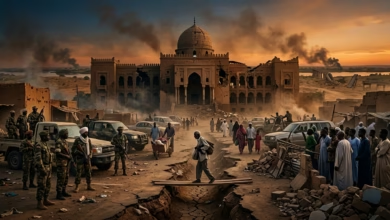
Consequently, the Germans adopted a ruthless strategic decision: a scorched-earth policy. The goal was no longer limited to defeating African fighters who bravely faced machine guns armed with faith in Maji; the objective became the destruction of the entire infrastructure supporting the rebellion. German forces launched systematic campaigns to burn villages, destroy crops, confiscate food supplies and livestock, and sever supply lines across vast areas. Iliffe describes this phase as the darkest in the colony’s history; the conflict transformed from a military war into environmental and economic devastation aimed at starving the population into submission.
The results were catastrophic by any measure. German bullets claimed thousands of lives, but the famine following the scorched-earth policy claimed tens, if not hundreds, of thousands of victims. The myth of Maji shattered under heavy gunfire, and the hopes peasants placed on spiritual intervention to save them crumbled. Yet, this human tragedy, despite its gravity, proved to be a decisive turning point in the political and social consciousness of the African peoples of Tanganyika. Survivors realized that armed resistance—whether driven by traditional bravery or religious innovation—was no longer viable against overwhelming European technological and military superiority.
This bitter realization forms the foundation of John Iliffe’s theory regarding the transition into what he termed the “Age of Improvement” or adaptation. Following the shock of the rebellion’s failure, Africans chose to change the rules of the game. Instead of direct confrontation, a quiet, clever movement began to absorb European tools of power and use them to their own advantage. They began seeking Western education, engaging in the cash economy, and striving to master colonial bureaucratic mechanisms to unravel them from within—or at least to improve their terms of survival under them.
The Berlin Political Earthquake and the Strategy of African Adaptation
This leads to the dramatic aftermath of the Great Maji Maji Rebellion’s suppression, when vast lands in southern and eastern Tanganyika were reduced to ashes and open graves by the German military’s scorched-earth policy. Yet while gunfire gradually subsided in the African savanna, leaving behind a crushing famine, a different fire blazed in the political corridors and parliamentary halls of Berlin, threatening to swallow the colonial administration entirely. In this section of his landmark book, historian John Iliffe transitions from blood-stained battlefields in East Africa to decision-making circles in the imperial capital, revealing how African resilience, despite military defeat, forced the German Empire to completely reshape its strategy in what became known as the “Dernburg Reforms.”
News from Tanganyika, as well as from South West Africa—where another brutal campaign was unfolding against the Herero and Nama peoples—was not mere routine military reporting to the German public. Horrors of military rule, stories of rampant corruption, and moral and financial scandals involving high-ranking colonial officials leaked into Berlin newspapers. This flood of scandals provided opposition parties in the Reichstag—specifically the Social Democratic Party and the Catholic Centre Party—with ammunition to launch a sweeping attack on government policies. Critics argued forcefully that militaristic colonialism was not only an immoral stain on Germany’s reputation, but also a drain on imperial resources that brought no benefit to average German citizens. This intense political crisis peaked in late 1906 when the Reichstag refused to pass a supplementary budget for colonial wars, prompting Chancellor Bernhard von Bülow to dissolve parliament and call early elections historically known as the “Hottentot Election.”
Amidst this political storm, and to save the colonial enterprise from collapse, German leadership summoned a prominent figure from outside the traditional military and bureaucratic establishment: the liberal banker and pragmatic businessman Bernhard Dernburg. Appointed Director of the Colonial Department (which later became an independent Colonial Office), Dernburg was tasked with cleaning up the chaos, restructuring the administration from its roots, and making colonies economically profitable and politically acceptable to the public. While traditional colonial historiography portrayed Dernburg as a noble moral reformer who saved Africans from military brutality, Iliffe dismantles this romantic myth with academic rigor. The book clarifies that Dernburg was driven not by humanitarian sentiment toward Africans, but by pure capitalist logic. He clearly recognized that Tanganyika’s true wealth lay not in its land, but in its population, and that continuing policies of destruction and forced labor would inevitably destroy the labor force without which the colonial economy could neither function nor flourish.
Based on this pragmatic vision, Dernburg implemented “Scientific Colonialism.” The core goal was a shift from reliance on brute force toward more rational, organized, and sustainable exploitation. Military influence was gradually curtailed and replaced by civilian administrators trained in local languages and customs to better understand native dynamics. New regulations were introduced to govern working conditions, limit arbitrary corporal punishment practiced by white settlers and minor officials, and encourage cash-crop farming by Africans rather than forcing them exclusively onto settler plantations. Dernburg sought to create an administration that preserved the lives and health of the “natives” so they could regularly pay taxes, efficiently grow export crops, and purchase German manufactured goods, thereby turning them into productive wheels in the imperial economic machine.
Here emerges the other half of the historical equation highlighted by John Iliffe: the parallel African response. As noted, the failure of the Maji Maji Rebellion marked the beginning of the “Age of Improvement” or smart adaptation. Dernburg’s “reforms,” which sought compliant laborers and farmers, met a new, quiet African desire to avoid suicidal armed conflict and exploit opportunities within the new system for personal gain. Many African leaders and communities realized that the only path to survival—and potential future advancement—was acquiring the white man’s intellectual tools. Thus, the period after 1907 saw unprecedented demand from Africans, particularly younger generations, for mission and government schools—not out of love for German culture, but as a pragmatic quest for literacy and numeracy, which served as keys to positions in lower colonial administration as clerks, teachers, railway workers, and bureaucrats.
Strategic adaptation was not confined to education; it extended into the economic sphere. In regions such as the slopes of Mount Kilimanjaro in the northeast and around Lake Victoria in the west—where Maji Maji had not reached and where soil and climate were favorable—African farmers voluntarily cultivated high-value cash crops like coffee and cotton independently of forced systems. They evolved into commercial farmers competing directly with European settlers in local and export markets. This rapid economic success presented an unexpected challenge to the German administration and created severe tension with white settlers, who viewed themselves as exclusive masters of the territory. Settlers felt threatened, believing Dernburg’s “soft” policies endangered their racial and economic privileges.
Clash of Wills: Settlers vs. Farmers and the Management of Balances
This complex dynamic shaped the “Age of Improvement.” The “Scientific Colonialism” policies engineered by Bernhard Dernburg in Berlin produced a new reality on the ground. During this delicate phase, the new German Governor of Tanganyika, Albrecht von Rechenberg, emerged as the actual architect of fragile balances within the colony. Rechenberg was an intelligent, pragmatic man fluent in Arabic and Swahili who recognized from day one that the ultimate nightmare to avoid at all costs was another rebellion like Maji Maji. To achieve this, he adopted a firm policy of avoiding provocation toward African communities and encouraging their voluntary entry into the cash economy as independent producers, viewing the African farmer as the safest, most efficient, and cost-effective engine for the German colonial economy.
However, this rational administrative vision collided directly with the ambitions of another influential group within the colony: white European settlers. Concentrated mainly in the temperate highlands of the northeast, such as the Usambara Mountains and the slopes of Kilimanjaro, these settlers held a contrasting colonial vision modeled after South Africa. To the white settler, the colony was an extension of Europe, fertile African lands were their natural right, and the African’s role was strictly to provide cheap—or free—labor for their vast estates. Settlers refused to accept African farmers competing with them in high-yield cash crop production, viewing Rechenberg and Dernburg’s protective policies as a betrayal of their racial interests.
Iliffe delves into the dynamics of this three-way struggle between a colonial administration seeking sustainable profitability, settlers hungry for absolute dominance, and Africans who astutely leveraged these divisions to consolidate their positions. Settlers formed powerful lobby groups and political associations, launching aggressive media campaigns in the local Dar es Salaam press and right-wing nationalist newspapers in Germany. They accused Governor Rechenberg of being “pro-African,” demanding mandatory labor laws to force natives off independent farms onto white plantations, and advocating for local self-government to marginallize the civilian administration.
Conversely, African communities did not remain passive spectators. As documented with precise evidence, emerging African elites demonstrated a sophisticated understanding of colonial political and economic dynamics. In the north, Chagga farmers expanded coffee cultivation with great success, accumulating wealth that enabled them to send their children to top mission schools. Around Lake Victoria, Sukuma farmers utilized new infrastructure, such as railway lines, to export cotton directly. This growing economic independence provided a shield against direct exploitation and forced labor. Additionally, a new class of African employees began taking shape within the German bureaucracy—teachers, clerks, telegraph operators, and translators. Though minor cogs in the imperial machine, they formed the nucleus of a new national consciousness that transcended narrow tribal affiliations, using education and economics as soft means for advancement.
The colony became a complex socio-political powder keg. Rechenberg attempted to keep settlers under legal restraint, while settler influence grew in Berlin alongside rising nationalist movements prior to the war. Simultaneously, the broader African population quietly built its self-reliance under a veneer of outward obedience. This fragile balance, fraught with deep structural tensions, could not endure indefinitely. As pressure mounted from Europe, settlers began scoring legislative victories that gradually eroded Rechenberg’s protective policies, and the central administration increasingly yielded to demands for racial discrimination and restrictions on African competitive rights, bringing tension back to the fore.
Emergence of the New Elite and Swahili as a Silent Weapon
By 1912, marking the end of the period focused on in the book, Rechenberg departed his post and was replaced by Heinrich Schnee. Schnee was pragmatic but showed a greater inclination to yield to the powerful settler lobby and growing conservative forces in Berlin. This administrative transition represented a retreat from the promises of “Scientific Colonialism,” as the administration reverted toward concessions for settlers on sensitive land issues and passed harsh labor regulations designed to constrain independent African farmers and push them into wage labor.
Nevertheless, as Iliffe demonstrates in his analysis, the African society the German administration confronted in 1912 was no longer the fragmented, traumatized population that emerged from the ruins of the Maji Maji Rebellion. The “Age of Improvement” had produced a new generation—one that did not wield spears or seek salvation in sacred water, but armed itself with the colonizer’s own tools. The book focuses extensively on the rise of an educated African elite—graduates of mission and government schools—who formed the backbone of the colonial bureaucracy. These teachers, clerks, telegraph operators, and local officials known as akidas possessed an intimate understanding of the German legal and administrative apparatus. Far from being mere tools of authority, they used their positions to protect local communities, advance their interests, and build subtle networks of influence. This was institutional resistance operating from within the system to adapt it to their needs.
In this transformative context, Iliffe highlights the pivotal role of the Swahili language. In their quest for efficient administration, the Germans adopted Swahili as the official language for governance and education throughout Tanganyika. Ironically, this colonial tool designed to facilitate control became the most powerful unifying weapon in African hands. For the first time in the region’s history, Swahili provided a common language and cultural vessel that bridged deep tribal and ethnic divides. A Chagga clerk in the far north could communicate, exchange ideas, and coordinate with a Ngoni teacher in the far south. Swahili laid the groundwork for an embryonic “national identity” transcending narrow affiliations, establishing the intellectual infrastructure upon which nationalist movements would build in subsequent decades.
Economically and socially, African strategies proved remarkably resilient. Despite restrictive legislation, African farmers stubbornly maintained their foothold in the cash economy as independent producers. Early forms of agricultural cooperatives emerged to bypass middlemen, while cotton and coffee farming served as a bulwark against impoverishment or reduction to wage laborers. Spiritually and culturally, Africans no longer settled for blind adherence to Western religious institutions; independent African churches and movements began emerging, blending Christian teachings with local spiritual heritage. These entities provided safe spaces for community organization and political expression beyond the strict surveillance of the colonial state.
Thus, by the end of 1912, as the period covered by Iliffe’s research drew to a close, Tanganyika had transformed into a different kind of arena. Africans had lost the direct, bloody military confrontation of Maji Maji, but they were quietly winning the struggle for survival, adaptation, and self-reconstruction. They engineered a cohesive intellectual, economic, and linguistic infrastructure that neither the German administration nor settler influence could easily dismantle. As the dark clouds of World War I gathered over Europe, casting their destructive shadow across Africa, the people of Tanganyika stood on a firm foundation of renewed consciousness.
The World War Earthquake and the Historical Triumph of African Will
In the final scene, sweeping winds of change prepared to uproot the German colonial presence entirely. While the new African elites consolidated their positions in education, economics, and administration, building an emerging national identity through the spread of Swahili, World War I erupted in Europe in 1914, quickly spreading to the colonies. Tanganyika became the theater for one of the longest and harshest military conflicts in African history, as German commander Paul von Lettow-Vorbeck waged a destructive guerrilla war against Allied forces. This war not only shattered the fragile infrastructure built during the “Age of Improvement,” but also caused a horrific human catastrophe through the forced recruitment of hundreds of thousands of African carriers, alongside widespread famine and disease.
Yet, Iliffe emphasizes that the intellectual and social infrastructure constructed by Africans during the post-Maji Maji adaptation years proved resilient against this military earthquake. Despite economic collapse and widespread destruction of villages and farms, the new consciousness forged among educated elites and independent farmers was not extinguished. Swahili communication networks endured, and aspirations for liberation burned beneath the ashes of war. Once the conflict ended with Germany’s defeat and Tanganyika’s administration was transferred to a British Mandate under the League of Nations, the British did not start from scratch. They inherited an African society experienced in navigating the European bureaucratic machine, equipped with tools for negotiation, and armed with an embryonic political consciousness that would prove decisive in the drive toward independence in subsequent decades.