

Soviet union
-
Featured Topics
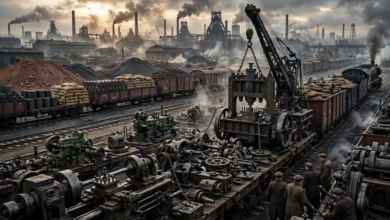
How Hitler Created His Greatest Enemy
The Book “Stalin’s Great Raid: The Rise Of The Soviet Union And The Plundering Of Germany” By The Author And Historian Bogdan Musial Is An Exceptional Historical And Investigative Document, And An Academic Reference That With Rare Courage Dismantles One Of The Most Complex, Bloodiest, Most Contradictory And Absurd Alliances In The Entire History Of The Twentieth Century, Namely The Secret And Overt Strategic, Economic And Military Alliance Between The Soviet Union And Nazi Germany. This Huge Work Does Not Merely Narrate Historical Events Within The Traditional Classic Framework We Are Accustomed To Reading In School History Books, But Rather Presents An Extremely Broad And Deep Panoramic Vision Of The Symbiotic And Lethal Relationship Between The Two Totalitarian Dictatorial Powers, Proving With Damning Archival Evidence That This Thorny And Intertwined Relationship Is What Actually And Decisively Shaped The Course, Repercussions And Results Of The Entire Second World War. The Bold Central Thesis That Musial Presents In A Smooth And Flowing Narrative Style Can Be Summarized In An Amazing And Shocking Historical Paradox For The Human And Political Conscience: That The Rise Of The Soviet Union As An Invincible Superpower After Its Crushing And Devastating Victory Over Germany In 1945 Would Never Have Been Achieved At All Without The Huge Material, Technological And Industrial Support That Germany Itself Voluntarily Provided To The Soviets, Driven By Short-Sighted Strategic Interests Before The Start Of Military Operations. While History And Peoples Often View These Two Huge Entities As Bitter Ideological Enemies, One Representing The Extreme Of Fascist Right And The Other The Extreme Of Communist Left, The Book, By Delving Into Recently Declassified Russian And German Archival Documents, Reveals That Until The Moment Of The Sudden And Stunning German Invasion At Dawn On The Twenty-Second Of June 1941, The Mighty German Industrial Machine Was The Main Supplier Of Engineering Expertise, Heavy Equipment, Precision Machines And Advanced Tools Without Which The Soviet Union, Amid The International Isolation It Was Living In, Could Not Have Built And Established The Foundations Of Its Heavy And Defense Industries. These Very Industries, Which Were Built Brick By Brick With German Machines, Presses And Lathes, Are What Enabled The Soviets Not Only To Absorb The First Horrific Shock And Withstand The Fierce Waves Of German Invasion That Swept Their Lands, But Also To Completely Turn The Tables On The Invaders, Crush Them Militarily, And Push Them To Retreat Step By Step Across The Plains Of Eastern Europe Until Raising The Red Soviet Flag Over The Ruins Of The Reichstag Building In The Heart Of The German Capital Berlin. In His Deep And Contemplative Introduction, The Author Borrows The Description Of The Writer And Historian Sebastian Haffner, Who Pointed Out With Unparalleled Brilliance That One Cannot Find In All Of Modern Human History Another Example Of Such Intimate Entanglement, Close Cooperation, And Deadly Enmity Between Two Nations As Happened Between Germany And Soviet Russia, Describing This Intertwined And Complex History As More Astonishing, Exciting And Terrifying Than Any Fictional Novel That A Dramatic Writer’s Mind Could Weave. To Demonstrate This Complex And Time-Spanning Entanglement, Musial Does Not Begin His Analysis From The Nineteen-Thirties Era As Most Historians Do, But Rather Takes The Reader’s Memory Back To The First Foundational Roots Of The Emergence Of The Soviet State Itself, Asking In A Deeply Indignant Manner Whether The Soviet Union Would Have Existed At All In The Pages Of History As A Ruling Political Entity Without The Direct Intervention And Generous Funding Provided By The German Empire. In The Spring Of 1917, Amid The Rampant Chaos And Political Unrest That Followed The Overthrow Of The February Revolution Of The Russian Tsar Nicholas II, Vladimir Ilyich Lenin, The Leader Of The Radical Bolshevik Faction, Was Living In A State Of Political Isolation And Marginalization In His Voluntary Exile In Switzerland, Cut Off From The Rapidly Accelerating Events In His Homeland. Lenin Would Not Have Been Able To Return To The Russian Scene To Overturn The Balance Of Power And Steer The Revolution Without Direct Assistance, Planning And Collusion From The Conservative German Government And The High Command Of The Imperial German Army At That Time. The Germans Provided Lenin And His Bolshevik Comrades With What Became Historically Known As The “Sealed Train,” A Safe And Secret Journey Through German, Swedish And Finnish Territories To The Finland Station In Petrograd, In Addition To Providing Very Huge Financial Funding Estimated At Millions Of Gold Marks, With A Purely Strategic And Military Goal Of Exploiting Lenin’s Inciting Skills To Destabilize Imperial Russia From Within, Destroy The Morale Of Its Army, And Ultimately Push It To A Humiliating Withdrawal From The First World War, Which Would Allow Germany To Close The Eastern Front And Mobilize All Its Forces To Crush The Allies On The Western Front. Haffner Describes The Decision To Send Lenin To Russia As Being Like Throwing “The Political Nuclear Bomb Of The First World War,” A Pragmatic And Tactical Alliance With The Devil On Both Sides That Eventually Led To The Outbreak Of The Bloody October Revolution And The Establishment Of The First Totalitarian Communist State In The World On The Ruins Of The Russian Empire. Without This Initial And Decisive German Assistance, Financially And Logistically, Lenin Might Have Remained Just An Obscure Political Theorist Living On The Margins Of The World’s Great Events, And The Geopolitical Map Of The Twentieth Century Might Not Have Been Formed In The Way We Know It Today. Musial Then Moves On To Discuss The Historical Doctrine, Political Justifications, And Ideological Restrictions That Surrounded That Pivotal Era, Pointing Out That Soviet History, Especially The Precise And Hidden Details Of German-Soviet Relations During The Interwar Period, Is Still Considered A Very Sensitive Subject Surrounded By Many Taboos That Are Forbidden To Approach, Especially In Contemporary Russia Which Has, With Governmental Support, Revived The Myth Of The “Great Patriotic War” As A Central, Essential And Sacred Element In Its Modern National Narrative, Deliberately Ignoring The Opportunistic Alliances That Preceded The Outbreak Of That War. Musial Sadly Explains How Many Historians And Academics In The Western Camp Have For A Long Time Repeated, In A Sometimes Unconscious And Naive Way, The Old Stalinist Propaganda That Tried Hard To Justify The Notorious Non-Aggression Pact, Known As The “Hitler-Stalin Pact” Or “Molotov-Ribbentrop Pact” Signed In Late August 1939, And To Market This Shameful Alliance To The World And Observers As A Purely Defensive And Compulsory Measure Imposed By Harsh Circumstances And The Inaction Of Western Democracies. This Misleading And Clever Defensive Narrative Was Founded And Its First Building Blocks Were Laid By Joseph Stalin Himself In February And March 1948 When He Wrote And Edited Large Parts By Hand Of A Famous Propaganda Booklet Published Widely Under The Title “Falsifiers Of History,” In A Desperate And Preemptive Attempt To Respond To The Leak By The United States Department Of State And The World’s Discovery Of The Secret Protocol Attached To The Pact, Which Explicitly Provided For The Division Of Eastern Europe And The Baltic States Into Spheres Of Influence Between Nazism And Communism. Stalin Claimed In That Justifying Booklet That The Soviet Union Was Forced Under Threat To Accept The Non-Aggression Agreement In Order To Gain Precious Time, Postpone The Inevitable Clash, And Prepare Its Forces And Modernize Its Industry To Confront A German Aggression That He Saw As Inevitably Coming. This Historical Claim Is Completely And Decisively Refuted By Musial, Based On Recently Declassified Russian Archival Documents And Minutes Of Politburo Meetings, Which Clearly Reveal That Stalin Was Not A Victim Seeking A Way To Survive, But Rather Was The Main Actor And Hidden Driver Who Deliberately And With All Strength And Cunning Sought To Ignite A Destructive And Comprehensive War Between The “Capitalist” And “Imperialist” Countries In Western Europe. Stalin’s Supreme Strategic Goal, Which He Expressed In Several Closed Speeches Before Party Leaders, Was To Push Germany On One Side, And France And Britain On The Other, To Exhaust Each Other In A Bloody And Long-Term Trench War Similar To The Slaughterhouses Of The First World War, So That The Soviet Union Lurking Safely Behind Borders Could Quietly Expand Geographically And Build Its Great Military And Economic Power, While All Its Ideological Enemies Bled To Death, Paving The Way, Without Realizing It, For The March Of The World Proletarian Revolution On The Bayonets Of The Red Army Toward The Exhausted Capitals Of Europe. On The Nineteenth Of August 1939, That Is, A Few Days Before The Staggering Announcement Of The Non-Aggression Treaty That Shocked European Capitals And Stunned The World Communist Movement, Germany And The Soviet Union Signed An Extremely Important And Dangerous Commercial And Credit Treaty, In Response To A Persistent And Urgent Request From The Soviet Capital Moscow Which Was Eager To Obtain Advanced German Technology. Under This Unprecedented Credit And Commercial Agreement In Its Size And Scope, The Government Of The German Third Reich Granted The Soviet Union A Huge Commercial Credit Worth 200 Million German Marks At A Low And Attractive Financial Interest Rate Of 4.5 Percent, And Berlin At The Same Time, Through Secret And Overt Protocols, Pledged To Export Additional Industrial Goods And Advanced Machines Worth 180 Million German Marks, On Condition That The Value Of These Advanced Equipment Would Later Be Paid Through The Soviets Delivering Strategic Raw And Agricultural Materials That Germany Severely Lacked And Suffered From A Chronic Shortage Of. Interestingly And Paradoxically, The Soviet Negotiating Side Was Given Complete And Absolute Freedom By The German Leadership To Choose The Major German Companies It Wished To Deal With And Buy Their Sensitive Products And Technologies, Where Modern German Industrial Machines And Giant Presses And Lathes Topped The Soviet Purchase List, Accounting For The Lion’s Share Of 44 Percent Of Total Purchases, With A Financial Value Of 167 Million German Marks, In Addition To Various Military Goods And Samples Of Modern Weapons Worth More Than 58 Million German Marks. This Close Economic Alliance, And The Comprehensive Securing Of The Eastern Front Provided By The Political Pact, Is What Gave Adolf Hitler Full Confidence And A Sense Of Security To Attack Hapless Poland At Dawn On The First Of September 1939, Igniting The First Spark Of The Second World War. And When Britain And France Abandoned The Policy Of Appeasement And Intervened And Declared War On Germany In Fulfillment Of Their Military And Moral Obligations Towards Poland, It Seemed As If Stalin’s Desired Dream Of An Imperialist War Exhausting The Great Powers Had Finally Become A Reality And A Bloody Drama Unfolding Before Him, While The Soviet Leaders Sat Quietly And Comfortably In The Corridors Of The Kremlin On The Sidelines Watching The Situation, Before The Invading Red Army Forces Later Intervened To Stab Poland In The Back To Invade And Divide Its Lands With Their New German Allies In Late September Of The Same Year, Meeting On The Bug River To Exchange Congratulations Over The Joint Victory On The Ruins Of The Polish State. Among The Most Prominent Strategic And Economic Axes That The Book Dismantles And Details With Sober…
Read More »