

Between the covers of the book “The Power and the Glory: The History of the World Cup,” the distinguished journalist and sports historian Jonathan Wilson does not offer merely a chronological account of goals and results, but weaves a complex literary and historical epic that makes football a mirror reflecting the transformations of the twentieth century and beyond. In this massive work, Wilson proves once again that he is not merely a sports critic, but a sociologist wearing the hat of a tactical analyst, as he dives into the depths of the planet’s most popular tournament to decode the ciphers of political power, nationalist ambitions, and technical evolution that transformed the game from a mere pastime for enthusiasts in Uruguay in 1930 into a global industry that dominates minds and money in 2022 and beyond.
The journey in this book begins from that foundational moment when the idea was born in the mind of Jules Rimet, where Wilson skillfully reviews how the tournament in its infancy was a struggle between identity and isolation. The first edition in Uruguay was not merely a sporting gathering, but was a declaration of the dawn of a new era for a young nation wanting to assert itself on the international map. Wilson recounts the details of the long sea voyages undertaken by the European national teams, as if they were exploratory expeditions to an unknown world, explaining how technical differences began to appear from the very first moment between Latin American football based on individual skill and European football which was still feeling its way toward organization. This narrative flow places the reader at the heart of the suffering and wonder that accompanied those beginnings, touching on the logistical difficulties that nearly smothered the dream in its cradle.
And with the helm passing to Europe in the 1930s, the tone of Wilson’s narrative changes to become darker and more connected to the bitter political reality. The writer analyzes how the second and third editions of the World Cup were turned into propaganda tools in the hands of totalitarian regimes, specifically in Mussolini’s Italy. Here, Wilson does not talk about goals alone, but describes how stadiums became arenas for displaying fascist power, and how referees and players were subjected to enormous pressures that went beyond the bounds of sport. The author here highlights his superb ability to link Vittorio Pozzo’s strict tactics with the political climate that sanctified obedience and order, considering that Italy’s winning of two consecutive titles was not a purely football victory, but was a victory for a system that wanted to prove its racial and political superiority through the round ball.
Wilson then takes us to the post-World War II period, which he describes as the phase of “rediscovery.” In the 1950 edition in Brazil, the author lingers long on the tragedy of the “Maracanazo,” but he does not content himself with describing Brazilian tears; rather he delves into the deep psychological impact that Uruguay’s victory left on Brazil’s national identity. Wilson sees that defeat as the spark that pushed Brazilians to reinvent football, shifting from gifted randomness to the organization that later led to the emergence of Pelé’s generation. In this context, the book highlights how tactics began to evolve in Hungary with the “Dream Team” in 1954, where Wilson deeply analyzes how the Hungarians changed the concept of the traditional striker, and how their defeat in the final against West Germany in the “Miracle of Bern” was a political and economic turning point for wounded Germany, considering that match to have been the true birth of the new German republic.
Wilson continues his narrative flow, moving to the era of the sixties, where the game witnessed a struggle between aesthetics and toughness. He highlights Brazil’s victories in 1958 and 1962 as the peak of inspired individualism, but he warns that this success concealed behind it the signs of a shift toward physical power and roughness that appeared clearly in the 1966 edition in England. In this chapter, Wilson intelligently criticizes how England exploited home advantage and refereeing, but at the same time he does justice to the tactical evolution introduced by Alf Ramsey with the “wingless wonders” style. The book here turns into a study of how the defensive style evolved, and how the world began to move away from football romanticism in favor of a realism that guarantees results, which paves the way for talking about the coming revolution in the seventies.
With our arrival at the decade of the seventies, Jonathan Wilson in his book “The Power and the Glory” moves to a phase he describes as the “philosophical explosion” in the world of football. The tournament was no longer merely a competition for the cup, but turned into an ideological struggle between contradictory schools of thought. Wilson opens this chapter by talking about the Mexico 1970 edition, describing it as “the last anthem of football romanticism.” Here, the author analyzes how the Brazilian national team, led by Pelé, Tostão, and Rivellino, was able to deliver a symphony that seemed as if it were outside the bounds of time, exploiting the high heat and altitude to impose a calm yet deadly rhythm. But Wilson, with his discerning eye, sees in this success the end of the era of simple innate talent, paving the way for the emergence of the complex tactical machine.
The writer then delves into the revolution of “Total Football” led by the Dutch national team in the 1974 edition in West Germany. In this part of the narrative, Wilson’s brilliance in tactical analysis becomes evident; he does not speak of Rinus Michels or Johan Cruyff merely as coach and player, but as architectural engineers who redefined the concept of space and time on the green grass. Wilson explains how the Netherlands did not just lose the final to Germany, but lost to the “hard realism” embodied by Franz Beckenbauer. The book here highlights an astonishing historical paradox: how can a team change the history of the game without lifting the cup? Wilson sees the 1974 edition as the moment when the world realized that collective intelligence and high pressing are the language of the future, which paved the way for deeper transformations in the structure of the game.
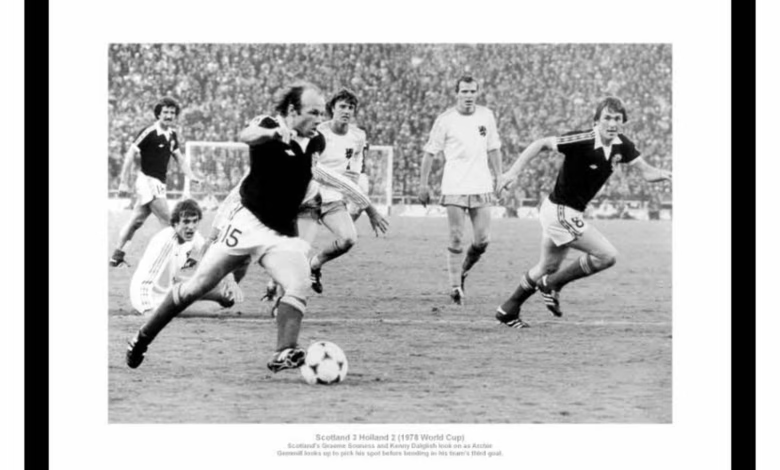
But glory in Wilson’s book does not always come pure, for in his review of the Argentina 1978 edition, he plunges us into the mire of dirty politics. Wilson links the screams of the crowds in the “Monumental” stadium with the muffled screams in the torture centers belonging to the military junta then in power. The author analyzes how Videla’s regime used the tournament as a front to whitewash its international reputation, and how the Peruvian national team was subjected to suspicious pressures in its famous match against Argentina. This chapter of the book represents the peak of dramatic narrative, where Wilson clarifies that “power” in his book’s title does not refer only to muscular strength or tactics, but to the power of authority that tries to hijack the dreams of peoples. Nevertheless, he does not neglect the technical side, describing how César Luis Menotti was able to build a team combining violent Argentine identity with the aesthetic he sought, in an internal conflict reflecting the nation’s own division.
And with the transition to the eighties, specifically the Spain 1982 edition, Wilson raises a major ethical and technical issue represented by the “death of beauty.” The author devotes ample space to talking about the Brazilian national team in that edition, led by Zico and Sócrates, considering them “the greatest team never to win the World Cup.” Wilson bitterly analyzes how this romantic school fell before the realism of Enzo Bearzot’s Italy and the efficiency of Paolo Rossi. The author sees that match between Brazil and Italy as a historic crossroads; had Brazil won, the world would have continued to believe in attacking football outright, but Italy’s victory sent a message that organized defense and quick transition are the surest path to glory, which affected the shape of football for decades to come.
Then comes the chapter devoted to the Mexico 1986 edition, a chapter dominated by the specter of one man: Diego Armando Maradona. Here, Wilson slightly abandons his tactical sternness to paint a portrait of a legend who turned the tournament into an unprecedented individual show. Wilson does not content himself with describing the “Goal of the Century” or the “Hand of God,” but places Maradona in his socio-political context as a national hero who avenged Argentina against England after the Falklands War. The author explains how coach Carlos Bilardo built an entire team whose sole function was to “liberate” Maradona, clarifying that Argentina’s success in 1986 was the last victory for the idea of the “inspired star” before strict collective systems completely overwhelmed the game in the nineties.
At the end of this era, Wilson stops at the Italy 1990 edition, which he describes as “the tournament that nearly killed football.” The author recounts in a caustic critical style how goal rates declined and roughness and boring defensive tactics prevailed, which pushed FIFA to later change the laws (such as forbidding the goalkeeper from handling a back-pass from a teammate). Wilson sees Germany’s winning of the title as a crowning of physical fitness and cold organization, but it was also an alarm bell that the game needed a legislative and technical revolution to save its appeal. This flow of analysis shows how the World Cup is not merely matches, but is a living organism that breathes and is affected by what surrounds it, and evolves in response to crises.
And with the dawn of the nineties, Jonathan Wilson in his book “The Power and the Glory” begins to monitor a fundamental shift not only on the pitch, but in the power balances that govern behind the scenes. The narrative moves toward the United States 1994 edition, which the author sees as the true starting point of the era of “football globalization” and hyper-professionalism. Wilson intelligently analyzes how FIFA tried to conquer the American market, and how that was reflected in the atmosphere of the tournament played in giant stadiums under scorching sun. But the most important thing in Wilson’s technical analysis is his observation of the transformation of the Brazilian national team; the Brazil that won the title in 1994 did not resemble Pelé’s Brazil or even Zico’s Brazil, but was a quintessentially “European” version under Carlos Alberto Parreira, relying on defensive discipline and a lethal attacking duo (Romário and Bebeto). Wilson sees this victory as tantamount to an official declaration of the end of the era of unconditional “beautiful play,” and the beginning of the era of “technical realism” that balances talent and strictness.
Nor does Wilson neglect in this part the tragic side that always accompanies football, as he stops at the story of the murder of Colombian player Andrés Escobar after scoring an own goal. The author recounts this incident not as a passing criminal event, but as evidence of the dangerous overlap between the sway of drug cartels and betting and the game in Latin America, explaining how “glory” can in a moment turn into a bloody national tragedy. This contrast between the clamor of celebrations in American stadiums and the dark shadows that hung over Colombia gives Wilson’s book a human depth that goes beyond mere match analysis.
And with the tournament moving to France in 1998, Wilson weaves narrative threads combining sociology and sports politics. The author describes France’s winning of the title as not merely a sporting achievement for Zinedine Zidane’s generation, but as a “project for national identity.” Wilson analyzes how France used the slogan “Black, White, and Arab” (Black, Blanc, Beur) to promote a model of social integration through the national team. Nevertheless, with his customary critical tone, Wilson wonders whether this success was real or whether it was a cosmetic veneer over deeper social problems. Technically, the book highlights in this edition how midfields became the true “operating rooms,” and how the role of the number 10 player evolved to suit increased speed and physical pressure, considering that Zidane was perhaps the upgraded and last version of the classic playmaker who possesses the ability to decide fate with a single touch.
And in the context of grand drama, Wilson devotes space to analyzing the “Ronaldo mystery” in the 1998 final. In a journalistic style combining investigation and suspense, the author addresses the mysterious collapse of the Brazilian star hours before the final match, linking it to the pressures of sponsoring corporations (Nike) and the enormous psychological burden placed on stars in the era of global satellite broadcasting. Wilson sees that moment as heralding our entry into the era of the “player as brand,” where a star’s health and decisions become property of sponsors and millions around the world, adding a new layer of “power” influencing World Cup results.
And with the dawn of the new millennium, specifically in the Korea and Japan 2002 edition, Wilson analyzes the first departure of the tournament from its traditional strongholds (Europe and South America). The author describes this edition as “the tournament of surprises and refereeing injustice,” where he boldly recounts how the hosts (especially South Korea) benefited from refereeing decisions that sparked widespread controversy and knocked out major teams like Italy and Spain. But on the other hand, he praises Brazil’s heroic path, considering its winning of the fifth title as a kind of “restoration of honor” for innate talent led by the trio (Ronaldo, Rivaldo, and Ronaldinho). Wilson here focuses on the struggle story of Ronaldo “the Phenomenon” and his return from devastating injuries, describing it as one of the greatest stories of willpower in the tournament’s history, and appreciating coach Scolari’s ability to blend Brazilian “fighting spirit” with modern tactical organization.
Wilson then moves to the Germany 2006 edition, which he describes as “the return to strict European traditions.” The author analyzes how the tournament in Germany turned into a popular festival that re-presented Germany’s image to the world as an open and hospitable country. But on the pitch level, Wilson sees that this edition witnessed the peak of organized defensive tactics, describing Italy’s winning of the title as a “victory of the system over the individual.” The author lingers long on the incident of “Zidane’s headbutt” in the final match, analyzing it not as a reckless act, but as a Greek tragic ending to the career of a great player who could not bear the burden of glory in its final moments. Wilson sees that headbutt as a symbol of the changing of generations and the fall of legends before the cruelty of the moment and pressures.
And with our entry into the 2010s, Wilson devotes an important chapter to the South Africa edition, the first time the tournament set down in the African continent. The author analyzes the gap between African ambition and organizational reality, but he focuses tactically on the dominance of Spanish “tiki-taka.” Wilson sees Spain’s winning of the 2010 title as the peak of the philosophical evolution begun by Cruyff at Barcelona, where football turned into a game based on absolute possession and depriving the opponent of the ball. Wilson describes this style as a “soft dictatorship” imposed by the Spanish national team on the world, showing how the rest of the national teams were forced to change their defensive methods to face this hurricane of short passes.
And in the more recent editions, such as Brazil 2014 and Russia 2018, Wilson watches with bitterness at times and with admiration at others how technology and Big Data have become an integral part of the game. He analyzes Brazil’s humiliating collapse (7-1) against Germany in 2014 as evidence of the superiority of German “structural planning” that lasted for years versus Brazilian “emotional randomness.” Wilson concludes in this part of the narrative by affirming that the World Cup is no longer merely a tournament, but has become a struggle between technological and economic systems, where glory is made in laboratories and data analysis centers as much as it is made in players’ feet.
Jonathan Wilson’s epic in his book “The Power and the Glory” reaches its dramatic and analytical peak as he approaches the modern era, specifically at that pivotal moment when the tournament moved to the heart of the Middle East in the Qatar 2022 edition. Here, Wilson does not treat the event merely as a football tournament, but sees it as the “ultimate laboratory” for all the ideas he raised in his previous chapters. The author analyzes in an engaging narrative style how the ambitions of the host state intertwined with FIFA’s geopolitical agendas, considering that this edition was the clearest embodiment of his book’s title; the “power” imposed by money and politics, and the “glory” chased by players on the green grass despite all the controversy surrounding the stadiums.
Wilson paints a complex picture of tactical transformations in the last decade, explaining that the dominance of absolute possession that characterized Spain’s era began to erode in favor of what he calls the “era of lightning transitions.” The author explains how the most successful national teams became those that master the art of playing without the ball, citing the rise of new powers and teams that managed to break traditional hegemony through defensive discipline and amazing speed on counterattacks. In this context, Wilson lingers long on the experience of the Moroccan national team in the 2022 World Cup, describing it as not merely an African and Arab “leap,” but as the crowning of a deep tactical understanding to bridge the technical gap between North and South by closing spaces and tightening the noose on giants.
But the beating heart of this part of the book centers on one figure who encapsulated the struggle of generations and humanity’s search for perfection: Lionel Messi. With novelistic skill, Wilson describes Messi’s journey in Qatar as a “last dance” against time and pressures and the heavy history of Maradona. The author analyzes how Messi transformed from a superhuman player relying on speed and skill in his youth, into an “orchestra conductor” who walks more than he runs, but who sees on the pitch what others do not. Wilson sees Argentina’s winning of the title in that “iconic” final against France as not merely a sporting victory, but as closing the arc opened by Maradona in 1986, and proof of the idea that glory in the World Cup needs a moment of absolute individual brilliance amid a forest of tactical complexities.
And in his reading of the 2022 final, Wilson describes it as “the greatest advertisement for football in its history,” where everything that makes this game enchanting and terrifying at the same time came together. He analyzes the struggle between Messi, who represents wisdom and experience and the end of an era, and Kylian Mbappé, who represents explosive power and the future knocking violently on the door. The author sees that this match summarized the entire history of the tournament in 120 minutes; from psychological swings to physical collapses, all the way to the penalty shootout which Wilson describes as the “savage lottery” that determines who enters history and who remains on its margins.
And as the book approaches its conclusion, Wilson raises fundamental questions about the future of the tournament in light of the anticipated expansion in the number of teams and the multiplicity of host countries. The author expresses his fears that the “inflation” in the number of matches will dilute the value of “glory,” which used to require a path that was both arduous and concise at the same time. He warns that the World Cup could turn from a “rare celebration” into a “continuous consumer product,” which could cause it to lose that sacred aura that made millions weep behind their national teams since the 1930s. Wilson sees that the coming challenge is not in organizing tournaments, but in preserving the spirit of the game amid waves of sports commodification and artificial intelligence that has begun to infiltrate coaches’ decisions.
In the final analysis, the reader emerges from “The Power and the Glory” realizing that the World Cup is not merely passing entertainment, but is a historical record of humanity. Jonathan Wilson has succeeded in presenting an “encyclopedic” work with a vibrant journalistic spirit, where he made match results mere small details in a larger canvas that includes wars, revolutions, economic crises, and cultural transformations. This book is an invitation to reflect on how a piece of leather chased by 22 players can unite peoples and divide others, and how the search for “glory” remains the fundamental driver that pushes humans to transcend their physical and mental limits.
Wilson concludes his journey by affirming that football will remain the “only universal language” that needs no translation, and that the World Cup will remain the greatest stage on which our tragedies and victories as humans are displayed. “The Power and the Glory” is not merely a book about sport, but is a document about “the beauty that is born from the womb of suffering,” and about that magical moment when the captain lifts the golden cup high, announcing not only his team’s victory, but the triumph of dream over bitter reality. With this work, Wilson proves once again that he is the foremost historian of the game, capable of turning dry numbers into inspiring stories that live in the memory of generations.
