
Football vs. the Enemy: When the beautiful game sheds its mask of innocence to reveal the harsh face of politics

For a long time, we have been told, naively or intentionally, that football is just a game. Just twenty-two players chasing a leather ball on green grass, governed by a referee’s whistle and ninety minutes of honorable sports competition. But what if someone told you that this ball is a tool for building nations, a weapon to topple dictatorships, a spark to ignite wars, and a mirror reflecting the deepest ethnic and political divisions in human societies?
Here, in this complex space where ideology intersects with passion, stands the book “Football Against the Enemy” by British journalist and author Simon Kuper, as one of the most important works written in the history of both sports and political journalism. This is not just a book about tactics, goal statistics, or the golden biographies of stars; rather, it is a profound anthropological journey into the human soul, and into how the masses and regimes employ this sport to shape their identities and settle their scores.
The Journey Begins: A Backpack, a Shoestring Budget, and a History-Changing Question
In the early nineties, specifically in 1992, the world was going through a difficult transition. The Berlin Wall had just fallen, the Soviet Union had disintegrated into scattered republics searching for their identity, regimes in South America were trying to recover from years of military repression, while Africa was feeling its way toward fragile democratic transitions. At this turbulent time, a 22-year-old, freshly graduated from Oxford University, decided to pack his backpack with a budget not exceeding five thousand pounds sterling to travel across 22 countries around the world. His goal? To prove a theory that seems crazy at first glance: “Football is not on the margins of society; it is at its core.”
Simon Kuper was not looking for beautiful goals; he was looking for the “enemy.” In every city he visited, from Buenos Aires to Moscow, and from Cameroon to Scotland, there was an “enemy” against whom wars were fought in the stadiums. The book, published in 1994 and winner of the William Hill Sports Book of the Year award, established an entirely new style of writing. Kuper was a pioneer in what we might call “geopolitical sports journalism.” He broke the illusory golden rule constantly repeated by conservative football commentators: “Politics must be kept out of sports.” Kuper proved, conclusively, that politics and sports are conjoined twins, and that attempting to separate them is nothing but a fatal surgical operation on the soul of the game.
Stadium Diplomacy: When the National Team is the “State”
Kuper sets out in his book from a fundamental premise: football is the clearest expression of modern nationalism. In the absence of all-out traditional wars between major powers, international football matches have become “war by other means,” borrowing and modifying the famous quote by military theorist Carl von Clausewitz.
Ambassadors Extraordinary: Kuper highlights how newly independent nations, or those seeking international legitimacy, use their national teams as diplomatic tools. Winning a football match is not just a sporting victory; it is a declaration of existence on the global map.
Historical Vengeance: When a team representing a small or marginalized country plays against a former colonial power, every pass and every defensive tackle is loaded with a historical vendetta that cannot be erased by peace treaties.
Kuper’s journalistic style in narrating these facts blends live interviews in local cafes, meetings with politicians and generals, and descriptions of matches from dilapidated stands. This creates a narrative tapestry that makes you feel as if you are sitting with him in a bar in Eastern Europe, listening to an old fan explain how his local team’s victory is a triumph for the working class against the ruling elite.
Kuper’s Lens: No Innocence in the Stands
What distinguishes “Football Against the Enemy” is its categorical rejection of false romanticism. Kuper clearly sees how the masses are exploited:
The Opiate of the Masses: Totalitarian regimes find in football an excellent distraction from economic crises and a lack of freedoms.
The Voice of the Opposition: At the same time, the opposition finds in the stands the only space where thousands can gather to chant against the authority under the guise of cheering for the team.
This tug-of-war makes the stadium the most important political arena in many countries.
The Soviet Machine and the Resistance
The central idea in the Soviet Union and its satellites was both simple and terrifying: everything must serve the state. Because football is the primary popular passion, intelligence and military apparatuses had to control it. Kuper takes us through the corridors of the “Dynamo” clubs scattered from Moscow to East Berlin, Kyiv, and Bucharest. “Dynamo” was not just a sports name; it was a brand belonging to the Ministry of Internal Affairs and the secret police (KGB in the USSR, Stasi in East Germany). Kuper recounts how Erich Mielke, the head of the terrifying Stasi, was obsessed with Dynamo Berlin, directly interfering with referees and intimidating players to ensure his team won—not out of love for the sport, but to prove the superiority of his security apparatus.
In Ukraine, Kuper dwells on Dynamo Kyiv and legendary coach Valeriy Lobanovskyi, who treated football as a complex mathematical equation. Players became “cogs” in a massive industrial machine reflecting Soviet ambitions for scientific supremacy. While their victories over Western clubs were used as blatant propaganda for the “New Soviet Man,” the players lived in paramilitary camps, making football a golden prison.
In contrast, Kuper examines Spartak Moscow, the “People’s Team.” Supporting Spartak became a kind of silent, passive resistance against the security state. In their stands, Soviet citizens felt a fleeting sense of freedom. This silent struggle between Dynamo and Spartak was an embodiment of the conflict between oppression and the desire for liberation.
The Balkan Tragedy
Kuper then moves to the former Yugoslavia, in chapters written while civil war fires were consuming the Balkans. He documented with stunning accuracy how football stands turned into recruiting centers for ethnic militias. He tells the story of “Arkan,” the leader of the fanatical ultras of Red Star Belgrade, who turned the club’s supporters into a military unit that committed atrocities. Here, the “enemy” ceased to be symbolic; he became a real person killed in the streets based on shirt color or ethnic identity.
Kuper’s genius here lies in linking the fall of regimes with the collapse of their sports systems. Once the Berlin Wall fell and the Soviet Union disintegrated, those sporting fortresses crumbled, ushering in a new era of chaos, privatization, and a search for identity.
Africa and Latin America: The Illusion of Sovereignty and Smoke Screens
Cameroon (The Illusion of Sovereignty): Focusing on the 1990 World Cup, Kuper dives behind the scenes of Roger Milla’s famous dance to paint a picture of President Paul Biya, who realized his survival was tied to his players’ feet. Amidst a lack of infrastructure, the national team was the “only successful institution” in the state. Winning granted the people an illusion of sovereignty and silenced the opposition, acting as a crisis management tool where players became diplomats beautifying a dilapidated regime.
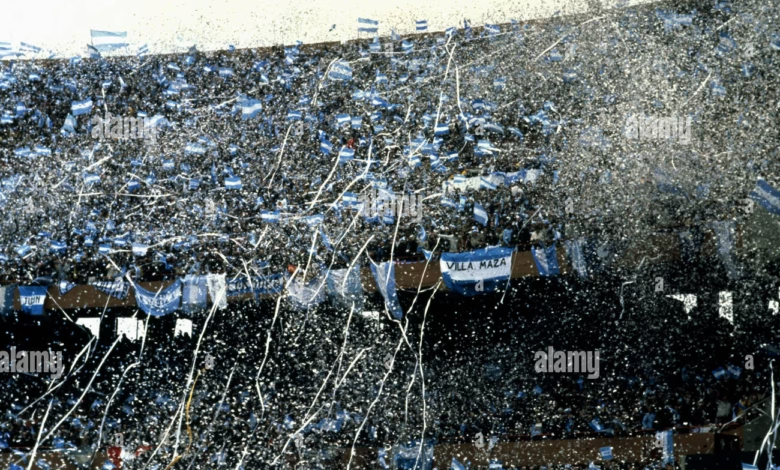
Argentina (The Smoke Screen): At the 1978 World Cup, the military junta used the tournament to launder its international reputation and cover up “forced disappearances.” For Kuper, Argentina’s title win was an absolute tragedy: people cheered in the stands while, meters away, secret prisons tortured dissidents. He poses the profound moral question: Was the team playing for the people or the generals?
Brazil (Anatomy of the Epic): Kuper shatters the Western stereotype of Brazilian football as innate “Samba.” He explains it is the product of bitter racial and social struggles. Originally a monopoly of aristocratic whites, black players fought hard for entry. The Brazilian playing style, reliant on individual skill, mirrors the national personality that relies on “dribbling” to circumvent life’s hardships and escape poverty.
Kuper notes a unique geopolitical phenomenon here: football is the only arena where the “Global South” has a real chance to defeat and humiliate the “Global North.” A victory over a European power is the reclamation of lost dignity and the settling of historical scores.
Europe: The Stadiums as Alternative Parliaments
Spain (Real Madrid vs. Barcelona): Kuper deconstructs “El Clásico” as a living embodiment of the Spanish Civil War. FC Barcelona was the “symbolic army” of Catalonia; during dictator Franco’s rule, the Camp Nou was the only safe haven where people could speak banned Catalan and chant against Madrid’s centralization. Real Madrid, conversely, became the “enemy” representing state oppression.
The Netherlands (Total Football): This wasn’t just a tactic, but a philosophy reflecting the Dutch mentality of managing limited space. Johan Cruyff was a philosopher who redefined space and time. However, Kuper highlights the dark side: the Dutch complex towards the Germans, where matches became a means of venting inherited WWII anger, proving the historical “enemy” remains even in tolerant societies.
England (The Privatization of Passion): Observing the 1990s shift from working-class hooliganism to a corporate “investment product,” Kuper shows how massive TV rights expelled traditional poor fans for new “consumers.” The “enemy” here took a new form: Capitalism, threatening to crush the sport’s popular soul.
Kuper convinces the reader that Western European football is a “mirror of society.” If you want to know a society’s tolerance toward immigrants, look at its stands. He ends his European tour with a bitter conclusion: European stadiums act as alternative parliaments where issues of identity, racism, and extreme nationalism are discussed loudly under the guise of sports.
The Evolution of the “Enemy”: From Trenches to Banks
In 1994, Kuper’s “enemy” was clearly defined: the oppressing dictator, the neighboring state stoking ethnic tensions, or the security apparatus controlling clubs. But decades later, analysts ask: Who is the “enemy” in contemporary football?
Many believe Kuper’s vision anticipated the shift from a direct political entity to a globalized economic one. Today, massive funds, sovereign wealth funds, and transnational corporations draw the boundaries of stadiums. The new “enemy” might be the “commodification” of the game and the loss of its popular soul. Nevertheless, the core of Kuper’s thesis remains constant: football will always be an arena of conflict—whether over identity, money, or global influence.