


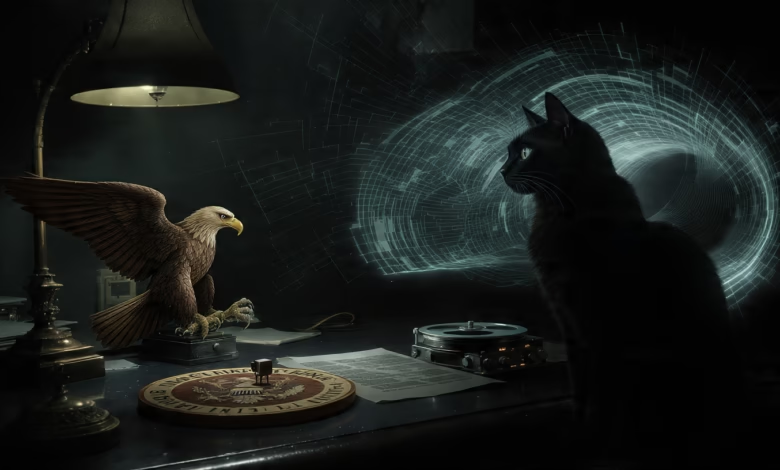
Closing The Eyes Is Enough To Stop Seeing, But Stopping Hearing Is Not That Easy At All. Even If We Block Our Ears With Our Fingers, We Will Still Be Able To Hear The Internal Operations Of Our Nervous Systems, Alongside The Contractions Of The Tensor Tympani Muscle, Which Is The Mechanism That Dampens Vibrations And Prevents Them From Reaching The Inner Ear. We Do Not Possess The Ability To Direct Our Hearing Or Focus It In The Same Way That We Train Our Eyes. This Means That We Do Not Only Hear The Sounds Directed At Us, But We Also Perceive Frequency-Based Content That Is Directed At Others, Which Makes Us Eavesdrop By Accident Often, But We May Also Eavesdrop Intentionally And By Design. When This Happens, We Are In A State Of ‘Secret Listening’.
This Book Starts From The Post-
World War II Period To Explore What Happens When The Act Of Listening Turns Into A Tool For Surveillance, And How It Is Later Enhanced, Manufactured, And Weaponized By Corporations And Military Organizations And Governments. During World War II, Secret Surveillance Operations Were Carried Out By Axis And Allied Forces To Gather Intelligence That Would Ultimately Lead To Achieving Territorial Advantages On The Ground. Today, In Addition To Deploying Surveillance For Ideological And Military Purposes, It Is Used In Schemes That Are More Politically Ambiguous, Such As Advanced Web User Analytics And Monetization Of Personal Data. The Information That Is Captured From Our Digital Interactions Is Traded And Sold To Feed Machine Learning Algorithms. In Turn, These Algorithms, Based On That Data, Model Everything And Predict It, Starting From Economic Trends And Weather Patterns, All The Way To Healthcare Logistics And Even The Longevity Of Human Relationships.
The Book Reviews Past And Present Methods Of Acoustic Surveillance, And Reflects On How Future Artificial Intelligence Frameworks Are Being Guided By Sonic Strategies Born In The Early Cold War Period. When We Look Collectively At The Surveillance Strategies And Technologies And Approaches That The Book Analyzes, We Find That They Speak To An Idea That The Obsessive Desire To Record And Listen To Everything That Has Ever Been Uttered Is Deeply Engraved In The Technological Operating System Of Western Culture. This Logic Leads To The Normalization Of Acoustic Surveillance Even Before Birth, Through Ultrasound Recordings And Images That Are Posted On Social Media, And Beyond.
There Has Always Been A Desire To Capture And Store And Redistribute Sonic Data Sets That Represent The Spectrum Of Human Emotions And Experiences, Starting From Thomas Edison’s Desire To Record The Important Speeches Of Men And Gods Across The Ages, To Charles Babbage’s Similar Conviction That The Air Itself Is A Vast Library Upon Whose Pages Is Written Forever Everything That A Man Has Said Or A Woman Has Whispered. This Concept That The Ether Is A Universal Utopian Sonic Space Is An Early Precursor To The Concept Of ‘The Cloud’ And The Remote Data Farms That It Conceals. Through These Meteorological Analogies, A Space Opens Up In The Cultural Consciousness For Limitless Storage Capacity.
The Enormous Density Of Vibrational Information Being Collected Has Led Thinkers Like Hito Steyerl To Conclude That When Reviewing Massive Data Sets, Not Seeing Anything Comprehensible Is The New Normal. No Longer Is Merely Capturing And Storing Data The Challenge, But The Focus Has Shifted From Acquisition To Discrimination. In Light Of This Lack Of Human Understanding, Automated Systems Such As Packet Inspection Devices Listen To Search For Signals Amidst The Incoming Noise. Machine Learning Tools And The Artificial Intelligence Systems That Support Them Have Become The New Sensory Channels; They Are The Total Listener That Operates Millions Of Listening Points And Opens New Experimental Ways To Confront And Hear Patterns Of Correlation.
The Book Is Divided Into Four Parts, Each Containing Four Chapters Covering Successive Time Periods. Part One Focuses On ‘Embedded Bugs And Tunnels’ (1945-1960s) While Part Two Deals With ‘Massive Distributed Surveillance Systems’ (1950-Present), Part Three Moves To ‘Domestic Self-Surveillance Cultures’ (1990s-Present), And Finally Part Four Which Bears The Title ‘Ambient Interfaces, Ambiguous Intelligence’ (2018-Future). Each Chapter Is Designed To Include Eight Fixed Subsections: Operation, Recording, Prediction, Worlds, Sound, Precision, Violation, And Intimacy. This Design Allows The Book To Be Read Horizontally Like A Musical Playlist, Or Vertically Like Listening To A Cassette Tape From Beginning To End, Opening Different Channels For Understanding How Acoustic Surveillance Turned Into Artificial Intelligence.
The Wooden Eagle, And The Invention Of ‘The Thing’ That Never Sleeps
The Modern Story Of Acoustic Intelligence Begins In Soviet Moscow On The Fourth Of August 1945, Although The Significance Of This Date Was Not Realized By The Western Allied Nations Until Nearly Seven Years Had Passed. At The End Of World War II, Russian Schoolchildren Presented A Carved Wooden Replica Of The Great Seal Of The United States To The American Ambassador To The Soviet Union, W. Averell Harriman, As A Symbol Of Trust And Ongoing Cooperation Between The Two Countries. But In Reality, This Presentation Was The First Whisper Of The Cold War, As A Secretly Hidden Listening Device Inside The Seal Was Used To Eavesdrop On Harriman’s Conversations And Those Of His Successors In The ‘Spaso House’ Building Until It Was Discovered In 1951.
The New Technology Powering This Device Was A Technical Achievement That Would Accelerate The Development Of Acoustic Intelligence For The Next Two Decades. It Was A Passive Listening Device Without Wires Or A Power Source. Behind The Beak Of The Carved Eagle, There Were Tiny Holes Barely Visible, Made Using A Jeweler’s Drill, To Allow Sounds To Enter The Resonant Chamber Of The Device. Instead Of Relying On Batteries That Would Need Replacement, Or A Wired Power Source That Would Be Easy To Detect, The Microphone Was Activated By A Very High-Frequency Signal Beamed To It From A Truck Parked Near The Building. The Signal Was Modulated When The Sound Waves Produced By Conversations Struck The Flexible Membrane Of The Device, Before Being Reflected Back To Listeners Hidden In Stationary Vehicles Outside. This Intermittent Nature Of Operation Made Discovering The Device Almost Impossible.
This Device Became Known As ‘The Great Seal Bug,’ Or Simply ‘The Thing’ By Intelligence Communities. It Was Developed By The Russian Inventor And Technician Lev Sergeyevich Termen, Known In The West As Leon Theremin. This Device Is Widely Considered One Of The First Effective Uses Of Passive Radio-Frequency Identification Technology, Which Is Now Known By The Acronym RFID. In Many Ways, This Device Reflected Functional Aspects Of The Theremin Musical Instrument That He Invented In 1928 And That Bore His Name, Which Played Without Physical Touch, Harnessing What Scientists At The Time Called ‘The Ether’.
Theremin Lived In The United States Between 1927 And 1938 With His Wife Lavinia Williams, And Became A Celebrity Thanks To His Musical Instrument, Which The Soviet Union Allowed Him To Tour With And Patent To Generate Income That The Soviets Later Used Against American Interests. After Accumulating Debts And Declining Sales, He Suddenly Returned To The Soviet Union In 1938, Where For Many Years He Was Forced To Work In A Secret ‘Sharashka’ Laboratory Within The Gulag Camp System. There, He Was Tasked With Designing ‘The Thing’ By The Hardline Chief Of The Soviet Secret Police, Lavrentiy Beria, Who Stipulated That The Device Contain No Wires Or Conventional Microphones And Be Encased In Something Inconspicuous.
The Recording Operation In Moscow Was Fraught With Paranoia, As Guests Arriving At The American Embassy Received Welcome Cards Warning Them That They Should Expect To Be Under Constant Surveillance, That Every Room Was Monitored By The KGB, And That Their Luggage Might Be Searched Several Times A Day. Despite This Background Radiation Of Suspicion, The Device Succeeded In Remaining Undiscovered In The Office Of One Of The Most Important Western Diplomats. After Its Discovery, The British Navy Sent Six Scientists To The ‘Marconi’ Laboratory Where They Reverse-Engineered The Technology To Develop Their Own Listening Device Called ‘SATYR’ For The British Domestic Intelligence Agency MI5.
The Most Violating Aspect Of ‘The Thing’ Was That It Was Presented As A Gift. Had American Officials Refused The Carving, It Would Have Caused Political Complications. The Soviets Exploited The Authenticity Of Traditional Russian Handicraft For Camouflage, As The Roots Of Russian Woodcarving Lay In Popular Peasant Culture. By Choosing The Eagle, The American National Symbol Of Air Superiority, Theremin Corrupted This Symbol By Hiding The Threat Inside The Bird. This Preemptive Device Paved The Way For The Era Of ‘Smart Things,’ Breaching The Gap Between Public And Private And Paving The Way For The Domestic Surveillance We Live With Today Where Transmitters Can Be Hidden In Any Small Space.
This Device Imposed A New Form Of Prediction Based On Incomplete And Noisy Data, And Produced A State Of Chaos And Tension, As American Staff Tried To Mislead The Soviets By Fabricating Meaningless Conversations To Prompt Them To Activate The Device And Reveal Its Signal. Thus The Embassy Building Became An International Stage Full Of Disinformation, And ‘The Thing’ Paved The Way For A Networked World Of Big Data And Industrial Intelligence.
Operation Gold, Digging Under The Cover Of Noise
Moving To The 1950s, And In Cooperation With The American Central Intelligence Agency (CIA), The British Secret Intelligence Service (MI6) Ran One Of The Boldest Acoustic Surveillance Operations Of The Cold War Period, Known As ‘Operation Gold’. The Operation Targeted Listening To The Landline Communications Of The Soviet Military Headquarters In Berlin, Taking Advantage Of Communication Cables That Had Been Laid By The German Imperial Postal Service In The Nineteenth Century. The Operation Involved Digging A Tunnel 1,476 Feet Long And 6 Feet Wide, And Accessing A Huge Amount Of Soviet Intelligence Information, Requiring The Analysis Of 67,000 Hours Of Recorded Russian And German Conversations.
The Operation Was Led By William King Harvey Of The Central Intelligence Agency, And Came As An Update To A Previous 1949 Strategy Called ‘Operation Silver,’ Which Involved Tapping Soviet Lines In Vienna. In The Berlin Operation, The Tunnel Ended In A Two-Story Warehouse In West Berlin Topped By A U.S. Army Radar. Construction Workers Were Instructed To Dig A Basement 23 Feet High To Store The Earth Excavated From The Tunnel, As Secrecy Required That Not A Single Cubic Foot Of Soil Be Removed From The Site, So That East German Border Guards Would Believe The Building Was Merely A Radar Intercept Station.
The Operation Faced Complex Challenges, Most Notably The High Groundwater Level, Which Forced Them To Dig The Tunnel Near Heavy Traffic And Soviet And East German Tank Routes, So That The Resulting Noise Would Serve As Cover To Mask The Sounds Of Digging Along The Espionage Route. And To Bypass The Soviet Cables That Were Pressurized With Nitrogen Gas To Prevent Moisture, British Technicians Attached Wires To The Circuits With Extreme Precision, And Sent The Signals Through The Tunnel To 600 Recording Devices In The Warehouse.
By March 1955, The Digging And Tapping Were Complete. Interestingly, The Soviet Intelligence Agency (KGB) Had Known About The Operation Since Its Beginning Thanks To A British Double Agent Named George Blake, But They Did Nothing To Stop It Or Warn Its Users, In Order To Protect Blake’s Identity. The Tunnel Was Not Publicly Discovered Until Twelve Months Later, When An East German Repair Team Was Addressing Damage Caused By Heavy Rainfall In Berlin, Where A Microphone In The Tunnel At 6:30 AM Picked Up The Phrase ‘The Cable Has Been Tapped’.
Processing The Huge Audio Data Itself Constituted A Huge Challenge. About 50,000 Tape Reels Representing 40,000 Telephone Calls Were Recorded, And An Average Of 1,300 Calls Were Processed Daily. To Speed Up The Work, They Used A Machine Called ‘The Bumblebee’ To Play The Tapes At Four Times Faster Than The Original Transmission Speed, Which Led To Separating The Circuit Channels And Later Printing Them As Texts. This Abundance Of Data Clearly Showed That The Human Model For Analyzing Information Had Reached Its Maximum Limits, Paving The Way For The Necessity Of Using Mechanical Automation, And What Would Later Be Known As Artificial Intelligence, To Extract Patterns From Statistical Noise.
One Of The Most Prominent Aspects Of This Operation Was The Use Of Noise As A Weapon. The Central Intelligence Agency Used Diesel Generators Running 24 Hours A Day Seven Days A Week To Power The Equipment, Causing Annoying Noise For Residents Of The Altglienicke Neighborhood, And Making Their Windows Vibrate. This Noise Was Intentional, For Its Purpose Was Not Only To Prevent The Soviets From Successfully Planting Listening Devices, But Noise Was Used.