

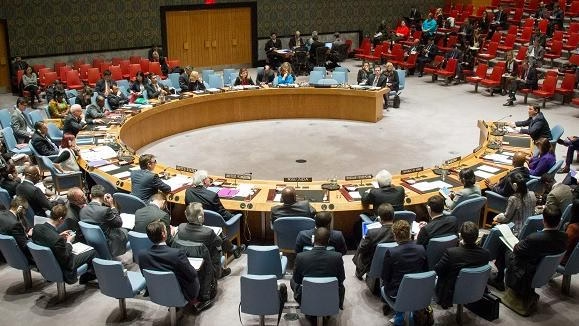
Khartoum – The Sudan Doctors Network Announced The Killing Of 5 People And The Injury Of 9 Others Due To The Targeting By A Rapid Support Forces Drone Of Two Fuel Stations In The City Of Kosti, Coinciding With The Convening Of The Security Council Session Proposed By Denmark, Alongside New Zealand And Spain, As A Meeting In The Arria Formula (Consultative) To Commemorate The Tenth Anniversary Of Resolution 2286 Issued On May 3, 2016, Which Addressed The Protection Of The Wounded And Sick, Medical And Humanitarian Workers, Hospitals, And Other Medical Facilities In Armed Conflicts.
The Network Indicated The Killing Of (5) People And The Injury Of (9) Others Due To The Targeting By A Drone Belonging To The Rapid Support Forces Of Two Fuel Stations In The City Of Kosti In White Nile State; The Network Confirms That This Deliberate Drone Attack Is Part Of The Repeated Targeting Of Civilian Facilities, Including The Critical Infrastructure That Citizens Rely On In Their Daily Lives, In A Clear Violation Of International Humanitarian Law Which Mandates The Protection Of Civilians And Civilian Objects.
The Statement Of The Network On Its Facebook Page Said That The Sudan Doctors Network Condemns In The Strongest Terms This Direct Targeting, Which Reflects A Blatant Disregard For The Lives Of Civilians And Increases Their Suffering In Light Of Deteriorating Humanitarian Conditions. The Network Considers That The Continuation Of These Attacks Exacerbates Health And Living Crises And Undermines Any Efforts To Provide The Minimum Basic Services To Citizens.
The Network Demands That The International Community Assume Its Responsibilities Toward These Grave Violations And Work To Hold The Leaders Of The Rapid Support Forces Accountable For The Crimes Committed Against Civilians, And Exercise Real And Effective Pressure To Stop The Targeting Of Civilian Infrastructure And Ensure The Protection Of Civilians In Accordance With International Conventions And Laws.
It Is Noted That The Security Council Meeting, Titled “Ten Years Of Resolution 2286: Protecting Medical Care In Conflict Amidst Changing Threats,” Will Evaluate The Implementation Of The Resolution And Consider How The Security Council And United Nations Member States Respond To Emerging Threats In This Field.
The Council Website Stated That It Is Expected That Briefings Will Be Provided By: Claude Maon, Legal Director For Intersectional Affairs At Doctors Without Borders; Leonard Rubenstein, Distinguished Professor At The Johns Hopkins Bloomberg School Of Public Health And Chairman Of The Safeguarding Health In Conflict Coalition; Naz K. Modirzadeh, Professor Of Practice Of Law At Harvard Law School And Founding Director Of The Program On International Law And Armed Conflict At Harvard Law School; And Elise Musquini, Permanent Observer Of The International Committee Of The Red Cross To The United Nations.
It Should Be Noted That Resolution (2286), Which Was Adopted Unanimously In May 2016, Remains The Only Independent Resolution Issued By The Council Regarding The Protection Of Medical Care In Armed Conflicts. Five Elected Members Co-Drafted The Resolution – Egypt, Japan, New Zealand, Spain, And Uruguay – A Formation That Was Notable At The Time For Its Regional Diversity And For Being A Departure From The Usual Practice At That Time In Which The Permanent Members, France, The United Kingdom, And The United States (Known As The “P3”), Undertake The Drafting Of Most Resolutions.
The Mentioned Text Strongly Condemned Acts Of Violence, Attacks, And Threats Directed Against The Wounded And Sick, Medical And Humanitarian Workers Whose Work Is Limited To Providing Medical Services, Their Means Of Transport And Equipment, Hospitals, And Other Medical Facilities, And Demanded That All Parties To Armed Conflict Comply With Their Obligations Under International Humanitarian Law And International Human Rights Law To Ensure Their Respect And Protection.
The Security Council Website Indicated That Since The Adoption Of Resolution 2286, Attacks On Medical Care In Conflicts Have Not Only Continued But Have Escalated Sharply.
In 2017, The Special Committee On Medical Care Documented 660 Incidents Of Violence Against Medical Care, Resulting In The Killing Of 160 Medical Workers. According To The Organization’s Latest Annual Report, 3,623 Incidents Were Recorded In 2024, Which Is The Highest Number Ever Recorded, An Increase Of 15% Over 2023 And 62% Over 2022, Resulting In The Death Of 927 Healthcare Workers. This Rise Is Attributed To The Intense And Continuous Violence In Gaza, Lebanon, Myanmar, Sudan, And Ukraine.
The Council Adds That The Organization Documented A Sharp Rise In The Use Of Explosive Weapons, Particularly Explosives Dropped By Drones, The Use Of Which Nearly Quadrupled In 2024 Compared To 2023.
The Council Website Said That It Is Likely That Many Council Members Will Condemn Attacks On Medical Care, Reaffirm The Obligations Of Parties To Armed Conflicts Under International Humanitarian Law, And Call For The Full Implementation Of Resolution 2286 And The Secretary-General’s Resolution Issued In August.
According To The Council, “Geopolitical Tensions May Surface, Particularly Regarding Attacks On Medical Care In Gaza, Sudan, And Ukraine, As Well As Allegations Of Selectivity In The Council’s Handling Of These Issues.”