
An Introduction to the Anatomy of the Religious Mind and Unlocking the Code of “Belief”
In a world where beliefs intertw and ideas clash over the nature and essence of religion, the book “Religion as Make-Believe: A Theory of Belief, Imagination, and Group Identity” by writer and philosopher Neil Van Leeuwen, published by Harvard University Press in 2023, emerges to represent a qualitative leap in our understanding of the psychological and cognitive mechanisms behind religious faith. This book is not merely a traditional critique or a historical survey of religions; rather, it is a deep and rigorous dive into the structure of the human mind and how it processes what we call “belief.”
Neil Van Leeuwen begins his book by challenging a common and deeply rooted assumption in our collective consciousness: the assumption that religious beliefs do not differ in their essence from factual beliefs or daily reality. We usually tend to believe that a person’s faith in the existence of a God, or supernatural entities that respond to prayers, is a mental process entirely similar to their belief that the month of May precedes the month of June, or that water boils at one hundred degrees Celsius. Van Leeuwen strikes a fatal blow to this assumption, presenting his central thesis based on the idea that these two types of belief differ fundamentally and astonishingly. Our brains, as the author argues based on empirical and psychological evidence, do not process religious beliefs in the same way they process beliefs related to tangible worldly reality. Instead, religious beliefs operate through a mechanism closely resembling the “imaginations” that guide games of “make-believe.”
To simplify this complex idea, Van Leeuwen terms religious belief as “Religious Credence,” to distinguish it from “Factual Belief.” He argues that this religious credence is best understood as a form of imagination used by people to define their group identity and express values they consider sacred. It is not an attempt to describe physical reality as it is, but rather a psychological and social tool to bind individuals together within a framework of shared symbols and meanings.
One of the most prominent and enjoyable methods the author uses to convey his idea is “The Parable of the Playground,” an extended and detailed allegorical story with which he opens his book to serve as the foundation upon which he will build all his subsequent theories. Van Leeuwen imagines a group of children gathering every day during noon recess in a shaded spot under a large wooden play structure in the schoolyard, playing with plastic dolls representing fictional characters. This group is closed and exclusive; the children feel fortunate to be part of it, and they do not allow strangers to join unless they bring the appropriate doll, even chasing others away.
These dolls are not just ordinary toys; the children have given them names, attributes, and superpower abilities. There is “Zalla,” the strongest of all, capable of summoning lightning from the sky and striking his enemies. There is his wife “Hirgin,” who possesses a supernatural ability to read and hear people’s thoughts. There are also the brothers “Aeter” and “Aul,” who fly and carry swords; Aeter’s sword is cold as ice, while Aul’s sword is ablaze with fire, in addition to the character of “Ghost,” who swiftly delivers messages. Over time, the children build sandcastles for these characters, and Zalla’s castle becomes the largest and most important. The storylines evolve to include rituals, wars with villains, and punishments for wrongdoers.
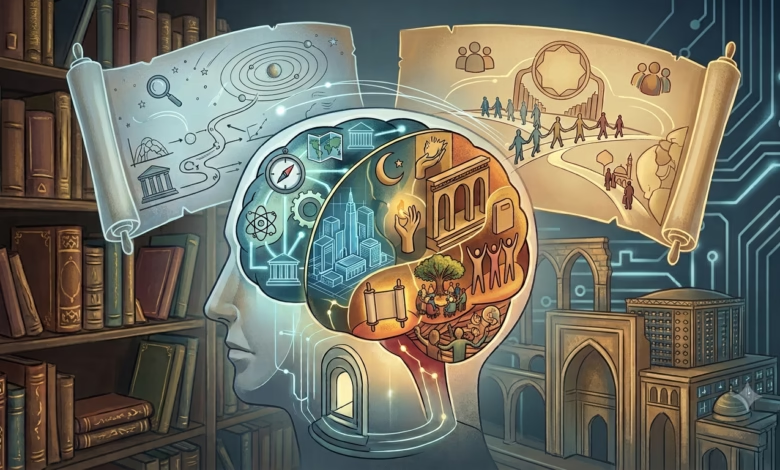
This parable is not merely a children’s story, but a precise anatomy of what the author calls the “Two-map Cognitive Structure.” When these children play, their minds do not suffer from confusion or delusion; they navigate skillfully between two entirely separate mental maps. The first map represents physical worldly reality: they know that the dolls are made of plastic and cannot talk or move on their own, they know that the castles are made of wet sand, and they know when recess ends so they can return to their classrooms. As for the second map, it is the one that overlays the world of imagination onto the first map: in this map, the dolls are supernatural beings, the sand is gold and marble, and the sounds they make are the voices of these great entities.
Van Leeuwen emphasizes that these two levels operate simultaneously. The child representing the role of “Zalla” must know, by virtue of the first map, that the doll is silent and inanimate so that he can move it and speak on its behalf, but at the same time he must imagine, by virtue of the second map, that “Zalla” is a powerful entity that speaks and moves. This cognitive duality is the foundation of the game of “make-believe.” Here emerges a crucial concept raised by the author, which is “Nonconfusion.” The author rejects what he calls the “myth of confusion,” the idea that children truly believe their toys are real or that they confuse imagination with reality. Scientific experiments and developmental psychology prove that children, even at an early age, clearly distinguish between what is real and what is imaginary, engaging in what the author calls “Continual Reality Tracking.” They track the features of worldly reality accurately (such as the location of the sand or the end of playtime) in order to properly build their imagination on top of it.
What does all of this have to do with religion? Van Leeuwen boldly proposes that religious communities operate through a mechanism very similar to this parable. Believers use the same two-map cognitive framework; they possess a factual-belief map that deals with ordinary objects and events in daily life, and they possess another religious-credence map that endows these ordinary objects and events with sacred and supernatural significance. An ordinary cup in church remains, by virtue of the first map, just a metal cup containing liquid, but by virtue of the second map, it becomes a sacred vessel holding divine blood.
The matter evolves in the parable of the playground when these children grow up, and one of them, “John,” goes through a harsh personal family crisis. In a moment of collapse in the attic, he sees the Zalla doll in a beam of light and feels a voice telling him, “You are not alone.” From here, the childhood game transforms into a doctrine, the dolls transform into sacred forces, the young adults return to the playground at midnight to practice rituals, and an entire religious movement named “The Playground” is established with its sacred principles and followers, even spawning a radical fundamentalist current. This seamless transition in the story embodies the author’s thesis: religious credence differs from factual belief just as fictional imagination differs from factual belief, with the difference that religious credence is tightly linked to group identity and sacred values.
Acknowledging that our minds process factual and religious beliefs in fundamentally different ways opens the door wide toward a deeper and more precise understanding of the psychology of individual and collective faith. Religion is no longer merely a set of hypotheses that carry material truth or falsehood, but rather a vast and complex psychological space where social needs intersect with human imaginative cognitive abilities.
Anatomy of Cognitive Attitudes and the Gap Between the Factual and the Sacred
Building upon “The Parable of the Playground,” which established our understanding of the dual-map cognitive structure in the first phase, Neil Van Leeuwen delves in this stage into the depths of cognitive philosophy and cognitive psychology to ask a fundamental and decisive question: What makes “Factual Belief” functionally and physiologically different from “Religious Credence”? To answer this complex question, the author meticulously deconstructs the characteristics of what he calls “Cognitive Attitudes,” demonstrating through empirical and theoretical evidence that we are facing two entirely different mental phenomena that operate under independent operating systems and play radically distinct roles in the arena of human consciousness.
Factual belief, as Van Leeuwen describes it, is our innate primary system for survival, navigating the physical world, and dealing with its direct inputs. This type of belief is characterized as “Involuntary” and comprehensive in its impact across all aspects of life. As a human, you do not consciously choose to believe that the sky is blue, that gravity pulls objects downward, or that fire burns skin; once you are exposed to direct experience or clear sensory information, your brain forcibly and automatically updates its factual map. More importantly, factual belief guides your motor, practical, and daily behavior in all contexts without stopping. If you truly and factually believe that there is a wild predator bear loose in the room where you sit, this belief will immediately direct your behavior toward fleeing or hiding, and this belief will not require specific rituals, a designated space, or a particular mood to activate in your mind and control your actions.
In stark contrast, the book proposes that “Religious Credence” operates as a secondary cognitive attitude built on top of this pre-existing physical foundation, just as the rules of advanced human make-believe and imagination games are built. These credences are characterized as highly “Context-dependent.” A devoted believer may hold a firm and certain credence that a sacred divine power protects and guards them from all harm and evil, yet, driven by the strong factual belief operating in the cognitive background of their brain, they will inevitably look right and left before crossing a busy street to avoid being hit by speeding cars. Religious credence activates intensely and effectively in specific contexts, such as being inside houses of worship, practicing religious rituals, or facing major existential crises, but it usually does not govern a person’s basic physical movements with the same strictness and moment-by-moment comprehensiveness imposed by factual belief.
Among the points raised by Van Leeuwen in this context is the concept of “Evidential Vulnerability.” Factual beliefs are very fragile and rapidly vanish in the face of direct counter-evidence. If you firmly believe that your car keys are on the table, then step forward, look, and do not find them, your old belief evaporates in a fraction of a second to be replaced by a new belief that the keys are lost or elsewhere, and this quick update will not cause you an identity crisis or a psychological collapse. Religious credences, however, feature what he calls “Evidential Immunity.” When pure physical evidence contradicts a deeply rooted religious credence, the human mind does not update the map and smoothly cancel the credence; rather, it exerts immense interpretive and defensive effort to protect it, intentionally reinterpreting and adapting reality to fit it in order to maintain its stability. This resilience is not proof of a logical flaw or inherent stupidity, as traditional critics of religion from the New Atheism school might argue, but rather, according to the author’s theory, conclusive proof that the mind inherently does not categorize these credences in the same drawer as factual beliefs. Their evolutionary and psychological purpose is not to accurately represent physical reality, but something else entirely related to meaning and social bonds.
Here we reach the most complex and beautiful dimension in the book’s cognitive approach: “The Normative Component.” In the cold world of factual beliefs, there is no moral duty requiring you to believe that water boils at one hundred degrees Celsius; it is merely a physical fact you accept. But in the fertile world of religious credences, “Belief” itself is a supreme virtue and a binding duty. You “must” believe, and doubt is often considered a sin, a weakness in character, or a betrayal of the surrounding community. This normative pressure closely resembles the strict membership rules of the children’s group in the playground parable; to remain an authentic part of “us” and not be expelled from the shaded area, you must commit to shared make-believe and adopt the second map with clear seriousness. This means quite clearly that religious credence requires continuous mental effort, permanent psychological maintenance, and active collective participation to remain alive and vibrant, unlike factual belief, which imposes itself by the force of gravity and requires no effort to maintain.
Through this stunning cognitive anatomy, Neil Van Leeuwen offers a revolutionary vision that liberates contemporary debate on religion from the dichotomy of “cold rationality versus naive superstition.” The human mind is not defective or deceived when it sincerely adopts religious beliefs that challenge simple physical logic; rather, it is practicing its highest and most complex cognitive capacities in creating imagined worlds and voluntarily believing in them for purposes far deeper than merely describing and framing physical existence.
Sacred Imagination as Social Glue and the Engineering of Group Identity
We move now to the most sensitive station in Neil Van Leeuwen’s thesis. The question that urgently imposes itself here is: If religious credences do not provide an accurate description of physical reality, and if they require mental effort and continuous maintenance to stay alive, why did the human mind develop this complex capacity in the first place? And why have religions persisted as a driving force in human history without fading away in the face of scientific progress? The answer presented by the book lies in the deep functional role of this sacred imagination; it is not a cognitive flaw, but rather the greatest evolutionary tool invented by humans to engineer “Group Identity” and form cohesive communities capable of cooperation and sacrifice.
Van Leeuwen takes us in this part of his theory into the world of sociology and evolutionary anthropology to prove that “factual beliefs,” by their cold and neutral nature, are completely incapable of creating emotional bonds or tribal loyalties among humans. Sharing with millions of humans the belief that the Earth is spherical, or that the Sun rises from the east, does not make you feel brotherhood toward them, nor does it drive you to sacrifice your life for them; these are facts imposed on everyone by the force of physical reality. In contrast, sharing in a map of “imagination” or “religious credence” requires a decision, an affiliation, and a readiness to adopt a set of symbols that cannot be physically proven. When a group of individuals agree that a certain river is not just a body of water, but a sacred entity that washes away sins, this shared agreement creates an invisible wall separating “us” (the enlightened believers) from “them” (strangers or non-believers). Religious credence functions here as an encrypted and complex “passcode,” ensuring that every individual in the group truly belongs to it and shares its deep values.
To understand the strength of this social glue, the author indirectly returns us to the dynamics of “The Parable of the Playground.” The children in the playground were not expelling strangers because they were ignorant of physical facts, but because they rejected the shared rules of the game and did not respect the sanctity of Zalla’s character. Similarly, in human societies, the heretic or apostate is punished severely, not because they committed a scientific error in understanding the universe, but because by breaking the religious credence, they threaten the social fabric and the moral foundation upon which the group’s identity rests. Rejecting the second map (the map of sacreds) is immediately translated as a rejection of the group itself, and a betrayal of the unwritten covenant that binds its members. This explains why religious or ideological conflicts are often bloodier and more violent than any other conflict; because they do not revolve around material resources alone, but around meaningful existence and foundational identity.
In this context, Van Leeuwen touches upon a crucial concept known in evolutionary psychology as “Costly Signaling.” In order for a group to prove its cohesion, and to ensure the loyalty of its members and their readiness to cooperate in times of crisis, it requires them to offer sacrifices that seem, from the perspective of pure factual belief, illogical or burdensome. These sacrifices may take the form of arduous rituals, long fasting, donating money, or even bodily alterations. Adopting a “religious credence” that justifies these actions and bestows sacred meaning upon them is the way an individual proves to the group that they are trustworthy and will not evade their responsibilities when facing a common enemy or a natural disaster. The human mind realizes, instinctively, that a person who shares your same sacred imagination and bears its costs is a person you can rely on in the real battlefield.
Thus, the book flips the table on the traditional view that considers religious faith merely a primitive, failed attempt to explain natural phenomena prior to the emergence of modern science. Religion, according to the theory of “belief as make-believe,” was never a competitor to science in the arena of reading physical reality; rather, it was, and still is, playing in a completely different arena: the arena of building complex networks of meaning, and forming massive social entities that transcend direct biological ties. The ability to believe in the myth and live inside the map of sacred imagination is precisely what made Homo sapiens capable of building civilizations and empires, while other creatures remained trapped in their immediate physical reality. It is a stunning paradox that our voluntary, collective departure from literal reality is the most powerful tool by which we ensured our dominion over that very reality.
The Enigma of “Religious Hypocrisy” and Double Standards Under the Lens of Cognitive Maps
We now arrive at one of the most complex and controversial dilemmas in the study of human behavior: the immense gap between what believers sincerely profess and what they actually practice in their daily lives. Philosophers and critics of religion have long stood baffled, and sometimes mocking, before the phenomenon of “religious hypocrisy.” How can a person who declares their absolute and certain faith in the existence of a God who watches their every action, and an eternal punishment awaiting transgressors, so easily commit a sin, lie, or violate sacred teachings? If this person held a “factual belief” that fire burns them, they would never put their hand in it. So why do they put their hand in the potential “fire of Hell” if their faith in it equals their faith in physical fire?
Here, the explanatory brilliance of the “Dual Cognitive Maps” model shines. Van Leeuwen rejects the superficial explanation that accuses these believers of intentional lying or conscious deception. Instead, he clarifies that this glaring contradiction is a natural and inevitable result of the nature of “religious credence” itself. As noted earlier, religious credence does not operate on the operating system of factual belief; it does not exert an automatic, compulsive, and immediate control over physical behavior at every moment and in every context. When a person faces a direct material temptation, Map One (the map of factual belief governed by instincts and immediate material interests) takes the helm in that critical moment, and Map Two (the map of sacred imagination) recedes into the background, not because the believer abandoned it, but because the context of its activation changed.
What appears to an outside observer as hypocrisy is actually a state of “Cognitive Compartmentalization” or mental division that the human mind masters with stunning skill. A sincere believer may weep moved by a sermon inside a house of worship, where the map of “religious credence” is at the height of its activity, and where they live with their entire being inside the world of sacred symbols. In that moment, they are not acting or lying; they are experiencing a deep psychological truth. However, as soon as they step out into the street or engage in fierce commercial competition, the map of “factual belief” takes over the reins to ensure their material survival, and sacred standards become less capable of guiding their moment-to-moment behavior. This functional separation is what allows humans to coexist with their contradictions without suffering a nervous breakdown or an acute identity crisis.
The author adds another dimension to this dilemma regarding the nature of “Professing Belief.” In the world of religious credences, declaring words—such as performing public prayers or proclaiming faith—is not merely a description of an internal mental state, but a performative and social act in itself. You declare your faith to announce your loyalty to the group and affirm your commitment to its higher values, even if your daily actions fall short of reaching this idealism. The human mind is designed to consider this declaration a sufficient commitment to maintain membership in the social fabric, showing tolerance toward material lapses as natural human weaknesses that fall within the scope of Map One.
Through this analysis, the book strips “religious duality” of its moralizing tone, re-framing it as a natural cognitive phenomenon that reflects the flexibility of the human brain and its ability to accommodate contradictory worlds. We are not rigid logical machines, but complex beings navigating between a harsh physical reality in which we must survive, and a sacred imagination that grants us meaning and belonging. This confusing blend between the two maps is precisely what crafts the human experience in all its permanence, beauty, and enduring paradoxes.
Re-engineering the Dialogue Between Science and Religion in the Twenty-First Century
It is no longer a matter of a traditional debate over the truth or falsity of the historical and physical claims of sacred texts; rather, the discussion, thanks to the theory of “religion as make-believe,” has shifted to an anatomy of the cognitive nature of humans and how the mind uses its unique tools to create a social fabric that is resilient and capable of enduring across ages.
The New Atheism movements that dominated the past two decades erred when they treated religion as merely a “failed primitive science” trying to explain the mechanics of the universe while failing in the face of experimentation. This strategic error in critique stemmed from their mistaken assumption that believers use “factual belief” when speaking of their sacreds. But Van Leeuwen proves that trying to refute “religious credence” using physics equations or fossil evidence is very much like trying to refute a poem using the laws of thermodynamics; both operate in an independent cognitive map and serve a function completely different from the other. Science tells us how the physical universe works in Map One, while sacred imagination tells us how we connect with one another, how we manufacture meaning, and how we build collective identities in Map Two.
Critique from an Islamic Perspective
The book “Religion as Make-Believe: A Theory of Belief, Imagination, and Group Identity” by cognitive science philosopher Neil Van Leeuwen presents a bold explanatory attempt to understand religious faith away from traditional materialist theses, seeking to bridge the gap between material rationality and spiritual phenomena. Nevertheless, subjecting this theory to the scale of Islamic conceptualization reveals a fundamental contrast and a wide gulf that cannot be bridged, because the book’s thesis strips away the essence of faith in Islam, reducing it from an absolute existential reality to a mere “collective game of imagination” or a “utilitarian social structure.”
The Islamic perspective departs from a solid and certain foundation stating that belief in God, His angels, His books, His messengers, the Last Day, and divine decree is a “true conviction in absolute realities,” not merely a “functional religious credence” detached from reality. The Holy Quran defines faith as a decisive conviction that matches the absolute reality of existence; God Almighty says: (That is because Allah is the Truth, and that which they call upon besides Him is falsehood). The view that divides the map of the human mind into a “worldly factual belief” and a “sacred imagination map” conflicts with the comprehensive tawhidic (monotheistic) vision; a believer in Islam believes in the existence of God and His absolute sovereignty over the universe with the very same decisive certainty by which they believe in the existence of tangible sensory objects—if not even stronger. This is because unseen realities in Islam (such as the Hereafter and angels) are the enduring truths, whereas this worldly life, with all its material aspects, is a transient enjoyment and a fleeting shadow, rather than the only “true reality,” as the author claims.
Furthermore, Van Leeuwen’s description of religious beliefs as resembling games of “make-believe” or shared imagination empties Islamic acts of worship and legislation of their true divine content, turning them into a mere sociological tool for engineering “group identity” and confirming tribal or social belonging. In Islam, prayer, fasting, zakat, and pilgrimage are not merely symbolic rituals to solidify solidarity among individuals or costly signals to prove loyalty to the group; rather, they represent true servitude submitted to the commands of the All-Wise, All-Knowing Creator, carrying real cosmic, worldly, and afterlife consequences that occur in truth, not metaphorically. The assumption that a believer internally knows the non-factuality of these doctrines physically but adopts them imaginatively diminishes the mind of the human believer, placing them in a state of intentional duality or organized psychological self-deception.
As for the book’s interpretation of the phenomenon of “hypocrisy and double standards” as an inevitable result of the separation of the religious map from physical reality, the Islamic vision addresses this flaw from a strict moral and spiritual perspective. Hypocrisy in Islam is not merely a “cognitive compartmentalization” or a natural transition between mental maps; rather, it is a disease of the heart, a behavioral perversion, and a volitional failure where a person falls into bad choice and contradicts what their tongue and heart acknowledged. Islam does not accept this comfortable functional separation between what a person believes and what they practice; instead, it binds true faith with direct, active deeds and absolute integrity in all walks of life, making moral character and practical commitment conclusive evidence of the truthfulness of heart-felt certainty.