
The Architecture of Spirit And Belonging: How Does Islam Offer a Moral Antidote To a Crisis-Ridden Modernity?

The Contemplative Reader Stands Before The Book “Travelling Home: Essays On Islam In Europe” By Abdal Hakim Murad (Timothy John Winter) As A Highly Complex And Deep Intellectual Document That Does Not Merely Observe The Social Surface Of The Muslim Presence On The European Continent, But Rather Dives Deep Into The Epistemological, Theological, And Historical Roots That Have Shaped This Complex Relationship. The Author, Abdal Hakim Murad, Presents A Thesis That Transcends Traditional Minority Lamentations As Well As Reverse Orientalist Reactions, Establishing What Might Be Termed A “Theology Of The Islamic Presence In Europe.” This Foundation Begins By Deconstructing The Concept Of “Home” And Belonging Within The Islamic Consciousness, Where The Author Borrows Emmanuel Levinas’s Maxim That Universal Truth Is More Precious Than Local Particularities, Affirming That This Universal Dimension In Islamic Monotheism Is Precisely What Grants The Muslim The Capacity To Take Root Anywhere. Islam, By Its Abrahamic Nature And Muhammadan Paradigm, Has Proven To Be A Highly Portable Faith, Laden With A Deep Historical Culture Of Migration And Emigrés. The Prophet Muhammad (Peace Be Upon Him), Like Abraham, Was A Refugee Seeking Shelter, And Migration Bisected And Defined His Prophetic Career; Yet He Quickly Developed A Love For Medina Rivaling His Love For His Native City, Turning This “Abode Of Emigration” Into His Permanent And Authentic Home.
From This Central Point, The Author Proceeds To Assert That This Prophetic Synthesis Provides A Model Forming Islamic Identity; While Muslims Face Mecca In Their Prayers And Pilgrimages, They Belong Fully To Wherever They Settle, Based On The Prophetic Tradition: “The Earth Has Been Made A Mosque For Me.” The Healing Signs Of God’s Presence Manifest Everywhere, Even On The Remote Isle Of Man Where Abdullah Quilliam Lived, Geographically Far From Traditional Islamic Lands. Accordingly, The Author Argues That Believers Feel A Sense Of Belonging To Place More Than Any Atheist Ever Could, For Losing Connection With God Entails The Immediate Loss Of Any Feeling Of Attachment To The Place He Created—It Means The Withering Of Roots And Identity. From This Islamic Perspective, Lenin Cannot Be Considered Truly Russian, Nor Douglas Murray Truly British, Nor Sam Harris Truly American; They Seem As Though Waiting In A Wretched Foreign Camp Even Within Their Official Homelands. Conversely, Embracing Islam, Or Coming From An Abrahamic Islamic Background, And Preserving That Traditional Sensitivity That Clearly Discerns The Signs Of God Everywhere, Means Immediately Beginning To See The Earth With Deep Understanding, And Consequently Cultivating Roots, Adorning The Earth, And Engaging With It. This Islamic Theory Of Abrahamic Mobility Differs Radically From The Jewish Diaspora Waiting For Messianic Intervention To Return To A Homeland Bigger Than All Homelands; Muslims Migrate In The Footsteps Of Abraham, And Every Country, Provided They Establish God’s Sacred Law And Connect With His Creatures, Is A Promised Land.
The Book Then Moves To Deconstruct The Concept Of “Traditional Islam,” Which It Adopts As A Reference Framework, Stressing That This Concept Is Not An Outdated Practice Seeking Uncritical Reenactment Of Medieval Rulings In The Modern World, But Rather A Return To The Ancient Epistemological “Origins” Of Islamic Civilization. It Represents An Effort To Utilize Accumulated Wisdom Across Islamic Centuries In All Its Breadth—From Schools Of Jurisprudence, Sufism, And Theology—To Broaden The Ongoing Narrative Of The Ummah And Formulate An Uncompromising Theory Of Islamic Belonging In The European Homeland Amid Late Modern Chaos. This Context Requires A Stiff Rejection Of Emotional Anti-Westernism That Characterizes Fundamentalist Movements, As Well As An Insistence That Integration And Harmony Must Occur On Islam’s Own Terms; Non-Muslim Think-Tank Theorists, Social Administrators, Or Party Politicians Have No Right To Interfere In Internal Matters Of Islamic Faith, Worldview, And Practice. Here, The Author Draws Inspiration From The Works Of Charles-André Gilis, Who Insists That The Islamic Relationship With Secular Societies Must Invoke The Non-Negotiability Of “Truth” And The Vital Need For The Virtue Of “Sincerity” In Interpretations And Desired Modes Of Coexistence.
Amidst These Analyses, The Author Highlights The Necessity Of Adopting A Positive Stance Toward Non-Muslim Majority Societies And Properly Engaging In Their Civic Structures—Not Merely As A Desirable Matter, But As An Urgent Imperative In The Post-Srebrenica Environment. Europe Is Rapidly Moving Toward A Hyper-Nationalist Trajectory, And Muslims Are Increasingly Viewed By Growing Numbers As The “Dark Other” That Must Be Securitized, Stigmatized, And Perhaps Expelled From The Gated European Garden In The Dreams Of Some. Therefore, Fundamentalist And Islamist Narratives Built On Polarization And Opposition Pose A Direct Threat To Muslim Flourishing In Europe, As They Align With The Harsh Image Drawn By Adversaries, Unintentionally Recruiting Enthusiasts To Serve Their Cause. However, The Turn Toward “Traditional Islam” Should Not Be A Mere Defensive Strategy; It Must Firmly Reject Two Core Weaknesses Afflicting Contemporary Muslims: First, An Emotional Identity Religion Driven By Egotistical Pursuits Of Status And Vengeance; And Second, A Decline In Recalling God’s Presence, Power, and Mercy—A Laxity Leading To Entrenched Fear. The Waning Of The Spiritual Dimension And Sufism, Resulting In An Externalized And Superficial Islam, Has Produced A Rigid Formalism Preoccupied With Boundaries And Divisions, Dominated By Defensiveness And Unhappiness.
The Book Masterfully Touches Upon A Critique Of Postmodern And Radical Currents Attempting To Remedy This Reality, Borrowing John Gray’s Insights From “Al Qaeda And What It Means To Be Modern,” Where He Uses Karl Kraus’s Satirical Remark About Psychoanalysis To View Radical Islamism As “The Disease Of Which It Pretends To Be The Cure.” Slavoj Žižek Agrees With This Point, Noting That Despite The Conventional Islamophobic Narrative, Extremist Islamism Marks A Radical Break With The Islamic Past, Adopting Enlightenment Or Counter-Enlightenment Strategies Pursuing Utopian Ends Through Violent And Terrorist Means. These Are Projects Seeking, According To Žižek, “Capitalism Without Capitalism,” Free From Social Dissolution Dynamics That Melt Everything Solid Into Air, Culminating In The Conclusion That The American Cultural Order Dominates The World So Absolutely That The Characterization Of “Jihad Vs. McWorld” Is No Longer Adequate; Rather, The Reality Of Alleged Jihad Has Itself Transformed Into “McJihad.”
The Analysis Shifts To Address The Geopolitical And Historical Knot Of Europe And Its Relationship With Islam Through A Provocative Question: Must One Be A Liberal To Belong To Europe? The European Union, Struggling To Articulate A Shared Civilizational And Economic Vision, Issues Grand Pronouncements Regarding Europe As A Vision Of A Free Human Society Whose Success Validates A Universal Model Imposed Upon The Rest Of The World. European Liberals, With Their Enlightenment, Civil Society, And Democratic Institutions, Appear To Define Themselves As A “Collective Secular Messiah” Ready To Redeem Non-Believers, Viewing Any Resistance To This Model As Alignment With An Unredeemed, Errant Humanity. Yet This Liberal Religion Of Progress Struggles Immensely To Respect Dissenters, Even As The EU Raises The Banner Of “United In Diversity.” The Author Explores Europe’s Deeper Roots, Evoking The Myth Of The Abduction Of Europa, Daughter Of The King Of Phoenicia, By Zeus, Treating It As A Telling Metaphor For Europe’s Inception As A Violent Colonial Raid Upon Asia. However, Europe Discovered The Contours Of Its Soul And Body Only After Losing Its African And Asian Shores To Islam In The Seventh Century. Then, Under The Weight Of Isolation, Europe Began Defining Itself, Drawing On Henri Pirenne’s Famous Thesis Asserting That The Franks—and Thus Europeans—Gained Their First Sense Of Self Only When Arab And Berber Advances Were Halted In France.
Europe Has Never Recognized Islam As A Legitimate Heir To Athens, Even Though Avicenna Was A Hellenized Philosopher Par Excellence Exceeding Any Christian Of His Era. Indeed, European Rejection Of Islam As A Partner In Classical Inheritance Symbolically Parallels The Dramatic Rejection Found In Genesis Regarding Abraham’s Firstborn, Ishmael, In Favor Of The Younger Son, Isaac. The Author Explains How Older Orientalist Perspectives Claimed Islam Caught A Brief Whiff Of Greece And Then Turned Away, Blaming Al-Ghazali For Sounding The Death Knell Of Greek Philosophy In The Islamic World—A Myth Continuing Among Modern Polemicists Like Leo Strauss, Who Had Influential Admirers Such As Donald Rumsfeld And Paul Wolfowitz. Even Pope Benedict XVI’s Controversial 2006 Regensburg Lecture Seemed Geared Toward Framing Muslims As Illegitimate Participants In The Classical Heritage Of Rationality And Rights, Presumed To Be An Exclusive European Monopoly. Yet Recent Scholarship, Such As Robert Wisnovsky’s Work, Refutes This Papal And Political Appropriation, Demonstrating That Towering Scholars Like Al-Juwayni, Al-Ghazali, And Al-Razi Were Advocates For A Deep, Critical Engagement With Greek Dialectics.
The European Continent, Having Entered A Post-Christian Era And Seemingly Embracing Gibbonian Views Of Classical Decline As A Triumph Of Barbarism And Religion, Witnesses Today The Rise Of New Crusading Atheists Attacking Faith For Its Alleged Lack Of Rationality. Amidst This Hostile Intellectual Climate, Theorists In Brussels Realize That Future EU Expansion Must Always Head Eastward, Never Southward. Though Tangier Lies Scarcely Twenty Miles Across A Sea That Was A Navigable Highway Rather Than A Barrier In Classical Times, It Is Psychologically Regarded As A Distant Foreign Land. Ishmael, Despite Being Abrahamic And Hellenistic In His Theology, And Fully Acknowledging Isaac As Brother And Prophet, Finds This Recognition Unreciprocated. This Entrenched Rejection Explains The Persistent Tension In European Debates Surrounding Turkey’s EU Accession, Exposing Liberal Contradictions As European Elites Oppose Accession For Reasons Pertaining To Europe’s Self-Definition As An Essentially Non-Muslim Entity. European Liberalism, Having Become A Rigid Secular Religion, Finds Itself Incapable Of Tolerating Those Who Reject Its Social And Corporeal Dogmas, Demonstrated When Italian Politician Rocco Buttiglione Was Forced To Resign Simply For Adhering To Conservative Catholic Teachings. This Soft Liberal Tyranny Creates An Environment Hostile Not Only To Muslims, But To Anyone Holding Traditional Moral Views, Necessitating Strategic Alliances With Conservatives Of Other Faiths To Safeguard Freedom Of Conscience And Defend The Dignity Of Difference.
Abdal Hakim Murad Dives, In The Second Phase Of His Analysis Of “Travelling Home,” Into The Depths Of The Modern European Wound, Utilizing The Bosnian War And The Srebrenica Genocide As A Historical And Theological Pivot To Understand The Nature Of This Violent Clash. The Author Does Not Treat The Bosnian Tragedy As A Mere Passing Political Event Or Diplomatic Failure Of The Old Continent, But Views It As A Terrifying Manifestation Of A Deep-Seated “Islamophobia,” Masterfully Deconstructing How Orthodox Theology Was Methodically Deployed To Target And Eradicate The Islamic Presence In The Balkans. The Serbs, In Committing Those Atrocities, Were Not Acting From A Mere Secular Vacuum; Rather, They Saw Themselves Performing Sacred Religious Acts To Cleanse The Land Of This “Other.” This Massacre, Which The Author Considers Far Worse In Severity And Symbolism For European Muslims Than September 11, Serves As A Harsh Alarm Reminding Muslim Minorities That They Live On A Forgetful Continent Ready In Any Crisis To Produce Bloody Exclusionary Discourses. Murad Illustrates In A Chilling Manner How The West Defined Itself, Constructed Its History, And Reinterpreted Its Intertwined Past Primarily To Position Itself As An Eternal Bastion Against Islamic Expansion. This Horrific Reminder Of The Fragility Of Islamic Presence In Europe’s Gated Garden Places Muslims Before A Complex Existential Challenge Requiring A Response Transcending Political Superficiality And Slogans, Diving Into The Depths Of Islamic Spiritual Heritage To Find A Compass For Survival.
Precisely Here, Murad Moves To Dissect The Internal Islamic Response To This Dual Threat Of Soft Secular Exclusion And Violent Nationalist Eradication, Warning Strongly Against Falling Into The Trap Of Emotional Reactions Fed By Victimhood And Blind Anger Dominating Certain Immigrant Circles. The Author Coins A Deeply Original Concept Within Its Semantic Field, Termed “Lahabism,” Drawing Inspiration From Abu Lahab, The Uncle Of Prophet Muhammad, Who Exemplified Blind Hatred And Destructive Rejection Of Islam At The Dawn Of Prophecy. The Author Views “Lahabism” Not As A Mere Historical Stance Concluded With Qur’anic Revelation, But As A Sustained Spiritual Sickness Able To Possess Even Those Believing They Defend Religion. It Manifests Today In Behaviors Of Extremism That Rely On Repulsion Rather Than Glad Tidings, Employing Verbal And Physical Violence, And Adopting An “Eye For An Eye” Principle That Makes The Whole World Blind, Ultimately Alienating People From Islam. The Author Emphasizes That Muslims Must Be “Attractors Of Souls,” And That The Greatest Error Lies In Thinking Harshness Equals Piety And Devotion. This Angry Emotion Drives Muslim Youth Toward Narrow Local Ideologies That Transform Faith From Universal Mercy Into An Instrument For Revenge, Serving The Very Far-Right Discourse Seeking To Demonize Islam As A Securitized Threat.
To Deepen This Psychological And Spiritual Analysis Touching The Roots Of The Issue, Murad Allocates Considerable Space To Distinguish “Praiseworthy Anger” From “Blameworthy Anger,” Linking It To The Central Doctrine Of “Associationism Of Causes” (Shirk Al-Asbab). In This Complex Context, The Author Sharply Criticizes Islamist Movements Absorbed In Political Protest To The Extent Of Forgetting That God Almighty Is The Absolute Controller Of Affairs. Over-Reliance On Material Causes And Thinking Human Rage And Revolution Alone Alter Reality Constitutes A Hidden Form Of Shirk, Stripping Absolute Agency From The Creator To Place It In The Hands Of Weak Creatures. The Author Does Not Advocate Fatalistic Passivity Or Total Withdrawal From Public Life, Nor A Stoic Philosophy Rendering One Emotionally Numb Like A Frozen Volcanic Being Unconcerned With Surrounding Reality; Rather, He Calls For Redirecting Emotions To Align With What God Truly Desires, Rather Than Rash Responses To Vengeful Desires. Good Anger Is Driven By Jealousy For Truth, Governed By Divine Law, And Shaded By Faith-Driven Tranquility Assured That God’s Decree Prevails; Bad Anger Is Fueled By An Egocentric Sense Of Injustice, Transforming The Activist Into A Mere Machine Of Violent Reactions Increasing Worldly Destruction.
From The Womb Of This Scathing Critique Of Violent Reactionary Culture, Abdal Hakim Murad Delivers A Radical Shift In Strategic And Spiritual Thinking For Western Muslim Minorities, Proposing A Swift Transition From Complaining Victims To Active “Healers,” Grounding This Epistemological Shift In The Noble Qur’anic Verse: “Repel With That Which Is Better.” The Author Invokes Classical Exegetical Texts With Academic Precision, Citing Al-Tabari, Al-Baydawi, And Fakhr Al-Din Al-Razi, To Establish A Firm Islamic Principle Derived From Revelation On Interacting With Hostile Or Spiritually Sick Environments. Murad Views Contemporary Western Societies, Suffering From Spiritual Emptiness, Moral Erosion, And Encroaching Secular Liberalism Making Pleasure And Power New Deities, As Sick Societies Requiring Authentic Healing, Not More Shouting, Complaints, And Lamentations Over Conspiracies. Hence, The European Muslim’s Role, Rooted In Ancient Abrahamic Traditions And Equipped With Muhammadan Mercy, Is To Function As A Spiritual Healer For This Distressed Society. Insisting On Producing Beauty As A Qur’anic Response To Ugliness Is Not A Temporary Defensive Tactic, But An Authentic Islamic Art Aimed At Winning Hearts, Transforming Equations, And Proving Islam Can Offer A Coherent Ethical Alternative Capable Of Curing Late Modernity’s Ailments. The Values Seeded By The Qur’an And Sunnah Can Penetrate All Human Hearts, However Obscured By Atheistic Materialism.
Yet How Can This Generation Of Muslim “Healers” Be Prepared In An Environment Characterized By Intellectual Liquidity And Identity Fragmentation? The Book Elegantly Moves To Address The Crisis Of The Western Muslim Student Of Knowledge, Described As Suffering From A “Lust For Wandering In Diaspora” Or A Dual Alienation Seeking Settlement. Murad Compares This Rootless Youth, Leaving The West Searching For Lost Religious Heritage Across The Islamic World, To The Character Of “Majnun” In Arabic Folklore, Wandering Deserts In Search Of A Metaphysical Mirage And Imagined Romantic Authenticity Lacking Tangible Reality. The Author Critically Examines Educational Options Available To This Fragmented Youth: Traditional South Asian Seminaries Often Present A Nineteenth-Century Reactionary Discourse, Curricula In Many Islamic Countries Are Saturated With Islamist Ideology Straying From Heritage, While Islamic Studies Departments In Western Universities Are Strongly Dominated By Orientalist Approaches Led By Non-Muslim Scholars Caring For Hyper-Specialized Research That Neither Feeds The Soul Nor Builds Certainty. Despite This Bleak Picture, Murad Sees A Bright Ray Of Hope In The Rise Of Serious Islamic Theological Institutions Within Western Universities Led By Capable Muslim Scholars, Paving The Way For A New Generation Of Scholars Understanding Western Complexities And Offering Jurisprudence Balancing Authenticity And Modernity Without Sacrificing Fundamentals.
Completing His Holistic Vision Unifying Faith And Worldly Reality, Abdal Hakim Murad Does Not Overlook The Economic Dimension Constituting The Core Engine Of Western Modernity And Its Resulting Social Crises, Allocating Broad Space To Critique Late Capitalism And Savage Neoliberal Consumer Economies. The Author Accurately Analyzes Deep Distortions In The Twenty-First-Century Global Financial System, Describing It As Full Of Absurdities Crushing Human Dignity, Increasing Spiritual Poverty, And Widening Material Disparities. The Emerging “Islamic Banking” Sector Does Not Escape His Sharp Critical Scalpel; He Views It As Often Failing To Offer A Real Substantive Alternative, Integrating Into A Financial System Little Different In Exploitative Outcomes From Prevailing Capitalism. Facing Financial Savagery And Consumerism, Murad Offers A Bold Vision Regarding The Vital, Forgotten Role Of Obligatory “Zakat” In Postmodern Economies Of “Liquid Modernity.” The Author Does Not Treat Zakat As Isolated Individual Charity To Ease Conscience, But Contemplates Deeply The Immense Potential Of Reviving Zakat Institutionally. Zakat, From This Integrated Perspective, Represents A Quiet Revolutionary Mechanism Capable Of Dismantling Egocentricity, Undermining Market Greed, And Establishing Social Justice And Solidarity—Values Urgently Needed By The Distressed West To Save Itself From Internal Collapse. Thus, The Knowledge Arc Completes, Binding Spirit And Matter, Faith And Social Reality, Proving Islam Possesses An Inexhaustible Conceptual Arsenal Capable Not Only Of Preserving Its Children’s Identity In Diaspora, But Of Offering An Intellectual Salvation Vessel For A Civilization Heading Toward The Abyss.
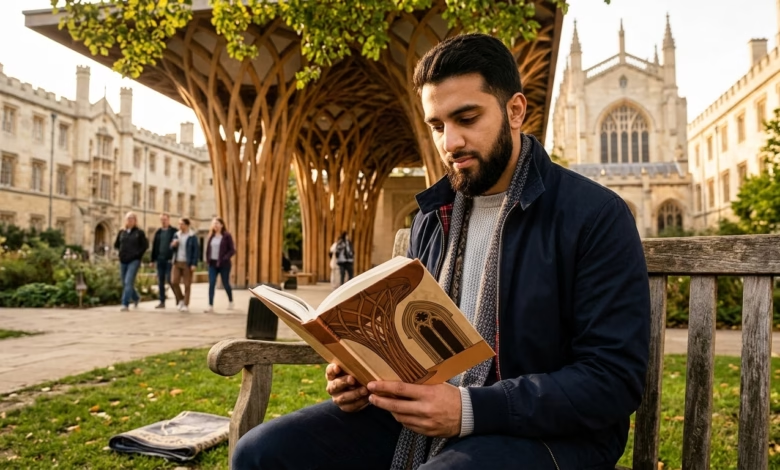
Moving From Theological Abstraction And Geopolitical Engagement To The Material And Visual Embodiment Of Islamic Presence In Europe, Abdal Hakim Murad Adopts The “Philosophy Of Architecture” As A Brilliant Gateway To Reading The Crisis Of Belonging And Localization. The Author Launches A Scathing Critique Of “Flying Saucer” Architecture Or Imported Mosques—Buildings Planted In European Cities As Distorted Cutouts Of Ottoman, Mamluk, Or Mughal Styles, Acting As Time Capsules Refusing Surroundings And Imposing Visual Estrangement. Murad Views This Insistence On Cloning Past Architectural Templates In Different Climates And Cultures Not As Expression Of Religious Authenticity, But As Psychological Alienation And Inability To Adapt. Traditional Islamic Architecture Throughout Its Golden Ages Was Never A Rigid Template; It Was Always An Intelligent Child Of Its Environment, Borrowing Local Cultures And Adapting Materials To Serve Monotheism And Worship. Hence, The Model Of The “Cambridge Central Mosque,” Where The Author Played A Pivotal Role In Conceptualization, Emerges Not Merely As Europe’s First Eco-Friendly Mosque, But As A Living Philosophical Manifesto Blending Islamic Aesthetics, Gothic Geometry, And English Nature. Utilizing Timber Columns Resembling Intertwined Trees In British Forests, Integrated With Sacred Geometry And Natural Light, Delivers A Deep Visual Message That Islam Can Sprout Naturally From European Soil Without Provoking The Eye Or Rejecting Aesthetic Integration. This Architectural Foundation Is In Essence A Practical Foundation For A European Muslim Identity Reconciled With Itself And Public Space, Building Bridges Rather Than Erecting Isolating Walls.
The Book’s Engagement With European Modernity Transcends Architecture To Dive Into Details Of Social Structure, Specifically The Crisis Of The “Family” And Its Rapid Disintegration In Postmodernity. Murad Deconstructs The Phenomenon Of “Hyper-Individualism” Devouring Modern Western Societies, Where Late Capitalism And Moral Liquidity Have Shattered Traditional Family Ties, Reducing Humans To Isolated Consumer Entities Fed By Fleeting Desires. Amidst This Fragmentation, Islam Offers Through Its Traditional Family Model And Balanced Vision Of Complementarity An Ethical Lifeline And Warm Refuge In An Increasingly Cold World. The Author By No Means Falls Into Defending Patriarchal Authoritarian Practices Imported By Some Immigrant Communities Under Religion’s Guise; Rather, He Directs A Dual Critique: A Firm Critique Of Outdated Tribal Customs Marginalizing Women Contrary To Sharia’s Spirit, And A Parallel Critique Of Radical Liquid Trends Blurring Natural Differences That Destroy The Family Concept And Destabilize Future Generations. Murad Asserts That Conscious Adherence To The Islamic Narrative On The Sacred Matrimonial Bond, Mutual Mercy, And Complementary Roles Represents A Civilizational Resistance Against Commercialization, And That A Stable Muslim Family In The West Is Itself The Greatest Contribution Offering A Coherent Alternative To Societies Suffering From Loneliness And Demographic Collapse.
To Address The Crisis Of Wandering Muslim Youth In The West, Caught Between Social Marginalization In Suburbs And Extremism Preying On The Lost, Abdal Hakim Murad Unearths From Islamic Heritage The Concept Of “Futuwwa” (Spiritual Chivalry) As A Holistic Spiritual And Social Remedy. The Author Does Not Treat “Futuwwa” As A Historical Term Or Romantic Chivalry Concluded In The Middle Ages, But Recasts It As A Practical Moral And Psychological Building Project For Youth. Futuwwa, In Its Sufi And Social Essence, Is Restraining The Ego, Preferring Others, Succoring The Weak, Resisting Injustice, And Absolute Commitment To Honesty, Honor, And Integrity. Murad Views Reviving Futuwwa Practices In The Western Context As The Authentic Traditional Sunnah Alternative To Destructive Urban Gang Culture And Angry Islamist Ideologies Alike. When A Young Muslim Absorbs Genuine Futuwwa Values, He Transforms From A Resentful Being Seeking Destruction Into An Active Agent Possessing Internal Nobility Impelling Him To Serve Society—Muslim And Non-Muslim—With Devotion. Modern Futuwwa Projects Offer Youth What Consumer Institutions Fail To Provide: True Belonging, Higher Purpose, And Self-Control Directing Energies Toward Beauty And Goodness, Uprooting Attempts To Recruit Them Toward Nihilism Or Terrorism.
Concluding This Intellectual Journey, The Book Embraces Its Deep Title, “Travelling Home,” Raising The Key Existential Question: Where Is True Home In An Age Of Diaspora? Murad Transcends Geopolitics And Legalities, Moving Beyond Passport Borders To Affirm That Material Belonging To Europe Must Be Crowned By Metaphysical Belonging To A Higher Horizon. The Believer Ultimately Is A Wayfarer In This World, And The Ultimate Eternal Home Is In The Hereafter Before The Creator. Yet This Firm Eschatological Certainty In No Way Justifies Withdrawal From The World Or Neglecting Earth’s Stewardship; On The Contrary, It Grants European Muslims Spiritual Freedom And Independence To Be Positively Present, No Longer Deriving Worth From External Recognition Or Changing National Identities, But Directly From Divine Mandate. The Muslim Deeply Realizing That The Entire Earth Has Been Made A Mosque, And That Every Spot Can Be An Ascent Toward God Through Good Deeds, Can Build A Real Home In Europe—A Home Not Built On Exclusion Or Paranoia, But Rising On Pillars Of Mercy, Relief, Justice, And Beauty. The Book Concludes With A Radiant Sufi Affirmation That The Crisis Of Islam In Europe Will Not Be Solved By Constitutions, Courts, And Political Struggles Alone, But When Muslims Return To Their Authentic Spiritual Center, Ceasing To Prove Worth To Sick Consumer Societies On Those Societies’ Terms, And Offering Instead The Moral Treacle Needed For Salvation. “Travelling Home” Is Ultimately A Continuous Journey Toward The Tranquil Soul Finding God Present In Every Time And Place, Where Every Corner Of God’s Earth Becomes A Warm Home Welcoming All, Turning The Islamic Experience In The West Into A Bright New Chapter Enriching Human History.