

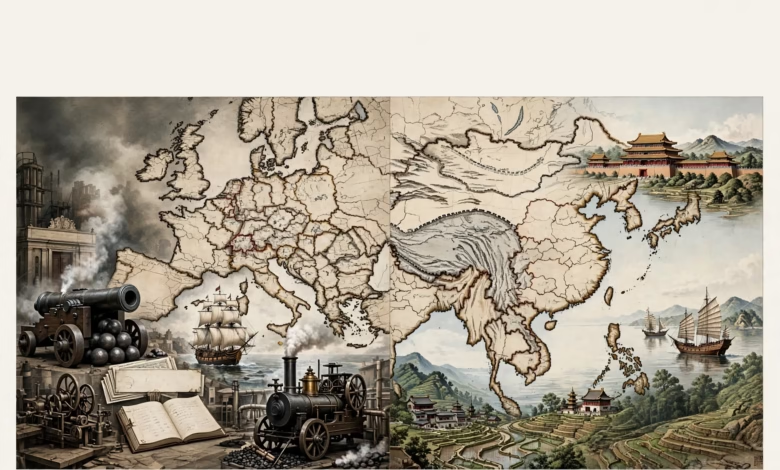
Why Europe? A Reading Into The Roots Of Hegemony And The Great Divergence
In A World Buzzing With Questions About The Causes Of Civilizational And Economic Superiority, A Fundamental Question Emerges That Has Long Troubled Historians And Economists: What Is The Greatest Achievement Humanity Has Ever Accomplished? Immortal Architectural Structures Might Immediately Come To Mind, Such As The Pyramids Of Giza, The Great Wall Of China, The Aztec City Of Tenochtitlan, Or Even The Great Roman Aqueducts. Art Lovers Might Lean Toward Considering The Timeless Works Of Shakespeare, Bach, Or Caravaggio As The Pinnacle Of Human Achievement, While Others Might Side With Modern Technological Achievements Like Computers, Space Travel, And Cancer Treatments. However, The Author And Economic Historian “Philip T. Hoffman” Presents In His Book Titled “Why Europe? The Great Divergence And The West’s Rise To Global Predominance” A Completely Different And Perhaps Shocking Answer To Some; He Believes That Humanity’s Greatest Achievement Is “Sustained Economic Growth.”
This Growth, Whose First Spark Was Ignited In Northwestern Europe During The Eighteenth Century, Is What Led To The Continuous Improvement In Living Standards, Which Later Extended To Include Large Parts Of The World. On The Surface, This Argument Might Seem Purely Materialistic, Or Perhaps Ignorant Of The Environmental Damage That Accompanied This Growth, As Carbon Dioxide Emissions Rise Almost In Parallel With The Increase In Per Capita Income. However, Hoffman Fiercely Argues That Economic Growth Has Improved The Lives Of A Huge Number Of Humans To An Extent That Makes It Worthy Of Being Classified As The Greatest Human Achievement, Especially If We Closely Examine The Miserable Condition In Which Humanity Lived Before Living Standards Began To Improve.
To Realize The Magnitude Of This Achievement, The Author Takes Us On A Journey Into The Near And Distant Past, Where Extreme Poverty Was The Rule, And People Breathed Toxic Air And Drank Water Far More Polluted Than What We Know Today. Economic Growth Brought In Its Wake A Huge Demographic Transformation That Slowed Population Growth, As Happened In Northwestern Europe More Than Two Hundred Years Ago, Dispelling Fears Of A Population Explosion.
The Author Points Out That Economic Growth Does Not Merely Mean The Accumulation Of Wealth; Rather, It Is Closely Linked To Continuous Technological Change That Reduces Production Costs And Lowers The Prices Of Goods And Services. In Britain, For Example, Spinning Machines Led To A 93 Percent Reduction In The Real Price Of High-Quality Cotton Yarn Between 1785 And 1825. In Our Modern Era, Computers By The Year 2006 Had Reduced The Cost Of Performing Calculations By A Factor Of Seven Trillion Compared To Doing Them Manually. This Continuous Technological Change Is A Completely New Phenomenon In Human History, And No Previous Civilization Experienced Regular And Continuous Technological Change Encompassing The Entire Economy As Occurred In Europe.
Hoffman Provides Heart-Wrenching, Conclusive Demographic Evidence Regarding The Harshness Of Life Prior To Economic Growth. Before This Growth Began, It Was Common For Half Of All Children To Die Before Reaching Adulthood, Often Falling Victim To Diseases That Have Disappeared Today In Developed Countries. In France During The Seventeenth And Eighteenth Centuries, One-Quarter Of Newborn Infants Died Before Reaching Their First Year. The Picture Was No Less Grim In England, Where A Quarter Of Children Passed Away By Age Nine During The Sixteenth And Seventeenth Centuries. These Heartbreaking Figures Changed Only Thanks To Economic Growth And Its Accompanying Scientific Ideas, Food Abundance, And Public Health Measures Funded By This Growth.
For Those Who Were Destined To Survive The Guillotine Of Early Death, Life Was A Matter Of Continuous Hardship. The Only Exception Was For The Rich Minority Capable Of Employing Servants. In Contrast, Women In Most Families Had To Carry Water From Nearby Wells Perhaps Ten Times A Day For Cooking And Washing, In The Absence Of Indoor Plumbing. The Author Provides A Shocking Example From The United States: In 1886, The Average Housewife In North Carolina Had To Carry 200 Pounds Of Water Daily, In Addition To Emptying Chamber Pots.
Men’s Work Was No Less Harsh. In The Era Prior To Tractors, Machinery, And Scientific Farming, Most Men Toiled On Farms, Plowing, Planting, And Harvesting Grain With Sickles. Fine White Wheat Went To The Rich, While The Poor Subsisted On The Worst Types Of Calories, Such As Vegetable Porridge, Salted Meat, Barley, And Dry Bread.
The Author’s View Extends To Include Details Of Daily Life, Such As Clothing. Simple Clothes Were Considered Major Capital Expenses, Akin To Buying A Car Today, Which Is Why Active Markets Existed For Used Clothing That Was Inherited By Children. The Author Mentions That In 1176 In The City Of Pisa, When The Property Of A Wealthy Foreigner Was Sold At Auction, The Cheapest Outfit He Owned Was Equivalent To Six Months’ Wages For The Auction Guard. This Harsh Equation Changed Only When Technological Change Accompanied By Economic Growth Appeared, Substantially Reducing Costs And Allowing Ordinary People In Eighteenth-Century Britain To Imitate The Silk Of The Rich Using Printed Textiles Made With Thread From New Spinning Machines.
However, Why Does The Author Inquire Specifically About “Sustained Growth” Rather Than Mere Wealth? Hoffman Answers By Explaining The Difference Between Sustained Growth And The Extravagant Wealth In Ancient Civilizations. In The Roman Empire, The Wealthiest Families In The Fourth Century Enjoyed An Income Reaching Up To 4,000 Pounds Of Gold Annually (Equivalent To 113 Million Dollars In 2024), But This Income Came From Rents And Seizing A Share Of Taxes; Meaning It Was A Redistribution Of A Fixed Pie Made By Others, Not A Result Of An Increase In Per Capita Gross Domestic Product. Ancient Civilizations Reached A High Level Of Per Capita Gross Domestic Product And Then Stopped Without Continuing To Rise, And Were Even Vulnerable To Collapse If Central Political Authority Disintegrated Or If Population Growth Swallowed Temporary Technological Gains—The Nightmare Malthus Feared.
From Here, The Author Places Us Before The Greatest Puzzle: Why Did This Sustained Growth Begin In Northwestern Europe (And In Britain Specifically) During The Eighteenth Century? And Why Did It Not Begin In Other Regions That Seemed Strongly Positioned, Such As China, Japan, The Prosperous Textile-Exporting Regions Of India, Or Even The Netherlands In The Seventeenth Century During The Era Of Vermeer And Rembrandt?
The Author Provides A Decisive And Perhaps Surprising Answer To Prevailing Discourse, Indicating That The Real Explanation Is “Not Slavery, Not Colonialism, And Not Capitalism Either.” Hoffman Explains That Innovation In The Textile Trade Did Not Depend On Cotton Grown By Enslaved People; Free Farmers Could Produce It Just As They Did In India And China. Colonies Were Not Necessary To Feed Northwestern Europe, Where Farmers Produced Enough Food To Support Urban Agglomerations Denser Than Anywhere Else In Eurasia. As For Capitalism (In The Sense Of Markets And Private Property), It Had Existed For Centuries And Was Not A Sudden Shock Appearing In The Eighteenth Century. Although Colonialism And The Slave Trade Slowed Economic Growth In Some European Colonies (Especially In Africa), They Do Not Explain The Economic Growth Experienced By Northwestern Europe Itself.
Recent Research, Particularly Ken Pomeranz’s 2000 Book “The Great Divergence,” Has Sparked Fierce Debate Surrounding The Timing Of Britain’s Economic Overtaking Of Asia And The Rest Of Europe. Thanks To New Evidence (Ranging From Real Wage Series To Gross Domestic Product Data), It Has Become Clear That Britain Had Leapt Ahead Of The Wealthiest Regions In Asia By The Early Eighteenth Century At The Latest. By 1750, Other Parts Of Northwestern Europe Followed Suit. Purchasing Power Parity-Adjusted Data Indicates That Per Capita Gross Domestic Product In Britain Was Growing At The Fastest Pace, Surpassing The Levels Of The Netherlands, While China, India, Italy, And Japan Lagged Behind In Terms Of Growth Rates And Overall Level.
Even When Comparing The Netherlands To The Yangtze Delta Region (One Of The Wealthiest Regions In Eighteenth-Century China), Figures Show That Per Capita Gross Domestic Product In The Yangtze In The 1820s Represented Only 54 Percent Of Its Counterpart In The Netherlands. Real Wage Data In London Compared To Suzhou/Shanghai In China Confirms That British Wages Between 1730 And 1850 Were Double Or Even Triple Their Chinese Counterparts. This Means That The Divergence Between Europe And Asia Had Already Begun Long Before The Full Industrial Revolution.
The Puzzle Of The “Tournament Model” And The Eurasian Arms Race
After Crossing Beyond Common Traditional Explanations Involving Slavery, Colonialism, And Mere Capitalism, Any Reader Of Philip Hoffman’s Thesis Finds Themselves Facing The Direct Question That Forms The Core Engine Of The Book: If Natural Resources Or Geographic Coincidences Were Not The Cause, What Was The Real Tool That Enabled Small States In Northwestern Europe To Decide The Fate Of The World? Hoffman Delivers His Pivotal Answer Through An Innovative Thesis Known In Economic History As The “Tournament Model” Or The Military Competition Race, Stating That European Superiority Was Not The Product Of Inherent Genius, But Rather An Unintended Byproduct Of Centuries Of Continuous And Fierce Wars Fought By European Kings And States Against One Another, Within A Political Setting Characterized By Extreme Fragmentation And Unforgiving Rivalry.
The Author Paints A Picture Of The European Geopolitical Reality That Began Taking Shape In The Late Middle Ages And Early Modern Era. Europe Differed Fundamentally From Its Contemporary Major Empires In Asia; While China Succeeded In Unifying Its Lands Under A Central Imperial Umbrella To Establish Peace And Stability For Long Periods, Europe Remained Divided Into Competing Small States And Kingdoms, Each Failing To Completely Subdue The Others. This Political Fragmentation Created An Open Track For A Continuous “Tournament,” Where Kings And Rulers Competed For Territorial Gains, Honor, Dynastic Glory, And The Spread Of Religious Doctrines. Rulers’ Motivation To Fight Was Driven By A Strange Incentive Structure: The Ruler Monopolized All Benefits Of Victory, Such As Expanding His Realm And Increasing His Prestige, While The General Populace And Taxpayers Bore The Devastating Financial And Human Costs Of Those Wars, Making War-Making An Attractive And Preferred Option For The Majority Of European Kings And Princes.
However, The Question Hoffman Poses Is: Why Did Wars In Europe Lead To Massive Technological And Economic Innovations, While Wars In Other Regions Of The World Did Not Lead To The Same Outcome? The Answer Lies In The Nature Of The Military Technology Europe Relied Upon, Most Notably “Gunpowder Technology.” Gunpowder Weapons—From Cannons, Muskets, Warships, And Advanced Fortresses—Required Huge Capital Investments And Relied Entirely On The Accumulation Of Knowledge And Learning By Doing. Whenever A State Fought A New Battle, It Discovered Defects In Cannons And Withdrew Them For Modification, Improved Metal Casting, And Enhanced Ship Engineering And Construction To Withstand Impacts And Firing Recoil. As Wars Continued Nonstop, Europe Transformed Into Something Akin To A Massive Laboratory For State-Sponsored Military Research And Development.
The Author Explains How European Rivalry Defeated Anyone Who Did Not Master The Game Of Military Technological Modernization. A State That Lagged Behind In Innovation Found Its Lands Exposed And Its Armies Defeated, Creating Continuous Existential Pressure On All Leaders To Invest In The Latest Technology. Improvement Was Not Confined To Weapon Design Alone; It Extended To Administrative And Logistical Organization, Army Training Methods, And Building High-Seas Naval Fleets. This Cumulative Process Of “Learning By Doing” Led To A Gradual And Continuous Decline In The Cost Of Effective Military Force In Europe, Elevating Its Statistical And Destructive Efficiency To Levels Unprecedented In The World.
In Contrast, Hoffman Highlights The Scene In The Chinese Empire, The Ottoman Empire, And The Mughal Empire In India To Illustrate How Different Geopolitical Conditions Led To Completely Different Trajectories. In China, For Example, The Empire Was Unified And Stable Most Of The Time, Making The Threat Of Civil Wars Or Border Conflicts Appear Intermittently Rather Than As A Permanent State. More Importantly, The Main Enemy Threatening Chinese Stability Was Not A Neighboring State Possessing A Fleet Or Heavy Cannons; Its Enemies Were Mostly Nomads And Horsemen On Its Northern And Western Borders. Confronting Nomadic Horsemen Did Not Require Huge Cannons Or Complex Warships; It Required Cavalry, Chains Of Light Forts, And Curtain Walls. Accordingly, There Was No Expected Benefit From Spending Enormous Wealth On Developing Gunpowder And Large Cannons To Face Enemies Moving At Rapid Speed Across The Steppes.
This Fundamental Difference In The Nature Of Enemies And Threats Led To A Major Shock In The Global Balance Of Power. China, The Original Inventor Of Gunpowder, Did Not Find The Economic And Political Incentive To Invest Its Resources In Developing Gunpowder Technology With The Same European Intensity. The Same Applied Partially To Other Asian Empires That Focused On Traditional Land Battles And The Stability Of Agricultural Tax Collection, While Europe Was Developing Strategies For Fighting Naval And Land Battles Using Concentrated Gunpowder Energy.
Hoffman Does Not Stop At The Boundaries Of Military Technology Itself; He Delves Into The Deep Institutional Changes Imposed By These Continuous Wars On The Economic And Financial Structure Of European States. Cannons And Fleets Required Massive, Immediate Cash Amounts That Could Not Be Provided Through Traditional, Slow Tax Collection Methods. Here Emerged What Historians Call The “Fiscal-Military State.” European Governments Were Forced To Invent Entirely New Methods To Collect Taxes With High Efficiency, And More Importantly, Develop Public Debt Markets And Treasury Bonds. In Order For States To Borrow At Low Interest Rates To Cover War Expenses, They Had To Establish Reliable Financial Institutions That Protected Creditors’ Rights And Guaranteed Debt Repayment.
Thus, The Modern Central Bank, Stock Market, And Complex Credit Systems Were Born In Britain And The Netherlands. Although The Primary Objective Of These Financial Institutions Was To Fund The War Machine In The European Conflict “Tournament,” Their Side Effects Quickly Leaked Into The Civilian And Commercial Sectors. Capital Became Available At Low Interest Rates For Companies And Merchants, And Investment Risks Decreased Thanks To Stable Property Protection Laws And Credit, Creating An Ideal Financial Environment Encouraging Risk-Taking And Innovation In Various Economic Fields, Not Merely In The Military Sphere.
In This Section, Hoffman Concludes With A Pivotal Result Stating That Western Superiority Was Neither An Inevitable Fate Nor The Result Of An Inherent Cultural Or Moral Superiority, But Rather The Direct Outcome Of A Unique Geopolitical Combination Uniting Political Fragmentation, Continuous Military Competition, And Capital-Intensive Gunpowder Technology. These Three Factors Created An Engine For Continuous Innovation And Institutional Development, Pressuring All European States Either To Evolve And Innovate Or Collapse And Perish. By The Eighteenth Century, The European State Had Transformed Into A Super-Powerful Financial, Military, And Organizational Entity Possessing Technologies And Tools Enabling It To Impose Its Hegemony Across The Seas, Surpassing The Mightiest Asian Empires That Remained Captive To Their Political Stability And Ancient Defensive Traditions.
From Battlefields To Factory Floors: How War Ignited The Industrial Revolution
The Analysis Provided By Philip Hoffman Leads Us To A Crucial Turning Point In Understanding World Economic History, Represented By How The Flame Shifted From Competing Military Establishments To Civilian And Industrial Sectors. The Apparent Paradox Addressed By The Author At This Stage Of His Study Is How Wars And Gunpowder Artillery—Destructive Tools By Definition—Could Become The Driving Engine For The Greatest Productive Transformation In Human History. Hoffman Clarifies That The Relationship Between The Eurasian Arms Race And Sustained Economic Growth Was Not Accidental; It Was An Integrated Trajectory In Which Technical And Institutional Expertise Built For Combat Transformed Into Tools For Constructing The Modern Industrial Economy.
The First Manifestations Of This Technological Transfer Appeared In Precision Engineering and Metal Casting. The Difficulties European Engineers Faced In Manufacturing Cannons And Boring Their Barrels With High Precision To Withstand Bursting Explosive Pressures Led To Developing Unprecedented Techniques In Handling Iron And Metals. These Techniques Were Not Bound To Remain Trapped Inside Military Barracks; The Progress Made By Cannon Makers In Smooth, Precise Boring Techniques Was The Very Breakthrough That Allowed Inventor James Watt To Manufacture Steam Engine Cylinders With The Precision Required To Contain Steam Without Energy Loss. Similarly, Building Massive Ships Capable Of Carrying Dozens Of Cannons And Sailing Tens Of Thousands Of Miles Across Oceans Demanded Huge Advances In Navigation, Cartography, Timber, And Metallurgy Technologies, Establishing An Industrial And Engineering Infrastructure Ready To Serve Civilian Trade And Production When The Right Moment Arrived.
Hoffman Links The Military Tournament Model To The Price And Wage Environment That Emerged In Northwestern Europe, Specifically In Britain, Which In Turn Stimulated Civilian Technological Innovation. Sharp Growth In Colonial Trade and Maritime Navigation, Backed By The Military Might Of The British Fleet, Led To Capitalizing Wealth And Economic Activity In Major Cities And Ports. Consequently, Britain And The Netherlands Experienced A Notable Rise In Wage Levels Relative To Increasing Capital And Energy Costs. Here, The Famous Economic Equation Emerged: When A Worker’s Wage Becomes Extremely High While The Cost Of Using Coal And Capital (Thanks To Low Interest Rates) Is Relatively Cheap, Business Owners And Investors Find Enormous Financial Incentive To Invest In Machines That Reduce The Need For Human Labor.
Conversely, Hoffman Draws A Revealing Comparison With The Asian Continent, Especially Regions Like The Yangtze Delta In China Or Bengal In India. In Those Regions, Human Labor Was Extremely Abundant And Cheap Due To High Population Density And Agricultural Stability, While Energy And Capital Costs Were Relatively High. Under This Economic Environment, It Was Not Financially Viable For Any Factory Owner Or Merchant In China Or India To Invest In Expensive Machines For Spinning Or Weaving Cotton, Because Hand-Spinning Cotton Using Cheap Labor Cost Far Less Than Buying And Operating A Steam Engine. Thus, The Asian Absence Of The Industrial Revolution Did Not Stem From A Lack Of Intelligence Or Manual Skill, But Was The Result Of A Completely Rational Response To Prevailing Economic Conditions And Labor Market Realities There.
The Impact Of The Fiscal-Military State Was Not Confined To Technology And Labor Markets; It Extended To Cover The Entire Financial Infrastructure. European States That Developed Public Debt Markets, Central Banks, And Credit Systems To Fund Consecutive Wars Coincidentally Created A Highly Stable Financial Environment Marked By Low Interest Rates And Available Liquidity. Over Time And As Financial Institutions Matured, Funds And Liquidity Previously Poured Into War Bonds Shifted Toward Financing Civilian Infrastructure Projects, Such As Cutting Canals, Building Toll Roads, And Later Establishing Railway Networks And Founding Industrial Complexes. Financial Capitalism Born In The Womb Of Military Conflicts Became The Nervous System Feeding Modern Economic Expansion.
Furthermore, European Political Rivalry Led To A Deep Evolution In Property Rights And The Rule Of Law. To Ensure Continuous Access To Loans And Taxes From Merchants And Investors, Governments And Kings Had To Make Firm Commitments Protecting Private Property Rights Against Arbitrary Confiscation Of Wealth. In Countries Like England, Political Developments Following The Glorious Revolution Of 1688 Constrained Crown Authority And Strengthened Parliamentary Power, Granting Creditors And Investors Unprecedented Legal Guarantees. This Institutional Security Encouraged Long-Term Investment In Research And Development, Protecting Inventions Via The Patent System, Which Assured Inventors And Entrepreneurs That The Fruits Of Their Innovations Would Not Be Wasted.
The British Textile Sector Witnessed The Most Prominent Application Of These Combined Transformations. With Raw Cotton Inflow And The Use Of Steam Engines And Mechanical Spindles, Fabric Production Costs Dropped Dramatically, Allowing Britain To Flood Global Markets With Cheap, High-Quality Goods. Traditional Manual Production Methods In India Or The Middle East Could Not Stand Before This Surge Of Escalating Mechanization, Leading To The Dismantling Of Ancient Craft Industries In Asia And Redrawing International Trade Maps, Where Europe Became The World’s Primary Manufacturer While Remaining Regions Transformed Into Raw Material Suppliers And Consumers Of Manufactured Goods.
Hoffman Reaffirms At The Conclusion Of This Section That The Great Divergence Was Not A Sudden Event Occurring In A Fleeting Moment, But The Cumulative Result Of Intersecting Gunpowder Technology, Geopolitical Competition, Financial Development, And Price Shifts In Labor And Energy Markets. Together, These Factors Formed A Technological And Institutional Sequence That Propelled Europe Along A Unique Developmental Path, While Other Empires Remained Constrained By Their Specific Economic And Political Circumstances.
Imitation Impediments And The Stagnation Puzzle In Major Asian Empires
The Historical Narrative Pursued By Philip Hoffman Raises A Troubling Question No Less Important Than Inquiring About The Origin Of European Superiority Itself: If Military Technology And Financial Institutions Developed By European States Were So Obvious And Impactful, Why Did Major Asian Empires—Such As Qing China, Tokugawa Japan, The Ottoman Empire, And Mughal India—Not Quickly Imitate, Replicate, And Adopt This Model To Counter Rising Western Dominance? Answering This Question Reveals That Technology And Institutions Are Not Mere Tools That Can Be Imported And Transferred By A Simple Administrative Decision; Rather, They Are Products Of Complex Geopolitical And Economic Systems That Function Only When An Incubation Environment And Conducive Structural Incentives Exist.
Hoffman Begins With Qing China, Explaining That Failing To Imitate The European Model Did Not Result From Ignorance Of Western Developments Nor From Inherent Intellectual Stagnation, But Was A Completely Rational Response To The Geopolitical Reality Faced By The Empire. Unlike Divided Europe Groaning Under The Weight Of Constant Wars Between Equal Neighbors, China Succeeded In Achieving Political Unity Across Vast Areas. The Primary, Real Security Threat For Qing Emperors Lay In Nomadic Tribes On Northern And Western Borders, Such As The Zunghars And Mongols. Facing These Mobile Cavalry Groups In Central Asian Deserts And Steppes Did Not Require Massive Naval Fleets Or Heavy Cannons Designed To Batter European Stone Fortresses; It Required Light Cavalry, Complex Logistical Supply Networks, And Chains Of Guard Forts.
Consequently, Directing Financial And Imperial Resources Toward Excessive Investment In Capital-Intensive Gunpowder Technology Offered China No Tangible Security Benefit Justifying Its High Cost. Added To This Was China’s Relatively Moderate Tax System Compared To European States; Emperors Kept The Tax Burden On Peasants Low To Ensure Social Stability And Prevent Internal Rebellions. This Low Tax Burden Meant The Chinese Treasury Lacked The Huge Liquidity Pouring Into British Or French Royal Treasuries Through Excessive Borrowing And High Taxes, Making Entry Into A Permanent Arms Race Politically Unfeasible And Undesirable.
In A Highly Important Comparative Case, Hoffman Brings Up Tokugawa Japan As A Rigorous Proof Model For The “Tournament Model.” In The Sixteenth Century, During The Warring States Period (Sengoku), Japan Experienced Severe Civil Wars. Japanese Military Leaders Quickly Adopted Gunpowder Firearms Introduced By The Portuguese, Manufactured Superior Local Versions, And Employed Them Heavily To Settle Major Battles. However, Once The Tokugawa Shogunate Unified The Country In 1600, Imposed Universal Peace, And Closed Borders To The Outside World, The “Tournament Race” Ceased Completely. In The Absence Of External Threats And Internal Conflicts, The Need To Develop Firearms Declined, And They Were Gradually Abandoned In Favor Of Restoring The Sword And Samurai Military Traditions. This Case Demonstrates That Military Technology Does Not Evolve Automatically By Itself; It Halts And Regresses When The Core Engine Of Fierce, Existence-Threatening Competition Is Absent.
As For The Ottoman Empire, The Story Takes A Completely Different Turn. The Ottoman State Was An Early Superpower In Utilizing Gunpowder, Managing Through Heavy Artillery To Conquer Constantinople And Expand Across Hearts Of Europe, Asia, And Africa. However, Entering The Seventeenth And Eighteenth Centuries, The Technological And Institutional Gap Widened Between Ottomans And Northwestern European Powers. Hoffman Attributes This Decline To The Nature Of Ottoman Financial And Administrative Structures; The Central Treasury Faced Difficulty In Collecting Sufficient Revenue To Fund Modern Standing Armies, And Military Reforms Faced Fierce Resistance From Traditional Military Corps Like The Janissaries, Who Transformed Into A Conservative Political Force Protecting Privileges. Furthermore, Ottomans Focused Efforts On Land Battles and Securing Vast Borders, Whereas The European Industrial And Financial Revolution Was Nourished By Maritime Expansion And Transoceanic Trade—An Arena Ottoman Fleets Never Entered With Equal Intensity Or Long-Term Investment.
This Comparative Picture Completes In The Indian Subcontinent, Where The Mughal Empire Enjoyed Enormous Wealth And Great Industrial Craft Production In Textiles And Silks. However, The Indian State Lacked Centralized Taxation And Advanced Financial Institutions Permitting Organized Government Borrowing; Mughals Relied On Local Networks Of Provincial Governors And Tax Collectors, Rendering Central Authority Fragile And Constrained. When Imperial Power Waned And Regional Conflicts Erupted, European Colonial Powers—Led By The British East India Company—Exploited This Fragmentation. The British Company Was Not Merely A Commercial Entity; It Was A Modern Institution Blended With The Fiscal-Military State, Possessing Organizational, Credit, And Weaponry Techniques Enabling It To Recruit Local Armies, Train Them In European Methods, And Fund Them Via Loans And Taxes, Ultimately Controlling The Entire Subcontinent.
Hoffman Concludes From This Comprehensive Analytical Tour That The Phenomenon Of “Learning By Doing” In Military And Financial Spheres Cannot Be Replicated Simply By Purchasing Weapons Or Importing Foreign Advisors. Sustained Technological Progress Requires A Closed Loop Integrating Continuous Political Competition, Existential Security Pressure, Material Capacity To Tax And Borrow, Along With Open Markets And Risk-Tolerant Capital. When Any Of These Elements Was Missing In Major Asian Empires, Modernization Attempts Fractured Or Remained Partial Initiatives Failing To Reach A Level Creating A Comprehensive Qualitative Leap Qualifying Them To Compete With Western Powers.
Thus, This Divergence In Incentives And Geopolitical Conditions Deepened The “Great Divergence,” Leaving Europe By The Nineteenth Century Possessing Firepower, Financial Might, And Organizational Capability Enabling It To Impose Direct And Indirect Dominance Over Large Portions Of The Globe. This Divergence Was Not The Result Of Racial, Moral, Or Climatic Superiority, But The Inevitable Outcome Of Historical And Institutional Paths Where Europe Chose Fighting, Competition, And Continuous Technological Development As Survival Options, While Other Empires Chose Internal Stability, Tax Moderation, And Adaptation To Traditional Threats, Leaving The Whole World To Pay The Price For This Imbalance In Power.
In This Context, Hoffman’s Thesis Intertwines And Simultaneously Diverges From Concepts Of Major Contemporary Economic Historians; He Agrees With “Ken Pomeranz” That Divergence Was Not An Ancient Historical Inevitability Dating Back To Greek Or Roman Times, But Differs With Him Regarding The Timing And Mechanism Of This Divergence, Stressing That Mechanical And Financial Roots Had Struck Deep Centuries Before The Industrial Revolution. He Also Complements “Robert Allen’s” Thesis On High-Wage, Cheap-Energy Economies, And Blends With “Joel Mokyr’s” Vision Of The Industrial Enlightenment, Demonstrating That The Arms Race And Interstate Competition Served As The Primary Financial Sponsor For Scientific Experiments And Innovations.
Yet One Might Anxiously Ask: Does Hoffman’s Argument Encourage War And Armed Conflict As Tools For Economic Growth In The Modern Era? The Author Is Careful To Spare Readers This Misunderstanding By Explicitly Distinguishing Between War In The Early Gunpowder Era And Its Nature In Modern Times. War In Europe Between The Fifteenth And Eighteenth Centuries Relied On Capital-Intensive Technology Requiring Continuous Learning And Development Without Necessarily Causing Total Destruction To Productive Infrastructure, As Battles Were Fought In Confined Territories With Relatively Small Armies Compared To Total Twentieth-Century Wars. The Spillover Of Military Technology Into Civilian Sectors Like Steam, Metallurgy, And Navigation Occurred Smoothly. In Modern Times, Total Destructive Wars Consume Capital, Resources, And Humanity In Ways That Impede Growth And Destroy Economic Life Essentials. Consequently, The “Tournament Model” Was A Specific Historical Mechanism Tied To A Particular Time And Technological Context, And Cannot Be Considered An Economic Recipe Capable Of Being Repeated Or Recommended Today In A World Armed With Weapons Of Mass Destruction.
Perhaps The Most Exciting Chapter In Hoffman’s Reading Of Contemporary Reality Lies In Contemplating The Reverse Phenomenon Humanity Witnesses Today, Which Many Economists Term The “Great Convergence.” As The Twentieth Century Closed And The Twenty-First Century Began, The Huge Economic And Technological Gap Between The West And The Rest Of The World Started Noticeably Shrinking. Successful Development Experiences In East Asia—Starting From Japan, Then South Korea And Taiwan, Reaching The Chinese Giant And India—Proved That Structural Barriers Preventing Ancient Asian Empires From Adopting Western Technology Were Not Immutable Civilizational Traits. Once These Nations Reformed Their Political And Institutional Structures, Adopted Market Mechanisms, And Invested Heavily In Education, Scientific Research, And State Organizational Capabilities, Asian Economies Successfully Transferred, Localized, And Developed Technology At Rapid Speeds Exceeding Expectations.
When Examining China’s Modern Rise Through Hoffman’s Lens, We Find That The Chinese Dragon Has Cleverly Reshaped The “Tournament Model” Under Modern Attire; The Tournament Is No Longer A Battle Fought With Gunpowder And Traditional Cannons, But Has Transformed Into Intense Geopolitical, Economic, And Technological Competition On Frontiers Of Artificial Intelligence, Renewable Energy, Supercomputing, And Semiconductor Manufacturing. Fierce Competition Taking Place Today Between The United States And The European Union On One Side, And China And Emerging Powers On The Other, Functions Once Again As A Massive Engine Driving Technological Innovation And Enormous Government Spending On Basic And Applied Research. Thereby, The Global Balance Of Power Is Rebalancing Itself, Eliminating The Absolute Western Monopoly On Hegemony, And Redrawing The International Economic Map Toward A Multipolar Order Shared By East And West On Frontiers Of Innovation And Economic Growth.


