
The Paradox Of Existence And The Imagined
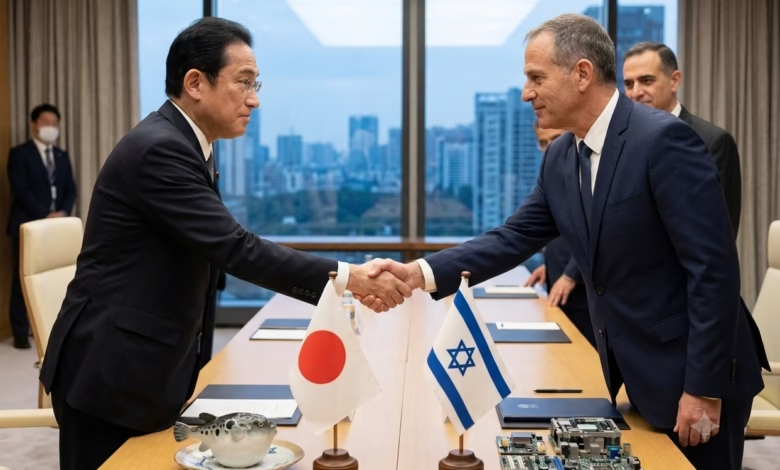
In Early January 2015, Israeli Prime Minister Benjamin Netanyahu Stood Alongside His Japanese Counterpart Shinzo Abe To Announce At A Press Conference A Golden Era And An Unprecedented Shift In The Level Of Economic And Technological Cooperation Between Tel Aviv And Tokyo. Netanyahu Spoke In A Celebratory Tone Of The “Mutual Genius” Uniting The Two Peoples, While Shinzo Abe Responded By Evoking The Legacy Of Japanese Diplomat Chiune Sugihara, Who Issued Thousands Of Visas To Rescue Jewish Refugees From The Nazi Holocaust During World War II, Emphasizing That There Are “Deep And Ancient Ties Uniting Japan And The Jews.”
These Official Statements Project A Harmonious Picture Of History, Claiming The Existence Of Ancient Civilizational Connections And Mutual Understanding Between Two Nations Living At The Opposite Ends Of Two Distant Continents. However, Rigorous Academic Historical Truth Reveals A Completely Different Narrative—One Enveloped In Myths And Governed By Dual Stereotypical Perceptions.
The Comprehensive Work By Dr. Silvia Pingers, Jews In Japan: Presence And Perception – Antisemitism, Philosemitism And International Relations, Published By The Esteemed German Publishing House De Gruyter (2024), Arrives To Provide The Deepest And Most Precise Deconstructive Study Of This Multi-Dimensional, Complex Relationship.
In This Encyclopedic Work, Pingers Advances A Central Thesis Summarized As Follows: While The Actual Physical Presence Of Jews On Japanese Soil Was Always Marginally Small In Numerical Terms, The “Imagined Perception” Of The Jew In The Japanese Collective Imagination, Consciousness, And Political Mind Played An Immense And Pivotal Role In Shaping Japanese National Identity, Formulating Its Imperial Doctrine, And Even Guiding Its Foreign Policy Decisions Toward Major Powers.
The Stark Historical Paradox Highlighted By The Book Lies In The Unique And Peculiar Coexistence Of Two Seemingly Contradictory Currents: “Antisemitism” And “Philosemitism” (An Intense Admiration And Fascination With Jews) Within The Japanese Mind. Notably, These Two Concepts In The Japanese Context Do Not Stem From Religious Or Racial Motives Arising From Direct Contact Or The European Christian Anti-Jewish Heritage. Instead, They Derive From A Broader Umbrella Concept Termed By Sociologist Zygmunt Bauman As “Allosemitism”—A State Of Dual Vision Of The Other As An Exceptional Being Possessing Extraordinary Powers Of Influence, Wealth, And Control, Causing The Perception To Oscillate Abruptly Between Supreme Admiration And Extreme Caution Without Requiring A Real Physical Presence Of This Group’s Members.
Initial Beginnings: Merchants And Refugees In Open Ports
The Actual Formation Of A Jewish Presence In Japan Dates Back To The Mid-Nineteenth Century, Specifically With The End Of Japan’s Period Of National Isolation (Sakoku) And The Signing Of Unequal Treaties Of Commerce And Navigation With The United States And European Powers In 1858. These Treaties Enforced The Opening Of The Ports Of Nagasaki, Yokohama, And Kobe To International Trade, Establishing Foreign Settlement Enclaves Enjoying Extraterritorial Rights.
Among These Initial Waves Of Foreign Merchants Converging On Japanese Ports In Search Of Investment Opportunities And New Markets, Jewish Trading Families Arrived From Diverse Backgrounds:
Baghdadi Family Networks (Sephardi/Baghdadi Jews): Merchant Families Emerged Via Established Trade Routes In India And Shanghai, Such As The Family Of Elias Sassoon, Who Established A Branch Of His Expanding Enterprise In Yokohama, Alongside The Ezra, Yehuda, And Hardoon Families. They Relied On Maritime Trade, Financial Intermediary Services, And Raw Material Supply.
European And British Merchants: Prominent Figures Emerged, Such As The Samuel Brothers (Marcus & Samuel Samuel), Who Founded “Samuel Samuel & Co” In Yokohama And Kobe. This Firm Played A Vital Role In Japan’s Industrial Renaissance During The Meiji Era, Purchasing 40 Million Yen Worth Of Japanese War Bonds In 1897 To Support The Imperial Treasury. Marcus Samuel Later Founded The Energy Giant Shell.
Russian Jews And Nagasaki Settlers: Nagasaki Witnessed The Formation Of The First Organised, Legally And Religiously Established Jewish Community In Japan. This Foundation Was Led By Figures Like Reuben Haskell Goldenberg, Who Established A Chain Of Hotel-Taverns Serving Foreign Sailors And The Russian Fleet, Allocating His Profits To Build Japan’s First Synagogue, “Beit Israel,” In 1896. Additionally, Sigmund David Lessner Emerged, Founding The Jewish Benevolent Society In 1901 And A Local Zionist Association In 1906.
Despite This Remarkable Economic Activity, Pingers Emphasizes That The Japanese Authorities And Society Did Not View These Individuals Through Specific Religious Or Racial Discrimination; Rather, They Were Categorized Simply Under The Group Of “Foreigners” (Gaijin). Their Original Nationalities (British, Russian, American) Were The Primary Identifiers Of Their Identity In Official Documents. Due To The Absence Of Historical Roots Of Christianity In Japan, No Automatic Popular Hostility Formed Against Jews; Rather, Their Religious Rites Were Viewed Simply As Another Pattern Of Western Christian Worship Or Exotic Eastern Traditions.
Crafting The Image: Between The Common Race Myth And Capital
If The Physical Presence Of Jews Remained Limited, How Did The Idea And Imagined Conception Of The Jew Flow And Evolve In Modern Japanese Culture? Researcher Silvia Pingers Tracks The Dual Shift Of This Image Through Three Primary Streams That Formed The Japanese Mind In The Late Nineteenth And Early Twentieth Centuries:
The Myth Of Common Ancestry (The Common Ancestry Theory)
This Peculiar Theory Began At The Hands Of Scottish Missionary Norman McLeod, Who Published A Book In Nagasaki In 1879 Titled Epitome Of The Ancient History Of Japan: Japan And The Lost Tribes Of Israel. McLeod Claimed That The Japanese People Were Nothing Less Than The Direct Descendants Of The Tribe Of Manasseh, One Of The Ten Lost Tribes Of Israel Scattered Following The Assyrian Captivity In 722 BC.
The Strangeness Of This Western Colonial Theory Was Initially Aimed At Explaining How A “Colored” Non-White People Like The Japanese Could Achieve A Brilliant Industrial And Military Renaissance; Western Racial Logic Could Not Conceive Such Success For An Asian Nation Unless Tied To An Ancient Semitic Or Western Lineage!
Yet The Historical Paradox Was Revealed In How This Myth Was Recycled Inside Japan Itself. Japanese Nationalist Thinkers And Christians (Such As Oyabe Zenichiro And Saeki Yoshiro) Did Not Reject It; Instead, They Reformulated It To Assert The Superiority And Popular Sacredness Of The Japanese. They Claimed That The Japanese People Retained Divine Racial Purity, Commissioned To Save The World And Rebuild The State Of Israel In Palestine Under The Umbrella Of The Japanese Empire.
The Jacob Schiff Experience And Financing The Russo-Japanese War (1904–1905)
The Russo-Japanese War Formed A Pivotal Geopolitical Turning Point In Modern History. When Japan Launched Its War Against The Russian Empire, The Japanese Treasury Faced A Dead End In Obtaining Continental Loans From European Banks. Here Appeared The Prominent Jewish-American Banker Jacob Schiff, Head Of The Financial Firm Kuhn, Loeb & Co In New York.
Schiff Led A Massive Financial, Humanitarian, And Economic Consortium That Granted Japan Consecutive Loans Totaling Approximately 82 Million Pounds Sterling (Equivalent To Over 13 Billion Dollars In Today’s Value), Capital That Covered Over 68% Of The Direct Costs Of Japan’s War Effort, Culminating In Tokyo’s Historic Victory.
Schiff’s Stated Motivation Stemmed From His Desire For Retaliation Against The Anti-Semitic Russian Tsarist Regime, Which Sponsored Pogroms Against Jews In Odessa And Other Imperial Russian Cities. However, For The Japanese Financial And Political Elite, Such As Bank Of Japan Vice Governor Takahashi Korekiyo, Jacob Schiff’s Action Provided Definitive Proof Validating The Notion That “Jews Possess Mythical Transnational Financial Power, Capable Of Directing The Destinies Of Nations And Empires.” Emperor Meiji Received Jacob Schiff At The Imperial Palace In 1906, Awarding Him The Order Of The Rising Sun, Transforming Schiff In The Japanese Imagination Into A Symbol Of “The Powerful, Beneficent, And Friendly Jew.”
War Transformations And The “Global Conspiracy” Doctrine
Just As Jacob Schiff’s Loan In The 1904 War Was The Primary Reason For Solidifying The Myth Of Exceptional Jewish Financial Power In The Consciousness Of Japanese Military And Political Leaders, The Tumultuous Developments Following The 1917 Bolshevik Revolution In Russia Arrived To Overturn This Image Entirely, Transforming It From Admiration Into Extreme Caution And Security Concern. The “Siberian Intervention” Military Campaign, In Which Japan Dispatched Tens Of Thousands Of Soldiers Between 1918 And 1922 To Support Counter-Revolutionary White Russian Forces Against Bolshevism, Placed Japanese Officers In Direct Contact For The First Time With The Fiercest Anti-Semitic European Literature.
In The Isolated Siberian Wilderness And Besieged Encampments, Japanese Officers Mingled With White Russian Commanders Hostile To The Bolshevik Revolution. These Russian Commanders Carried In Their Baggage Heavily Printed Translations Of A Widely Circulated Forged Document Known As The Protocols Of The Elders Of Zion. This Pamphlet Claimed The Existence Of A Secret Worldwide Jewish Conspiracy Planning To Overthrow Traditional Imperial And Monarchical Systems Through Two Seemingly Contradictory Tools: Global Monopoly Financial Capitalism On One Hand, And Revolutionary Communist And Bolshevik Movements On The Other. For Japanese Officers Raised In An Environment Sanctifying The Emperor And Viewing The Japanese Governance System (“Kokutai”) As A Sacred Entity, This Narrative Arrived Like An Electric Shock Shaking Their Military Security Doctrine.
Those Japanese Officers Returned To Tokyo Carrying This Fictional Text, Led By Prominent Military Figures Such As Colonel Yasue Norihiro And Lieutenant Commander Inuzuka Koreshige. These Military Officers Formed What Became Known Within The Japanese General Staff As The “Jewish Affairs Ring.” Rather Than The Reading Of The Protocols Of The Elders Of Zion Leading To A Popular Extermination Movement Or Hatred Against Jews As Occurred In Nazi Germany’s Brutality, The Japanese Military Mind Produced A Completely Different Pragmatic Reading. These Military Leaders Believed Every Word In The Forged Protocols Book; However, Instead Of Fearing This “Global Conspiracy,” They Took A Strange Strategic Decision Summarized As: “If The Jews Truly Control The Global Economy, Media, And The American Administration, Why Don’t We Harness This Immense Power For The Benefit Of The Japanese Empire And Employ It To Build Our Expansionist Project In Asia?”
The Fugu Plan: Pragmatic Exploitation Engineering In Manchuria
This Pragmatic Vision Reached Its Zenith Of Development And Practical Application Following The Japanese Invasion Of Manchuria In Northeast China In 1931 And The Establishment Of The Puppet State Of Manchukuo. The Japanese Empire Faced A Severe Economic And Investment Crisis In Manchuria; The Region Required Massive Investments To Construct Infrastructure, Extract Minerals, Build Railway Lines, And Secure Extensive Borders Against The Soviet Union. Here, Japanese Jewish Affairs Experts, In Coordination With Industrial Magnates Such As Ayukawa Yoshisuke, Founder Of The Nissan Industrial Cartel, Formulated What Became Historically Known As The Fugu Plan.
The Project’s Name Resembles The Famous Poisonous “Fugu” Fish In Japanese Culture; This Fish Is Considered A Nutrient-Rich Delicacy, But Contains Highly Toxic Organs. If The Skilled Chef Does Not Remove The Poison With Utmost Care, Whoever Eats It Will Die Of Poisoning. This Metaphor Was A Precise Embodiment Of The Japanese View Of Jews During That Era: They Possessed Capital, Investment Minds, And Immense International Connections (The Delicious Meat), But Also Held Political Influence That Might Threaten The Japanese Imperial System If Not Managed With Care And Craft (The Lethal Poison).
The Fugu Plan Aimed To Settle Tens Of Thousands Of Jewish Refugees Fleeing The Brutality Of Nazi Germany And Eastern Europe In Manchuria, Specifically In Harbin And Shanghai. The Plan Was To Offer These Refugees Safe Haven, Freedom Of Religious Practice, And Economic Autonomy In Exchange For Investing Their Capital, Developing Industry In Manchukuo, And Utilizing Their Presumed Ties With The American Administration And President Franklin Roosevelt To Persuade Washington To Recognize Japanese Occupation And Inject American Loans Into The Japanese Economy. Toward This End, Japanese Authorities Convened A Series Of Conferences In Harbin Between 1937 And 1939 Gathering Prominent Far East Jewish Figures, Promising Them Justice, Equality, And Complete Security Protection From Any Racial Practices.
Teaspoon Diplomacy: Rescuing Refugees Between Visas And Alliances
This Complex Historical Period Witnessed Sharp Tension Within Japanese Decision-Making Institutions. While The War Ministry And Military Authorities Sought To Implement The Fugu Plan, The Japanese Ministry Of Foreign Affairs Was Steadily Approaching The Signing Of The Tripartite Pact With Nazi Germany And Fascist Italy In 1940. This New Alliance Created A Stark Contradiction Between Japan’s Political Commitment To Berlin And Its Pragmatic Policy Toward Jewish Refugees. Despite Repeated German Diplomatic Pressures On Tokyo To Implement Racial Laws And Hand Over Jews Present In Areas Under Japanese Control, The Japanese Government Refused Full Compliance With German Demands, Continuing A Policy Of Maneuvering That Prioritized Japanese National Interests Over Any Ideological Consideration.
In This Tension-Filled Space, Historic Individual Initiatives Emerged, Led By Japanese Diplomat Chiune Sugihara, The Japanese Consul In Kaunas, Lithuania. In The Summer Of 1940, With All Outlets Closed To Thousands Of Jews Fleeing The Expanding Forces Of The Nazi State And The Soviet Union, Sugihara Violated Direct Instructions Issued To Him From The Foreign Ministry In Tokyo. He Began Writing And Signing Thousands Of Transit Visas By Hand Around The Clock, Allowing Over Six Thousand Jewish Refugees To Board Trains Across Soviet Railways To Reach The Japanese Port Of Tsuruga, And From There To Kobe And Shanghai.
Sugihara Was Not The Sole Case; General Higuchi Kiichiro Preceded Him In 1938, Allowing Thousands Of Jewish Refugees To Cross From The Soviet Border Into Manchuria Via Otpor Station While Serving As A Local Military Commander, Overriding Sharp Protests From The German Embassy In Tokyo. Although These Initiatives Were Distinguished By Courageous Moral Humanism By Their Actors, The Japanese State Itself Later Exploited These Events As Public Relations Tools To Polish Its International Image And Defend Its Humanitarian Stance During The War, Attempting To Demonstrate Intellectual Independence From Its German Ally And Its Extermination Policies.
The Shanghai Ghetto And Post-Defeat Reconfiguration
The Japanese Maneuvering Policy Toward Jewish Presence Reached Its Decisive Moment Of Truth Following The Outbreak Of The Pacific War and The Japanese Attack On Pearl Harbor In December 1941. Direct Military Confrontation Between Japan And The United States Caused The Collapse Of The Entire Strategic Myth Behind The Fugu Plan; Military Leaders In Tokyo Realized That Enticing American Jewish Capital Failed To Prevent Washington From Declaring War And Imposing Severe Economic Squeezing On Japan. Simultaneously, German Pressures Renewed From The Nazi Ally, With Berlin Dispatching Special Officers Demanding The Japanese Implement The “Final Solution” And Completely Dispose Of Thousands Of Jewish Refugees Gathered In The Japanese-Controlled Port Of Shanghai.
The Japanese Military Authorities’ Refusal To Comply Directly With German Demands For The Liquidation Of Jews Did Not Stem From A Sudden Moral Awakening So Much As A Continuation Of Japanese Caution Against Provoking A Power They Believed Possessed The Capacity For Economic Retaliation After The War. Instead Of Surrendering To The Nazis, The Japanese Military Administration Devised A Compromise Ensuring Control And Security Without Massacres; In February 1943, Japanese Authorities Announced The Establishment Of The “Designated Area For Stateless Refugees” In The Impoverished Hongkew District Of Shanghai, Historically Known As The Shanghai Ghetto.
Approximately Twenty Thousand Jewish Refugees Fleeing European Horrors Were Forced To Relocate Immediately Into This Overcrowded, Confined Area Under Strict Military Surveillance Managed By Japanese Officer Kanoh Inuzuka. These Refugees Lived Under Extremely Harsh Living And Health Conditions, Suffering From Food And Medicine Shortages, Overcrowding, Severe Cold, And A Rigid Pass System. Nevertheless, Despite Severe Human Suffering, The Vast Majority Of This Ghetto’s Population Survived The Holocaust Consuming Their Kin In European Death Camps; The Ghetto Remained Intact Until Liberation With Japan’s Surrender Ending World War II In The Summer Of 1945.
Japan’s Humiliating Surrender And The Entry Of American Occupation Forces Led By General Douglas MacArthur Caused A Massive Earthquake In The Intellectual And Political Structure Of The Japanese Public. Imperial Doctrine Was Dismantled, A New Constitution Renouncing War Was Imposed, And Military Institutions Sponsoring The “Jewish Affairs Ring” Were Abolished. Yet Old Stereotypes Did Not Disappear; They Underwent Radical Reformulation Suited To The New Era, Shifting From Exploitative Military Philosemitism To A Pacifist, Diplomatic Philosemitism Relying On Reintegrating Japan Into The International Community And The United Nations.
With The Declaration Of The State Of Israel In Palestine In 1948, Tokyo Hurried To Recognize The New State As A Means To Align Itself With Washington And Western Nations. In 1952, Japan Became The First Asian Country To Establish Full Official Diplomatic Relations With Israel, Opening An Embassy In Tel Aviv. However, These Nascent Relations Soon Collided With A Painful Geopolitical And Economic Reality For Tokyo: Japan’s Absolute Need For Middle Eastern Oil To Rebuild Its Shattered Industrial Economy, Placing It Between The Hammer Of Pleasing The West And The Anvil Of Fearing The Arab Boycott.
The Critical Balance: Oil, The Arab Boycott, And Foreign Policy
Japanese-Israeli Relations Entered A Long Period Of Stagnation Extending Over Three Decades Following The Outbreak Of The October 1973 War And The Oil Embargo Imposed By Arab Oil-Exporting Countries On Israel-Supporting Nations. This First Oil Shock Caused An Economic Nightmare And Panic Across Japan’s Business And Ruling Circles, As Technocrats Realized Interrupting Arab Oil Flows Meant Total Paralysis For Japan’s Electrical Grid And Factories Within Weeks.
Under Severe Pressure, The Japanese Government Headed By Kakuei Tanaka Issued A Historic Official Statement In November 1973 Known As The “Nikaido Statement.” Tokyo Announced For The First Time Explicit Support For The Legitimate Rights Of The Palestinian People, Calling On Israel To Withdraw Fully From All Arab Territories Occupied In The 1967 War Pursuant To United Nations Resolutions. Japan Did Not Stop There; It Complied Almost Entirely With The Rules Of The “Arab Boycott Of Israel,” With Major Industrial And Financial Corporations Like Toyota, Nissan, Sony, And Panasonic Refraining From Direct Investment, Trade, Or Branch Openings In Israel For Fear Of Blacklisting And Deprivation From Arab Markets And Gulf Oil.
This Economic Submission Reflected On Japanese Official Diplomacy, As The Foreign Ministry Adopted A “Low-Profile, Cold Diplomacy” Toward Israel. High-Level Ministerial Visits Were Deferred, And Tokyo Avoided Important Trade Or Technological Agreements With Tel Aviv, While Actively Strengthening Relations With Arab Countries And Dispatching Development Assistance. This Forced Equilibrium Tilted In Favor Of The Arab World Continued Through The 1970s And 1980s, As Japan Prioritized Energy Security Above Other Considerations, Leaving Relations With Tel Aviv In Cautious Freezing.
Popular Literature Phenomenon And International System Shifts
While Official Foreign Policy Maintained Cold Pragmatic Calculations Balancing Gulf Oil With Washington’s Alliance, Japan’s Local Publishing Market Witnessed An Unprecedented Surge In Popular Anti-Semitic Literature During The 1980s. This Phenomenon Assumed Commercial Proportions; Books Addressing The “Global Jewish Conspiracy” Topped National Bestseller Lists, Selling Millions Of Copies In Major Bookstores. Prominent Japanese Authors Such As Uno Masami Wrote Popular Series Bearing Titles Like If You Understand The Jews, You Will Understand The World And The Jewish Conspiracy To Control The Japanese Economy.
The Intriguing Aspect Of This Cultural Trend Was That Book Sales Were Not Accompanied By Physical Manifestations Of Hatred, Violence, Or Exclusionary Calls Against Jewish Residents In Japan. The Mental Model Of “Allosemitism” Continued Operating Via Traditional Mechanisms; The Average Japanese Reader Viewed Imagined Conspiracies With A Mixture Of Astonishment, Admiration, And Awe, Rather Than Malicious Hatred. The Economic Boom Experienced By Japan In The “Bubble Economy” Era, The Appreciating Yen, And Japanese Corporate Dominance Over American Competitors Were Interpreted As Threats Prompting “Secret Jewish Financial Powers” In New York And Washington To Plot Against Japan’s Economy Through Financial Restructuring Agreements.
However, This Complex Intellectual Scene Underwent Radical Restructuring At The Beginning Of The 1990s As Three Major Historical Shifts Converged. The First Was The Bursting Of Japan’s Economic Bubble, Leading To Long-Term Stagnation (“The Lost Decade”) And Reduced Popularity For Conspiracy Literature. The Second Shift Was The Collapse Of The Soviet Union Ending The Cold War, Establishing A Unipolar International System Led By The United States And Forcing Japan To Reevaluate Its Geopolitical Positioning In East Asia And The World.
The Third Shift In The Middle East Was The 1991 Madrid Peace Conference And The 1993 Oslo Accords Between Israel And The Palestine Liberation Organization. This Diplomatic Development Provided Japan An Ideal Exit Strategy To Gradually Disengage From The Arab Boycott And Transcend The Nikaido Statement Constraint. Tokyo Viewed The Peace Process As Political Cover Allowing Direct Economic And Political Ties With Israel Without Fearing A Renewed Oil Embargo.
This Structural Change Prompted A Shift In Major Japanese Corporate Behavior Toward Tel Aviv. Giant Corporations Such As Toyota, Nissan, Mitsubishi, And Sony Lifted Trade Restrictions, Exporting Products And Investing In The Israeli Market. This Was Accelerated By Global Economic Shifts Toward Advanced Technology, Cybersecurity, Artificial Intelligence, And Software, Where Japanese Companies Seeking Innovation Found In Israel’s Startup Ecosystem A Vital Partner, Paving The Way For A New Era Of Technological Strategic Partnership In The Twenty-First Century.
The Abe Era And The Modern Strategic Approach
Japanese-Israeli Relations Entered An Unprecedented Phase Of Momentum With The Accession Of Late Prime Minister Shinzo Abe To Power In His Second Term In 2012. Abe Adopted A Proactive Foreign Policy Known As “Diplomacy That Takes A Panoramic View Of The World Map,” Aiming To Break Free From Pacifist Isolationism Imposed On Japan Since World War II And Enhance Tokyo’s Geopolitical Presence Globally To Counter China’s Growing Power. In This New Strategic Context, Israel Was No Longer Viewed Merely As An Regional Flashpoint To Be Avoided For Oil Protection, But Transformed Into A Vital Technological And Security Partner Holding Keys To Advanced Innovation In Space, Cybersecurity, And Dual-Use Military Technologies.
The Year 2015 Marked The Historic Peak Of This Diplomatic Shift; Shinzo Abe Paid An Official Visit To Tel Aviv Heading A High-Level Economic Delegation, Reciprocated By Benjamin Netanyahu In Repeated Visits To Tokyo. These Visits Yielded Strategic Agreements, Including Investment Protection Accords, Defense And Cybersecurity Cooperation Agreements, And Facilitation Of Expert Exchanges. This Led To A Surge In Direct Japanese Investment In Israel’s Tech Sector, With Billions Of Dollars Flowing From Japanese Investment Funds And Corporations To Acquire Stakes In Startups And Establish Joint Research And Development Centers In Artificial Intelligence, Autonomous Vehicles, And Biotechnology.
Nevertheless, Dr. Silvia Pingers’ Analysis Demonstrates That This Modern Rapprochement Is Not Free From The Shadows Of Ancient Historical Myths, Which Have Been Reproduced Through Modern Diplomatic Means. When Japanese And Israeli Leaders Evoke The Legacy Of Diplomat Chiune Sugihara Or Speak Of “Exceptional Genius And Civilizational Convergences,” They Engage In Political Utilization Of Historical Records. The Japanese State Reuses Sugihara’s Humanitarian Story To Reaffirm Its Peace-Loving Image, While The Israeli Establishment Leverages These Narratives To Reinforce The Idea That Israel Enjoys Special Historical Affection In The Far East, Ignoring The Pragmatic Contexts That Guided Japanese Behavior Across Decades.