
In An Era Where Political Conflicts Intertwine With Cultural Identities, And Scenes Of Violence Top Television Screens And Newspaper Fronts, The Book “Fields Of Blood: Religion And The History Of Violence” By The Prominent Researcher Karen Armstrong Emerges As An Extremely Important Historical And Intellectual Document. This Massive Tome, Which Was Brilliantly Translated Into Arabic By The Translator Osama Gawji And Published By The Arab Network For Research And Publishing, Does Not Merely Narrate Historical Events, But Dives Into The Depths Of The Psychological, Political, And Social Structure That Shaped Human Civilization. The Book Takes Us On An Epic Journey Extending From The Eras Of Hunting And Gathering, Passing Through The Cradle Of Agricultural Civilizations, Arriving At The Era Of Globalization And What Is Known As The War On Terror, Attempting To Answer A Central And Thorny Question: What Is The True Nature Of The Relationship Between Religion, Violence, And The Establishment Of The State?
The Modern Secular Narrative Is Founded On A Postulate That Seems Almost Axiomatic In The Contemporary Collective Consciousness, Which Is The Necessity Of A Decisive Separation Between Religion And The State, Based On A Fundamental Assumption Linking Religion And Blind Fanaticism Inevitably Leading To Violence. This Claim, Which Is Repeated Like Incantations In The Media, On The Tongues Of Politicians, And Even Among Academics And Taxi Drivers, Claims That Religion Was The Main Cause Of All Major Wars In Human History. However, Armstrong Places This “Axiom” Under The Microscope Of Strict Critical Questioning, Pointing Out That This Claim Ignores Clear Historical Facts, Such As The Two World Wars That Did Not Erupt For Religious Reasons At All. Rather, Military Historians Agree That Wars Break Out As A Result Of Complex Intersections Of Economic, Social, And Material Factors, On Top Of Which Is The Fierce Competition For Scarce Resources.
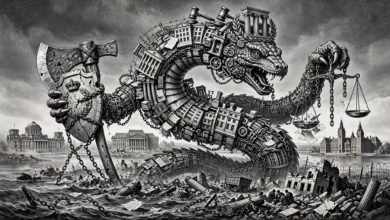
Modern Society, According To The Analysis Adopted By Armstrong Based On The Vision Of The Thinker René Girard, Has Created For Itself A “Scapegoat” Represented By Religions, To Bear The Burden Of All Its Sins And Latent Violence. The Author Evokes The Image Of The High Priest In Ancient Israel Who Would Release A Goat Into The Wilderness Loaded With The Sins Of The Society, To Compare Between This Ancient Ritual And What Contemporary Secularism Does When It Strips Itself Of The Responsibility Of Institutional And Political Violence To Attach It To Religion. In This Context, The Translator Osama Gawji Provides In His Opening Remarks An Important Critical Illumination, Pointing Out That Secularism Made Religion A Scapegoat For The Sins Of The Modern State, Ignoring That Secular Ideologies, On Top Of Which Is Nationalism, Were No Less Violent Or Bloody, But Rather Practiced A Multiplied And Systematic Violence, And Crowned That With A Colonial Project That Dismantled Other Cultures And Imposed The Nation-State Model As The Only Choice.
One Of The Major Problematic Issues Raised By The Book Is The Conceptual Evolution Of The Word “Religion” Itself. Armstrong Clarifies That The Modern Western Concept Of Religion, Which Confines It To The Space Of Personal Spiritual Experience And Private Beliefs, Is A Relatively Modern Invention Dating Back To The Seventeenth And Eighteenth Centuries, Specifically With The Rise Of Protestant Christianity And The Establishment Of The Nation-State In Europe. Before This Stage, Religion Was Not Separate From Politics, Economics, Or Any Of The Affairs Of Daily Life. In Ancient Languages, Such As Arabic Which Uses The Word “Deen” To Denote A Comprehensive Way Of Life, Or Sanskrit Which Uses The Vocabulary “Dharma” To Express Concepts Of Law, Justice, And Social Order, We Do Not Find An Exact Equivalent To The Modern Secular Concept Of Religion. Religion In Pre-Modern Societies Permeated Every Human Activity, From Agriculture And Building To Drinking Wine And Waging Wars, And The Ancients Could Not Imagine A Dividing Line Between What Is Religious And What Is Political.
To Understand The Deep Roots Of Violence, Armstrong Takes Us Back To Neuroanatomy, Showing That Humans Possess Three Superimposed Brains. The First Brain Is The Old “Reptilian Brain”, Which Focuses Exclusively On Survival, Fierce Competition, And Protecting Territory, And It Is The Source Of Selfish Ego-Centric Motives. The Second Brain Is The “Limbic System” That Evolved With Mammals, Which Granted Creatures The Ability To Care For The Young, Attachment, Building Alliances, And Forming Feelings Of Empathy. As For The Third Brain, It Is The “Neocortex” That Appeared With Stone Age Humans, Which Granted Us The Ability For Rational Thinking, Self-Awareness, And Sensing The Tragedy Inherent In Human Existence. This Complex Biological Makeup Makes The Human Being A Permanent Battlefield Between The Instinct To Kill And Survive On One Hand, And Feelings Of Mercy And Empathy On The Other.
And This Duality Manifests Clearly In The Ancient Cave Paintings In “Lascaux” In France, Where Stone Age Hunters Expressed Their Pain And Empathy With The Animals They Were Forced To Kill For The Sake Of Survival. Art And Religion In Their Beginnings Were A Ritualistic Attempt To Mitigate The Severity Of This Fundamental Contradiction: The Need To Destroy The Lives Of Other Creatures For The Sake Of The Continuation Of Human Life. Hence, Hunting Was Associated With Complex Purificatory Rituals, As An Expression Of Deep Respect For The Victim.
But The Dramatic Shift In The Trajectory Of Human Violence Did Not Come From Hunting, But From Agriculture. With The Discovery Of Agriculture In The Levant Around 9000 BC, Specifically In Settlements Like Jericho Which Surrounded Itself With Massive Defensive Walls, There Appeared What Armstrong Calls “Structural Violence”. The Production Of Agricultural Surplus Led To Massive Demographic Growth, But It Created At The Same Time Harsh Hierarchical Societies. And For The First Time In History, A Small Aristocratic Class Emerged Not Exceeding Two Percent Of The Population, Seizing By Organized Force The Fruits Of The Toil Of The Overwhelming Majority Of Peasants. This Exploitative System, Which Was Clearly Embodied By The Civilization Of Sumer In Mesopotamia Through The Epic Of Gilgamesh, Relied On Military Force For Subjugation And Protection, Which Made War An Indispensable Economic And Political Necessity For Any Agricultural State.
Building Civilization Was Conditional Upon This Structural Violence, As The Exploitation Of Peasants Provided The Free Time And Wealth Necessary To Develop Arts, Sciences, And Laws. In This Context, Religion Was Not Separate From This Dark Political Structure, Rather Myths, Such As The Myth Of The Cosmic State In Sumer, Were Employed To Justify This Class Disparity And Bestow A Heavenly Legitimacy On The Orders Of The Ruling Elite, Imagining That Their Harsh Social Organization Reflects The Will Of The Gods In Heaven. However, Armstrong Asserts That Religion Itself Represented In Many Times A Pained Protesting Voice, As We See In The Supplications Of The People Of Uruk Against The Tyranny Of Their King Gilgamesh, Attempting To Curb The Violence Of The State And Searching For A Human Alternative Amidst The Cruelty Of Civilizational Necessities.
With The Deepening Of Agricultural Empires In Entrenching Their Control Mechanisms, And Humanity’s Entry Into The Iron Age Which Provided Lethal And Cheap Weapons That Allowed Building Massive Armies, The World Witnessed What Is Known As The “Axial Age” (Extending Approximately Between 900 And 200 BC). In This Context Saturated With Blood And Imperial Expansion, Karen Armstrong Traces The Emergence Of The Major Spiritual And Philosophical Traditions In The World, Not As Instigators Of Violence, But As Deep And Sorrowful Reactions To The Atrocities Of The Emerging Military State. The Axial Age, Which Witnessed The Birth Of Buddhism, Hinduism, Confucianism, Daoism, Greek Philosophy, And Middle Eastern Monotheism, Was In Its Essence A Grand Human Attempt To Curb The Structural And Direct Violence Practiced By Political Regimes In Order To Monopolize Power And Resources.
Moving To The Indian Subcontinent, The Author Reviews How The Concept Of “Ahimsa” (Non-Violence) Crystallized As A Categorical Rejection Of The Violence Inherent In Vedic Sacrificial Rituals And In The Expansionist Wars Of The Emerging Kingdoms. Buddhism And Jainism Were Movements Of Spiritual Rebellion Against The Brutality Of The Agricultural State, Where Monks Chose To Withdraw From The Cycle Of Production And Consumption That Requires The Oppression Of Peasants And The Shedding Of Blood. However, Armstrong Places Us Before One Of The Deepest Historical Paradoxes Through Evoking The Biography Of The Indian Emperor “Ashoka” Who Ruled The Mauryan Empire. For After A Horrific Massacre In The Kalinga War That Claimed The Lives Of Hundreds Of Thousands, Ashoka Embraced Buddhism And Declared His Repentance From War. But He Collided With The Bitter Political Reality; As He Realized That Managing A Vast Empire Necessarily Requires Maintaining A Strong Army, Collecting Taxes By Force, And Using Harsh Punishments To Deter Rebellion. Ashoka’s Experience Proved That The Ruler, No Matter How High His Spiritual Elevation Reaches, Does Not Possess The Luxury Of Abandoning “Structural Violence” If He Wants The State To Continue, For The State By Its Nature Is A Coercive Entity Whose Mechanisms Of Violence Cannot Be Dismantled Without Causing Sweeping Chaos.
And This Dialectic Gains Harsher And Clearer Dimensions When Studying The Chinese Experience During What Is Known As The “Warring States Period” (475 – 221 BC). In That Stage, Wars In China Transformed From Mere Ritualistic Skirmishes Led By The Aristocratic Elite, To Comprehensive Wars Of Annihilation In Which Massive Armies Of Forcibly Conscripted Peasants Participate. This Civilizational Shock Produced Diverse Intellectual Schools That Attempted To Restore The Collapsed International Order. For While Confucius Sought To Revive Ancient Rituals (Li) And Spread The Values Of Humanity (Ren) To Refine The Behavior Of Rulers, And Daoists Chose Total Withdrawal From Coercive Political Action, The “Legalist School” Emerged As A Strict Pragmatic Current That Does Not See Any Political Value In Ethics. Legalist Philosophers, Such As Shang Yang And Han Feizi, Founded A Theory Of Governance Based Exclusively On Maximizing The Material Power Of The State Through Two Sectors With No Third: Agriculture And War. This School Formed The Ideological Foundation That Enabled The State Of “Qin” To Unify China With Iron And Fire, To Prove Once Again That The Cohesion Of The Political System And The Establishment Of Empires Was Never Based On Religious Sermons, But On A Brutal Monopoly Of The Tools Of Power And Material Violence, Which Heavily Intersects With The Literature Of Structural Realism In Explaining The Dynamics Of Power Across History.
And On The Other Bank Of The Ancient World, And In The Middle East Region, Armstrong Presents An Exceptional Analysis Of The Ancient Israelite Experience. Unlike The Great Empires In India And China, Israel Was A Small Marginal Kingdom Stuck Between The Great Powers In Egypt And Mesopotamia. Here, Religion Did Not Take The Form Of A State Philosophy, But Crystallized As A “Radical Critique” Of The Violence Of The Agricultural State. Prophets, Such As Amos And Isaiah, Emerged As Voices Of Political And Social Opposition Denouncing The Elite Class That Monopolizes Wealth And Crushes Poor Peasants. The Prophetic Heritage Established A Theology Linking Worship And Social Justice, Considering That Holding Rituals In The Temple Has No Value If Accompanied By The Exploitation Of Widows, Orphans, And The Poor. This Pivotal Shift Was Akin To Stripping The Divine Legitimacy From The Structural Violence Practiced By The State, And Holding The Ruling Elite Responsible For Class Disparity.
Through This Panoramic Reading Of The Axial Age In India, China, And The Middle East, Armstrong Demonstrates That The Major Religions And Philosophies Were Not The Engineers Of State Violence, But Were In Most Cases Desperate Attempts To Mitigate Its Excesses Or Criticize Its Exploitative Foundations. However, This Tension Between Spiritual Idealism And The Necessities Of Political Power Will Take A New And More Complex Curve With The Rise Of The Major Monotheistic Religions And Their Later Transformation Into Expansionist Imperial Ideologies. And It Is The Development That Will Reshape The Geopolitical Scene Of The Ancient World.
With The Dawning Of The Imperial Era For Monotheistic Religions, Armstrong’s Narrative Enters A Decisive Turning Point Revealing The Mechanisms Of Mutual Taming Between Theology And Political Authority. Perhaps The Dramatic Transformation Of Christianity Presents The Most Prominent Model For This Complex Dynamic. Christianity Began As A Peaceful Utopian Movement On The Margins Of The Roman Empire, Where Christ And His Early Followers Embodied A Radical Rejection Of Roman Violence. And For Three Centuries, Christians Adhered To The Principle Of Non-Violence, Preferring Martyrdom Over Enlisting In The Imperial Armies. However, This Spiritual Purity Collided With The Imperatives Of Political Survival When Emperor Constantine Embraced Christianity In The Fourth Century AD. At That Defining Moment, The Church Transformed From A Victim Of State Violence Into A Partner In Managing It, And Discovered That Managing A Sprawling Geopolitical Entity Requires Armies, Taxes, And Coercive Power That Do Not Align With The Early Peaceful Beginnings.
This Glaring Contradiction Between Evangelical Idealism And The Necessities Of The State Pushed Great Thinkers, At The Forefront Of Whom Was Saint Augustine, To Formulate The “Just War” Theory. This Theory Was Not A Founding Of A Theology Of Violence, But It Was A Pragmatic Attempt To Reconcile Religious Ethics And The Requirements Of National Security For The Empire That Was Reeling Under The Blows Of The Germanic Tribes. And Thus, Religion Was Domesticated To Serve The State System, And The Cross Came To Lead Armies, Not As An Expression Of The Essence Of Religion, But In Response To The Necessities Of Monopolizing Power In A World Governed By Chaos And The Struggle For Survival.
And When We Move To The Phenomenon Of The “Crusades”, Which Is Repeatedly Posed As The Irrefutable Proof Of The Bloodiness Of Religions, Armstrong Presents A Material And Political Deconstruction Of This Era. For The Crusades Were Not Merely A Bout Of Pure Religious Fanaticism, But Were A Response To Grinding Demographic, Economic, And Social Crises That Battered Europe In The Eleventh Century. The Papacy Employed Religious Discourse To Export The Internal Violence Practiced By Feudal Knights Outside The Continent, And To Strengthen The Political Authority Of The Church In The Face Of Secular Kings. The Latent Motives Behind Those Campaigns Related To Controlling Lands, Trade Routes, And Resources, Where Religion Formed The Ideal Ideological Cover To Mobilize The Masses And Justify Conflicts Of Hegemony And The Balance Of Power.
And In The Same Context, The Author Approaches The Experience Of Early Islam In The Arabian Peninsula, Which Is A Region That Historically Was Characterized By A Fragmented Tribal Structure, A State Of Intractable Conflict, And The Absence Of A Central Authority. The Historical Reading Shows That The Prophetic Project Was In Its Essence An Attempt To Build A Unified State And Political Structure That Transcends Tribal Fanaticisms, And Establishes A Stable Security And Social System. And Although The Term “Jihad” Emerged As A Tool To Defend This Nascent Entity In A Highly Hostile Environment, The Later Transformation Of Islam Into Vast Empires, Such As The Umayyad And Abbasid, Reproduced The Logic Of “Structural Violence” That Governs All Major Agricultural Empires. The Islamic Caliphate Found Itself Forced To Adopt The Bureaucratic And Military Structures Of The Empires Preceding It, To Secure Resources And Control Geographic Spaces Extending Across Multiple Continents.
What This Stage Of Human History Reveals Is That Religions, Once Adopted By The Political Institution, Transform Into Tools To Enhance Social Cohesion And Justify Policies Of Power. The State, Whatever Its Ideological Cover, Operates According To Determinants That Push It Towards Expansion Or Strategic Defense To Protect Its Vital Interests. But, How Will This Scene Change With The Fading Of Religious Empires And The Beginning Of The Rise Of The Modern Nation-State In Europe? And How Did Secularism Itself Transform Into A Totalitarian Ideology No Less Violent Than What Preceded It?
With Turning The Page Of Classic Religious Empires, We Enter In This Stage Of Reading “Fields Of Blood” Into The Defining Historical Moment That Shaped Our Contemporary World: The Rise Of The Nation-State And The Labor Of The Birth Of Secularism. Karen Armstrong Pauses At Length At What Was Historically Known As The “Wars Of Religion” In Europe, Specifically The Thirty Years’ War, To Deconstruct One Of The Most Entrenched Narratives In Modern Political Thought. For While These Wars Are Promoted As The Peak Of Theological Fanaticism That Summoned The Intervention Of Secularism To Save Humanity, The Examining Reading Of The Dynamics Of Power Reveals That These Conflicts Were In Their Essence A Fierce Struggle Over Sovereignty And Resources, And A Violent Attempt To Break The Imperial Hegemony Of The House Of Habsburg. Religion In Those Battles Was Nothing But A Mobilization Tool In A Purely Geopolitical Conflict, Where Catholics And Protestants Fought Side By Side When Political Interest Necessitated That, Which Confirms That Structural Determinants And Material Interests Were The True Motive For Actors In The Nascent International System, And Not Doctrinal Differences.
This Violent Labor Resulted In The “Peace Of Westphalia” In 1648, Which Officially Inaugurated The Modern Nation-State System Based On The Principle Of Absolute Sovereignty. And Here, Armstrong Presents An Analysis That Heavily Intersects With The Literature Of Structural Realism, Where Excluding Religion From The Public Sphere And Confiscating Church Properties Led To The Modern State’s Monopoly Of The Sources Of Wealth And The Tools Of Legitimate Violence In A Way Unprecedented In The History Of Previous Agricultural Empires. The Sanctification Of The Individual Transitioned From God To The “Nation”, And Nationalism Transformed Into A New Secular Religion Requiring Bloody Sacrifices Multiplied By Folds Compared To What Traditional Religions Demanded. This Transformation Was Not Merely A Change In The Form Of Government, But Was A Harsh Movement In The Path Of A Historical Dialectic, Where The Modern State Replaced The Religious Absolute With A Political Absolute, Imposing A Coercive Cultural And Linguistic Homogeneity To Crush Any Sub-Identities That Might Threaten Its Cohesion And Central Structure.
The Author Takes Us To The Era Of The French Revolution To Dissect How Secularism In Its Jacobin Version Practiced A Systematic Violence Against Its Opponents, Using The Protection Of The Values Of Reason And Enlightenment As An Excuse. The “Reigns Of Terror” That Followed The Revolution Proved That Secular Ideologies Are Capable Of Producing A Bloody Extremism Exceeding Religious Extremism, And That The State Machine, When Liberated From Any Moral Or Metaphysical Brakes, And Relies Only On Purely Instrumental Rationality, Is Capable Of Committing Unprecedented Massacres In The Name Of Progress. This Structural Violence Inherent In The Formation Of The Nation-State Was Not Limited To The European Interior, But Expanded Externally Through Fierce Colonial Expansion, Where Technological And Industrial Development Was Harnessed To Plunder The Wealth Of Other Peoples And Impose Dependency Upon Them, Justifying All Of That With The Slogan Of The Secular “Civilizational Mission”.
What Armstrong Asserts In This Analytical Joint Is That Violence Is Not A Monopoly Of Theology, But Is A Tool Inherent In The Mechanisms Of Maintaining Authority, Securing Resources, And Managing The Balance Of Power. But, With The World’s Entry Into The Era Of Intensive Industrialization And The Emergence Of Totalitarian Ideologies In The Twentieth Century, How Will The Human Killing Machine Evolve To Reach The Levels Of Horrific Genocide? And How Will The Shape Of Violence Crystallize In Light Of The Strategic Competition Between Great Powers And Modern Ideological Divisions?
With Humanity Stepping Onto The Threshold Of The Twentieth Century, Armstrong’s Thesis Reaches Its Bloodiest And Darkest Chapters, Where The Catastrophic Consequences Of The Separation Of The State Machine From Any Moral Or Transcendent Brake, And Its Exclusive Reliance On Instrumental Rationality And Intensive Industrialization, Manifest. In This Era, Violence Was No Longer Merely A Tool To Subjugate Peasants Or Expand The Agricultural Patch, But Transformed Into An Institutionalized Bureaucratic Industry Managed With Cold Engineering Efficiency. The Two World Wars Emerge As The Clearest Manifestation Of The Purely Secular Nature Of Modern Conflicts, Where These Grinding Confrontations Erupted As A Result Of The Dynamics Of Strategic Competition, The Imbalance Of Power, And The Relentless Pursuit To Maximize Power And Extend Hegemony Over Vital Resources In Light Of The Anarchic International System, Far Removed From Any Theological Stimuli Or Religious Conflicts.
In This Context, The Author Deconstructs The Rise Of Totalitarian Ideologies, Such As Nazism, Fascism, And Stalinism, Considering Them Secular Religions Par Excellence. These Regimes Replaced The Unseen God With Latent Earthly Absolutes, Whether It Was The “Pure Race” Or The “Working Class” Or The “Nation-State”, And Imposed On Their Followers Rituals Of Absolute Loyalty And Maximum Sacrifice Exceeding What The Most Fanatic Religious Movements In History Demanded. The Holocaust And The Gulag Camps Were Not A Regression To The Ages Of Religious Backwardness, But Were, Ironically, The Peak Of The Products Of Secular Modernity; As Science, Technology, And Modern Bureaucratic Administration Were Employed To Engineer Systematic Mass Extermination Operations, Aiming To Achieve Absolute Homogeneity And Crush Any Variance That Hinders The Development Of The Path Of History According To The Ruling Ideological Vision.
These Ideologies Proved That Liberating Politics From The Constraints Of Religion Did Not Necessarily Lead To Establishing The Desired Kantian Peace, But Led To Unleashing An Unprecedented Violence. And With The Collapse Of These Totalitarian Projects By The End Of The Second World War, The Engine Of Violence Did Not Stop, But Took A New Shape Fitting The Bipolar Nature Of The New International System. During The Cold War Era, The Direct Confrontation Between The Great Powers Transformed Into A Complex Geopolitical Conflict Governed By The Balance Of Nuclear Terror, Which Pushed The Machine Of Violence To Take A Proxy Character, And The Arenas For Settling Scores And Redrawing Maps Shifted To The Theaters Of The Peripheries In The Developing World.
In Those Marginal Arenas, The Brutality Of Modern Imperial Interventions Intertwined With The Cruelty Of Local Authoritarian Regimes That Adopted Coercive And Imported Secular Modernization Models, Supported By The Major Powers. This Violent Top-Down Modernization, Which Aimed To Reshape Societies And Dismantle Their Traditional Structures To Align With The Requirements Of The Global Market Or The Socialist System, Caused Deep Fissures In The Social And Psychological Structure Of Those Peoples. And In The Midst Of This Structural Tear And Political Blockage, And With The Failure Of The Nation-State Projects In The Peripheries To Achieve Development, Justice, And The Sustainability Of Sovereignty, The Seeds Of A Reverse And Violent Reaction Began To Form.
With The Exacerbation Of The Crises Of The National State In The Developing World, And In Light Of The Failure Of The Coercive Modernization Projects Imposed By Secular Elites Supported By The Major Powers, Karen Armstrong Places Us Before The Most Important Analysis Of The Contemporary “Fundamentalism” Phenomenon. Unlike The Simplistic Orientalist Vision That Considers Fundamentalism A Regression To The Dark Ages Or A Resurgence Of A Violent Theology Inherent In Sacred Texts, The Author Asserts That Fundamentalism Is A Modern Phenomenon Par Excellence. It Is The Offspring Of A Deep Feeling Of Marginalization And Alienation, And A Violent Reaction To The Political And Cultural Exclusion Practiced By Armed Secularism In Its Authoritarian Version. When Repressive Regimes In The Middle East Nationalized The Public Sphere And Crushed Political And Syndical Opposition, Nothing Remained For The Frustrated Masses Except The “Mosque” As The Sole Arena For Mobilization And Expressing Their Grievances, Which Led To The Politicization Of Religion And Formulating It Into Modern Ideological Templates To Resist The Tyranny Of The State.
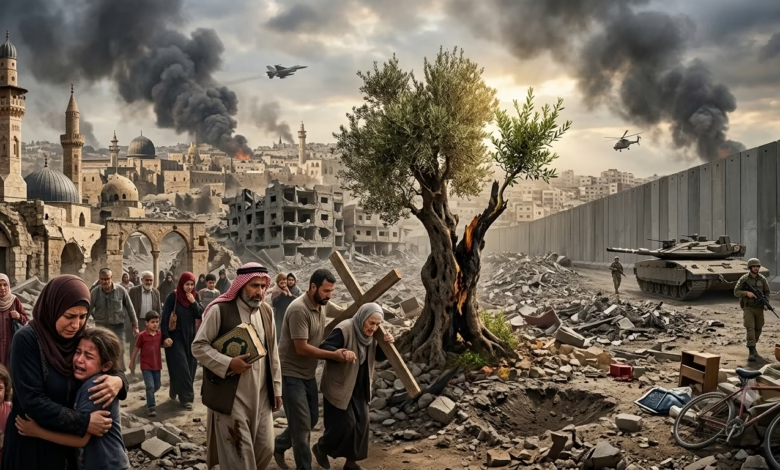
And In This Complex Context, Armstrong Tackles The Phenomenon Of “Global Terrorism” And The Suicide Operations That Marked The Recent Decades. And She Relies In Her Deconstruction Of This Phenomenon On Solid Scientific And Strategic Studies To Prove That The Overwhelming Majority Of Suicide Attacks Do Not Stem From Pure Religious Motives, But Are Organically Linked To Clear Political And Geostrategic Goals, On Top Of Which Is Resisting Foreign Intervention And Expelling Military Forces From The Lands That The Perpetrators Consider Their Homelands. Modern Armed Organizations Do Not Derive Their Tactics From Traditional Jurisprudence That Forbids Killing Civilians, But Replicate The Tools Of Asymmetric Warfare And Guerrilla Warfare To Face An Overwhelming Technical Military Superiority. Religion Here Has Become Merely A Mobilizing Cover That Bestows A Sacred Character Upon A Worldly Political Struggle Over Land, Sovereignty, And The Distribution Of Wealth In An Unequal International System.
And From Here, The Author Directs A Scathing Critique At What Is Called The “War On Terror”, Asserting That The Violent Military Response And Destroying Entire Countries Based On The Premise That “Religion Is The Problem”, Only Led To Feeding The Cycle Of Violence And Hatching New Generations Of Extremists. The Deliberate Ignorance Of Historical Political And Economic Grievances, And The Exclusive Focus On Religious Texts As The Sole Driver Of Violence, Represents A State Of Strategic Blindness That Exempts The Major Powers From Their Responsibility For Expansionist Policies, Supporting Despotism, And The Disastrous Military Interventions That Dismantled Infrastructural And Societal Frameworks In Vast Regions Of The World.