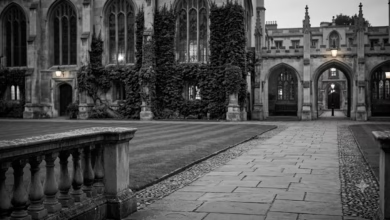


Paul Celan: Son Of The Lost Empire And Heir To The Language Of Murderers
In The World Of Literature And Poetry, Figures Who Carry Within Themselves The Tragedy Of An Entire Century As The Poet Paul Celan Does Are Rare. The Book “Paul Celan A Life” By Author Anna Arno, Published By Harvard University Press In 2026 And Translated Into English By Soren Gauger, Offers Us An Extraordinary Dive Into The Depths Of This Tormented Soul. This Work Is Not Merely A Biographical Narrative Of A Remarkable Poet, But Rather A Precise Dissection Of A World That Has Completely Vanished, And Of A Language That Became Simultaneously A Warm Homeland And A Desolate Exile. In This First Installment Of Our Comprehensive Review Of This Valuable Tome, We Will Dwell At Length On The Roots, On The City That Shaped Celan’s Early Consciousness, And The Cultural And Social Environment That Embraced His First Contradictions And Wove The Threads Of His Genius.
The Author Anna Arno Begins Her Exploratory Journey From The Streets Of The City Of “Chernivtsi”, Specifically From Its Cemetery That Stands Today As A Silent Witness To A Multicultural History Lost In The Folds Of Oblivion. It Is A True Ghost Town, As The Author Describes It, Where Tombstones Bearing Hebrew Inscriptions And Stars Of David Lie Adjacent To Christian, Catholic, And Orthodox Graves, In A Clear Visual Indication Of The Complex Human Mosaic That Once Inhabited This Place. However, Celan, Whose Original Name Was Paul Antschel, Does Not Rest In This Overgrown Green Spot, But Lies Alone In Thiais Cemetery On The Outskirts Of The French Capital, Paris, After Choosing To End His Life By Drowning In The Cold Waters Of The Seine River In 1970, Escaping The Ghosts Of His Past.
Arno Takes Us In Her Flowing Narrative Style On A Visual and Historical Tour Through The Alleys Of Chernivtsi, This City That No Longer Exists In Reality Except In Photographic Memory And Literary Nostalgia. It Was A Thriving City During The Reign Of The Austro-Hungarian Empire, Where Germans, Poles, Jews, And Ruthenians Coexisted In Striking Apparent Harmony. The Cultural Institutions Built There, Such As The Ukrainian House Established By Order Of Emperor Franz Joseph, The German House, And The Polish House, Embody This Rich Diversity That Celebrated Its Differences Rather Than Making It An Arena For Conflict. Celan Himself Was Aware Of This Unique Composition, And Bitterly Described Himself As An “Orphan Son Of The Empire”, Raised In A Place Representing A Historical Paradox That Turned Its Back On The Present To Remain Stuck In The Glories Of The Past.
In The Interwar Period, And Following The Collapse Of The Empire And The City’s Annexation To The Kingdom Of Romania, Chernivtsi Seemed As Though Time Had Stopped In It. Jews Formed A Large And Influential Part Of The Middle Class, Leading The Scene In Trade, Industry, and Free Professions. Despite The Strong Presence Of Zionist Movements And Hebrew Schools, The German Language In Its Elegant Viennese Dialect Was The Dominant Language Among The Jewish Elite And Bourgeoisie. This “German” Was Not Just A Tool For Daily Communication, But Represented The Pinnacle Of Civilization, Or As One Writer Described It, “A Victory For The German Spirit” In Those Eastern Regions. The Children Of The Bourgeoisie Continued To Frequent Cafes Bearing Names Like “Cafe Habsburg” To Sip Viennese Coffee, Or “Cafe Europe” To Eat Salmon And Caviar, Ignoring The Stormy Political Changes Surrounding Them.
In This Atmosphere Saturated With Luxurious Habsburg Culture, Paul Antschel (Who Would Later Be Known As Paul Celan) Was Born On November 23, 1920. The Author Paints A Precise Picture Of His Family Environment; His Father, Leo Antschel, Was A Strict Man Working As A Timber Broker After His Engineering Ambitions Dissipated, And Was A Convicted Zionist Who Enforced Discipline In His Home. As For His Mother, Friederike Schrager, She Was The Exact Opposite; A Woman Embodying Tenderness And Deep Understanding, Hailing From The Suburb Of “Sadagora”, Which Was A Vibrant Center For Religious Hasidism. Despite Her Religious Origins, She Was An Avid Reader Of German Classics, And She Was The One Who Instilled In Her Son The Love For Literary German, Or What Celan Later Called The “Motherword” That Guided Him Throughout His Life. This Radical Contradiction Between The Strict Father Who Forced Him To Study The Hebrew Language, And The Loving Mother Who Encouraged Him To Read The Works Of Schiller And Goethe, Created Within Celan An Extreme Sensitivity And An Early Rebellion That Formed The Building Blocks Of His Poetic Personality.
Arno Tracks With A Scrutinizing Eye Celan’s Early Educational Path, Starting From His Enrollment In The “Safa Ivria” School Where He Excelled In Learning Hebrew Despite Considering It A Heavy Duty, Leading To His Studies In Romanian High Schools. In The 1930s, The Clouds Of Anti-Semitism Began To Gather and Thicken In The Skies Of Romania With The Rise Of The Fascist “Iron Guard” Movement, And Widespread Campaigns To “Romanianize” The Region Began. Celan Faced Clear Systemic Discrimination At His School; Fanatical Teachers Punished Students For Speaking Yiddish Or German, And Intentionally Asked Impossible Questions To Jewish Students. Despite This Hostile Atmosphere Charged With Hatred, Celan Emerged As A Brilliant, Argumentative, Well-Read Student Who Loved Literature, And He Did Not Hesitate To Boldly Confront His Fascist Teachers, Reminding Them That The Jews Were The Ones Who Gave “The Book Of Books” To Humanity.
The Young Celan At That Stage Lived In A Complex World Of Adolescent Contradictions; He Was The Handsome, Spoiled Youth Who Loved Attracting Attention And Making Friends, And He Was Also The Deep Intellectual Immersed In Reading Marx, Rilke, Trakl, And Kafka. He Briefly Engaged In Underground Communist Activities With A Group Of His Friends, As A Natural Reaction To Rising Fascism, Reading Karl Marx And Rosa Luxemburg And Learning Morse Code. But, Thanks To His Sharp Awareness And Deep Readings, He Was Soon Disillusioned By This Ideology, Especially After Reading Andre Gide’s Critiques Of The Soviet Union, Turning Completely Towards The Magic Of The Word And The Vast World Of Poetry.
The City Of Chernivtsi, With Its Cultural Richness And Rising Political Tensions, Was The True Crucible In Which Celan’s Talent Was Forged. Here His Complex Relationship With The German Language Was Formed, The Language Of His Mother That He Loved And Celebrated, And Which Would Soon Tragically Become The Language Of Her Murderers.
As The End Of The 1930s Approached, The Ghosts Of War Were Gathering On The European Horizon, And The Features Of The World That Paul Celan Knew Began To Crack Under The Weight Of Hatred. Arno Relates How The Young Man Realized, Amid The Strict Restrictions And Unfair Quotas Imposed By Romanian Universities On Jewish Students, That Remaining In Chernivtsi Meant Suffocating His Ambitions. Thus, In The Autumn Of 1938, Celan Boarded A Train Heading West Bound For The French City Of Tours To Study Medicine, Escaping The Suffocating Atmosphere In His Homeland. But This Very Journey Carried Within It An Unforgettable Omen Of Doom; His Train Crossed German Territory On The Morning Of November 10th, The Day Following “The Night Of Broken Glass” (Kristallnacht). The Teenage Boy’s Face Was Glued To The Train Window To See With His Own Eyes The Shattered Storefronts, The Burning Synagogues, And The Ash Covering The Streets Of Berlin. This Horrific Scene, Which He Would Later Recall In His Poems, Was A Bloody Announcement That The German Language He Loved, The Language Of Goethe, Schiller, And His Mother, Had Been Hijacked By The Throats Of Barbarians.
In France, Celan Lived The Life Of A Student Open To The World, Discovering Contemporary French Literature And Surrealism Thanks To His Uncle Who Was Seeking To Enter The World Of Acting In Paris. The City Of Tours Provided Him With A Safe Haven And A Window Towards Hope. However, Fate Was Weaving A Tragic Trap For Him; In The Summer Of 1939, Celan Returned To His Birthplace To Spend His Usual Summer Vacation. No Sooner Had His Feet Touched The Soil Of Chernivtsi Than World War II Broke Out, Closing The Borders Completely And Making His Return To France Impossible. Celan Found Himself Trapped In An Inescapable Historical Catch, Starting To Study Romance Philology And Literature At His City’s University Instead Of Medicine, In A Desperate Attempt To Cling To The Last Threads Of Normal Life.
Arno Masterfully Describes How Events Accelerated In A Nightmarish Manner From Then On. In 1940, Soviet Forces Invaded The City As Part Of Influence-Sharing Agreements, And Although This Invasion Temporarily Saved The City’s Jews From The Grip Of Romanian Fascism, It Imposed A Suffocating Ideological And Cultural Suppression. But The Major Catastrophe Struck In The Summer Of 1941, When Nazi German Forces, Supported By Their Allies From The Romanian Army, Regained Control Of Chernivtsi. Within A Few Weeks, The Cosmopolitan City Turned Into An Earthly Hell. The Jewish Population Was Gathered In A Narrow, Horrific Ghetto, The Yellow Star Was Imposed On Them, And Systematic Deportation Campaigns To The Death Camps In Transnistria Began.
The Biography Reaches Here The Major Breaking Point In Celan’s Life, Which Is The Bloody Saturday Night In June Of 1942. The Author Reports How A Disagreement Occurred Between Celan And His Parents; He Tried To Convince Them To Hide With Non-Jewish Friends In An Abandoned Factory, But His Father, Who Surrendered To Despair And Exhaustion, Refused On The Grounds That One Cannot Escape One’s Shared Fate With One’s Kinsmen. Celan Left The House Angry And Spent His Night In A Distant Hideout. The Next Morning, He Returned To Find The Front Door Wide Open And The House Empty. Leo And Friederike Antschel Had Been Deported. This Absence, And That Night In Which He Survived Alone, Would Plant In His Soul A Deep And Destructive Sense Of “Survivor’s Guilt”, A Feeling That Would Scorch Him Until His Final Days.
Shortly Thereafter, Celan Himself Was Dragged To Romanian Forced Labor Camps In The South Of The Country. There, Under Inhumane Conditions, He Spent Eighteen Months Breaking Rocks And Building Roads, Enduring Humiliation, Hunger, And Disease. In This Dark Trench, The Tragic News Reached Him Regarding The Fate Of His Parents. His Father Died First As A Result Of Contracting Typhus, While His Mother, Who Had Instilled In His Heart The Love Of The German Language, Collapsed From Exhaustion Only To Be Executed By A Bullet Fired By A German Guard Into The Back Of Her Head. The Mother Was Killed At The Hands Of Those Who Spoke The “Motherword”. Time Stopped For Celan At That Bullet, And The World Turned Into A Desolate Place That Could Not Be Borne, And A Conviction Was Born In The Depths Of His Soul That Poetry From Now On Must Pass Through This Ash, And That Words Must Be Snatched From Between The Fangs Of Death.
Paul Celan Survived Physically When The Red Army Liberated Chernivtsi In The Spring Of 1944, But He Emerged From That Holocaust An Entirely Different Person, A Broken Soul Walking On Two Feet, Burdened With A Heavy Legacy Of Loss And Accumulated Guilt. He Returned To His City That He No Longer Recognized, Only To Discover That His Old World Had Been Completely Erased, And That His True Journey With Pain Had Just Begun.
Paul Celan Returned To Chernivtsi In The Spring Of 1944, But It Was No Longer That Cosmopolitan City He Knew In His Youth. The Soviets Had Tightened Their Grip On It, And The Streets That Once Buzzing With Discussions Of Literature And Philosophy Turned Into Gloomy Grey Spaces Dominated By Fear And Strict Censorship. In This Suffocating Atmosphere, Celan Worked Briefly As A Nurse And Translator In A Psychiatric Clinic, Where He Found Himself Surrounded By Patients Suffering From War Trauma, Which In Essence Reflected His Own Shattered Psychological State. The Young Man, Burdened By The Scars Of Loss And Survivor’s Guilt, Realized That Remaining In His Homeland Had Become Impossible; Soviet Tyranny Was Not About To Leave Room For The Freedom That Poetry Breathes, Especially Poetry Written In The German Language Which Had Become Hated Throughout Eastern Europe.
In April Of 1945, Celan Made A Decisive Decision To Leave, Sneaking Across The Border Towards The Romanian Capital, Bucharest, Which Was Then Known As “The Paris Of The East”. There, Celan Found A Temporary Breathing Space And A Vibrant Literary Life Still Resisting Under The Rubble Of War. He Quickly Engaged In Avant-Garde And Surrealist Cultural Circles, Befriending Many Young Writers And Poets Who Formed A Psychological And Intellectual Lifeline For Him. In Bucharest, Paul Antschel Decided To Be Born Anew, Rearranging The Letters Of His Family Name In Romanian Spelling (Ancel) To Create For Himself A Pseudonym That History Would Immortalize: “Paul Celan”. This Was Not Merely A Name Change, But An Implicit Declaration Of A Break With An Unbearable Past, And An Attempt To Invent A New Identity Capable Of Carrying The Burden Of Memory Without Being Crushed Beneath It.
In The Midst Of This Temporary Renaissance In Bucharest, Celan Wrote His Immortal Masterpiece “Death Fugue” (Todesfuge), Which Is Considered Today The Most Important Poem Ever Written About The Nazi Holocaust. The Tragic Paradox In This Poem Lies In Its Language; Celan Chose To Document The Suffering Of The Victims And The Brutality Of The Executioners Using The German Language Itself, Transforming It From The “Language Of Murderers” Into An Instrument For Universal Funeral Lamentation. Nevertheless, Due To The Extreme Sensitivity Towards The German Language In The Aftermath Of The War, The Poem Was Published For The First Time In 1947 Translated Into The Romanian Language Under The Title “Death Tango”. This Early Publication Was An Initial Recognition Of Celan’s Genius, But At The Same Time It Was A Painful Reminder Of His Linguistic Isolation; The Poet Who Writes In German Cannot Publish His Poem In Its Original Language In The Place Where He Lives.
Bucharest’s Brightness Did Not Last Long. As 1947 Approached, The Iron Curtain Began To Descend With Its Weight Upon Romania, And The Communist Party Tightened Its Grip On The Reins Of Power. The Rules Of “Socialist Realism” Were Imposed On Literature And Art, And Any Deviation From The Party’s Strict Ideological Line Was Considered Treason Deserving Imprisonment Or Exile. Celan, A Poet Immersed In Surrealism And Dark Symbolism, Found The Noose Tightening Around His Neck Once Again. He Knew Full Well That His Poetry Could Not Flourish Under A Dictatorship That Dictated To The Writer What To Say And How To Say It. Thus, In A Scene Repeated In The Lives Of Oppressed Creators, Celan Decided To Flee Once More.
In Late December Of 1947, On A Perilous Journey Across The Hungarian Border, Celan Snuck On Foot In The Bitter Cold Of Winter, Bound For The Austrian Capital, Vienna. Vienna At That Time Was A Shattered City Divided Among The Allied Forces, But To Celan It Meant One Thing: A Return To The Geography Of The German Language. Despite The Short Stay He Spent There, It Was Decisive; Vienna Witnessed The Publication Of His First Collection Titled “Sand From The Urns”, And More Importantly, It Witnessed His Historic Meeting With The Young Austrian Poet Ingeborg Bachmann. This Meeting, Which Brought Together A Jewish Victim And The Daughter Of A Former Nazi Party Member, Produced One Of The Most Complex And Deepest Love Stories And Literary Correspondences Of The Twentieth Century, A Story Whose Emotional And Intellectual Effects Would Extend To Stamp Celan’s Journey Until Its Tragic End.
Vienna Was Nothing More Than A Short Transit Station In The Continuous Wandering Journey Of Paul Celan; In July Of 1948, The Poet Packed His Bags Heading To Paris, The Capital That Would Become His Final Exile And Settled Home Until The End Of His Life. Celan Arrived In France Carrying With Him His German Language As His Only Remaining Homeland, In A Poignant Paradox For A Poet Living In The Heart Of Francophone Culture Yet Insisting On Writing In The Language Of Those Who Exterminated His Family And His World. In Paris, Celan Lived His First Years In Poverty And Isolation, Struggling To Provide For His Living Expenses By Working As A Factory Worker And Then As A Translator And Teacher Of The German Language. However, This Enchanting City Also Offered Him Emotional Stability When He Met The French Visual Artist And Painter Gisèle De Lestrange, Who Hailed From A Catholic Aristocratic Family. Despite The Vast Differences In Social And Religious Backgrounds, They Married In 1952, With Gisèle Becoming His Greatest Support, And The Window Through Which He Looked At The World Of Visual Art That Enriched His Poetic Experience Later On.
The Year 1952 Was Pivotal In Celan’s Literary Career, As His Most Important Collection “Poppy And Memory” (Mohn Und Gedächtnis) Was Published In Germany. This Collection Included The Original German Version Of The Poem “Death Fugue”, Which Caused An Earthquake In German Literary Circles. Celan Forced The German Reader To Face The Ugliness Of The Holocaust Through A Poetic Language That Was Condensed, Musical, And Horrifying All At Once. But This Success Was Not Without A Price; In That Same Year, Celan Was Invited To Read Before “Group 47”, The Most Prominent Literary Gathering In Post-War Germany. There, The Poet Collided With The Coldness and Aversion Of German Writers Who Did Not Comprehend His Recitation Style, Which Resembled A Funeral Chanting Of Prayers In Jewish Synagogues. Some Attendees Mocked His Manner, Leaving A Deep Wound In Celan’s Pride, And Reinforcing His Sense Of Total Alienation Even Among His Fellow German-Speaking Writers.
With His Growing Fame As One Of The Greatest German Language Poets Of The Twentieth Century, Black Clouds Began Gathering Around Him Anew, Manifested In One Of The Harshest Trials He Faced: Accusations Of Plagiarism. In The Mid-1950s, Claire Goll, The Widow Of The Poet Yvan Goll Whose Works Celan Had Translated Some Of And Shared A Short Friendship With Him, Launched A Savage Slander Campaign Accusing Celan Of Stealing Metaphors And Poetic Imagery From Her Late Husband’s Poems. Although Major Critics And Academicians Proved The Falsity And Absurdity Of These Claims, The Campaign Continued For Years In The German Press. For An Extremely Fragile And Sensitive Personality Like Celan, Haunted By Persecution And Guilt Complexes, These Accusations Were Not Merely A Literary Dispute, But A Systematic Attempt At Character Assassination To Strip Him Of His Sole And Most Precious Possession: His Poetic Voice And The Credibility Of His Suffering.
Claire Goll’s Campaign, Combined With The Accumulations Of Old Trauma And The Legacy Of The Holocaust, Led To A Sharp And Tragic Deterioration In Celan’s Mental Health. The Poet Began Sliding Gradually Into The Abyss Of Paranoia, Imagining That There Was A New Nazi Conspiracy Hatched Against Him In German Cultural Circles To Silence Him. His Isolation Deepened, And His Poetic Language In Subsequent Collections, Such As “Latticework” And “The No-One’s-Rose”, Transformed Into A Language More Abstract, Fragmented, And Defiant Of Easy Understanding. His Poems Became Wounded Linguistic Entities, Breathing With Difficulty, Searching For Meaning In A World That Seemed To Him To Have Completely Lost Its Sanity.
In The 1960s, And Under The Weight Of Accumulated Traumas And Harsh Slander Campaigns, Paul Celan Entered A Dark Tunnel Of Repeated Nervous Breakdowns. His Life Turned Into A Series Of Involuntary Stays In Psychiatric Clinics, Where He Underwent Harsh Treatments Including Electroshock Therapy And Sedative Medications That Burdened His Soul And Body. He Separated From His Wife Gisèle, Not Due To An Absence Of Love, But Because Living With Him Had Become Impossible Under One Roof Dominated By Paranoia And Continuous Fear Of Imagined Persecution. Nevertheless, And Amid This Terrifying Psychological Fragmentation, His Mind Remained Brilliant And Haunted By Major Existential Questions, And He Continued To Read And Write Voraciously, Searching In The Depths Of Classical And Contemporary Western Philosophy For A Lifeline, Or Perhaps An Explanation For The Radical Evil That Swallowed His World.
This Arduous And Continuous Search Into Matters Of Metaphysics And Phenomenology Drove Him To One Of The Most Controversial And Sorrowful Meetings Of His Later Life. In 1967, Celan Traveled To Meet The German Philosopher Martin Heidegger At His Famous Cabin In The Todtnauberg Region. This Meeting Represented For Celan An Inevitable Confrontation With The Peak Of The German Philosophical Pyramid, But At The Same Time It Was A Confrontation With A Man Institutionally And Ideologically Involved With The Nazi Party. Celan Went There Aspiring To Extract A Single Word, A Mere Human And Philosophical Acknowledgment Or Apology From The Philosopher Whom He Had Long Read And Been Influenced By His Deconstruction Of Language And Existence. But Heidegger Chose Complete Silence Regarding His Past And The Holocaust. This Heavy Phenomenological Silence Acted As A Final Dagger In Celan’s Heart; He Realized Then That The German Intellectual Establishment Was Unable, Or Unwilling, To Offer True Solace Or Radical Self-Criticism For Its Sin, Doubling His Intellectual And Spiritual Alienation.
After His Return From Todtnauberg, Celan’s Poetic Language Became More Austere and Closed, As If The Words Themselves Had Been Strangled. He Stripped His Poems Of Any Remaining Lyricism, And His Texts Turned Into Sharp, Silent Fragments, Loaded With The Emptiness Of Existence. He Wrote As Though Sending Messages In Bottles To An Unknown Future, Hoping They Would Be Picked Up By Shores Capable Of Deciphering The Pain Embedded In Them. But The Ability To Continue In This World Was Slipping Through His Fingers Day After Day. In Late April Of 1970, On A Night Whose Minute Details History Has Not Documented, Celan Left His Apartment In Paris And Walked Toward The Seine River. There, At The Pont Mirabeau, The Poet Who Survived The Nazi Death Camps Chose To End His Life With His Own Hand, Casting His Tired Body Into The Cold Waters, Leaving Behind A World That Could Never Forgive Him Or Reconcile With Him.
Anna Arno Concludes Her Book With A Deep Analytical Elegy For The Legacy Of This Extraordinary Poet. Paul Celan Was Not Merely An Eyewitness To The Most Horrific Crimes Of The Twentieth Century, But He Was The Alchemist Who Took The Executioners’ Blood-Stained Language And Smelted It In The Furnace Of His Suffering To Forge From It Pure Poetic Gold. Celan Proved, Contrary To Theodor Adorno’s Famous Dictum That Writing Poetry After Auschwitz Is Barbaric, That Poetry Is The Only Tool Capable Of Piercing The Wall Of Silence And Death. Through Deconstructing The German Language And Rebuilding It, Celan Created A New Linguistic Homeland, A Homeland Unbounded By Geography And Undefiled By Empires, But Rather Guarded By Poems That Stand As Eternal Tombstones For Those Who Were Denied Even The Right To Possess A Grave.