
The Myth Of The Rupture: How Did Thomas Bauer Rebuild The Structure Of World History From The Islamic Gateway?
Our Human History Is Not Merely A Series Of Successive Events, But Is In Its Essence A Narrative We Craft To Understand Our Place In This World. And For A Long Time, This Narrative Remained Captive To A Strict Chronological Division, A Classical Division That Seems Like A Law Of Nature: “Ancient Times, Then Dark Middle Ages, Then A Modern Renaissance.” But What If This Division, Which We Learn In Schools And Upon Which Theories Are Built, Is Merely An Illusion? What If The “Middle Ages” Were Just A Purely Local European Experience, Forcibly Projected Onto The Rest Of The World?
Here Comes The Book “Why There Was No Islamic Middle Age: The Legacy Of Antiquity And The Arabs” (Warum Es Kein Islamisches Mittelalter Gab) By The Prominent German Historian And Islamic Studies Scholar “Thomas Bauer”, To Represent A Stone Thrown Into The Stagnant Pool Of Orientalism. Bauer Does Not Present In This Thorny Work A Mere Review Of A Past History, But Rather He Launches A Systematic Attack On “Eurocentrism” In Writing History, Presenting A Deconstructive Reading That Re-engineers Our Understanding Of Human Civilization.
The Tyranny Of Periodization: How Was The Myth Of The Middle Ages Woven?
Bauer Begins His Journalistic And Academic Approach Simultaneously By Dissecting The Concept Of “The Middle Ages”. Historically, This Term Was Coined In Europe During The Renaissance To Describe The Millennium That Separated The Glory Of The Ancient Roman Empire And The Alleged Return Of That Glory In The Fifteenth Century. Europe In That Era Was Experiencing A Demographic Collapse, An Urban Decline, And An Almost Complete Disappearance Of The Civil And Intellectual Life That Characterized Rome And Athens.
But The Methodological Disaster, As Bauer Sees It, Occurred When Western Philosophers Of History And Historians In The Nineteenth Century Generalized This Local European Pattern To Become A Universal Template. They Assumed, With Epistemological Arrogance, That As Long As The West Had Gone Through A “Middle Age” Of Decline, Then Every Other Civilization, Including Islamic Civilization, Must Have Suffered From The Same Rupture And Decline.
In Its Essence, Bauer Presents A Radical Deconstruction That Serves Researchers In The Development Of International Systems, As He Places Us Before A Comparative Analysis Of Global Political Structures At That Time. While The Latin West Was Drowning In The Chaos Of The Absence Of Central Authority, The Disintegration Of Institutions, The Disappearance Of Regular Armies, And Their Replacement By Feudal Militias, The Islamic Sphere Represented The Peak Of Institutional Hierarchy And Administrative Complexity. The Term “Middle Ages” Was Projected Onto The East For One Purpose: To Depict Islamic Civilization As A Civilization Living In A Darkness Parallel To The Darkness Of Europe, Paving The Way To Legitimize Modern Western Superiority.
The Continuity Of Late Antiquity: Damascus And Baghdad As Roman Capitals With An Arab Touch
Bauer Presents His Revolutionary Thesis: Early, Umayyad, And Abbasid Islam Did Not Represent A Rupture With Antiquity, But Was Rather A Natural And Prosperous Extension Of It. What Is Academically Called “Late Antiquity” Did Not End With The Fall Of Rome Or The Emergence Of Islam, But Rather Continued, Developed, And Deepened In The Mediterranean Basin And The Near East Under The Islamic Banner.
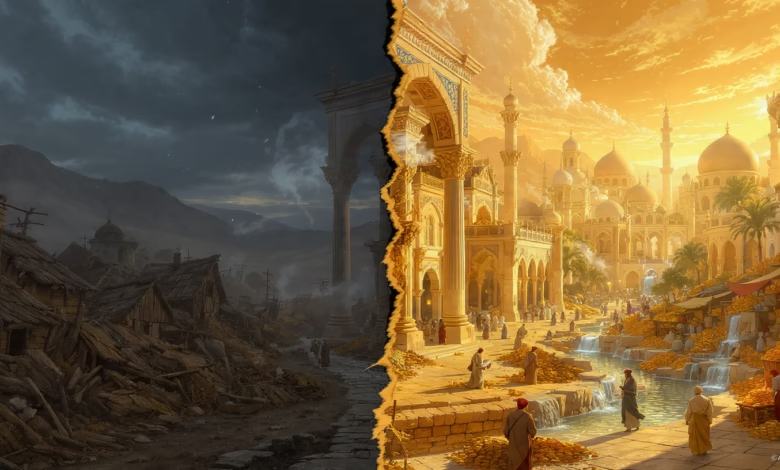
The Book Takes Us On An Amazing Visual And Historical Tour. Look At The Islamic Cities In The Eighth And Ninth Centuries Ad. While Paris And London Were Mere Miserable Villages Consisting Of Wooden Huts And Mud Roads, Cordoba, Damascus, Baghdad, And Cairo Were Teeming With Millions Of People, Shining With Public Baths (Which Are Among The Most Important Features Of Ancient Roman Civilization), Central Markets, Sewage Systems, And Paved Streets.
The Author Emphasizes That Arabs And Muslims Did Not Destroy The Structure Of The Ancient Empires (Byzantine And Sassanian) But Inherited And Absorbed Them, Then Extremely Successfully Reproduced Them. They Retained The Complex Tax System, The Bureaucratic State Structure, The Express Mail, And Even The Urban Lifestyle That Despises Roughness And Glorifies Poetry, Literature, And Philosophy. The Umayyad Caliphate, In Bauer’s View, Was The Legitimate, And Most Efficient, Heir To The Roman Empire In The East.
The Cosmic Economy And The Prosperity Of Money
Bauer Continues To Review The Material Evidence That Supports His Vision. In “Medieval” Europe, The Monetary System Collapsed Completely And Societies Returned To The Primitive Barter System. Cross-Border Trade Vanished, And The Economic Horizon Of The European Individual No Longer Exceeded The Borders Of The Village In Which He Was Born.
In Stark Contrast, Muslims Established An Amazing Globalized Economic Network. The Islamic Gold Dinar And Silver Dirham Were Like The “Dollar” In That Era, A Global Currency Circulated From The Borders Of China To The Atlantic Coasts Of Spain. Banking Financial Transactions, Bonds (Sukuk), And The Freedom Of Movement Of Capital And Goods, Were All Highly Advanced Economic Technologies Proving That The Islamic World Was Living A “Late Antiquity” In Its Finest Forms, Benefiting From The Stability Of The International System Established By The Sprawling Islamic Empire, And Was Never Living Any “Middle Ages”.
The Resurgence Of The Mind: Science And Language As Bridges To Late Antiquity
If The First Part Of Our Article Focused On Infrastructure, From Cities, Roads, And Currencies, Then Thomas Bauer In His Book “Why There Was No Islamic Middle Age” Moves Us To A Deeper And More Sensitive Area: The “Superstructure” Or The Cognitive Spirit That Prevailed In The Islamic World. Here, Bauer Poses A Fundamental Question: Were The Muslims Merely A “Safe” For The Greek Inheritance, Or Were They The Legitimate Heirs Who Continued Building On The Same Foundations Without Interruption?
Knowledge As An Act Of Continuity, Not Rescue
One Of The Common Ideas In The Western Historical Narrative Is That The Arabs “Rescued” Greek Philosophy And Sciences From Loss, Then “Returned” Them To Europe In The Renaissance. Bauer Rejects This Description Which Carries A Tone Of “Guardianship”; The Word “Rescue” Assumes That This Inheritance Was Foreign To Them Or That They Kept It As An Idle Trust.
The Truth Highlighted By The Book Is That The Islamic Society In The Ninth And Tenth Centuries Did Not See Aristotle, Ptolemy, Or Galen As “Foreigners”, But They Represented To The Islamic Collective Mind The Continuous “Universal Science”. The Translation Movement In Baghdad Was Not Just A Passion For Old Books, But Was An Urgent Need For A Society Living An Extension Of Late Antiquity, Where Medicine, Engineering, And Astronomy Are Daily Tools For Managing The Empire. While “Middle” Europe Was Burning Books Or Neglecting Them In Isolated Monasteries, The Physician In Damascus Or The Chemist In Basra Was Reading Greek Texts As If They Were Written Yesterday, Correcting Them, Adding To Them, And Developing Them As Part Of A Living Professional Specialization.
The Scientific Method: Where Is The “Darkness”?
Bauer Believes That What We Call “The Middle Ages” In Europe Was Characterized By The Dominance Of Absolute Metaphysical Thinking And The Retreat Of The Empirical Method. But In The Islamic World, We Find The Exact Opposite. Bauer Analyzes How The Natural And Mathematical Sciences Enjoyed Amazing Independence. There Was No “Dramatic” Conflict Between Religion And Science As Orientalists Later Portrayed, But There Was A “Functional Distribution”.
In This Context, The Book Reviews How Muslim Scholars Preserved The “Spirit Of Antiquity” In Investigation And Skepticism. The Continuity Of Educational Institutions, From The “Houses Of Wisdom” To The Nizamiyya Schools, Ensured The Flow Of Scientific Knowledge Without Interruption. This Flow Is What Made It Impossible To Describe That Era As “Middle”; Because It Was Not A Gap Between Two Periods Of Prosperity, But Was Rather The “Peak” Of Scientific Prosperity Of Late Antiquity, Reaching Its Full Maturity Under The Umbrella Of The Arabic Language.
The Arabic Language: The Living “Latin” Of The East
Bauer Moves To Analyze The Role Of The Arabic Language As A Civilizational Tool. In Europe, Latin Turned Into A Dead Language Confined To The Church, While Peoples Fragmented Behind Primitive Local Languages. As For The Islamic World, Arabic Became The “Language Of Science, Politics, And Literature” From Sindh To Andalusia.
Bauer Emphasizes That Arabic Not Only Replaced Ancient Languages, But Absorbed Their Philosophy And Logic. Arabic Poetry, With Its Complex Philosophical Debates And Celebration Of Life And Beauty, Was An Extension Of Ancient Rhetorical Traditions. The Muslim Human In That Era Found No Contradiction Between Being Religious And Enjoying Flirtatious Poetry Or Engaging In Purely Rational Philosophical Debates. This “Pluralism” And This “Acceptance Of Ambiguity” (Which Is A Central Concept In Thomas Bauer’s Thought) Are What Distinguished That Era And Made It Completely Alien To The Closure Of The European Middle Ages.
The Latent Secularism In The Traditional Society
Here Bauer Presents An Idea That Might Seem Shocking To Many: The Islamic World In That Period Possessed The Seeds Of “Functional Secularism”. Not In The Sense Of Separating Religion From The State In The Modern Concept, But In The Sense Of The Existence Of Life Domains (Medicine, Trade, Literature, Philosophy) Managed With A Purely Rational Logic, Without Direct Interference From The Religious Authority.
This “Flexible” Separation Is What Allowed Jews, Christians, Persians, And Turks To Contribute To Building This Civilization. The Identity Was Not “Narrowly Religious” As It Was In Crusader Europe, But Was A Broad-Minded “Civilizational Identity”. Bauer Argues That This Openness Is The Original Characteristic Of Antiquity, Which Islam Preserved And Developed, While Europe Lost It For Many Centuries.
Architecture And Beauty: Were Mosques “Cathedrals”?
In An Enjoyable Chapter, Bauer Compares Islamic Architecture And European Medieval Architecture. The Gothic Cathedral, With Its Massiveness And Shadows, Expresses The Spirit Of The Middle Ages Which Looks At The Sky With Awe And Despises The Earth. As For The Islamic Mosque (Like The Umayyad Mosque Or The Great Mosque Of Cordoba), It Is A Building Characterized By Light, Open Courtyards, And Infinite Geometric Decorations That Celebrate Mathematics And Reason.
Islamic Architecture, According To Bauer, Is A Legitimate Daughter Of Roman And Byzantine Engineering, But It Purified It From The Funerary Tendency And Added The Vitality Of The East To It. It Is A “Civil” Architecture Even In Its Sanctity, Designed To Be Part Of The City’s Fabric, Not Isolated From It.
The Invention Of “Decline”: How Did The Nineteenth Century Create The Myth Of The Eastern Middle Ages?
As We Proceed Through The Labyrinths Of Thomas Bauer’s Thesis, We Reach The Most Controversial Area, Which Is The Area Where Bauer Deconstructs The Concept Of “Decline” That Has Long Been Attached To Late Islamic History. Bauer Believes That The Greatest Disaster In Writing History Was Not In The Past Centuries, But In The Nineteenth Century Ad, That Century Which He Describes As The “Actual Producer” Of The Image Of The Backward East. Here, The Article Stops At A Fundamental Turning Point; The Islamic World Never Needed A “Renaissance” On The European Model, Because It Simply Did Not Go Through A Clinical “Death” Like The One That Afflicted Europe After The Fall Of Rome.
Western Orientalists And Researchers In The Nineteenth Century Were Haunted By An Overwhelming Desire To Find A Symmetry Between Their History And The History Of The Other. And Since Europe Had Just Emerged From Its “Middle Ages” And Began The Age Of Enlightenment, It Was Imperative For Them To Find A “Middle Age” Among Muslims So That They Could Later Bestow “Modernization” Upon Them. Bauer Argues That What We Call The “Era Of Decline” In Traditional Arabic Literature Is In Fact A Colonial Invention Par Excellence, Later Adopted By The Educated Elites In The Arab And Islamic World Without Sufficient Examination. The Islamic Society In The Sixteenth And Seventeenth Centuries, And Even The Eighteenth, Was Still Practicing Its Life According To The Logic Of Developed “Late Antiquity”; Where Sciences, Arts, Markets, And Social Ties Functioned With Amazing Efficiency, Even If They Moved Slowly In Proportion To The Pre-Industrial Rhythm.
Here Emerges Bauer’s Other Central Concept, Even If He Refers To It Implicitly In This Book, Which Is “The Loss Of Tolerance For Ambiguity”. The Author Believes That The “Old” Islamic Society Was A Very Flexible Society, Accepting Pluralism In Jurisprudential Opinions, Ambiguity In Literary Texts, And Diversity In Lifestyles. This Society Did Not See A Need To Settle Everything Or Put Every Phenomenon In A Rigid Mold. But, With The Entry Of Western “Modernity” In The Nineteenth Century, A Process Of Forced “Stereotyping” Of History Began. A Narrative Was Imposed On Muslims Saying: “You Were In Dark Middle Ages, And You Must Now Catch Up With The Train Of Modernity.” And Instead Of Muslims Continuing To Develop Their Own Model That Had Not Been Cut Off From Its Ancient Roots, They Found Themselves Forced To Disavow Their Past And Consider It A “Medieval Burden” To Be Disposed Of.
This Process, According To Bauer, Led To The Distortion Of Our Consciousness Of Time. The Physician In Cairo In 1750 Was Still Reading Avicenna And Using Surgical Tools That Were A Direct Development Of What Existed In The Roman Era, And Did Not Feel That He Was Living In “Darkness”. The Real Disruption, And The Major Cognitive Rupture, Occurred When The Printing Press Arrived, Not Only As A Tool For Spreading Knowledge, But As A Tool Imposing A “Single” And “Normative” Version Of The Truth, Which Led To The Marginalization Of Manuscripts, Oral Traditions, And Local Practices That Constituted The Spirit Of That Continuous Civilization.
And Bauer Goes Further Than That, When He Analyzes How “Modernity” Is What Created “Fundamentalism” And “Radicalism”. Traditional Societies That Were Living The “Legacy Of Antiquity” Were More Tolerant And Open Because Of Their Complex And Intertwined Structure. As For The Modern Desire For “Purification” And “Return To Pure Origins” (Whether They Were Religious Or Ethnic Origins), It Is A Direct Product Of The Shock Caused By Imposing The Concept Of “The Middle Ages” On A Reality That Did Not Know Them. The Reformers In The Nineteenth Century Wanted To Jump Over The “Lost Thousand Years” (Which Is Actually An Era Of Continuous Prosperity) To Reach The Imagined Moment Of “Purity”, Which Led To Tearing The Civilizational Fabric That Was Not Torn Originally.
Therefore, Bauer’s Book Is Not Merely An Intellectual Luxury For A Historian Arguing Over Labels, But Is A Political And Cognitive Cry Inviting Us To Reconsider Those Centuries Described As Stagnant. It Is An Invitation To Look At “Continuity” As A Strength, And Not As A Weakness. The Arabs Were Not “Stagnant”, But Were “Stable” In A Civilization That Had Reached Its Maximum Maturity, A Civilization That Managed The Ancient World Brilliantly, And Did Not Fall Except Before The Military And Material Machine Of An Industrial Revolution Alien To The Historical Context Of All Humanity At That Time.
The Aesthetics Of Living And The Brilliance Of The Senses: When “Urbanity” Was A Daily Creed
Thomas Bauer Transports Us At This Juncture Of His Book To The Most Intimate Corridor In Islamic Civilization, Which Is The Corridor Of “Daily Life” And The Culture Of The Body. Bauer Raises Here A Question That Seems Simple On Its Surface But Is Deep In Its Historical Implications: How Did The Human In Baghdad Or Nishapur View His Body, His Clothes, His Hygiene, And His Pleasure? The Answer To This Question Is What Puts The Last Nail In The Coffin Of Naming That Era “Middle”. While Europe In Its Centuries Following The Fall Of Rome Was Languishing Under The Yoke Of An Extreme Ascetic Culture That Viewed The Body As A Vessel For Sin And Bathing As A Suspicious Pagan Luxury, The Islamic World Elevated “Cleanliness” And “Beauty” To The Level Of Worship And Social Duty.
Bauer Analyzes How The “Public Bath” Was Not Just A Place For Purification, But Was The Direct And Legitimate Heir To The Roman “Thermae”. In Every Islamic City, The Bath Represented The Center Of Urban Gravity, Where Architecture Celebrated Water And Light, And Where Social Rituals Reflected Refinement In Dealing With The Senses. This Continuation Of The Culture Of Bathing, Massaging, And Perfuming Is Not Just A Passing Detail, But Is Material Evidence Of The Survival Of The “Ancient Urban Pattern” Alive And Flourishing. The Human In The Islamic World Was Not Cut Off From The Heritage Of “Self-Care” That Characterized Antiquity, But Added To It Spiritual And Aesthetic Dimensions That Made The Individual’s Appearance And Elegance Part Of His Civilizational Identity.
And This Sensory Brilliance Extends To Include The World Of “Literature”, Not In Its Narrow Sense As Writing, But In Its Broad Sense As “Etiquette” And A Behavioral System. Bauer Explains How The Concept Of “The Man Of Letters” In Those Centuries Represented The Perfect Human Model; For He Is The Person Who Combines Breadth Of Culture, Eloquence Of Tongue, Cleanliness Of Dress, And Good Companionship. This Model Is The Antithesis Of The European “Medieval Knight” Who Was Characterized By Roughness And Crude Physical Strength. In The East, Strength Was Refined By Rhetoric, And Courage Was Adorned With Wit. This Civic “Tenderness” Is The Essence Of Late Antiquity Which Reached Its Peak Under The Rule Of The Caliphs, Where Poetry, Music, And Philosophical Debates In Gatherings Became An Integral Part Of The Daily Fabric Of Life, Just As They Were In Athens And Rome, But In A More Vibrant Arabic Language Capable Of Expressing Complex Emotions.
And In The World Of Fashion And Textiles, The Book Reveals The Volume Of “Aesthetic Globalization” That Prevailed Then. While Clothes In Western Europe Were Primitive And Uniform, Reflecting A State Of General Poverty, The Islamic World Possessed An Amazing Textile Industry Producing Silk, Linen, And Cotton In Colors And Designs Changing With The Change Of Seasons And Occasions. Bauer Believes That This Attention To “Fashion” And Small Aesthetic Details Is A Milestone For A “Post-Primitive” Society, A Society Possessing A Surplus Of Time, Money, And Taste To Spend In Improving The Quality Of Life. This Celebration Of Material Beauty And Permissible Pleasure Proves That The Prevailing Spirit Was Not A Closed “Medieval” Spirit, But An Open “Classical” Spirit To The World And To The Joys Of Existence.
And Perhaps The Most Exciting Point Raised By Bauer In This Context Is The Society’s Relationship With The Literary And Poetic Text. While Knowledge Production In Europe Was Confined To Religious Texts And Church Hymns, The Islamic World Overflowed With Flirtatious Poetry, Wine Poetry, Nature Description, And Political Satire. This Thematic Diversity Reflects A Society Possessing The Courage To Express Human “Ambiguity”; Where One Could Be A Pious Jurist In The Morning, And A Poet Celebrating Beauty In The Evening, Without Feeling A Tear In His Identity. This “Reconciliation With Multiplicity” Is What The European Concept Of The Middle Ages Lacks, And It Is What Bauer Tries To Prove Exists At The Core Of The Arab Islamic Civilization, Emphasizing That Those Centuries Were Not A Time Gap, But A “Continuous Festival” For The Mind And Senses.
Timeless Power Structures: How Did The “Dinar” And The “Diwan” Manage An Empire Without Feudalism?
We Cannot Understand Those Aesthetics That We Reviewed In The Previous Part, From Elegance In Dress And Refinement In Gatherings, In Isolation From The Backbone That Supported This Society: And By It We Mean The Political And Administrative System. In This Section Of His Book, Thomas Bauer Puts His Hand On One Of The Most Profound Points In Clarifying The Difference Between The European “Middle Ages” And The Islamic Reality; Which Is The Idea Of The “State” And Its Institutions. While Europe Lived Under The Weight Of The “Feudal System”, Where Power Was Fragmented Among Local Warlords, Loyalty Was Personal And Based On Land Ownership, And Armies Were Militias Of Peasants And Amateur Knights, The Islamic World Presented A Completely Different Model, A Model That Is In Its Essence A Continuation And Development Of The Bureaucracy Of The Major Empires In Antiquity.
Bauer Explains How The Muslims, Immediately Upon The Stabilization Of Their State, Did Not Demolish The Administrative Structures Of The Byzantines Or Sassanians, But Rather “Expanded” And “Arabized” Them. The Caliphate Inherited The “Diwan” System, Which Is A Complex Bureaucratic Apparatus Tasked With Censusing The Population, Collecting Taxes Accurately, Disbursing Salaries, And Managing The Express Mail That Connects The Edges Of The Empire. This Type Of Central Administration Was Completely Absent From “Medieval” Europe, Which Lost The Ability To Manage Cash Taxes For Centuries. In The East, The “Dinar” And The “Dirham” Remained The Drivers Of Political Life, Allowing For The Existence Of Professional Regular Armies Receiving Their Salaries From The Central Treasury, Which Is A Basic Feature Of Advanced States In Both Ancient And Modern Times Alike, And Has No Place In The Definition Of “Middle Ages” Based On Disintegration.
And Bauer Moves To Analyze The Concept Of “Law” And “Judiciary”, To Clarify That Islamic Sharia In Those Centuries Did Not Operate As A Rigid Text Imposed By Extremist Theocrats, But Represented A “Professional” And “Pluralistic” Legal System. There Was Relative Independence Of The Judiciary, Where The Judge Operates According To Mechanisms Of Deduction And Complex Legal Logic, Often Far From The Whims Of Rulers. This “Legal Professionalism” Is A Direct Extension Of Roman And Sassanian Legal Traditions, Where The Law Is A Tool To Regulate The Crowded Commercial And Civil Society. The Existence Of A Class Of “Jurists” Who Are Actually Professional “Lawyers”, Proves That The Society Was Managed By Reason And Institutional Logic, Not By The Law Of The Jungle Or The Absolute Power Of Feudal Nobles.
And The Author Goes Further Than That In Analyzing “Pluralism” Within The Political System. The Islamic State Did Not Seek To Melt Everyone Into One Mold, But Was Managing An “Empire Of Cities” Enjoying A Kind Of Actual Self-Rule In Their Daily Affairs. This Balance Between The Symbolic And Central Authority Of The Caliph, And The Independence Of Local Elites, Scholars, And Merchants In The Cities, Created A Long Social Stability. Bauer Argues That This Model Of The “Limited State” That Contented Itself With Security And Taxes And Left Society To Organize Its Scientific, Economic, And Legal Affairs, Is A “Classical” Model Par Excellence, And It Is What Allowed Transcontinental Trade To Flourish, And Cities To Remain Centers Of Civilizational Radiance Without Interruption.
What Bauer Wants To Emphasize Is That The “Chaos” That Characterized Europe After The Fall Of Rome, Which Necessitated The Emergence Of The Feudal System As An Emergency Solution For Security, Never Occurred In The Islamic World. Political Power Remained, Despite The Fluctuation Of Dynasties, Preserving Its “Civility” And “Institutionalism”. And Even When New Military Powers Such As The Seljuks Or Mamluks Appeared, They Quickly Melted Into The Existing Administrative Structure And Did Not Transform It Into Isolated Rural Fiefdoms. The “State” Remained A Present Idea, The “Diwan” Kept Working, And The “Market” Remained Protected By Law. This Institutional Continuity Is What Made The Islamic World, In Bauer’s View, Represent The “True Heir” To The Greatness Of Political Organization In Antiquity, While Europe Was Trying To Reinvent The Wheel Amidst The Rubble Of Primitive Kingdoms.
The Pluralism Of Truth And The Acceptance Of Ambiguity: How Did The Modern Age Kill Islamic “Flexibility”?
We Now Reach The Core Of The Philosophical Thesis Of Thomas Bauer, Which Is The Point That Makes His Book “Why There Was No Islamic Middle Age” A Work That Transcends The Mere Narration Of Historical Facts To Become An Anatomy Of The Civilizational Psyche. In This Part, Bauer Analyzes A Central Concept In His Thought That He Launched In Previous Works And Applied Here Brilliantly, Which Is “Tolerance For Ambiguity” (Ambiguitätstoleranz). Bauer Believes That The Greatest Characteristic Of What We Falsely Call “The Islamic Middle Ages” Was Its Amazing Ability To Coexist With Multiplicity, Contradiction, And Ambiguity Without The Need For Forced Settlement, A Characteristic That Makes It Closer To The Tolerant Spirit Of “Antiquity” Than To The Narrow Spirit Of “Modernity”.
Bauer Explains How The “Late Antique” Islamic Society Found No Objection In The Existence Of Four Major Jurisprudential Schools, Dozens Of Theological And Philosophical Schools, And Hundreds Of Interpretations For A Single Text, All Considered “Correct” Or “Probable” Simultaneously. There Was No Feverish Quest To Reach A “Single Version” Of Absolute Truth That Must Be Imposed On Everyone By State Power. This Acceptance Of Ambiguity Was Not Evidence Of Weakness Or Confusion, But Was A Sign Of Civilizational Maturity Recognizing That Human And Divine Truth Is Too Great To Be Encompassed By A Single Mind Or A Single Text. This Openness Is What Allowed Sciences And Arts To Flourish, Where The Mind Moved In Vast Spaces Of Expressive And Investigative Freedom.
And Bauer Moves To Compare This Reality With The Spirit Of “Modernity” That Began To Seep Into The East In The Nineteenth Century. The Author Believes That Western Modernity, By Its Nature, Is A Culture Of “Hostility To Ambiguity”. It Seeks Stereotyping, Precise Definition, Sorting, And Binary Division (Right/Wrong, Black/White, Progress/Backwardness). And When This Spirit Was Imposed On The Islamic World, The Tragedy Of “Puritanism” Began. Reformers And Politicians, Under The Pressure Of The Western Model, Began To Feel Ashamed Of That “Pluralism” Which They Stigmatized As Stagnation Or Chaos, And Sought To “Purify” Islam And Unify Its Understanding, Which Ultimately Led To The Emergence Of Fundamentalist And Radical Movements That Reject Any Kind Of Ambiguity Or Difference.
Here Bauer Connects The Myth Of “The Middle Ages” And This Cognitive Transformation. Stigmatizing Those Centuries As “Middle” Was Aimed At Convincing Muslims That Their Old System Based On Pluralism And Ambiguity Is A “Primitive” System That Must Be Overcome. But The Truth, As Bauer Sees It, Is That That System Was More “Modern” (In The Sense Of Humanity And Openness) Than Many Modern Ideologies Claiming Enlightenment. The Loss Of “Tolerance For Ambiguity” Is What Turned Religion From A Spacious Space For Contemplation And Life Into A Tool For Strict Political Identity. And Instead Of The Muslim Being An “Heir To Antiquity” With All Its Richness, He Became A “Prisoner Of Modernity” With All Its Narrowness.
And Bauer Cites The Arabic Language As A Tool For This Creative Ambiguity. Arabic Is A Language Rich In Synonymy, Metaphor, And Semantic Multiplicity, Which Was Invested By Poets And Jurists Alike To Build A World Of Interlocking Meanings. In Those Centuries That The West Describes As Dark, Playing With Words And Exploring Language Probabilities Was Considered Among The Finest Types Of Mental Activity. As For The Modern Era, Language Has Been Simplified And Transformed Into A Dry Functional Tool, Causing Man To Lose The Ability To Taste The Complexity And Beauty That Characterized His Continuous Heritage.
What Thomas Bauer Ultimately Invites Us To Do Is To Break Free From The “Dictatorship Of Western Periodization”. Acknowledging That “There Was No Islamic Middle Age” Necessarily Means Acknowledging That The Islamic Civilization Was, And Remained For A Long Time, Possessing The Keys To Coexistence And Cognitive Prosperity Through Its Embrace Of Ambiguity. Restoring This Concept Is Not Just A Journey Through History, But Is An Urgent Necessity To Understand Our Present And Overcome The Crises Of Identity And Extremism That Resulted From The Attempt To Cram Islamic History Into Temporal Molds That Do Not Belong To It.