

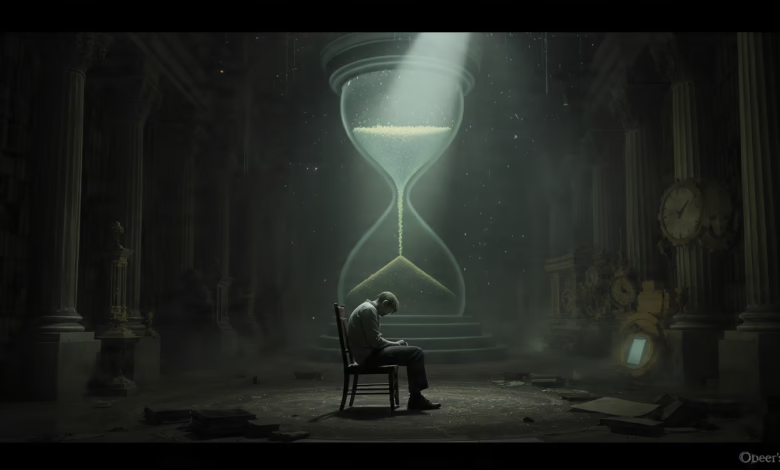
Boredom In Its Daily Manifestations Seems Like A Mere Passing Stumble In The Flow Of Time, Or A Moment Of Lethargy Interspersing The Accelerated Rhythm Of Life. But, What If This Simple Feeling Carries Within It A Long And Dark History Of Moral Condemnation, Medical Diagnosis, And Philosophical Rebellion? The Philosopher Søren Kierkegaard Opens His Famous Allegorical Tale By Saying: “The Gods Were Bored; Therefore They Created Human Beings.” And From That Mythological Moment, Boredom Sneaked Into The World To Become A Driving Force, An Engine Of History, And An Epidemic Haunting Humanity.
In Her Recently Published Book “The Disease Of Boredom: From Ancient Philosophy To Modern Psychology”, Researcher Josefa Ros Velasco Dives Into The Philosophical, Literary, And Medical Archives Of The West, Attempting To Deconstruct This Mercurial Concept. This Book Does Not Aim To Provide A Magic Recipe To Get Rid Of Boredom, But Explicitly Invites Us To Learn How To “Endure” This Feeling, Warning Us That The Hope Of Stopping Suffering From Boredom Is A False Hope For Which We Will Find No Consolation In These Pages Or Anywhere Else.
In This Article, We Trace The Journey Of Boredom From Being A Vice In Ancient Greece, To A Deadly Sin In The Middle Ages, Then Its Transformation Into A Sign Of Melancholic Genius In The Renaissance, Reaching Its Consideration As A Societal Epidemic In Modernity, And Finally Its Diagnosis As A Psychological Disorder In The Current Era.
The Map Of Boredom: From Function To Dysfunction
To Establish A Solid Ground For This Historical And Philosophical Journey, Velasco Lays Out A Theoretical Framework Classifying Boredom Into Four Basic Experiences, Ranging From The Most Functional To The Most Dysfunctional And Pathological:
-
Transient Situation-Related Boredom (Functional): Which Is The Simple Boredom We Feel When We Lose Interest In A Specific Activity Or Context, And It Disappears As Soon As A Change Occurs In The Surrounding Environment Or We Make A Decision To Move On To Something Else. This Boredom Represents An Adaptive Mechanism Pushing Us To Search For Alternatives And Preventing Us From Stagnation.
-
Chronic Individual-Related Boredom (Dysfunctional): A State Where The Individual Experiences Boredom Pathologically In Most Contexts, Not Because Of The Environment, But For Psychological Or Neurological Reasons That Prevent Them From Developing Coping Strategies Or Imagining A Better Scenario.
-
Chronic Situation-Related Boredom (Dysfunctional): Occurs When An Individual Or Group Falls Into The Trap Of An Environment Or Context That Cannot Be Changed, Making The Feeling Of Boredom Chronic And Resistant To Individual Solutions.
-
Profound Or Existential Boredom (Dysfunctional): Which Is An Overwhelming Feeling Of Fatigue And Weariness Of Life (Ennui), Where The Entire Existence Loses Its Meaning, Whether As A Result Of Chronic Individual Boredom Or Chronic Situational Boredom.
The Author Emphasizes That Boredom In Itself Is Neither Good Nor Evil, But It Becomes A Real Problem, And Perhaps A “Disease” In A Metaphorical Or Literal Sense, When It Takes On A Chronic Character.
Ancient Times: The Burden Of The “Polis” And The Silence Of Philosophers
Did The Ancients Know Boredom? To Answer This Question, We Face A Surprising Historical Obstacle: The Scarcity Of Direct References To Boredom In Classical Greek Texts. The German Poet Goethe Believed That The Ancients Did Not Know Boredom Because Their Minds Were Buzzing With Myths And Stories. But The Historical And Social Reality Revealed By Velasco Seems More Complex And Profound.
The Almost Total Absence Of Boredom In Greek Literature And Philosophy Was Not The Result Of An Absence Of Feeling It, But Because Of The Underlying Moral And Social Prohibition Against It. In Classical Athens, The Ideal Of A Citizen Was The “Political Animal” (Zoon Politikon), Where Every Individual Was Expected To Dedicate Themselves Body And Soul To Serving The “Polis” (The City-State) Through Political, Military, And Social Participation. In This Context, Admitting Boredom Was Considered Tantamount To Acknowledging Laziness, Or Preferring Isolation And Personal Leisure Time At The Expense Of Societal Duty. Consequently, Boredom Was Considered A “Vice” And An Abandonment Of Civic Virtue, And Even A Renunciation Of The Human Condition Itself.
However, The Scene Gradually Began To Change With The Rise Of The Roman Empire And Epicurean Philosophy. With The Unification Of Heterogeneous Peoples Under The Banner Of A Vast Empire, Rome Found In The Promotion Of Pleasure And The Management Of Leisure Time An Effective Political Tool To Control The Masses. Days Dedicated To Celebrations, Festivals, And Gladiator Shows Became More Numerous Than Those Dedicated To Work.
But, As Is Customary, Excessive Leisure Brought Its Opposite. Thinkers Like The Poet Lucretius And The Philosopher Seneca Realized The Danger Of This “Excessive Emptiness”. In His Poem “On The Nature Of Things”, Lucretius Describes How Wealthy Romans Suffered From “Horror Of Place” (Horror Loci), Constantly Fleeing From The City To The Countryside, Then Getting Bored Of The Countryside And Returning To The City In An Endless Vicious Circle. Here Emerges The First Metaphorical Use Of Boredom As A Disease, As Lucretius Describes Them As Hating Themselves Because They Are “Sick And Do Not Understand The Cause Of Their Sickness”.
As For The Stoic Philosopher Seneca, He Dove Deeper Into Dissecting This Condition, Warning Against “Weariness Of Life” (Taedium Vitae). In His Letters To Lucilius, Seneca Describes How The Repetition Of The Same Things Leads To Existential Nausea: “I Do Nothing New, I See Nothing New… And This Sometimes Leads To Nausea”. Seneca Linked This Profound And Chronic Boredom To Suicidal Behavior, Pointing Out That Some Prefer To End Their Lives Rather Than Bear The Heavy Burden Of An Unchanging Routine.
The Middle Ages: The Noonday Demon And The “Disease Of The Soul”
If The Romans Treated Boredom As A Byproduct Of Luxury, The Christian Middle Ages Elevated It To The Ranks Of Deadly Sins, Calling It “Acedia”.
Boredom In Early Monastic Literature Became A “Disease That Afflicts The Soul”. Theologians, Starting From Origen To Evagrius Ponticus And John Cassian, Began To Dissect This Complex Psychological And Spiritual State. Evagrius Ponticus Called This Type Of Boredom The “Noonday Demon”, A Demon That Specifically Targets Monks When The Sun Reaches The Middle Of The Sky, Trying To Delude Them That Time Has Stopped, And That Their Day Extends For Fifty Hours.
This Demon Instills In The Monk’s Heart A Hatred For His Cell (Which Cassian Later Called The Horror Of The Place), An Aversion To The Life Of Asceticism And Contemplation, And A Longing For The Worldly Life He Left Behind. This Boredom (Acedia) Was Considered The Most Dangerous Of The Original Eight Sins (Before Pope Gregory The Great Modified Them To Become Seven And Merged Acedia With Sadness), Because It Threatened The Core Of Monastic Life, And Pushed The Monk To Abandon His Most Important Duty: Communicating With God.
But What Velasco Draws Attention To Here With Dazzling Sociological And Historical Brilliance, Is That What These Monks Were Going Through Was In Fact “Chronic Situation-Related Boredom”. Imagine The Monastic Routine: Prayer, Reading, Manual Labor, Then Prayer Again, In The Same Place, With The Same People, Day After Day, And Year After Year. It Is Very Natural That A State Of Transient Boredom Is Generated That The Individual Needs To Deal With.
But The Problem Lies In The Fact That The Monastic System Was So Strict That It Prevented Any Attempt To Change This Situation Or Invent New Spaces. And Because The Absolute Religious System Cannot Err, The Blame Was Completely Shifted From The Shoulders Of The Environment (Which Lacks Stimulation And Generates Boredom) And Placed On The Shoulders Of The Individual. Thus, The Failure Of The Institutional System To Manage Time Was Diagnosed As A Moral Failure Of The Individual, And The Natural Symptom Turned Into A Sin Requiring Harsh Repentance, And Sometimes Suicide Out Of Despair.
This Precise Analysis Paved The Way For A Radical Change That Would Later Sweep Europe. With The Approach Of The Renaissance, The Phantoms Of This Heavy Moral Burden Began To Disintegrate, To Be Replaced By Another Explanation No Less Interesting, But This Time Acquitting The Soul To Accuse The Body.
The Renaissance: From The Sin Of The Soul To The Melancholy Of The Body
Can A Spiritual Disease Like “Acedia” Turn Into A Biological Defect Like Melancholy? Velasco Answers With A Resounding Yes, Showing That This Transformation Was Necessary And Desired; For If The Responsibility For Suffering Is Transferred From The Moral Realm To The Physical Realm, The Patient Is Relieved Of Blame. The Oppressive Atmosphere In The Middle Ages Generated A Deep Sense Of Individual Guilt Towards Boredom. But With The Dawn Of The Renaissance, This Moral Burden Was Lightened And Thrown Onto The Shoulders Of Physiology.
The Inability To Interact With The World Was No Longer Seen As A Spiritual Failure, But As A Purely Physiological Failure, Which Freed Individuals From Feeling Guilty, And Their Attitude Became: “You Are Free To Feel Bored Because You Are Sick”. This Chronic Boredom (Which Depends On The Individual) Was Explained As A Purely Organic Issue Resulting From The Corruption Of The Yellow Bile In The Blood, Leading To An Excessive Increase In “Black Bile” (Atra Bilis). Thus, The Ancient Medical Theories Of Hippocrates And Galen Were Revived To Absolve Sinners Of Their Personal Mistakes.
Great Writers Like Dante And Petrarch Paved The Way For This Transformation. In “The Divine Comedy”, Dante Linked “Acedia” To Chronic Sadness And The Paralysis Of The Will. Petrarch, On The Other Hand, Provided In His Dialogues A Precise Description Of Boredom (Melancholy) As A Condition That Afflicts Both Body And Soul Together, With Disastrous Consequences For Both.
But The Great Paradox Occurred In The Fifteenth Century, When The Philosopher Marsilio Ficino Turned The Tables, Declaring In His Book “Three Books On Life” That Black Bile (Melancholy) Is An Essential Condition For Genius. Ficino Argued That This Temperament Pushes The Soul To Contemplate And Dive Into The Deepest Mysteries Of Existence. Suddenly, Profound Boredom Transformed From A Disease That Must Be Cured, To A “Gift” Reserved For A Select Few Genius Thinkers. It Became Customary And Acceptable To Flaunt This Weariness As Evidence Of Sophistication, Intelligence, And The Ability To Reach Levels Of Thinking That Surpass Ordinary Humans.
The Conflict Of Thinkers: The Active “Choleric” Versus The Depressed “Melancholic”
Not Everyone Accepted This Romanticization Of Boredom. Concurrently With The Rise Of Melancholic Genius, The Religious Reformation Movement And The Calvinist Protestant Ethic Were Planting Seeds Of Another Kind. The Calvinists Linked Divine Salvation To Productivity And Tireless Work. The Continuous Accumulation Of Material And Intellectual Wealth Became A Moral Duty, And Laziness And Wasting Time Were Condemned As The Greatest Sins.
This Nascent Capitalist Ethic, Supported By Enlightenment Rationality, Produced A New Kind Of Intellectual: The “Choleric Intellectual” (Angry/Active), As Opposed To The Melancholic Intellectual. These Enlightenment Thinkers, Like Diderot And Voltaire, Were Driven By An Overwhelming Desire To Impose Their Will On The World And Produce Knowledge Abundantly. For Them, Boredom Was Not A State Of Contemplation Or A Source Of Genius, But A Pathological State And A Waste Of Precious Time That Must Be Utilized In The Search For Truth And Progress. The Philosopher Immanuel Kant, For Example, Clearly Criticized Boredom In His Book “Anthropology”, Describing It As A Pain Resulting From Inaction And Luxury, And That Its Only Cure Is Hard Work.
The Romanticism Of Pain: The “Disease Of The Century” And Metaphors Of “Spleen”
In The Late Eighteenth Century And Early Nineteenth Century, A Group Of Thinkers And Writers Rebelled Against This Strict Rational System Imposed By The Endeavors Of The Enlightenment And Capitalism. These “Romantics” Felt That Repetitive Tasks Kept Them Trapped In A Highly Superficial Dance Devoid Of Pleasure Or Adventure. In Pursuit Of Freedom, They Broke The Rules, But They Paid A Heavy Price: They Fell Into The Trap Of “Chronic Situation-Related Boredom”.
Two Crucial Terms Emerged In This Era: “Ennui” (Weariness Or Existential Boredom) And “Spleen” (Melancholy). Ennui Represented Weariness From Life Itself, A Pain That Formed As A Symptom Of Living In A Specific Society. As For Spleen, Whose Roots Go Back To The “English Malady” And The Theory Of Humors, It Evolved To Express The Physical And Psychological Manifestation Of This Boredom, Where The Individual Literally Gets Sick Due To Weariness Of Life.
The Literary Critic Sainte-Beuve Called This Condition The “Disease Of The Century” (Mal Du Siècle) In 1833, When Reviewing Senancour’s Novel “Oberman”. In This Novel, The Aristocratic Protagonist Suffers From A Deep Existential Boredom That Pushes Him To Contemplate Suicide, Before Learning In His Old Age How To Tolerate His Weariness. Another Famous Character Is “René” By Chateaubriand, The Sensitive Young Man Who Clashes With Society And Suffers From A Paralysis Of Will Due To Boredom, But He, Unlike Oberman, Finds In This Pain An Unexpected Pleasure And Relish In His Illness.
The Exploration Of Boredom Was Not Limited To Men; Female Novel Heroines Embodied Even Harsher Dimensions Of This Feeling. Women In That Era Were Trapped In The Strict Routine Of Married Life. The Most Famous Of These Without A Doubt Is “Emma Bovary”, The Heroine Of Flaubert’s Novel, Whose Chronic Boredom And Yearning To Break The Monotony Of Marriage Led Her To Betrayal, Then To Destroying Herself And Her Family, Preferring Death And Suicide Over Continuing In Boredom.
When The Metaphor Becomes A Medical Diagnosis
Writers Did Not Stop At Dissecting This Disease, But The Matter Reached Symbolist Poets, Like Charles Baudelaire, Who Saw Life As “An Oasis Of Horror In A Desert Of Boredom”. Baudelaire Considered Boredom To Be The Gateway To All Evils, But At The Same Time Contradicted Himself When He Considered “Spleen” A Necessary Condition For The Emergence Of Genius And The Outburst Of Creative Work. His Friend And Partner Arthur Rimbaud Also Suffered From The Burden Of Chronic Boredom Throughout His Short Life, Confessing That He Was A Victim Of The “Invincible Virus Of Boredom”.
This Massive Literary Momentum Did Not Go Unnoticed By The Doctors Of That Era. Mental Health Professionals Took These Literary Metaphors Seriously, And Began To Transform The Metaphorical “Disease Of Boredom” Into A Literal Medical Diagnosis. The Doctor De Sauvages Described Boredom As A “Disease” Accompanied By Clinical Symptoms. The Psychiatrist Esquirol Also Included Boredom Among The Causes And Precursors Of Suicide, Confirming That “Weariness Of Life (Taedium Vitae) Leads To Suicide”.
What Is Surprising Is The Continuous Circular Overlap Between Literature And Medicine In That Era; Doctors Would Cite Fictional Characters Like “René” As Case Studies To Diagnose Melancholy Or Boredom Disorder. And At The End Of The Nineteenth Century, The Doctor And Psychologist Émile Tardieu Declared That Boredom Is Indeed A “Real Disease” Whose Symptoms Manifest In Mental Disorders, Strange Impulses, And Degeneration Into Hypochondria.
The Industrial Revolution And Beyond
As We Entered The Twentieth Century, Boredom Was No Longer An Aristocratic Luxury Or An Anxiety Limited To Literary Salons, But Transformed Into A Collective And Par Excellence “Democratic” Phenomenon, Creeping From The Margins Of Society To Its Beating Heart In Factories, Offices, And Homes. Josefa Ros Velasco Observes At This Historical Turning Point How Modernity Reshaped Boredom, Transforming It From A “Disease Of The Soul” To A “Symptom Of The System”. The Transition To The Machine Age And Mass Production Led To The Birth Of A New Kind Of Monotony; The Factory Man Who Spends His Day Replicating A Single Mechanical Movement Was No Longer Suffering From Baudelaire’s Romantic “Spleen”, But From A “Chronic Situational Boredom” Imposed On Him By The Force Of Earning A Living, Which Early Sociologists Called “Alienation Of Labor”.
In This Climate Charged With Mechanism, The German Philosopher Martin Heidegger Appeared To Offer One Of The Deepest And Most Complex Philosophical Approaches To Boredom In The History Of Western Thought. Heidegger Did Not Just Describe Boredom As A Passing Psychological State, But Made It A “Fundamental Mood” That Reveals To Us The Truth Of Our Existence. In His Famous Lectures Delivered In The Late Twenties, Heidegger Distinguished Between Three Levels Of Boredom: The First Is “Becoming Bored By Something”, Like Waiting For A Delayed Train, Where We Are Aware Of The Time Passing Slowly And The Situation Imposed On Us. The Second Level Is “Being Bored With Something”, Where We Are At A Loud Party, For Example, But We Feel A Strange Inner Emptiness Despite Our Apparent Busyness. As For The Third And Most Dangerous Level, It Is “Profound Boredom” Or Existential Boredom, Where We Are Not Bored By Anything Specific, But Existence Itself Is Bored With Us, And A Deafening Silence Prevails Making All Things, Including Ourselves, Seem Meaningless. Heidegger Believes That This Profound Boredom, Despite Its Harshness, Is The “Moment Of Truth”; Because It Forces Us To Confront Our Freedom And Responsibility To Create Meaning For Our Lives In A Silent World.
But This “Silence” That Heidegger Spoke Of Was Soon Filled With The Noise Of The “Culture Industry” Analyzed By The Thinkers Of The Frankfurt School, Like Theodor Adorno And Max Horkheimer, With Surgical Precision. Velasco Explains How This School Argued That The Modern Capitalist System Found In Boredom A Golden Opportunity For Investment. For Consumption To Continue, People Must Feel A Constant Boredom That Needs Immediate “Gratification” Through Entertainment Products And New Commodities. Thus, Leisure Time, Which Was Supposed To Be A Space For Freedom And Creativity, Turned Into An Extension Of Work Time, Where The Individual Consumes Stereotypical Entertainment Products Aimed At Sedating Them, Not Liberating Them. Boredom Here Has Become An Economic Engine; We Do Not Buy Goods Because We Need Them, But To Escape The Emptiness Generated By The Stereotypical Modern Life, Creating A Vicious Circle Of “Boredom, Then Consumption, Then Boredom Again”.
With The Middle Of The Twentieth Century, The Epistemological Weight Began To Shift Gradually From Philosophy To Experimental Psychology And Neuroscience, In An Attempt To “Quantify” This Mercurial Feeling. Velasco Points Out That The Real Turning Point Was In 1986, When Researchers Richard Farmer And Norman Sundberg Developed The “Boredom Proneness Scale” (BPS). This Was The First Scientific Recognition That Boredom Is Not Just A Reaction To The Surroundings, But A Personality Trait That Differs From One Individual To Another. Here, Science Began To Look At Boredom As A Biological “Warning Signal”, Similar To Physical Pain, Telling The Brain That The Current Activity Is Unsatisfactory And That There Is A Need For Change. But The Problem Lies In The Fact That This Signal, If It Malfunctions Or If The Individual Does Not Find A Way To Respond To It, Turns Into A Pathological State Associated With Depression, Anxiety, Addiction, And Even Aggressive Behaviors.
Modern Science Has Revealed That The Brain Of A Person Who Feels Bored Is Not “Asleep”, But Is In A State Of High Arousal Looking For A Way Out. This Tension Between The Desire To Engage In A Meaningful Activity And The Inability To Find This Activity Is What Makes Boredom Painful. And In Our Current Era, The Era Of The “Attention Economy” And The Endless Flow Of Information Through Smartphones, Velasco Argues That We Have Lost Our Ability To “Endure” This Signal. We Have Come To Escape From The Slightest Moment Of Silence Or Emptiness By Resorting To Screens, Which Led To The Atrophy Of Our “Boredom Muscle”. This Continuous Escape Does Not Solve The Problem, But Makes Us More Vulnerable To Chronic Boredom, Because We Always Return To Our Reality Only To Find It More Monotonous Than What The Virtual Worlds Offer Us.
Velasco Reaches A Bitter Conclusion At The End Of This Part Of The History Of Boredom; Which Is That We, In Our Frantic Attempt To Eradicate Boredom Through Technology And Consumption, Have Already Turned It Into An “Incurable Disease”. While The Medieval Person Saw Boredom As An Invitation To Repentance, And The Romantic Person Saw It As A Gateway To Creativity, The Twenty-First-Century Person Sees It Merely As A “Glitch” In The System That Must Be Fixed Quickly, Ignoring That This “Glitch” Is Actually An Existential Cry Asking Us To Stop And Think About The Usefulness Of What We Are Doing.
The Civilization Of Escape
Velasco Transitions In Her Final Chapters From Historical Theorization To The Social And Political Dissection Of Contemporary Boredom, Considering That We Live In A “Civilization Of Escape”. We Have Designed A World That Trembles From A Single Moment Of Stillness; As Soon As The Ghost Of Boredom Looms On The Horizon, We Rush To Draw Our Smartphones Like Protective Shields, Drowning Ourselves In A Torrent Of Images, Clips, And Posts That Do Not Aim To Enrich Our Minds As Much As They Aim To “Kill Time”. But The Paradox Put Forward Sharply By The Author Is That The More We Try To Kill Time, The More We Actually Kill Our Capacity For Innovation And Contemplation, And Transform Transient Boredom (Which Was Supposed To Be A Catalyst For Change) Into Chronic And Deep-Rooted Boredom.
The Researcher Opens A Thorny File She Calls “Institutional Boredom”, Which Is The Dark Side That Is Rarely Highlighted In Traditional Psychological Studies. Velasco Points Out That There Are Groups In Society Condemned To Boredom “Forcibly”, Not Because Of A Defect In Their Brain Chemistry, But Because Of The Environments In Which They Have Been Placed. She Speaks Bitterly About Nursing Homes For The Elderly, Prisons, And Long-Term Care Hospitals, Where Time Turns Into A Silent Enemy. In These Places, Boredom Is Not Just A “Feeling”, But A Tool Crushing The Human Spirit. When An Individual Is Deprived Of The Capacity For Action, The Possibility Of Changing Their Surroundings, And Interacting With New Challenges, Boredom Transforms Here Into An “Incurable Disease” Imposed By The System. She Demands “Attentional Justice”, And The Necessity Of Redesigning These Institutions To Be Spaces For Life, Not Just Warehouses For Waiting.
On The Level Of Modern Psychoanalysis, Velasco Returns Us To The Idea Of “Boredom As A Signal”. She Argued In The Chapters Of The Book That The Problem Is Not In Boredom Itself, But In Our “Inability To Respond To The Signal”. Today We Suffer From What Can Be Called “Poverty Of Qualitative Alternatives”. Despite The Abundance Of Consumer Choices, They Are Superficial Choices That Do Not Satisfy The Existential Hunger For Meaning. This Contradiction Leads To A State Of “Painful Arousal”; Where The Individual Feels An Overwhelming Desire To Do Something, But Finds Nothing Worth Doing, Which Ultimately Leads Them To Impulsive Behaviors, Binge Eating, Or Addiction, As Primitive Ways To Numb The Pain Resulting From This Emptiness.
The Author Reaches The Peak Of Her Analysis When She Links Boredom With The “Crisis Of Meaning” In Modern Societies. In Light Of The Decline Of Grand Narratives And The Reduction Of The Human Being To Their Consumerist Dimension, We Have Lost The Compass That Directs Us Towards Goals That Transcend The Self. Boredom At Its Core Is The Cry Of The Soul That Refuses To Be Just A Cog In A Machine. It Is The Constant Reminder That We Are “Transcendent” Beings, Who Cannot Be Satisfied Merely By Fulfilling Biological Needs Or Superficial Entertainment.
The Disease of Boredom: From Ancient Philosophy to Modern Psychology
Josefa Ros Velasco