
Dismantling The Traditional Narrative And The Alternative Timeframe (1931–1945)
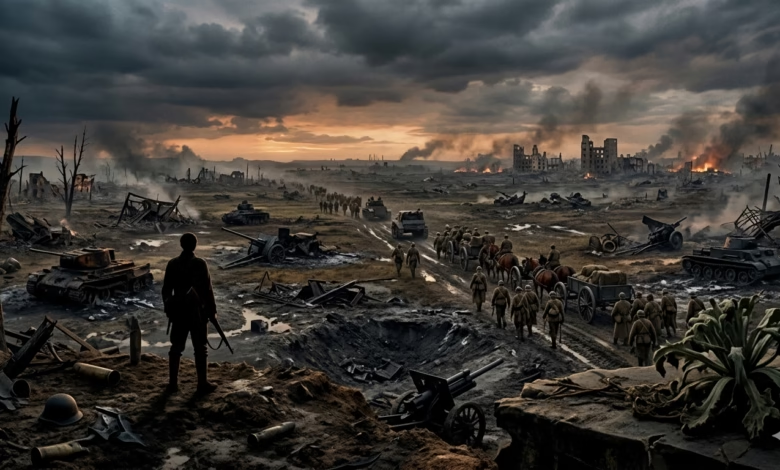
When The Former American Secretary Of State Cordell Hull, In His Brief Message On The Occasion Of Winning The Nobel Peace Prize In December Nineteen Forty-Five, Recalled The Human Catastrophe, Describing It As A Stunning And Most Grievous Ordeal In The History Of All Ages, He Was Not Engaging In Rhetorical Luxury Or Literary Showing-Off; Rather, He Was Expressing, From The Position Of A Witness And Participant, The Shock Of Human Consciousness In the Face Of A Flood Of Organized Violence That Almost Swept Away The Foundations Of Modern Civilization. Nevertheless, That Global War, Which Settled In The Global Conscience Under The Banner Of “The Second World War,” Remains, Despite Thousands Of Volumes That Chronicled Its Battles and Generals, Difficult To Understand Deeply Unless We Free Ourselves From The Shackles Of Simplistic And Reductionist Explanations. Here Emerges The Great Philosophical And Historical Value Of The Latest Massive Tome By The Renowned British Historian Richard Overy, Entitled “Blood And Ruins: The Last Imperial War, 1931–1945,” Published By Viking, Where Overy Does Not Merely Provide A Repeated Military Narrative Of Battles And Alliances, But Rather Raises The Ax Of Epistemological Criticism To Demolish The Traditional Structure Upon Which History Books Have Settled For Seventy-Five Years, Placing Us Before A Radical Vision That Redefines The War As The Concluding And Bloodiest Chapter In The Long Human Struggle For Imperial Colonial Hegemony And The Distribution Of The Terrestrial Cake.
The Central Thesis Upon Which This Huge Work Rests, Which Exceeds One Thousand Nine Hundred Pages, Is Summarized In The Fact That The Second World War Was Not Just A Principled Moral Confrontation Between The Peace-Loving Forces Of Good And Democracy And The Fascist And Nazi Forces Of Evil, But Was Rather An Imperial War Par Excellence; A Global Conflict That Exploded As A Result Of The Clogging Of The Channels Of The Old International System, And A Violent Attempt Made By Rising And Crisis-Ridden Radical Nationalist Powers, Which The Author Describes As “Have-Not” States Or Those That Do Not Possess Sufficient Geographical Space To Preserve Their Survival, Meaning Germany, Japan, And Italy, In the Face Of The Large, Settled, And Satiated Colonial Empires, Foremost Among Them Britain And France. Overy Believes That Adolf Hitler, Benito Mussolini, And The Ruling Military Elite In Tokyo Were Not The Primary And Independent Causes Of The International Crisis That Swept The Twentieth Century, But Were Rather Natural Byproducts, And Inevitable Manifestations Of A Diseased International Pattern Based On The Unequal Distribution Of Vital Spheres, And The Monopolistic Control Over Resources And Markets Imposed By The Old Colonial Powers Since The Nineteenth Century And Reinforced By The Unjust Treaty Of Versailles.
The Process Of Epistemological Reconstruction For Richard Overy Begins By Shaking The Traditional Chronological Sequence Settled In Minds And Textbooks, Which Links The Outbreak Of The War To The First Day Of September Nineteen Thirty-Nine, When German Forces Invaded Polish Territory. This Date, In Overy’s View, Is Nothing But A Narrow, Short-Sighted European Angle Of Vision That Fails To Comprehend The True Global Character Of The Tragedy. Therefore, The Author Proposes An Alternative, More Extensive, And Rational Timeframe, Starting From Nineteen Thirty-One, Specifically With The Japanese Invasion Of Manchuria In Northeastern China And The Establishment Of The Puppet State Of “Manchukuo.” From This Geographical And Temporal Starting Point In East Asia, The Train Of Rising Imperial Violence Launched, And It Would Not Stop Until Nineteen Forty-Five; In Fact, Its Violent Repercussions and Aftershocks Of Civil Wars And Bloody Insurgencies Would Continue To Strike Wide Areas Of Southeast Asia, Eastern Europe, And The Middle East For Long Years After The Official Signing Of The Documents Of Surrender. Linking The War To The Beginning Of Japanese Aggression Against China Transforms The Second World War, In Overy’s Reading, Into A Conflict That Spanned Fourteen Years, A Conflict In Which The Asian Issue Was Linked To The European Issue In One Inseparable Fabric.
Overy Is Not Content With Extending The Temporal Horizon to Nineteen Thirty-One, But He Takes The Reader Back In His Wonderful Introductory Chapters To The Late Nineteenth And Early Twentieth Centuries, Considering That The First and Second World Wars Are Not Separate Events, But Are In Their Essence Successive Stages Of “The Second Thirty Years’ War” Which Centered On Rearranging The International System And Settling The Great Imperial Crisis. The First World War Left Behind A Distorted And Destabilized World; Old Empires Like The Ottoman, Austro-Hungarian, And Tsarist Russian Empires Collapsed, While The British And French Empires Emerged With Vast Geographical Expansions Through The Mandate System, Deepening Other Countries’ Sense Of Inferiority, Geographical Siege, And Economic Blockade. This Structural Blockage In The International Financial And Trade System During The Nineteen Twenties And Thirties, Which Culminated In An Unprecedented Great Depression, Made The Idea Of Violent Imperial Expansion The Only Way, In The Eyes Of Extremist Nationalist Elites, To Save Their Countries From Economic And Social Annihilation, Ensure The Flow Of Raw Materials and Closed Markets, And Build Biologically And Politically Protected Geographical Spaces.
The Book Reframes The Geopolitics Of That Era; The Old Empires That Controlled Vast Areas Of The Planet Were Presenting Themselves As Protectors Of International Law And Human Peace, While In Reality They Were Practicing A Global Monopoly Based On Brutal Military Power. Hence, The Nazi, Fascist, And Japanese Military Rise Was Not A Sudden Deviation In The Course Of Human History Or Merely A Bout Of Collective Madness That Afflicted Entire Peoples, But Was Rather A Radical, Late Emulation, Charged With Violent Racial Ideologies, Of The Same Imperial Behavior Practiced By Britain And France In Previous Centuries. Japan Wanted To Build The “Greater East Asia Co-Prosperity Sphere” To Be Its Own Version Of The British Empire, Italy Sought To Revive Roman Glories In The Mediterranean And North Africa, While Hitler Planned To Turn The Vast Plains Of Eastern Europe And Russia Into A Major Agricultural Colony Belonging To The Third Reich, Where Slavic Peoples Would Be Treated As Enslaved Labor To Serve The Aryan Race, Just As European Powers Treated African And Asian Peoples At The Peak Of The Colonial Rise.
This Innovative Theoretical Formulation Presented By Richard Overy Allows Us To Understand How The War Transformed Into A Comprehensive Global Conflict That Extended From The Remote Aleutian Islands In The North Pacific To Madagascar In The South Indian Ocean, Reaching Naval Bases In The Caribbean Basin. There Was No Longer Any Spot In The World Immune From This Hurricane, Because The Core Stake Was Not Merely Adjusting Political Borders Between Neighboring Countries, But Was A Complete Redrafting Of The Map Of Terrestrial Ownership And Global Influence. From Here, Overy Firmly Rejects Treating The War In The Pacific And Asia As A Secondary Appendix Or A Marginal Chapter To The Focal War In Europe; Rather, He Sees That The Asian War, With China’s Legendary Resilience In The Face Of The Japanese Military Machine And The Difficult Birth Pangs Of Modern China, Was The Cornerstone In Shaping The Post-War World, And Perhaps Surpassed In Its Long-Term Geopolitical Importance The Results Of The German Collapse In The Old Continent, Because It Sparked The Inevitable And Final Dissolution Of The Traditional Colonial System In The Entire World.
Overy’s Style Is Characterized By A Synthesis That Integrates Precise Economic Analysis With A Deep Philosophical Vision Of The Nature Of The Modern State, Moving From Monitoring Industrial Production Figures and Inflation Rates In The Nineteen Thirties To Analyzing The Mental And Ideological Structures That Moved The Masses And Decision-Makers. He Emphasizes That The Three New Colonial States, When They Rushed Toward Their Military Adventures, Were Moving Under The Weight Of A Fatal Feeling Of Fear Of Internal Suffocation And Decay, Driven By Salvationist Ideologies That Saw War As The Only Means For National Purification And Rebirth. Thus, The Book Places Us Before A Complex Tragic Scene: Old Powers Ready To Do Anything To Maintain Their Acquired Imperial Privileges, And New Powers Rushing With Suicidal Madness To Snatch Their Share Of The Global Cake, And Between The Two Sides Lie The Colonized Peoples And Millions Of Innocent Victims Who Were Crushed By The Hooves Of Horses And The Wheels Of War Factories In This Last Imperial Confrontation.
The Added Value Of Overy’s Book Lies In Its Ability To Make The Contemporary Reader Realize The Nature And Scale Of Total Mobilization Witnessed By That Era, Where More Than One Hundred Million Men And Women Engaged In Direct Military Service, And The Economies Of Whole Major Countries Transformed To Serve The War Effort, To The Point Of Allocating Nearly Two-Thirds Of The National Gross Domestic Product For Purposes Of Destruction, Killing, And Fighting. How Can Our Modern Mind, Settled In The Shadows Of Relative Luxury And Digital Transformation, Comprehend The Acceptance By Entire Societies Of Abject Poverty, Rationed Hunger, And The Loss Of The Savings Of Entire Generations Within A Few Short Years, All Poured Into The Maw Of The Insatiable War Dragons.
The Multiple Symphony Of Death.. Dismantling The Fragmentation Of Wars And Civil Dimensions
If Demolishing The Traditional Chronological Narrative Is The First Step In Richard Overy’s Project To Reread The Second World War, Then The Second and More Surprising Step Lies In Dismantling The Solid Structure Of The Event Itself. War In Common Historical Convention Is An Armed Conflict Taking Place Between Sovereign States, In Which Regular Armies Move In Uniformed Clothes Under The Command Of Generals Who Move Military Pieces On Maps According To Classical Strategic Plans. But Overy, With His Penetrating Historical Scalpel, Tears Up This Smooth Outer Wrapper To Reveal A More Complex And Fragmented Reality; For He Sees That What We Call “The Second World War” Was Not One Homogeneous Conflict, But Was Rather A Complex Matrix Of Multiple And Overlapping Wars, Whose Chapters Took Place Simultaneously, Fed On One Another, Completely Transcending The Traditional Boundaries Of Regular Military Operations. It Is A Tragic Blend Of Interstate Wars, Parallel Civil Wars, And Independent Civilian Wars, All Of Which Merged In One Cauldron To Create The Comprehensive “Total” Character Of This Last Imperial Conflict.
Overy’s Analytical Fabric Begins With The Recognition That War Between States, Whether Wars Of Aggression And Expansion Led By The Axis Powers, Or Wars Of Defense And Recovery Led By The Allied Powers, Remains The Most Massive Visible Structure Because It Was The Only One That Possessed The Ability To Mobilize Enormous Resources And Sustain Violence On A Vast Scale Through Factory Production Lines and Major State Budgets. But The Added Epistemological Value Of The Book Appears When It Highlights The “Minor Civil Wars” That Ignited In The Belly Of The Great War, Exploiting The Collapse Of Central State Authority Or The Changing Of Occupying Powers. In China, For Example, The Scene Was Not Merely A Confrontation Between Invading Chinese Forces And The Imperial Japanese Army; Rather, It Was A Three-Dimensional Existential Struggle, Where The Chinese Nationalist Party Led By Chiang Kai-Shek And The Kuomintang Party Fought A Fierce, Bloody Confrontation Against The Communist Party Led By Mao Zedong, At The Same Time That Both Sides Were Fighting The Japanese and Competing For Who Would Inherit The Throne Of China Following The Evacuation Of The Colonialist. This Civil War Latent In The Bowels Of The Liberation War Was Not Marginal, But Was Rather The Main Engine That Reshaped Asia As A Whole After Nineteen Forty-Five.
This Civil Fragmentation Is Not Limited To The Asian Arena, But Rather Extends To Tear The European Continent Apart In Various Spots Ignored By Traditional Historians. Overy Recounts With Both Criticism And Analysis How Ukraine Transformed Into A Theater For A Multi-Front Civil War, Where Ukrainian Nationalists Fought Against The Soviets, Against The Germans, And Against Polish Minorities, In A Whirlpool Of Mutual Ethnic Cleansing That Took Place Under The Cover Of The Great Eastern Front. In Italy, After The Fall Of Mussolini In Nineteen Forty-Three And The Establishment Of The Puppet Fascist “Salò Republic” In The North With German Support, A Heavy and Fracturing Italian-Italian Civil War Exploded Between Fascists Loyal To Hitler And Liberation Factions, Communist Partisans, And Democrats, A War That Was Taking Place In Villages, Farms, And Back Alleys, Far From The Regular Fighting Fronts Led By The American And British Armies. As For Greece, The Conflict Of Resistance Against The Nazi Occupation Soon Turned Into A Fierce Civil War Between The Communist Resistance And The Monarchist And Conservative Forces Backed By Britain, A War That Did Not Stop With The End Of The World War But Continued For Years To Be The First Front Of The Cold War To Ignite With Blood.
Alongside Interstate And Civil Wars, Richard Overy Introduces A New Concept He Calls “Civilian Wars.” This Concept Does Not Mean Merely Civilians Falling As Unintended Victims Of Military Actions, But Rather Refers To The Involvement Of Non-Regular Civil Society As A Direct Actor And Warrior In The Fray. Civilian Wars For Overy Take Two Basic Forms; The First Form Is “Wars Of Liberation And Resistance” Fought By Secret Resistance Movements and Partisans In France, Yugoslavia Under Tito, The Philippines, And Poland. These Civilian Groups That Carried Weapons Fought An Invisible Guerrilla War, Lacking Classical Rules Of War, Characterized By Excessive and Harsh Mutual Violence, Where Occupation Forces Confronted This Resistance With Collective Reprisals, Extermination Of Entire Villages, And Random Executions Of Hostages, Making Civil Society The First Line Of Defense And Fighting.
As For The Second Form, It Is What The Author Calls “Wars Of Civil Self-Defense” To Confront The Hell Of Comprehensive Aerial Bombardment. Here, Civilians In Cities Like London, Berlin, Tokyo, Hamburg, And Chongqing Transform Into A Special Kind Of Fighters; They Are Required To Maintain The Cohesion Of The Home Front, Extinguish Global Fires Resulting From Incendiary Bombs, Organize Medical Evacuation and Sheltering Operations Amid Mountains Of Corpses And Rubble, And Continue Operating Factories Under The Hail Of Fire Falling From The Sky. It Is A War Fought By Millions Of Women, Children, And The Elderly Against The Organized And Systematic Destruction Practiced By The Air Forces Of Both Conflicting Parties, Which Systematically And Deliberately Targeted Breaking The Moral Will Of Peoples By Turning Their Historical Cities Into Human Slaughterhouses and Open Crematoria Under The Name Of “Moral Bombing” Or “Area Bombing.”
This Terrible Overlapping Between Different Patterns Of Wars Is What Gave The Second World War Its Absolute Total Character, And Made The Traditional Distinction Between “Combatant” And “Civilian” Fall And Completely Dissolve In The Practices Of Warring States. Overy Explains With A Great Deal Of Economic And Social Precision How General Mobilization Abolished The Fringes Between The Factory and The Trenches; The Woman Working In A Munitions Factory In Detroit Or In The Soviet Ural Mountains, Or The Worker Manufacturing Fighter Parts In A Small Workshop In The Suburbs Of Tokyo, Became In The Military Doctrine Of Enemy States Legitimate Military Targets Fully Equivalent To Soldiers On The Front Lines Of Fighting. Thus, The Liquidation Of Entire Societies And The Crushing Of Their Vital Infrastructure Became A Conscious And Declared Strategy, Justified By The Imperial Need To Defeat The Enemy With An Absolute Defeat Beyond Recovery.
Overy Links This Fragmentation In The Nature Of War To The Essence Of The Imperial Crisis. The Imperial States, When They Began To Stagger Under The Blows Of The Axis Powers Between Nineteen Forty And Nineteen Forty-Two, Left Behind Huge Geopolitical Vacuums In Their Old Colonies and In The Territories From Which They Withdrew. This Vacuum Was Not Filled Stably By Axis Armies, But Rather Exploded The Suppressed National And Social Energies Of Colonized And Oppressed Peoples, Who Suddenly Found Themselves Confronting Fateful Questions About Their Identity and Political Future. Thus, The War Transformed From A Mere Clash Of Armies Into A Volcanic Explosion Of Sub-Identities, Class Conflicts, And Conflicting Ideologies Settling Their Old And New Scores Using The Absolute Violence Legalized By The Great War.
In This Complex Scene, The Yugoslav Resistance Emerges As A Stark Model Of These Overlapping Wars; The Partisans Led By Josip Broz Tito Were Not Only Fighting The German And Italian Occupiers, But Were Fought A Bloody, Relentless Civil War Against The Monarchist-Loyal Serb Nationalist “Chetniks,” And Against The Fascist Croatian “Ustaše” Who Committed Horrific Acts Of Genocide Against Serbs And Jews. The Yugoslav Scene Was A Miniature Of The Global Tragedy: An Overlap Between An External Imperial Conflict, Internal Ethnic Cleansing, And A Communist Social Revolution That Turned Old Class Structures Upside Down. Through This Flowing Presentation, Richard Overy Proves That Looking At War Through The Barrels Of Regular Cannons Is A Historical Blindness, And That The Horrific Truth Of The Second World War Lies In Those Dark Corners Where Neighbor Killed Neighbor, and Where Civilians Made The Tools For Their Survival Or The Tools Of Their Destruction Amid The Rubble Of Falling Empires.
The Miracle Of Logistic Mobilization.. How The Ural Factories And Detroit Chimneys Decided The Battle Of Existence
When The Last Imperial War Reached Its Raging Climax Between Nineteen Forty-Two And Nineteen Forty-Four, Military Resolution Was Not Merely Contingent Upon The Bravery Of Soldiers In The Field Or The Tactical Brilliance Of Generals’ Plans, But Was Rather Decided In A Hidden and Secret Way Inside Economic Planning Offices, Across Continuous Production Lines In Steel Mills, And Upon Vast Port Wharves And Railroads. In This Context, Richard Overy Presents An Economic Anatomy That Overturns Common Romantic Concepts Of Victory and Defeat; Military Power In The Era Of Total War Is Nothing But The Outer Facade Entirely Dependent Upon The Core Of Industrial And Logistic Mobilization And The State’s Ability To Transform Millions Of Citizens From A Civil Workforce Into Cogs In A Giant, Insatiable Destructive Machine. The War, In Its Dark Material Essence, Was A Raging Global Race Between The Ability Of The Rising “Have-Not” Empires To Exploit The Spaces They Occupied Quickly, and The Ability Of Opposing Powers To Mobilize Resources And Achieve Extraordinary Production Leaps Surpassing the Opponent’s Ability To Destroy.
Overy Begins With The Structural Dilemma That Faced The Axis Powers, A Dilemma Directly Linked To Their Hasty Imperial Ambitions; The Expansionist Ideology Of Germany, Japan, and Italy Was Based On The Premise Of Controlling Vital Spheres Rich In Raw Materials In Order To Secure Self-Sufficiency and Build Fortified Empires. But The Great Historical Paradox Highlighted By The Author Lies In The Fact That These Countries, Despite Their Astounding and Swift Military Successes At The Start, Failed Dismally In Transforming The Vast Territories And Millions Of Subject Peoples Into A Real Economic and Industrial Lever For Their War Effort. German Imperial Administration Of Occupied Areas In Eastern Europe Was Characterized By Random Plundering, Excessive Brutality, And Edifying Subjugation Of Human Material In Primitive Ways That Destroyed Production Structures And Ignited Armed Resistance Movements, Instead Of Building An Integrated and Sustainable Economic System. Similarly, Japan Failed To Exploit The Enormous Oil And Mineral Wealth In Southeast Asia And The East Indies Due To A Acute Shortage In Its Merchant Fleet And The Success Of American Submarines In Severing Maritime Supply Lines, Making New Colonies A Strategic And Military Burden Rather Than A Source Of Strength And Growth.
In Contrast, Overy Contemplates The Logistic And Industrial Miracle Achieved By The Allied Camp, Specifically The Giant Duo: The United States Of America And The Soviet Union. These Two Powers, Despite The Stark Ideological Contradiction Between Liberal Capitalism and Stalinist Communism, Possessed Common Denominators That Decided The Battle; Namely, The Enormous Geographical Expansion Fortified Against External Invasion, The Profound Abundance Of Essential Natural Resources Like Oil, Coal, And Iron, And Most Importantly, The Ability To Apply The Model Of “Standardized Mass Production” To The Arms Industry. The Author Explains How The Soviet Union, Despite Losing More Than Half Of Its Industrial Capacity And Fertile Agricultural Fields In The Early Months Of The German Invasion In Nineteen Forty-One, Managed To Execute One Of The Greatest Logistic Epics In History, Represented In Dismantling Thousands Of Huge Factories From The West Of The Country and Transporting Them Via Railways Beyond The Ural Mountains And Siberia, To Resume Production Under Harsh Weather Conditions And In The Open, Flooding From Their Lines Thousands Of Tanks And Fighters That Numerically Outmatched Skilled But Limited, Slow German Industry.
On The Other Side Of The Atlantic Ocean, The United States Of America Transformed Into What President Franklin Roosevelt Called The “Arsenal Of Democracy.” Overy Analyzes How American Capitalism, Under Strict Guidance and Coordination From The State and Through Partnership With Major Industrial Complexes, Succeeded In Converting All Its Massive Consumer Production Capacity Into Military Production Within A Few Short Months. Major Car Factories In Detroit Abandoned Creating Civilian Vehicles To Manufacture Heavy Bomber Aircraft, Tracked Vehicles, And Engines Instead, While American Shipyards Invented Revolutionary Methods To Build “Liberty” Cargo Ships In A Few Days Rather Than Months, Allowing For The Establishment Of A Global Maritime Bridge Supplying Britain, The Soviet Union, And Fighting Fronts In The Pacific Ocean With A Never-Ending Stream Of Hardware, Fuel, And Foodstuffs Via The Famous “Lend-Lease” Program, Which Overy Views As The Most Important Economic Tool That Bound The Joints Of The Anti-Axis Alliance And Prevented It From Collapsing In The Darkest Circumstances.
This Superior Capacity For Mobilization And Gathering Was Not Limited To Machines And Factories, But Extended To Include Human Material And Redrafting The Social Contract Within Warring States. Overy Recounts With Intellectual Depth How Total War Required Merging Entire Social Classes That Were Previously Excluded From The Economic and Productive Cycle; Chief Among Them Were Women Who Stormed War Factories, Mines, and Administrative Institutions To Compensate For The Acute Shortage In Labor Resulting From Sending Millions Of Men To The Fighting Fronts. This Shift Was Not Just A Temporary Economic Measure, But Was A Violent Social and Cultural Shake That Changed The Nature Of Modern Societies And Their Features Forever After The War. The Totalitarian State Was Intervening In Every Detail Of Its Citizens’ Daily Lives; Organizing Food Rations, Fixing Wages, Directing Consumption, And Imposing Long Working Hours, A Heavy Price Accepted By Peoples Under The Weight Of Intense Propaganda And The Sense Of Imminent Existential Danger Threatening The Survival Of The Nation.
It Becomes Clear To Us How The Imperial Illusions Of The Axis Powers Collapsed Against The Rock Of Material Reality; The Germans And Japanese, Despite Their Initial Tactical Superiority And High Combat Experience, Were Fighting A War Against Figures and Production Rates Impossible To Match. When Overy Mentions That The United States Alone Was Producing In Some War Years Airplanes And Ships Equivalent To The Output Of The Combined Axis Countries Multiplied Many Times, He Explains That The End Of The War Was Merely A Matter Of Time And Logistic Management. The War In Its Final Chapters Transformed Into An Organized Mechanical Crushing Process, Where German And Japanese Armies Confronted An Acute Shortage In Fuel, Ammunition, And Men, While The Allies Possessed The Luxury of Replacing Their Material and Human Losses Instantly And With High Efficiency, Making Resistance In The Face Of This Machine Suicidal, Desperate Labors That Ultimately Led To Demolishing Those Rising Empires And Transforming Their Industrial Cities Into Debris Scattered By The Wind.
The Emotional Geography Of The Human Holocaust.. How The Structure Of Hatred And Justifications For Genocide Were Formed
When Historian Richard Overy Moves Beyond Monitoring Factory Numbers And Armies’ Movements On Maps, He Penetrates Into The Most Complex And Dangerous Trench In Studying The Last Imperial War; Meaning The Trench Of Human Consciousness And The Psychological and Emotional Matrix Of Both Warriors and Civilians Alike. Under A Striking And Shocking Title, “The Emotional Geography Of War,” Overy Allocates Broad Analytical Spaces From His Book To Dismantle A Puzzle Confronting Our Modern Human Conscience: How Was It Possible For Millions Of Sane Humans, Whom Historian Christopher Browning Described As “Ordinary Men” Who Were Neither Sadists Nor Mentally Ill By Birth, To Transform Within A Few Short Years Into Pliant Tools For Committing The Most Horrific Crimes, Ethnic Cleansing, and Organized Mass Genocides In Human History? The Answer For Overy Does Not Lie In Biological Determinism Or Passing Mass Madness, But In A Conscious and Systematic Engineering Of Human Emotions, Led By Warring States Through Arsenals Of Propaganda and Ideological Mobilization, To Redraw The Terrain Of Fear, Hatred, And Moral Obligation In The Minds Of Their Peoples.
Overy’s Analytical Narrative Starts By Tracking Feelings Of Fear And Existential Threat As The Most Powerful Psychological Movers Utilized By Imperial Systems; Nazi Ideology In Germany, And Militarism In Japan, Did Not Present Their Expansionist Ambitions To Their Peoples As Aggressive Whims To Plunder Others, But Rather Formulated Them With Wicked Cleverness In The Mold Of Desperate Defense Of The Nation’s Survival In The Face Of Global Conspiracies Seeking To Destroy And Uproot It. The German Soldier On The Eastern Front Was Convinced That His Fight Against The Soviets Was A Holy Battle To Protect European Civilization From The “Judeo-Bolshevik” Onslaught Aiming To Destroy The Reich And Enslave The German People, While The Japanese Soldier Was Charged With A Doctrine Dictating That Expansion In Asia Was The Only Way To Break The White Western Colonial Cordon Suffocating The Empire. This Sharp Sense Of Siege And Fear Of National Annihilation Generated Enormous Energy Of Preemptive Defensive Violence, Making Excessive Cruelty Against The Other A Behavior Justified By The Basic Survival Instinct.
Overy Explains How Fear Was Linked Instantly With The Process Of “Demonizing The Enemy” and Stripping Human Status From Him, Which Is The Most Important Psychological Technique That Paved The Way For Committing Atrocities Without Pricks Of Conscience. When The Official Propaganda Machine Transforms The Adversary From A Human Being Possessing A Family And Feelings Into A “Germ” Or “Monster” Or “Subhuman Element” Threatening The Safety Of The Nation’s Vital Fabric, Killing Stops In The Killer’s Consciousness From Being A Moral Crime, And Becomes A Cleansing, Medical, Or Sanitary Operation Necessary To Protect The Community. Thus, The Imperial War Linked In Its Core To The Ideological And Racial War Against Jews In Europe, Whom The Hitlerite System Took As A Global Scapegoat, Burdening Them With The Responsibility For Igniting The World War And Thwarting The Aspirations Of The German Nation, Legalizing In The Minds Of The Executors Of “The Final Solution” The Grand Industrial Slaughter As A Salvaging Act For The Reich.
But Overy Does Not Confine This Psychological Analysis To The Axis States Alone, But Extends His Vision To Monitor How The Contagion Of Excessive Violence And Dehumanization Transferred To The Allied Camp As Well Under The Weight Of The Conflict’s Severity and Long Duration. Deep Feelings Of Extreme Anger, And A Raging Desire For Revenge And Retaliation For Victims Of Initial Aggression, Created A General Emotional Climate In Britain, The Soviet Union, And The United States, Justifying The Use Of The Most Bloody Methods Without Moral Equivocation. The Book Analyzes How Sheet-Bombing Operations Of German And Japanese Cities Garnered Wide Support And Popular Enthusiasm In Western Democratic Societies, Where Masses Considered Crushing Berlin Or Tokyo With Incendiary Bombs and Burning Hundreds Of Thousands Of Civilians As A Just and Necessary Retribution To End The War And Crush Fascist Evil. Similarly, The Violent And Harsh Behavior Of The Soviet Red Army During Its March Toward Berlin Was Driven By A Flood Of Deep Hatred That Accumulated In The Soldiers’ Hearts Throughout Years Of Bitter Nazi Occupation Of Their Country, And What They Witnessed Of Demolishing Whole Villages And Wiping Out Millions Of Their Families.
Alongside Hatred And Fear, Overy Highlights A Bright And Complex Spot In That Emotional Geography, Represented In Feelings Of Bravery, Self-Sacrifice, And Ancient Human Solidarity That Appeared In The Darkest Circumstances. In Contrast To The Atrocities Of The Fronts, Mythological Images Of Human Solidarity And Loyal Companionship Manifested In Fighting Trenches and Underground Shelters, Enabling Individuals To Maintain Their Mental and Psychological Cohesion. Soldiers In Many Instances Were Not Fighting For Abstract Concepts Like The State Or Ideology, But To Protect Their Companions Sitting Next To Them In The Trench, Driven By An Unwritten Bloody Bond Transcending Class and Social Differences. Civilians In Cities Struck With Explosives Also Demonstrated Astounding Capacity For Adaptation and Developing Collective Survival Mechanisms, Transcending Individual Panic Feelings To Create Miniature Societies In The Belly Of The Earth, Sharing Morsels and The Sense Of Hope Amid Rubble Of Death And Destruction.
The Greatest Philosophical Challenge Placed Before Us By Richard Overy In This Chapter Is The Ease Of Humanity’s Slippage Toward Barbarism When Traditional Legal And Moral Constraints Fall Away And The State Legalizes Absolute Violence As The Sole Tool To Manage International Relations. The Second World War Was Equivalent To A Horrific Human Laboratory Proving That Modern Human Civilization, With What It Possesses Of Science, Technology, and Advanced Administrative Organization, Can Turn Entirely To Serve Primitive Bloody Instincts If Emotions Are Charged With True Fear And Hatred. Hence, “Blood And Ruins” In Overy’s Thesis Were Not Mere Accidental Results Of Battles, But Were The Final Manifestation Of A Global Imperial Culture That Persisted For Centuries Viewing The World As An Arena For Racial And Geographical Struggle Where Survival Belongs Only To The Strongest And Most Cruel, A Poisoned Legacy For Whose Settlement Humanity Paid Five Times What It Paid In The First Great War.
The Exploding Ashes.. Dismantling The Liquidation Of Empires And The Birth Of The World Of National States
When The Last Imperial War Officially Drew To A Close In September Nineteen Forty-Five, Following The Ceremonial Signing Of Japanese Surrender Documents Aboard The American Battleship “Missouri,” The World Was Not Standing Before A Traditional Final Scene Of Fighting Between States, But Was Rather Standing On The Ruins Of An International System That Endured For Five Whole Centuries. In This Epic Concluding Chapter Of His Magisterial Book “Blood And Ruins,” Richard Overy Rejects The Common Myth That Views Nineteen Forty-Five As A Moment Of Immediate and Stable Peace; Rather, He Shows It As A Year In Which Dust Settled Over Global Destruction, And The Beginning Of A Long, Violent Geopolitical Labour That Lasted For Years, Requiring The Detonation Of Bloody Aftershocks In Eastern Europe, Asia, and The Middle East Before The Terrain Of The New World Settled On The Map of National States That We Know Today. The Material, Crushing Victory Of The Allied Camp Was Not Just A Defeat Of Fascist, Nazi, and Japanese Imperial Projects, But Was, In Its Deep Historical Truth, The Last Nail In The Coffin Of The Traditional Colonial System As A Whole, Including The Empires Of The Victorious Powers Themselves.
Overy Analyzes The Enormous Historical Contradiction Experienced By Britain and France At The Moment Of Victory; These Two Old Empires Emerged From The Fray Of Conflict Raising Winning Banners And Sitting On Victors’ Seats In The Yalta And Potsdam Conferences, But In Reality They Were Entities Engaged In A Process Of Financial And Economic Bankruptcy And Irreparable Military And Political Decay. The Prestige Of The British Empire In Asia Vanished Entirely After The First Humiliating Defeats At The Hands Of The Japanese In Singapore And Malaya, and London Failed After Nineteen Forty-Five To Bear The Enormous Costs To Maintain Its Vast Naval Garrisons Overseas To Subjugate Hundreds Of Millions Of Peoples Whose National Consciousness Awoke And Who Emerged Demanding Independence And The Right To Self-Determination. Thus, British, French, Dutch, and Belgian Colonial Dissolution Turned From A Remote Possibility Into A Fast-Paced Historical Inevitability, As Post-War Years Witnessed A Swift And Humiliating Retreat Of Traditional Colonialism In India, Indonesia, Indochina, and The Middle East, Folding The Page Of Global European Geographical Expansion That Began Since The Age Of Geographical Discoveries.
The Historical Alternative That Replaced This Falling Imperial System Was The Emergence Of The World Of “The National State” As A Dominant Political And Legal Concept On The Planet. Among The Paradoxes Highlighted By The Author Is That This Great Transformation Garnered Support And Guidance From The Two New Superpowers That Sat On High In The International System: The United States Of America And The Soviet Union. Despite The Radical Ideological Divergence Between The Poles Of The Nascent Cold War, They Committed, Driven By Their Own Ideologies (Whether Open Anti-Traditional Colonial Liberalism Or Marxist-Leninist Communism), To Undermining The Edifice Of Old European Empires. Washington Wanted To Dismantle Closed Colonial Markets To Open The Door For Its Globalized Economic And Financial Influence Through The System Of “Bretton Woods,” While The Soviets Sought To Support National Liberation Movements To Disrupt Western Influence and Expand The Borders Of The Socialist Camp. Thus, The World Found Itself Governed By A New Bipolarity Dependent Not On Direct Geographical Occupation And Sending Governors-General, But On Military Alliances, Economic Aid, And Ideological and Political Dependency Under Formal Sovereignty Of Independent National States.
Overy Does Not Miss In This Context Monitoring The Heavy Price Paid By Humanity In This Concluding Labour; For The War Did Not End With The End Of Combat Operations, But Transformed Into Civil Wars and Bloody Insurgency Movements In Various Areas. The Book Recounts How Poland and Eastern Europe Transformed Into Arenas For Horrific Accountability Settling And Violent Conflicts To Establish Communist Systems and Expel Millions Of Germans From Their Ancestors’ Lands In What Was Considered The Largest Forced Displacement and Ethnic Cleansing Operation In Modern European History. In China, The Suppressed Civil War Broke From Its Shackles As Soon As Japanese Forces Evacuated, To Wage Raging, Grind Battles Between Nationalists And Communists Concluding In Nineteen Forty-Nine With The Establishment Of The People’s Republic Of China and The Rise Of Mao Zedong, A Massive Geopolitical Event That Reshaped Powers’ Balances In Asia And The Whole World For A Century To Come. The Korean Peninsula, Vietnam, and The Middle East Also Witnessed Seeds Of Chronic Bloody Conflicts That Were Entirely Direct Offshoots of Premature Second World War Arrangements and Abandoned Imperial Vacuums.
The Conclusion Of Richard Overy’s Thesis Is Characterized By A Philosophical Contemplative Halt Around The Fate Of The “Have-Not” States That Ignited This Global Fire To Extract Their Own Colonies; Meaning Germany And Japan. The Author Explains With Brilliant Historical Paradox That These Two Countries, Which Fought A Relentless Suicidal War To The Bitter End Driven By Fear Of Economic Annihilation and National Diminution If They Did Not Own Geographical Empires, Were Allowed By The New International System To Reborn As Demilitarized National States Deprived Of Imperial Armaments But Fortified By Integration In The Global Free Trade Network. West Germany And Japan Achieved In Post-War Decades Massive Economic Leaps And Industrial Miracles That Their Brutal Military Machines Failed To Achieve Under The Ambitions Of The “New Order,” Proving Practically And Historically That The Era Of Territorial Empires And Controlling Land And Resources By Armed Power Had Gone and Ended Beyond Return, And That National Welfare In The Modern Era Has Become Contingent Upon Technological Innovation and Economic Integration In A World Ruled By Sovereign States.
In The Final Summation, Richard Overy’s Book “Blood And Ruins” Places Us Before A Revealing Mirror Of Human History; The Final Audit For The Second World War Is Not Just Numbers Of Eighty-Five Million Victims Or Hills Of Coal Rubble Covering Major Cities, But Is Rather The Story Of The Greatest And Most Grievous Turning Point In The Course Of The Modern Era. The Last Imperial War Was Equivalent To A Painful Purgatory and A Mass Grave For Illusions Of Colonial Hegemony That Dominated The European and Global Mind For Centuries, And From Above The Ashes Of Those Exploding Empires, Our Current International System Was Born With Its Ailments, Conflicts, and Aspirations. Overy’s Deep Reading Reminds Us That Global Peace Is Not A Given Fact, But Is A Fragile Structure Built By The Blood Of Millions And Sacrifices Of Whole Generations, and That Maintaining It Requires Continuous Awareness Of The Roots Of Structural Crises Which, Whenever Their Diplomatic And Economic Channels Are Clogged, Give Way Anew For Monsters Of “Blood And Ruins” To Emerge From Their Dark Hiding Places To Spread Corruption And Destruction Across The Earth.