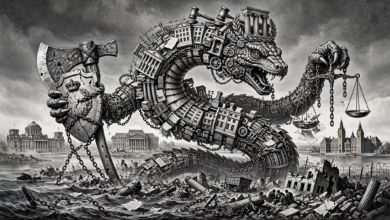

The dragon in the African continent: From the cloak of “non-intervention” to the engineering of political “stability”

Historically, the spectacular rise of Chinese power in recent decades has been linked to a massive deepening of economic relations with the African continent. The prevailing narrative, which has long dominated international relations and political economy literature, focused almost exclusively on commercial encroachment, the new Silk Roads, the flow of goods, and strategies for acquiring strategic resources. But beneath this bustling economic surface, there was a deeper and quieter geopolitical shift reshaping the fundamental rules of the international game. This subtle shift is what the book “China’s New Role in African Politics: From Non-Intervention towards Stabilization?”, edited by Christof Hartmann and Nele Noesselt (published by Routledge, as part of the Global Cooperation Series), addresses.
This book presents us with a bold and contrasting thesis; instead of getting bogged down in the language of numbers and trade volumes, the work delves into the complex political and diplomatic structure of Chinese engagement in Africa. The central question the two researchers pose here is not “How much does China invest?”, but “How does China deal with political instability in Africa?”, and in parallel, “How do African elites and populations view this Chinese role: is it a lifeline that enhances stability, or a tool that deepens crises?”.
The “Non-Intervention” Doctrine Under the Microscope of Empirical Reality
For a long time, Beijing marketed itself in international forums, especially through the Forum on China-Africa Cooperation (FOCAC), as a partner that does not dictate political conditions, and an investor that stands equidistant from internal conflicts, adhering to the principle of “non-interference in internal affairs” as a cornerstone of its foreign policy. This principle served as the antidote to Western policies that have long tied aid and investments to conditions regarding democratic reform and human rights. However, Hartmann and Noesselt argue in the book’s opening chapter that this principle has gradually begun to erode, or at least, has started undergoing a broad pragmatic reinterpretation.
The reality is that the growth and ramification of Chinese interests within the African continent have made it impossible for Beijing to remain merely a passive observer of political events. When multi-billion dollar infrastructure investments are jeopardized by military coups, ethnic conflicts, or a decline in the state’s capacity to exert its influence, the Chinese leadership finds itself compelled to intervene—not necessarily militarily, but through political and economic engineering aimed at “achieving stability.” This gradual transition from “non-intervention” to “developmental stability” reflects a maturity in Chinese foreign behavior, and indicates that the Chinese political system, with its complex centralized mechanisms and long-term strategic planning, has begun exporting part of its stability management model abroad.
China’s “African Dream”: A Re-evaluation of Grand Strategy
In the second chapter of the book, researcher Nele Noesselt provides an in-depth analysis of what she terms “China’s African Dream.” This vision is closely linked to the “Chinese Dream” project of national rejuvenation, which is based on building a complex network of strategic alliances that guarantee resource security on one hand, and provide sustainable markets for Chinese industrial and technological outputs on the other. However, Noesselt warns against viewing Africa in the Chinese political imagination as a single monolithic bloc. Although official Chinese discourse deliberately presents the continent as a homogeneous unit in major forums, practical implementation reveals highly customized policies adapted to the local contexts of each individual country.
This apparent contradiction between the comprehensiveness of the discourse and the precision of tactical practice is what Julia Strauss addresses in her chapter entitled “Overlapping Discourses and Multiple Realities.” Strauss argues that China manages its relationship with Africa across multiple linguistic and diplomatic levels; there is the discourse directed at the West, portraying China as a responsible soft power seeking mutual benefit within South-South relations; there is the discourse directed at African leaders, which plays on the chord of shared historical grievance and combating imperialism; and finally, there is the practical reality based on unequal bargaining and securing vital supplies.
Understanding this gradation in Chinese behavior requires an awareness of the nature of the political and economic system in Beijing. It is a state that highly efficiently manages state capitalism, employing its financial arms—such as the Export-Import Bank of China and Silk Road funds—as sovereign tools to tame crises and guide development paths in countries suffering from institutional fragility. China does not export troops to occupy lands; rather, it exports loans, state-owned enterprises, engineers, and, at times, models of surveillance management and automated infrastructure control, to create a network of stability entirely dependent on it.
The Architecture of “Developmental Peace”: A Confident Alternative to the Liberal Model
For decades, the “Liberal Peace” approach has dominated the agenda of the international community and Western donor institutions in Africa. This approach assumes that political stability can only be achieved through specific social and political engineering: establishing pluralistic democracy, strengthening civil society organizations, enforcing transparency, and holding periodic elections. However, the middle chapters of this book brilliantly reveal how Beijing radically challenges this Western narrative, offering instead the model of “Developmental Peace.”
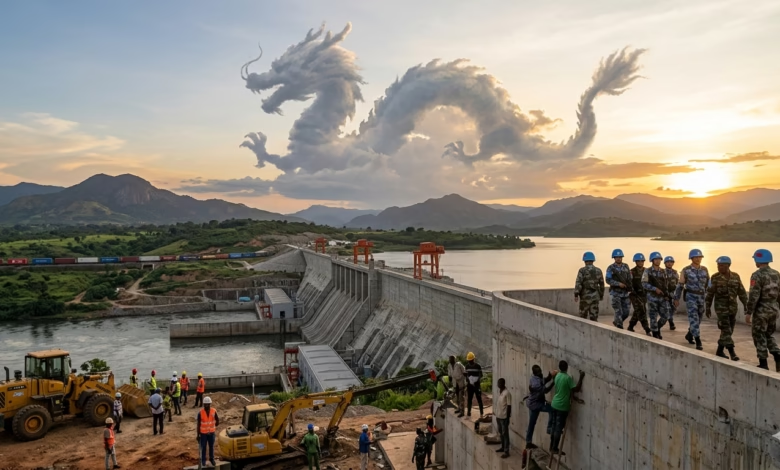
The Chinese strategic mind stems from a firm conviction that poverty, underdevelopment, and weak infrastructure are the true roots of ethnic and political conflicts on the African continent. Instead of wasting time imposing democratic institutional templates on resource-scarce societies, Beijing believes that pouring concrete to build dams, laying railway lines, and constructing ports is the shortest and most effective path to achieving “stability.” Direct physical investment in state capacity creates a layer of economic interests, provides job opportunities that absorb popular anger, and enhances the central government’s authority and its ability to extend its influence and provide services.
This proposition finds a wide and welcoming echo among many African political elites, who have long felt exhausted by Western “conditionality.” China, as the researchers explain in this pioneering work, does not arrive with a list of political or human rights demands in hand, but comes with maps of roads, bridges, and lines of credit. This approach grants African regimes political breathing room and reshapes the concept of “legitimacy”; the legitimacy of tangible economic achievement becomes an alternative to the legitimacy of the ballot box.
Party Diplomacy: Exporting the “Party-State” Model
But how does China manage this politically complex relationship if it claims non-intervention? Here, the book sheds light on a vital and clever tool that bypasses traditional diplomatic channels represented by ministries of foreign affairs and embassies; namely, “party diplomacy.” The Chinese Communist Party possesses a deep, tentacular network of relationships with dozens of ruling parties in Africa.
These parallel channels allow Beijing to pass on its expertise in political management, social control, and mass mobilization. Through continuous training programs for African party cadres in Beijing’s institutes, the “genes” of the Chinese model are quietly transferred. They learn how rapid economic growth can be achieved without relinquishing the centralized political grip. This soft intervention, or “engineering stability from behind,” is not classified in the Chinese dictionary as blatant interference, but rather as an “exchange of governance experiences.” It is a form of political solidarity that guarantees China strong and stable allies, capable of protecting shared interests and sustaining debt repayment, reflecting a highly complex evolution in the philosophy of soft power.
The Conflict Laboratory: The Testing Ordeal in Sudanese Oil Fields
The book’s thesis is manifested in its finest empirical form when analyzing the Chinese handling of complex crises in the Horn of Africa, specifically in Sudan and South Sudan. This geopolitical file in particular represents a pivotal turning point in the history of modern Chinese foreign policy, and the true laboratory where the traditional cloak of “non-intervention” was incinerated.
Historically, China invested billions of dollars in the oil infrastructure of a unified Sudan, from extraction wells and pipelines to refineries. When Sudan began sliding towards partition, Beijing found itself facing an existential dilemma: the ideological principle dictated that it remain neutral and not interfere in Khartoum’s internal affairs, but the pressing economic reality indicated that most of the oil reserves would go to the new state in the South (South Sudan), while the export infrastructure would remain in the North.
The book analyzes with captivating academic and journalistic detail how China was forced to abandon its passivity. In a historical precedent, Beijing began to play the role of an active mediator between Khartoum and Juba, and even appointed a special envoy for Africa whose tasks focused on deciphering the enigmas of this conflict. More importantly, when the devastating internal civil conflict later erupted in South Sudan, threatening the safety of Chinese workers and the flow of oil, China took the unprecedented step of sending combat troops under the umbrella of the United Nations Mission (UNMISS). These troops were primarily tasked with securing oil facilities and protecting civilians.
This deep engagement in dissecting political dynamics and complex debts in the Sudanese context proves that China is willing to engage in high-risk political and security engineering operations when its strategic supply lines are threatened. China is no longer merely a “free rider” benefiting from the security umbrella provided by other powers; instead, it has become an active producer of security and stability, cloaked in the cover of international legitimacy and developmental mediation initiatives.
The “Debt-Trap” Narrative: A Political Myth or an Economic Reality?
One cannot discuss the Chinese role in Africa without encountering the term “debt-trap diplomacy,” a term popularized in Western capitals to describe massive Chinese loans as traps aimed at seizing the sovereign assets of African nations. However, the book presents an analytical defense that calls for pause; the contributing researchers argue that this narrative, despite its political appeal, often lacks accuracy when individual cases are examined.
The book clarifies that Chinese loans are not forcibly imposed, but are rather a response to a pressing demand from African elites suffering from a massive gap in infrastructure financing. For an African leader seeking popular legitimacy through tangible achievements like a highway or a power plant before an election, Chinese loans—”which lack political conditions”—appear far more attractive than the painful structural reform packages imposed by the International Monetary Fund.
The true “danger” that the book identifies lies not in Beijing’s “malicious intentions” so much as in the “lack of transparency” and the weak competitiveness of some projects. Nevertheless, the analysis reveals that Beijing has shown unexpected flexibility in rescheduling debts, and even canceling some non-performing loans in certain cases—not out of generosity, but to protect its international reputation and ensure the continuation of its influence as a reliable and long-term partner.
“African Agency”: Africa is Not Just a Playground
Perhaps the most important contribution this academic work provides is restoring consideration for “African Agency.” The book rejects the stereotypical image that portrays African countries as passive victims or pawns on a chessboard over which great powers compete. Instead, we find chapters explaining how African governments are learning to “play with the dragon.”
From Ethiopia to Kenya, and from Nigeria to Angola, we find examples of countries that have managed to employ Sino-Western competition to maximize their national gains. The existence of the Chinese alternative has granted the African negotiator “bargaining power” that did not exist during the unipolar era. The book highlights how some African nations impose their own conditions, demanding technology transfer and the employment of local labor, and even pushing China at times to alter the trajectories of its projects to align with national development plans.
This “agency” means that the relationship is not a one-way street from Beijing to the continent, but rather an interactive process in which Chinese interests are reshaped to suit local aspirations. China, in turn, has become more cautious and sensitive towards African public opinion, and has begun to realize that the stability it seeks requires winning the hearts of the people, not just signing contracts with the ruling elites in presidential palaces.
The “Resources for Infrastructure” Model: The Grand Barter
The book delves deeply into the mechanism of the “Angola Model” or “resources for infrastructure,” where Chinese loans are repaid via shipments of oil or minerals. This model, which provided rapid financing during commodity boom periods, faced severe tests with the fluctuation of global energy prices. The researchers analyze how the drop in oil prices placed countries like Angola in a predicament, compelling Beijing to enter into complex negotiations to prevent a financial collapse that could devastate its investments.
Here the question of “stability” arises once again; public debt, from the Chinese perspective, is not merely a financial obligation, but a “political bond” linking the fate of the debtor state to the interests of the creditor. This bond is what drives China to intervene in the monetary and fiscal policies of these countries, in an unannounced manner, to ensure their ability to repay—a new type of intervention that blends financial technocracy with geopolitical influence.
The Institutional Dimension: The Forum on China-Africa Cooperation (FOCAC)
The book does not overlook the institutional role played by the “Forum on China-Africa Cooperation” as a platform for drawing up grand policies. The book describes this forum as a “policy laboratory,” where Chinese concepts of development are internationalized. By analyzing the concluding declarations of the forum’s summits, it becomes clear how the language of a “shared destiny” and a “win-win” situation has permeated African political discourse, creating a cultural and linguistic environment that facilitates economic penetration.
What this part of the review reveals is that the Sino-African relationship is not merely a process of buying and selling, but rather a new “structural construct” that redefines the concepts of sovereignty, indebtedness, and strategic alliances in the twenty-first century.
The Politicization of Security: Beyond the Military Base in Djibouti
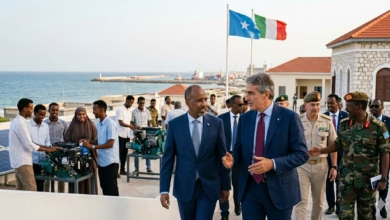
For years, China’s military presence in Africa was limited to the symbolism of participating in UN peacekeeping missions. But the book observes a sharp turn that began with the opening of the first overseas Chinese military base in Djibouti in 2017. The researchers analyze this step not as a classic “imperialist tendency,” but as a logistical necessity to protect the “Maritime Silk Road” and secure Chinese nationals who are now spreading across the most dangerous parts of the continent.
The new Chinese security presence takes a hybrid form; it blends the sale of advanced weaponry (which is not subject to Western human rights conditions) with the training of African police and military forces in surveillance and border control techniques. The book argues that China exports “stability technology”; the smart city systems and facial recognition cameras implanted by Chinese companies in African capitals are not merely technological tools, but political tools that enhance the local regimes’ capacity for control, which ultimately serves the “stability” sought by the Chinese investor.
Manufacturing Consent: The Invasion of Minds and Hearts
While Western powers relied on “Hollywood” and prestigious universities to build their soft power, China developed a parallel strategy that is astonishing in its precision. The book dedicates an entire chapter to “education and media diplomacy.” Today, China surpasses the United States and the United Kingdom in the number of scholarships offered to African students. These graduates return to their countries not only with fluent Chinese, but with a deep understanding of the Chinese bureaucratic and political system, creating an African “cadre generation” that sees Beijing as a role model for rapid development.
On the media front, the book sheds light on the massive expansion of the China Media Group (such as CGTN Africa) in Nairobi and Johannesburg. The goal here is clear: “telling the Chinese story with an African tongue.” Beijing is trying to break the Western media monopoly on the image of Africa by presenting a narrative focused on developmental successes and equitable partnerships, avoiding talk of coups or famines except in the context of developmental solutions. This “soft war” aims to create an incubating popular environment that protects Chinese interests from political volatility.
Confucius Institutes: Cultural Exchange as a Geopolitical Tool
The role of Confucius Institutes, which have mushroomed across African universities, cannot be overlooked. The book analyzes these institutes as centers not just for teaching language, but for marketing “Asian values” that emphasize collectivism, order, respect for authority, and diligent work, as an alternative to liberal individualistic values. The researchers believe that China is betting that changing the “cultural consciousness” of the young African elite is the only guarantee for sustaining its long-term influence on the continent, especially given the rise in African nationalist sentiments that could turn against the “neo-colonizer” if the relationship is not culturally framed.
Frictions on the Ground: When the Dragon Collides with Local Communities
Despite successes at the official and macroeconomic levels, the book boldly observes the areas of shadow and tension. The intense Chinese presence has led to the emergence of complex social phenomena; from labor disputes in Zambian mines to competition from small Chinese traders against local artisans in the markets of Senegal and Nigeria. The book analyzes how these daily frictions sometimes create waves of “Sinophobia” that political opponents exploit in their electoral campaigns.
Beijing, as the book indicates, has begun to sense this danger and has transitioned from a strategy of “isolating Chinese workers in closed compounds” to attempting to engage in “corporate social responsibility.” Nevertheless, the challenge remains: how can a superpower maintain its stability and interests in a continent characterized by an unpredictable social and youthful dynamism?
This security and cultural dimension revealed by Hartmann and Noesselt proves that the Chinese ambition in Africa is not “fleeting” or “purely commercial,” but rather an integrated “hegemonic” project seeking to redefine the international order from within the African continent.
Geopolitical Competition: Africa as an Arena for the “New Cold War”
The book leaves no room for doubt that the African continent has become the most vital laboratory for testing global power balances in the twenty-first century. The researchers argue that the Chinese approach based on “developmental stability” has placed Western capitals in a strategic dilemma. While the West focused on “promoting democracy” as a condition for stability, China proved that “providing infrastructure” might be a more enticing (albeit more authoritarian) path to achieving short- and long-term stability.
The book observes how the United States and the European Union have begun reviewing their policies to counter the Chinese advance, by launching initiatives such as “Build Back Better World” (B3W) or “Global Gateway.” However, the book warns that the West may find itself forced to adopt the “Chinese style” in dealing with African regimes (i.e., reducing the focus on political conditionality) if it wishes to maintain a foothold in the strategic minerals and renewable energy sectors currently dominated by Beijing.
Africa Between “Stability” and “Digital Authoritarianism”
One of the deepest ideas presented by Hartmann and Noesselt in conclusion is the political cost of “Chinese stability.” While Beijing succeeds in building bridges and airports, it also contributes to enhancing the capabilities of the “deep state” in Africa by exporting surveillance and digital control technologies. The book poses a fundamental question: Is the “stability” that China grants Africa a sustainable stability stemming from development, or is it merely a “freezing of conflicts” through strengthening the security grip of regimes?
China’s experience in Sudan and South Sudan, which the book analyzed extensively, remains the most prominent lesson; once political stability collapses, China finds itself forced to engage in “interventionist” security and diplomatic missions that it historically rejected. This contradiction between discourse and practice will remain the greatest challenge for the Chinese leadership in the coming years.