

The Concept of the Person in Contemporary Philosophy
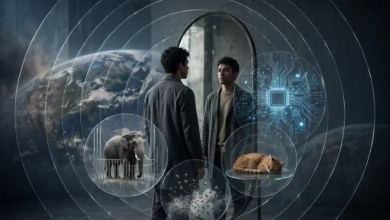
At the dawn of the twenty-first century, the concept of the “person” stands as a fundamental key to understanding man’s relationship with himself, the world, and those around him. In this complex intellectual context, the name of the German philosopher Robert Spaemann emerges. He coined the term “forgetfulness of the person”—a clever nod to Martin Heidegger’s famous term “forgetfulness of being”—to describe the central problem in modern philosophy, which has nearly ignored the personal dimension amid scientific and intellectual transformations.
From here stems the immense importance of the book edited by Hanns-Gregor Nissing, entitled The Fundamental Manifestations of the Person: Dimensions of Human Being in Robert Spaemann. This work dives deep into philosophical thought, attempting to explore the multiple dimensions of human nature to provide a comprehensive critical review that restores humanity’s status as an end in itself. This profound work rests on the firm belief that being a person does not merely mean possessing biological traits or momentary mental capacities. Rather, it means possessing a certain nature, and not just having a way of life, but taking a conscious stance toward this life; persons are individuals who cannot be replaced or represented by others in their individual existence.
In this philosophical journey, the contributions of several thinkers converge to discuss Spaemann’s ideas, which are clearly rooted in the classical traditions of philosophers like Boethius and Thomas Aquinas. Personhood is defined through complex and intertwined human phenomena such as intention, transcendence, religion, time, death, conscience, freedom, the promise, and forgiveness. Answering “yes” to the question “Are all humans persons?” stems from an authentic philosophical realization that the person is the human being in their entirety, not merely an accidental trait that may appear and disappear.
The book goes beyond mere historical exposition to engage in deep critical confrontation with contemporary issues. It addresses Spaemann’s ideas on the natural teleology that gives life its meaning, the philosophy of a successful life, the staunch defense of the idea of God based on reason and language, as well as a profound understanding of human artistic and creative activity. Philosophical reflection in this work stems from the ancient tripartite division of human activity—theory, practice (praxis), and artistic creation (poiesis)—serving as a solid structural framework for the discussions that unfold in its chapters, paving the way for a deeper understanding of how these dimensions intertwine to shape human existence.
Reality as Anthropomorphism
At the core of this intellectual construct, Spaemann himself offers a highly significant foundational contribution wherein he addresses the concept of “reality as anthropomorphism” (or the projection of human characteristics). In his bold thesis, he considers persons to be the optimal and original paradigm of reality. Spaemann proceeds from the idea that persons represent objective subjects to one another; they maintain their identity and continuity over time, and exchange the complex understanding that they possess a being that goes far beyond what they appear to be in the material world.
Because the primary and fundamental access to reality stems from within the living human self, it is impossible to view non-human life, and reality as a whole, except from the angle of its similarity to or difference from the human being. This makes an anthropomorphic and humanized understanding of reality an inevitable and inescapable necessity for understanding the world around us. This unique philosophical approach represents a necessary and vital alternative to the modern scientific understanding of the world because it transcends the deeply entrenched and restrictive dichotomy between subject and object, spirit and matter, consciousness and existence. Historically, this dualism stripped man of his teleology and living essence, nearly hiding the reality of the person entirely behind a curtain of material and mechanistic explanations.
Distinguishing Reality from Illusion
Speaking philosophically about reality does not mean adding a new property to what already exists; rather, it is a concept that fundamentally seeks precise distinction and separation. The question of what is real always implicitly or explicitly includes a desire to exclude what is unreal, such as dreams, imagination, illusion, or the virtual reality that besieges modern man.
The strict distinction between being and appearance is the first and fundamental distinction with which philosophy begins its journey. Despite repeated historical objections attempting to blur this distinction since the Eleatic philosophers—including claims that dreams carry a truth equal to wakefulness—the loss of one side of this distinction logically and necessarily leads to the loss of the other, turning life into a mere series of closed subjective perceptions.
Modern philosophy and accelerating technological developments at the end of the second millennium pushed these philosophical reflections to their utmost limits. Technological simulation no longer simply displaces physical reality; it now boldly claims to reveal its essence. Cybernetic entities do not merely imitate life, but claim absolute power to explain and replicate its nature. Amidst this dangerous blurring between reality and illusion, the philosophical mind anxiously questions whether there is a decisive, objective criterion to distinguish between them. Spaemann’s profound philosophical answer is that reality is not a trait that can be measured by a material standard or external tool; rather, it is the standardless certainty we experience directly upon waking from a dream. In essence, it is the shared world that we divide and interact within alongside others.
The real world is, by definition, the shared world. This does not simply mean that whatever everyone agrees upon is necessarily real; rather, it means that the capacity for universal consensus is the defining feature of truthful statements about reality. Things do not become real merely through human agreement; we consider them capable of agreement and consensus because they are real in themselves and because they correspond to an objective reality independent of our illusions.
In this epistemological context, dreams and imagination are excluded from the circle of complete reality because they represent a mode of existence that can only be explained and understood internally, within the isolation of the individual. Here, existence dissolves into being merely an object of individual thought. Things that are merely objects cannot be real in the full sense, even if there is an apparent consensus about them.
Subjectivity as Objective Truth
To clarify this abstract philosophical concept, the example is given of a dying patient on his deathbed. Around him, a team of doctors agrees, based on modern medical data and indicators, that he feels no pain and cannot hear what is happening. Yet, in the reality hidden from their devices, he is clearly in pain and can hear. This scientific consensus would thus be a glaring consensus on falsehood, because the absolute truth in that moment was held by the patient alone.
Pain, hearing, and inner feeling are quintessential subjective events, but at the same time—and according to sound philosophical perspective—they are objective and absolute. This means they are a binding and inevitable reality for anyone attempting to pass judgment on them. The subjective certainty of the existence of pain is not merely a truth for the suffering person alone; it is an objective truth that imposes itself on every human being possessing the capacity for understanding and empathy.
This deep philosophical understanding highlights the true and precise meaning of Descartes’ famous phrase, “I think, therefore I am.” The matter does not stop at proving thought; it adds the verb “to be/exist” to “thought” as a decisive affirmation that subjectivity is not merely an internal illusion or empty reflection. Instead, it is a solid objective reality that forms the primary reference for any truthful judgment in this world. This is exactly the essence meant by the concept of “persons” in both classical and contemporary philosophy.
Talking theoretically about subjects and objects as completely separate and parallel realms bypasses the truth of reality and ultimately leads to its disappearance and fading. Objects that are isolated to be merely objects only have a subjective existence, and are only real insofar as they are objects subordinate to the perceiving subject. There is no longer any fundamental difference between them being a passing dream or a lived reality, as long as they do not exceed being a passive given to the subject.
Conversely, pure and abstract subjectivity cannot be described as real unless it manages to become a subjectivity that transcends time and the moment—that is, to transform into persons who possess a biography and a history formed by deep personal memory and the memory of others who share this existence. Persons do not represent mere momentary subjective points that flash and disappear; they are the product of the continuous reflection of the self and its perpetual return from multiple experiences to its center. Their true and complete existence is only realized in the plural and participatory form, as objective subjects perceiving one another in a shared space. Here, the nature of personhood manifests in all its splendor through live interaction and mutual recognition, which grants human feelings and experiences their objective reality and anchors their roots in the fabric of existence.
The Intentionality of Feelings and the Critique of Materialism
This in-depth philosophical journey continues to explore the intentional nature of human emotions. Spaemann strongly warns against sliding into an exclusive focus on the pleasurable emotional state in itself, which ignores the functional meaning of these states and overlooks the intentional nature that reveals the truth of reality through feeling. Pleasure sought merely for the sake of a pleasant feeling, without regard to the object that arouses this feeling, is akin to the pleasure of someone suffering from a skin disease who finds delight in constantly scratching their skin—a superficial vision that reduces human experience. True joy differs radically from mere passing amusement; joy has a content, and it changes as this content changes. It always represents an honest and authentic openness to the surrounding reality.
This openness reaches its peak in the concept of love, which is defined as the transformation of the “other” into an actual reality for the loving self. The other ceases to be merely an environment or an object of interest, becoming a true reality equal to the reality of the self, thereby reinforcing the personalist vision that calls the individual to consider themselves part of the other’s world.
In the context of critiquing the modern materialistic worldview, philosophical reflection highlights how Cartesian dualism—which divided the world into consciousness and extended matter—stripped reality of its truth by eliminating the intermediate link that was always the basis for speaking about reality: Life. Life is the original paradigm of existence, and consciousness is nothing but an elevation and completion of this life.
When we contemplate the non-living material world, we find that ancient thought always viewed it anthropomorphically, considering it close to the nature of living beings (evident in religious literature and prayers addressing elements of nature as partners in existence). Abandoning this anthropomorphic view and drifting behind purely scientific understanding ultimately leads to the demise of the idea of the person itself. Nietzsche astutely pointed this out when he considered the idea of things as entities possessing a continuous identity over time to be, in itself, a human projection and anthropomorphism. If we abandon this projection toward things, we will eventually be forced to abandon it toward ourselves. The human being will turn into a mere anthropomorphic phenomenon dissolving before cold scientific analysis, taking with it the idea of human centrality upon which modern science and technology were built, leaving behind a cold world of objects devoid of any subject.
The empirical philosophical trends that deny the existence of a continuous self and only recognize a series of psychological states open the door to justifying dangerous practices like suicide and euthanasia. Here, the suffering patient is viewed not as a suffering person, but merely as a collection of states of suffering that must be eliminated to remove the pain. These societies, which focus exclusively on maximizing pleasure and minimizing pain—as championed by neo-pragmatists—descend toward self-destruction because they eliminate the existence of the person, leaving only abstract subjects living in the moment without temporal dimensions or biographical identity.
Relationship as Ultimate Truth and the Role of Art
In the face of this disintegration, philosophical thought restores consideration to the concept of relationship as the highest truth. Things do not acquire their true reality apart from the relationships that bind them to others. The individual does not realize their complete identity alone; they rely on others to actualize their personality and shape their self-awareness through language and mutual recognition. It is the human capacity to transcend the self and see the world through the eyes of others that gives each person their absolute value. The truth lies in this interconnected structure of relationships, not in reducing one party in favor of the other, as done by materialist evolutionary theories that fall into the trap of circular logic when attempting to explain consciousness and perception.
In this era, where true reality recedes in favor of the virtual and the artificial, contemporary visual arts take on a role akin to religion in reminding us of the sanctity of existence and hidden reality. Arts intentionally conceal certain things to force the viewer to remember them as an indelible true reality, making the invisible truth the only truth that cannot be destroyed.
The Proof of God and the Future Perfect
This philosophical journey continues tracing complex intellectual threads, moving to another critically important space regarding the person’s ability to perceive truth. This is linked to Robert Spaemann’s attempt to formulate a proof for the existence of the Creator stemming from the concept of the “Future Perfect” tense.
In this framework, Thomas Buchheim offers a rigorous critical analysis of this proof. He begins his discussion by invoking Friedrich Nietzsche’s famous, sarcastic quote about that fleeting minute in a remote corner of the universe when clever animals invented knowledge, calling it the most arrogant and mendacious minute in world history, before the planet froze and those animals died.
Confronting this nihilistic vision, Spaemann presents his profound idea: this minute of knowledge, if it is true knowledge, is not limited to a fleeting moment but embraces eternity. Knowledge presupposes the existence of a content that establishes what is absolutely and forever. If a truth is perceived today, it will remain true even after our planet cools and intelligent beings go extinct.
Here emerges the deep philosophical question: Where and how is this difference between the existence or non-existence of a thing preserved after the demise of human consciousness? Spaemann argues that the truth must either vanish—which the mind cannot accept when claiming true knowledge—or remain preserved and established. Since human consciousness is finite, preserving this truth necessarily requires assuming the existence of an absolute, infinite consciousness: the consciousness of the Creator. Through the human capacity for knowledge, this Creator grants man a guarantee that what was, and what will be, remains preserved and transcends annihilation. This philosophical proposition serves as a guide for the human being who wishes to continue understanding themselves as a free being capable of perceiving truth, offering intellectual immunity against Nietzsche’s nihilism.
Buchheim’s critical analysis dives into the structure of this proof, distinguishing between two versions. The first relates to the transmission of the attribute of “what was” (pastness) through time, and the second relies on the concept of truth itself. The analysis argues that the first version faces logical hurdles, as temporal predicates—like saying “such-and-such happened”—describe the nature of a thing during its existence, and do not relate to its absolute mode of existence or the transmission of this existence into the future. Much of what happened in the past (like the shape of a milk drop dissolving in coffee) is physically lost. If there were an automatic transmission of the state of “what was,” this alone would suffice to necessitate a divine presence to physically preserve it. Furthermore, things that did not happen might be just as important to a future consciousness as things that did, negating the existence of a magnetic force that distinguishes what happened and imposes it on eternal memory.
Therefore, the analysis leans toward the second version of the proof, which relies on the concept of truth as the correspondence between the mind and reality. If the human mind perceives a truth, this truth requires a permanent correspondence between reality and its expression. Since the human mind is finite, the continuation of this correspondence in the infinite future seems to require an eternal mind to guarantee this formulation. However, precise philosophical critique deconstructs this link, explaining that the concept of truth can be understood in two ways: either as a goal of knowledge, or as an attribute applied to a specific formulation of reality. The correct formulation of reality remains correct and possible as a logical structure regardless of the existence of an actual mind thinking about it in the future. This means man’s capacity to perceive truth can be justified without the strict need to accept this proof as the only condition. Still, the capacity for truth remains tied to essential personal traits—like trust in a reality independent of the self, the ability to negate and affirm, and the possibility of shared communication about the same reality. These traits are, in themselves, strong indicators that open the door toward thinking about the Absolute without imposing coercive conclusions.
Religion in the Age of Modernity
This intellectual flow extends to touch the dimensions of religious experience in the context of modernity and postmodernity. Holger Zaborowski discusses Spaemann’s philosophy of religion and the possibility of establishing criteria to evaluate it. In an era characterized by a sudden and vibrant resurgence of religion in the public sphere—after many thought the path of Enlightenment and secularization would inevitably lead to its decline—philosophical thought finds itself tasked with redefining the relationship between reason and faith. Modernization no longer simply means a radical critique of religion; it now demands self-critical reflection by reason toward the claims of faith.
The philosophical vision here stems from the necessity of transcending traditional binaries that either abolish religion or marginalize it. It attempts to explore the essence of religious practice away from purely functional interpretations that consider religion merely a tool for biological or social adaptation. Spaemann’s philosophy of the person emerges as an attempt to find a balance between transcendence and the internal reflection of consciousness. The human mind tends to either subject external reality to its own laws of thought or slide into endless attempts to justify its own existence.
To avoid this disintegration or dissolution into materialist explanations that negate the value of the self and freedom, the concept of “what cannot be conceived in advance” arises. This points to existence given to man as an absolute truth that cannot be mentally deduced from nothingness. This existence is understood more deeply through the idea of Creation, where nature is not viewed as a final, deaf given, but as a reality “owned” within the context of freedom, and as a creation carrying purpose and meaning stemming from the Creator’s will.
Considering reality as a creation represents a philosophical stance that protects humans from sliding either into an idealism that abolishes the material world, or a materialism that abolishes freedom and subjectivity. Religion, in its pure essence, is understood eminently as an event of freedom. It is not merely an expression of the human person’s freedom but rests primarily on the freedom of the Creator Himself. Since God is understood as an absolute and free subject, any attempt to explain religion functionally—making it merely a means to achieve other ends—fundamentally contradicts the nature of this God and the nature of the pure religious relationship.
A functional understanding of religion ultimately leads to its abolition and emptying of its unconditional content. Conversely, authentic religious practice finds its goal in thanksgiving and reverence for God Himself, far from any utility or instrumentality. From this standpoint, critical philosophical criteria crystallize to evaluate religious practices: religious forms that deny freedom and justify coercion are rejected, as are those that adopt materialist visions destroying the unity of reality, or those that subject religion to worldly ends, causing the religious experience to lose its connection to the Absolute. This positive philosophy fully realizes its own limitations and connection to historical context, preferring openness to truth as it is lived and experienced, rather than claiming to build a closed theoretical system that explains everything but loses touch with the pulse of life.
Bioethics and Human Dignity: “Born, Not Made”
The journey delving into the dimensions of human personality continues by moving into the arena of applied and medical ethics. Eduard Zwierlein addresses the philosophical cry of rejection raised by Spaemann against contemporary violations of human dignity, under a profoundly significant title: “Born, Not Made.” This vision stems from sensing the imminent danger of the arbitrary separation between the right to life and the right to dignity, in an era where scientific technology rapidly encroaches upon the deepest foundations of human existence. A vivid and horrifying image from contemporary reality is invoked: a center marketing itself as the world’s first embryo bank, where embryos are offered for sale as commodities subject to strict quality standards, carefully selected based on the supposed genetic and academic history of the donors. This model embodies a dangerous shift where the natural act of procreation—stemming from the meeting of two free wills—is replaced by programmed industrial production aimed at eugenics according to commercial and instrumental standards.
Here, the child transforms from an unconditional gift subject to the mystery of existence into a mere product that can be selected, designed, and perhaps even result in manufacturers being held accountable if it does not meet the required specifications. This throws the door wide open to justifying discrimination and exclusion against anyone who does not meet the criteria of genetic quality.
This philosophical analysis stands fiercely defending the spiritual and natural vision of human personality, rejecting scientistic trends that treat human nature as mere material subject to experimentation and control. The idea of “Born, not made” asserts that a human’s arrival in this world must retain its character as a natural event transcending utilitarian calculations. Procreation is the indirect result of a relationship based on unconditional giving, where fate plays a role protecting the new being from becoming a pre-drawn project fulfilling the desires of external parties. When a human transforms into a manufactured thing, they are stripped of their uniqueness and independence, becoming subject to evaluation and pricing, which destroys the solid foundation upon which the idea of equal dignity for all humans rests.
The critique escalates to include the functional logic governing much of modern science, which tends to explain every phenomenon by reducing it to purely material causes, thereby excluding teleological dimensions and unconditional concepts like conscience and absolute dignity. This logic, if left unchecked, goes beyond being a tool for controlling nature to become a tool for man’s control over man. It reduces human life to a mere series of states and feelings evaluated based on metrics of pleasure and pain, paving the way to justify dangerous policies like the consumption of embryos and the disposal of lives deemed unproductive or full of suffering.
In confronting the attempts of empirical and utilitarian philosophies to redefine the concept of the “person” exclusively based on criteria of mental capacity or momentary self-awareness, the philosophical alternative is posited: human dignity is not granted by evaluation committees or based on acquired traits, but stems directly from belonging to the human species. Being a person represents an essential predisposition and a latent nature. It may manifest as consciousness and reason when conditions are right, but its non-manifestation—as in cases of coma or embryonic stages—absolutely does not negate the latent existence of this person, nor does it strip their rights. It is akin to someone possessing the skill to play an instrument but not practicing it due to the lack of an instrument; the skill is latent and present even if not translated into a tangible act.
To protect this human existence in its most fragile and vulnerable states, this thought adopts the jurisprudential guiding principle: “In case of doubt, rule in favor of the person.” This acknowledges the human mind’s inability to fully encompass the mystery of life and the ambiguity of the transition from concealment to manifestation. This humble view guards human dignity and prevents humans from being turned into victims of exclusionary definitions that shift with interests. It affirms that true humanity is tested in its solidarity with its weakest links, not in its feverish pursuit of an illusory genetic perfection.
The Crisis of Modernity: Praxis vs. Poiesis
The study moves to analyze the crisis of modernity, which Robert Spaemann believes stems from a methodological reductionism in the natural sciences. An initial methodological restriction transformed into an ontological and epistemological statement about the nature of reality as a whole, making the scientific hypothesis the sole paradigm for any prediction related to reality. This functional perspective leads to replacing the fundamental question of what a thing is by nature with the question of how it originated and functions. This threatens man’s ability to understand moral absolutes or the existential meaning of human life, and even makes human nature vulnerable to being equated with non-human objects.
In the context of distinguishing between action and fabrication, Spaemann insists on recovering the Aristotelian concept that differentiates between “Praxis” (as human action finding its end in itself) and “Poiesis” (as a production process aiming to achieve external ends). He warns that modernity’s absorption of practice into the logic of production leads to the loss of the moral dimension of action. He argues that the being of the human person reveals the limits of instrumental and technological logic, as human flourishing and happiness depend on virtuous “Praxis” and the recognition of inherent dignity that cannot be manufactured or programmed.
The concept of “Self-being” (كينونة الذات) forms the cornerstone of Spaemann’s philosophy to overcome the modern dualism between spirit and nature. The person is defined as a “name of dignity” expressing the transcendence of objectivity and existence within the self. The person is not merely a mind trapped in a body, nor pure matter, but a being inherently linked to freedom. This connection is clearly evident in their capacity to “promise” and “forgive”—actions that transcend natural determinism and establish the person’s identity across time.
The study presents Spaemann’s vision of philosophy as a Socratic endeavor based on “self-reflection” and recollection. It does not discover entirely new things but brings back to mind what was known and has been forgotten or betrayed amid the clamor of technical knowledge. Philosophy operates here as a guardian of the unspoken boundaries of human action. It warns that denying personal identity or reducing morality to mere byproducts of random evolutionary processes necessarily leads to a self-contradiction: one who denies the existence of the person cannot justify writing books addressing the consciousness and conscience of others.
Regarding the relationship between Christianity and philosophy, Spaemann observes that Christianity, as an absolute religion, remains foreign to modern civilization and cannot be fully absorbed within its categories. Yet, his philosophy is not hostile to modernity; rather, it seeks to restore its realistic features and embed the contents of self-realization introduced by modernity within deeper existential visions. Defending Christianity represents one of the organizing threads of his thought—not through preaching, but by offering a philosophical model that views existence as a “gift” or “creation” preceding human will, thus limiting the ambitions of deductive reason to fully dominate reality.
Spaemann’s style is characterized by a dialogical tendency and an aversion to building closed philosophical systems. He prefers the essayistic form that allows the discussion to remain open, believing that philosophy flourishes only in a climate of “philosophical anarchy” that rejects intellectual authoritarianism. This style aims to reach an audience beyond specialists, relying on “common sense” and daily awareness of reality—what he calls “education on reality” (التربية على الواقع). This seeks to awaken the reader to participate in existence more completely, freed from ideological or scientistic distortions.
Core Dimensions: Conscience, Time, and Society
In its subsequent chapters, the book proceeds to investigate the “essential dimensions” that form the pillar of human experience, pausing carefully at the concept of “conscience” as the solid core of personality. Robert Spaemann sees, through the analytical readings included in this volume, that conscience is not merely a subjective “inner voice” or the echo of oppressive social upbringing, but rather the cognitive organ through which a human being perceives the absolute demands of reality. Conscience represents the moment when a person steps out of their narrow circle of interests to acknowledge the existence of a value system that transcends them, granting human action its true moral character. Without this grounding in an objective reality that echoes in the depths of the self, morality turns into a mere “behavioral technique” aimed at social adaptation or mutual benefit. Personalist thought rejects this entirely, affirming that the dignity of the person lies in their ability to say “no” in the name of truth, even if it costs them a clash with their environment or immediate interests.
In a related context, the work dedicates ample space to discussing the person’s relationship with time and death—a relationship that grants human life dramatic tension and a unique existential meaning. The person, unlike other creatures, does not merely live “in” time, but is a “time-conscious” being seeking to transcend it. The concept of “anticipation” emerges as a fundamental manifestation, where man lives his present in light of his future, and at the forefront of this future stands “death” as the ultimate limit. Spaemann rejects views that consider death a mere biological cessation; instead, he sees it as a “horizon” that gathers the fragments of life and turns it into a complete “biography.” It is the person’s awareness of their mortality that drives them to search for the “absolute” and the “eternal.” This is manifested in actions like the “promise,” which represents a courageous human attempt to impose stability and continuity upon the fluidity of time. The person binds themselves in the future to a word uttered in the past, thereby achieving a victory for spirit and freedom over determinism and forgetfulness.
The book also delves into analyzing the “social dimension” of the person, starting from the premise that “man is only a person with others.” However, this sociality is not merely a biological necessity for mutual services, but an “existential openness” clearly realized in the phenomena of “language” and “friendship.” Language, in the Spaemannian perspective, is not merely a tool for transferring information, but the space where mutual recognition of subjects as free beings takes place. Friendship represents the highest form of this recognition, where the other becomes an “end in themselves” to the friend, and their existence is viewed as an absolute good independent of any utility. This communicative dimension protects personalist philosophy from falling into “solipsism,” asserting that shared truth is what gathers persons in one world. True isolation is not the absence of people, but the absence of the shared truth that makes communication possible.
Teleology, Aesthetics, and Politics
In a sharp critique of “reductionist” tendencies in contemporary thought, the book discusses Spaemann’s recovery of the concept of “natural teleology.” The German philosopher argues that modern science—by abandoning the question of “purpose” and settling for the question of “material cause”—has emptied nature of its meaning, turning it into mere raw material for technical control. Since humans are part of this nature, this approach ultimately reduced man himself to merely a “genetic machine” or a “complex nervous system.” The philosophical review here restores the idea that nature “harbors intentions,” and that vital organs, feelings, and instincts are not merely random byproducts of evolution, but carry a “meaning” that directs the person toward their perfection. This “teleological view” is not a retreat into mystical metaphysics, but a “philosophical realism” that sees natural harmony as evidence of a rational order that man can only respect if he wishes to preserve his humanity.
This section of the book is crowned by discussing the “aesthetic” and artistic dimension in Spaemann’s thought, where art is viewed as a form of “witnessing reality.” Authentic art, in Spaemann’s eyes, does not create an illusory world to escape reality, but rather “unveils” the splendor of existence that habit and daily consumption obscure from us. The artwork halts the flow of utilitarian time and forces us into pure “contemplation”—a stance akin to the religious stance in its recognition of the beauty and majesty of what exists. The person who appreciates beauty practices a kind of “self-transcendence,” forgetting private desires to be dazzled by the truth of the thing in itself. This aesthetic openness is a constant reminder that man is not merely a “consuming being,” but a “witness to existence,” and that his ability to appreciate beauty is among the highest manifestations of the “divinity” of the human spirit and its transcendence of matter.
These intertwined dimensions—from conscience to time, and from sociality to teleology, all the way to beauty—collectively draw an intellectual “roadmap” for man to regain his centrality in a world threatened by the loss of meaning. This makes the book The Fundamental Manifestations of the Person an indispensable philosophical document for anyone seeking to understand the complexities of human being in the mirror of one of the deepest philosophers of our time.
The research turns toward deconstructing the dialectical relationship between the “person” and the political sphere, reviewing Robert Spaemann’s profound critique of the political and legal utilitarianism dominating late modernity. In this context, the person is not viewed as an isolated atom in a hypothetical social contract, but as a being enjoying rights “prior to the state” that stem from their ontological dignity, not from legislative grant. Here emerges the intellectual confrontation with legal positivism, which reduces right to the will of the legislator. Spaemann insists there are “moral limits” that political authority cannot cross without losing its moral legitimacy. Protecting the “private sphere” of the person is not merely a procedural necessity, but an acknowledgment that humans belong to an order of truth transcending the state’s goals and utilitarian management. This makes personalist philosophy a fortress against the soft totalitarianism that seeks to standardize human existence and subject it to the imperatives of technocracy.
Education, Transhumanism, and Ultimate Meaning
The horizon of analysis expands to include the “philosophy of education” (Paideia) as an essential process for forming the person. Spaemann rejects educational models that focus exclusively on acquiring instrumental skills or adapting to the labor market, considering the true essence of education to be “liberation for the truth.” A person is not born complete; they grow by confronting reality and acknowledging the independence of others. Education here is a process of “stepping out of the self” toward the world, where the individual learns how to love things for what they are, not for the utility they can provide. This openness to reality requires moral courage and the ability to distinguish between “momentary desires” and the “true good”—what Spaemann calls “education on reality.” This protects the person from falling into the trap of ideologies that simplify the complexities of human existence and reduce it to hollow slogans.
Regarding the concept of “human nature,” Spaemann’s thought restores consideration to the biological dimension of the person without falling into crude materialism. The person is a “natural being” living in a body. This body is not merely a machine or private property to be disposed of with absolute freedom; it is an expression of the person’s identity. Spaemann harshly criticizes modern attempts at “Transhumanism” that seek to technically modify human nature, viewing it as an expression of the arrogance of reason wishing to replace the Creator or destiny. Accepting the “natural given,” biological limitations, and human fragility is fundamentally an act of philosophical humility that protects the person from technological illusions. It affirms that human dignity lies in “existence” itself, not in the ability to continuously technically transcend biological limits.
The book also pauses at the issue of “sacrifice and meaning,” raising a fundamental question about the possibility of living in a world lacking the Absolute. Spaemann argues that a person’s ability to sacrifice their private interests, or even their life, for a higher value is the ultimate proof of their freedom and transcendence of animal instinct. This sacrificial act cannot be explained within utilitarian logic, which views every action as a trade-off. Personal existence finds its perfection in the “gift,” and in the ability to acknowledge that there is something more precious than biological life itself. This dimension is closely connected to “responsibility toward future generations,” where the person is viewed as a link in an extended existential chain, obligated to preserve the foundations of life and dignity for those to come, far from the selfish consumption of the world’s material and moral resources.
At the conclusion of these reflections, the “transcendent dimension” (the metaphysical/unseen) emerges as a necessary horizon for the completion of the concept of the person. Spaemann believes that the human mind, in its continuous search for meaning, reaches frontiers that cannot be crossed except by openness to the idea of the “Absolute.” The person, as a “questioning being,” cannot find a final answer within the confines of finite reality. Therefore, openness to the possibility of a God represents the only guarantee that man will not turn into a “thing” among things. Faith in the existence of an absolute consciousness that sees and loves the person in their uniqueness grants human dignity an unconditional character. It makes every human being a unique poem that is never repeated in the record of existence, transforming philosophy from mere cold logical analysis into a “living witness” to the right to existence and meaning in the face of contemporary nihilism. This reading of Robert Spaemann’s thought remains a call to restore the “humanity of man” by rediscovering the forgotten dimensions of the personality amidst the acceleration of technical and social transformations the world is witnessing today.
Grundvollzuge der Person: Dimensionen des Menschseins bei Robert Spaemann
Robert Spaemann