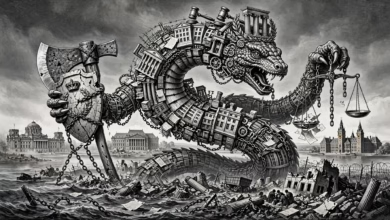

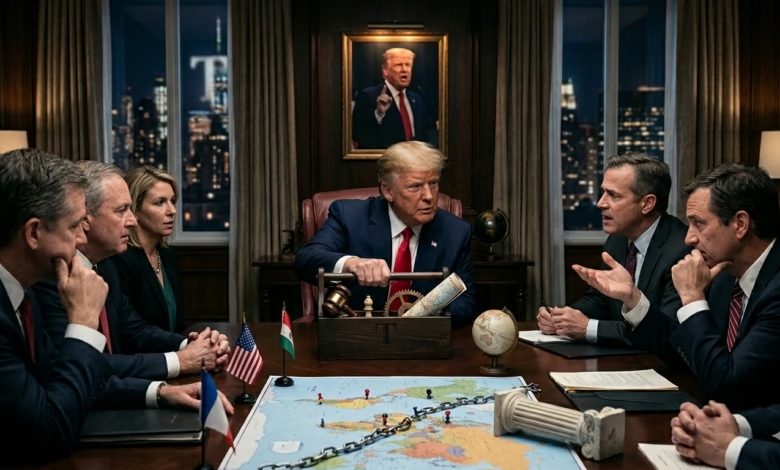
The book Trump’s Ten Commandments: Strategic Lessons from the Trump Leadership Toolbox, authored by Jeffrey Sonnenfeld in collaboration with Steven Tian, is an exceptional document that decodes the complex leadership style of one of the most controversial presidents in modern political history. This work goes beyond superficial journalistic narratives and traditional academic analyses, which often settle for describing Trump’s behavior as madness or random chaos. Based on five decades of studying leadership and a personal acquaintance with Trump spanning a quarter-century as a friend, advisor, and critic, Sonnenfeld offers a deeper vision asserting that there is a precise method behind this apparent madness. The author argues that actions which appear reckless or unpredictable are, in reality, deliberate tools and calculated strategies aimed at maximizing influence and absolute control. This book is not an ideological or political evaluation of policies; rather, it is a meticulous anatomy of the mechanics of power and how it is exercised in Trump’s world, making it a pivotal study for understanding the dynamics of power in American domestic politics and international relations.
This analytical vision begins with recognizing a fundamental truth that governs Trump’s worldview: everything revolves around him personally. In this solar system he has created, he is the center from which all authority is derived, leaving no room for independent institutional decisions. This is what the author terms the “hub-and-spoke” model, where traditional hierarchical structures and the usual bureaucracy in major institutions are dismantled, replaced by an organizational structure ensuring that all subordinates report directly to him. Trump deliberately fuels disputes among his aides and creates an environment of competition and internal conflict so that he remains the sole arbiter and the last resort for resolving disputes, thereby preventing any internal bloc that might limit his power. This strategy keeps his aides in a constant state of uncertainty, believing they are indispensable advisors, while in reality, they are treated as immediately replaceable tools the moment they step out of line.
To ensure that no independent power centers emerge, Trump resorts to the strategy of overwhelming aides with responsibilities that exceed their expertise—a policy that guarantees they remain weak and entirely dependent on him. Trump avoids appointing figures with independent professional weight or a long history of achievements that grant them legitimacy outside the framework of their loyalty to him. He views such independence as a direct threat to his absolute authority and a potential inclination to advise or publicly oppose him. Instead, he prefers appointing “acting” leaders who are easy to control and kept under constant pressure in their desire for permanent confirmation, which keeps them in a state of total submission. This approach is not limited to marginalizing experts; it extends to using subtle cues and indirect directives that push aides to make risky decisions. They bear the legal and political consequences, while he emerges completely innocent, pleading ignorance or a lack of direct involvement.
In the context of the art of negotiation and bargaining, Trump entirely rejects classical academic theories that advocate for gradual trust-building, seeking mutual interests, and finding solutions that satisfy all parties. Instead, he begins his negotiations with a strong, shocking blow to his opponent, adopting an extreme position that creates a state of confusion and intense psychological pressure. This strategy, based on depleting the opponent from the very first moment, aims to extract major concessions from the other party, who becomes willing to accept any settlement that seems moderate compared to the initial shock. This approach stems from Trump’s zero-sum view of the world, where he considers any gain achieved by the other party as a net loss for himself, completely negating concepts of good faith or long-term relationship building.
The strategy of preemptive strikes extends to creating a new reality by imposing a fait accompli or announcing deals before they are actually completed, placing other parties under immense time pressure to comply and concede. However, this excessive use of force and exaggeration of demands can sometimes backfire when it crosses the line and he is forced to retreat in the face of solid resistance, as happened with some of his tariff policies that sent severe shockwaves through global markets. To remedy these sudden retreats and save face, he usually reframes the situation and inflates illusory gains or massive investment announcements that do not entirely reflect reality, relying on media sensationalism to cover up the tactical concessions he was forced to make to escape the predicament.
The author then shifts his analysis to observe another equally dangerous tool in Trump’s arsenal: his excessive use of the legal system as a weapon of war, or what is known as “lawfare.” By filing thousands of lawsuits, Trump does not aim to win in courtrooms as much as he aims to drain his opponents financially and psychologically, forcing them to back down or submit to his terms regardless of the official legal outcomes. This strategy is clearly evident in his lawsuit against his biographer Timothy O’Brien, where he demanded astronomical damages of five billion dollars, knowing beforehand the writer’s inability to bear the costs of prolonged litigation. This proves that the goal was harassment and making his life miserable, not proving a right. This approach is not limited to individuals but extends to corporations large and small alike, such as his threat to smear Benjamin Moore paints to evade paying dues, or his battling of small contractors overwhelmed by legal bills that far exceeded the value of the original debts.
This offensive tendency connects to another central strategy Trump relies on in dealing with alliances and institutions: the policy of divide and conquer. Trump fully realizes that collective action and institutional alliances represent the greatest threat to his unilateral power, so he deliberately fragments any unified front that might stand in his way, akin to Gulliver resisting the Lilliputians’ attempts to bind him with ropes that paralyzed his movement. This was evident in his systematic attack on major law firms like Paul, Weiss, where he used intimidation and enticement to prevent these firms from banding against him, offering rewards to loyalists and punishments to opponents, which led to their division. This approach extended to the higher education sector, where he exerted massive pressure on elite universities like Columbia and Harvard by threatening to cut federal funding and revoke tax exemptions, attempting to isolate each institution individually to break academic solidarity.
In the economic landscape, the strategy of division was no less obvious. Trump faced unprecedented rebellion from business community leaders during his first term, especially after the Charlottesville events, which prompted many CEOs to resign en masse from his advisory councils. Business leaders realized then the power of collective action in curbing presidential excesses, which later drove them to unite to protect electoral integrity and the peaceful transition of power. However, Trump learned his lesson well for his second term. He began exploiting internal divisions among companies, particularly regarding tariffs, granting selective exemptions that struck at corporate blocs and made each company seek its individual salvation and compete for his exemptions away from a unified stance. He even transferred this approach to the international arena, deliberately dismantling traditional alliances and dealing with countries bilaterally and separately, as he did in his contradictory dealings with the leaders of Canada and Mexico, to ensure the other parties remained in a state of constant competition and collective weakness.
This extensive review takes us to the deconstruction of the most entrenched myth in Trump’s career: the narrative of the self-made billionaire who built his wealth from scratch relying on a mere one-million-dollar loan. The book reveals with conclusive evidence how Trump benefited from the financial empire of his father, Fred Trump, receiving massive support estimated at hundreds of millions of dollars since his childhood, utilizing a complex network of tax evasion and shell companies. Trump’s philosophy in deal-making does not rely on building real value, but on what the author calls the art of “stealing the deal,” where he adopts a fundamental principle that guarantees him perpetual profit while burdening others with the risk of loss. This is evident in the early Commodore Hotel deal, where he used his father’s strong political connections with the Mayor of New York to secure unprecedented tax exemptions and massive financing with minimal personal risk. This disastrous pattern repeated itself in his investments in Atlantic City casinos, where he drowned his companies in massive debt and junk bonds to siphon money for his personal interests and to pay off his own loans, leaving investors and creditors fighting over the scraps of bankruptcy while he escaped with most of his wealth.
This exploitative pattern did not stop at the borders of real estate. Trump gradually transformed into a media personality lending his name to any product that could be profited from without the need for real investment, starting from steaks and bottled water to universities and sneakers. Even more dangerous, as the analysis points out, is the extension of this insatiable commercial mentality to the corridors of the White House, where the presidency was turned into an unprecedented machine for personal and familial profiteering. These practices varied from receiving massive gifts from foreign figures and entities, such as a luxury jet from Qatar, to promoting cryptocurrencies that attract huge sums from international investors seeking to buy presidential influence indirectly. This blatant overlapping of national interest and personal benefit reflects a total disdain for constitutional norms, specifically the Emoluments Clause, which is fundamentally designed to prevent corruption and foreign influence on the executive branch.
Amidst this volatile trajectory, a unique trait in Trump’s character stands out: the absolute fluidity of his personal and political relationships, and his constant shifting between friends, enemies, and rivals. Trump does not recognize friendship in its traditional, deep sense; rather, he views people as functional tools whose positions change based on the needs of the moment and his immediate interest. The book cites glaring examples of political figures who fiercely criticized Trump, such as Lindsey Graham, Marco Rubio, and J.D. Vance, who once described him as America’s Hitler, yet miraculously turned into his fiercest defenders and closest aides. In return, Trump embraced them and overlooked their insults once they submitted to him and he realized their political utility and ability to reach certain audiences. The same logic applies to his dealings with the media, where he fiercely and hurtfully attacks media figures like Megyn Kelly, only to grant them exclusive interviews later to boost ratings and direct messaging, in a masterful psychological game aimed at keeping everyone off balance and constantly dependent on his volatile moods and sudden decisions.
At this juncture of the analysis, Sonnenfeld and Tian move to dissect one of Trump’s most ingenious and simultaneously dangerous tools: the creation of a “brand identity” and the transformation of a personal name into a moral authority that transcends material facts. The book explains that Trump was not selling real estate or services as much as he was selling the “myth of success.” Through a strategy of “universal licensing,” he managed to place his name on projects where he did not own a single brick, turning himself into a global brand symbolizing luxury and absolute capability. This strategy allowed him to reap profits from the successes of others while completely disavowing failure; if a project bearing his name stumbled, he blamed the developers or management, retaining his mental image as an invincible leader. This separation between the “name” and “reality” is what later enabled him to transfer this skill to the political arena, where he redefined truth to fit the narrative he promotes, relying on the principle that repetition and exaggeration create a parallel reality believed by followers and feared by opponents.
This manipulation of brand identity is closely linked to his superior ability to control the “news cycle” and use the media as a tool for strategic distraction. The authors reveal how Trump adopts the mentality of a “boxer” who never stops throwing punches; he realizes that a good offense is the best defense, and that creating a new crisis is the best way to cover up the failures of the previous one. Through his controversial statements and sudden tweets, Trump succeeds in forcing his opponents and the media to play on his turf and by his own rules, thereby distracting attention from core issues or legal investigations that might harm him. This political “pyrotechnics” is not merely random tantrums; it is a calculated tactic to flood the public sphere with noise, making it difficult for any opposing narrative to take hold or influence public opinion for long.
On the level of political institutions, the book observes what can be described as a “hostile takeover” of the Republican Party, where Trump applied the techniques of taking over struggling corporations in the business world to the old party structure. He treated the party as an “undervalued asset,” exploiting the gap between traditional leadership and an angry grassroots base. By marginalizing historical figures in the party and turning the Republican National Committee into an annex of his family empire, he managed to reshape the party’s identity to revolve around personal loyalty to him rather than steadfast ideological principles. Sonnenfeld explains that this transformation represents an existential threat to the concept of democratic institutions, where the “rule of law” and “institutional procedures” are replaced by the “will of the leader,” over time turning the state into a magnified version of the “Trump Organization” run by absolute loyalty and personal rewards.
In a deeper context, the book touches upon how Trump deals with the “gatekeepers” in American society, from judges to intelligence leaders down to academics. Trump follows a systematic strategy of “eroding trust”; instead of objective debate, he resorts to smearing the reputations of institutions that place limits on his power, labeling them the “deep state” or the “corrupt media.” This approach aims to strip these institutions of their moral legitimacy before the public, making it easier for him to ignore court rulings or intelligence reports that do not serve his goals. The danger lies in the fact that this method does not merely destroy opponents, but demolishes public trust in objective facts, creating a polarized society that is easily led through emotions and political tribal loyalties.
The two analysts also highlight the “leadership paradox” in Trump’s style: he combines administrative authoritarianism with ideological fluidity. He does not cling to a rigid political doctrine; rather, he is a “radical pragmatist” who changes his positions based on what grants him dominance in the present moment. This constant shifting confuses his allies and adversaries alike, enabling him to claim victory in any outcome, even if it is the opposite of what he previously advocated. His ability to reframe failure and portray it as a “tactical retreat” or a “trap set for opponents” is an advanced psychological skill that ensures his base remains in a state of perpetual awe of his imagined strategic capabilities, reinforcing his image as the sole “savior” capable of confronting conspiratorial elites.
This analytical reading moves to the most sensitive square in Trump’s “toolbox,” which Sonnenfeld calls the “sanctity of one-way loyalty.” The book dismantles the myth of mutual loyalty promoted by traditional institutional systems, explaining that loyalty in Trump’s dictionary is a one-way street starting from the subordinate and ending at the leader, without any obligation to reciprocate. This concept explains the shocking ease with which Trump discards his closest aides the moment their functional expiration date passes or the slightest hint of their independence emerges. During his tenure, the concept of an “advisor” transformed from an expert offering honest counsel into an “enforcer” seeking to satisfy the leader’s instincts. This led to the emergence of what could be called a “shadow government” of loyalists who often lack professional competence but possess the full willingness to break bureaucratic norms. The use of the presidential “pardon power” was not merely a legal procedure, but morphed into a tool to reward this absolute loyalty, sending a clear message to everyone operating in his orbit: legal and political protection is a personal grant from the leader, not a right stemming from adherence to the law.
This approach is connected to the strategy of “strategic ambiguity” or “keeping everyone guessing,” a rule Trump masterfully applied in foreign policy. The book argues that Trump transferred the “real estate speculator” mentality to the international stage, where there are no permanent alliances, only “temporary deals.” His withdrawal from major international agreements, such as the Iran nuclear deal and the Paris climate accord, was not just the fulfillment of campaign promises, but a strategic move aimed at upending the table and forcing the world to renegotiate on his terms. This style caused a deep fracture in the concept of “American reliability,” turning Washington from a guarantor of global stability into an unpredictable player seeking immediate gains. The analysis explains that this orientation not only emboldened adversaries but exhausted traditional allies who found themselves forced to deal with a president who viewed NATO as a “security company” that must be paid for its services, and diplomatic relations as mere balance sheets of profit and loss.
The most alarming chapter in Sonnenfeld and Tian’s study is the one regarding “rewriting history” or the “revisionist vision of reality.” The book points out that Trump possesses a unique ability to transform clear defeats into imagined victories by controlling the narrative. This is clearly manifested in his handling of the events of January 6th, where he succeeded in a short time in turning the storming of the Capitol from a democratic disgrace into a “day of love and patriotism” in the eyes of millions of his followers. This process is not merely a passing political lie; it is a systematic tactic to replace proven facts with “alternative truth,” exploiting the echo chambers of social media platforms and the weakness of traditional media in confronting the flood of misinformation. The danger of this approach lies in its undermining of the very foundation upon which democracy stands—the existence of a shared reference for facts—making it difficult to reach a national consensus or genuine political accountability.
This analysis extends to include the “global impact” of the Trump model, as the authors believe that “Trump’s toolbox” has become a manual for populist leaders worldwide. Trump legitimized a style of governance based on demonizing the opposition, disdaining the judiciary, and politicizing security apparatuses—a contagion that rapidly spread to democracies once considered stable. The book clarifies that “Trumpism” as a leadership method has transcended the person of Trump himself to become a structural phenomenon in contemporary global politics, where political success is measured by the ability to stir division and play on identity chords rather than offering realistic political solutions and programs. This shift heralds the end of the “liberal era” and the emergence of a new, more chaotic world order, where might makes right and the deal prevails over principle.
In a scrutinizing reading of the relationship between Trump and the finance and business community, the book reveals a state of “forced schizophrenia.” While Trump promoted himself as the greatest catalyst for the economy, his volatile management style terrified the heads of major corporations who revere stability and predictability. Drawing from his meetings with top executives, Sonnenfeld recounts how sudden tariffs and trade wars were not merely pressure tactics, but ticking time bombs that threatened global supply chains. Nevertheless, Trump succeeded in neutralizing many of these leaders by granting them massive tax cuts, creating a state of “silent barter”: financial prosperity in exchange for political silence. This utilitarian relationship reflects the essence of Trump’s vision of power, where positions can be bought or neutralized with money, and moral principles are merely obstacles in the path of achieving goals.
We reach in this concluding part of this in-depth review the final synthesis of Sonnenfeld and Tian’s vision, where the book moves beyond being a mere recounting of political tactics to become an anatomy of what could be called “strategic nihilism.” The authors argue that the true power in “Trump’s toolbox” lies in his ability to shatter the institutional “social contract” and replace it with a “personal loyalty contract” absolved of any prior legal or moral obligations. The tenth and final commandment looming on the book’s horizon is the “rejection of defeat as an existential option”; in Trump’s world, there is no honorable loss or legitimate retreat, there are only “conspiracies” woven against the leader, necessitating an earth-shattering response that strikes the entire structure of the system. This parochial approach to leadership redefines the concept of “national interest” to become entirely synonymous with the “leader’s survival in power,” a radical shift that makes it difficult for any oversight institution to operate efficiently without being classified as an enemy of the state.
The book delves into analyzing the phenomenon of the “erosion of expertise” as one of the inevitable consequences of this leadership style. Sonnenfeld explains that Trump views the “expert” or “technocrat” as an obstacle to his ambitions because expertise imposes constraints of facts and data that might conflict with the momentary desires of the leader. Hence, professional competence was replaced by “competence in loyalty,” leading to the hollowing out of federal institutions of their strategic minds, replacing them with figures who believe their primary mission is to protect the leader from the repercussions of his decisions. This “institutional strip-mining” not only threatens the quality of public policies but weakens the state’s ability to confront major crises, from pandemics to economic disasters, where the response to a crisis becomes governed by its impact on the leader’s image rather than its effectiveness in protecting citizens.
In a forward-looking reading of the future, the authors ask: Can the United States and the world return to the “pre-Trumpism” era? The answer provided by the book is laden with warning; the toolbox Trump opened will not be closed easily. This model has proven that major political successes can be achieved by breaking rules considered sacred for centuries. “Trumpism” has turned into a school of thought studied by aspirants to power, not just in America but everywhere, posing an existential challenge to traditional leaders and democratic institutions to reinvent themselves. Sonnenfeld stresses that confronting this approach does not lie in emulating it, but in reviving “moral accountability” and strengthening the legal fortresses that prevent public authority from being turned into private property.
The book concludes with a personal touch from Sonnenfeld, who has followed Trump’s career for a quarter of a century, pointing out that the true tragedy lies not in the person of Trump as much as in the “institutional silence” that allowed these tools to become effective. The book Trump’s Ten Commandments is essentially a wake-up call, urging business leaders, politicians, and citizens to realize that leadership is not just the art of deal-making or exercising influence; it is a moral trust that requires a commitment to truth and to institutions that outlive individuals. The work presented by Sonnenfeld and Tian will remain for many years the primary reference for understanding how the nature of power changed in the twenty-first century, and how tactical brilliance, when stripped of moral purpose, can become a tool for destruction rather than construction.