

A new dawn for the African continent
A review of the book "Empowering Africa through Artificial Intelligence"

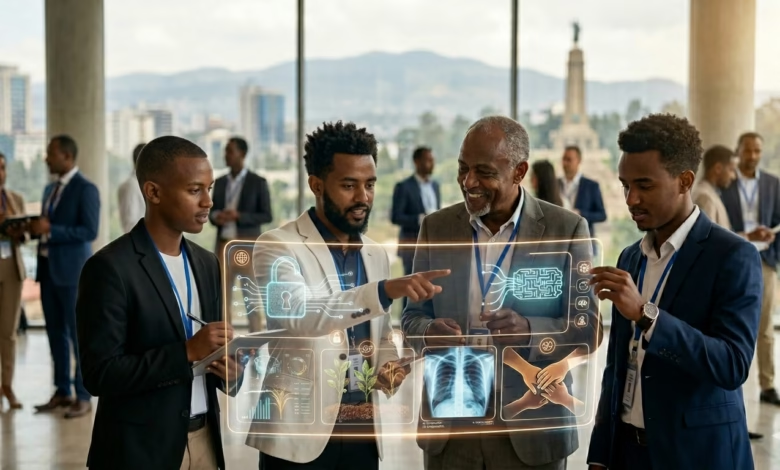
In the heart of the Ethiopian capital, Addis Ababa, and within the corridors of the Adwa Victory Memorial Museum—which is imbued with the fragrance of history and triumphs—an exceptional scientific and technological event was launched to shape the future of the African continent. We are not here to discuss a mere passing academic gathering, but rather an immensely important historical and scientific document; it is the proceedings of the “Third Pan-African Conference on Artificial Intelligence” (PanAfriCon AI 2024). This book, published by the prestigious global publishing house Springer as part of the Communications in Computer and Information Science (CCIS) series, volume 2550, bears a title that encapsulates the ambitions of an entire continent: “Empowering Africa Through AI.”
Reading this massive scientific compilation, edited by an elite group of scientists led by Taye Girma Debelee, Achim Ibenthal, Friedhelm Schwenker, and Yehualashet Megersa Ayano, takes us on a flowing journalistic and scientific journey. Through it, we dive into the depths of the challenges facing Africa and the innovative solutions offered by its own people using the latest technological advancements. This conference was organized and generously hosted by the Ethiopian Artificial Intelligence Institute (EAII) in October 2024 to serve as a vital platform for exchanging best practices and establishing joint African efforts to provide solutions to the 21st-century challenges in the social, economic, and environmental domains.
The Philosophy of “Ubuntu”.. When Technology Embraces the Roots of Humanity
We cannot delve into the complex technical chapters of this book without pausing extensively at the opening remarks delivered by His Excellency Mr. Temesgen Tiruneh, Deputy Prime Minister of the Federal Democratic Republic of Ethiopia. With a style that combines political astuteness and a forward-looking vision, Tiruneh crossed the t’s and dotted the i’s, asserting that artificial intelligence could add up to $1.2 trillion to Africa’s Gross Domestic Product (GDP) by 2030. But more important than these astronomical figures is the spirit with which he demanded this technological development be enveloped.
Tiruneh called upon the attendees to adopt the authentic African philosophy of “Ubuntu,” which translates to “I am because we are.” This profound philosophy must guide the continent’s approach to artificial intelligence; to ensure that, amidst this innovative momentum, the focus remains squarely on community, ethics, and shared prosperity. Technology here is not an end in itself, but rather a tool to serve and elevate humanity. This balanced vision negates the cold and abstract nature of artificial intelligence, cloaking it in a warm African garment that seeks to eradicate incurable diseases, connect remote villages to global markets, and open up horizons of personalized education for every African child.
Scientific Rigor and Minds Defying the Odds
Methodologically and academically, the book reflects immense rigor in the selection of research papers. After opening the call for proposals in February 2024, the conference received 66 research submissions, all of which underwent a meticulous single-blind review process by three independent reviewers. This stringent scientific filtration resulted in the acceptance of only 18 submissions, 15 of which were included as full scientific papers in the volume before us. These fifteen papers represent the cream of the contemporary African intellect, covering a broad spectrum of vital disciplines that touch the nerve of daily and sovereign life on the continent, divided into five main tracks: Cyber Security; AI in Medicine, Biology, and Sociology; Audio and Image Interpretation; AI in Engineering; and Natural Language Processing, Text, and Speech Processing.
The First Station: The Cyber Battlefield and Economic Protection
Leafing through the first section of the book, we find ourselves in the midst of an invisible war; the war of Cyber Security. Technological advancement is a double-edged sword; just as it brings prosperity, it also opens the doors to digital threats that drain emerging economies.
1. Countering Cross-Site Scripting (XSS) Attacks: In the first paper, researchers Mulugeta Linger Tariku, Solomon Zewdu Melese, and Temesgen Tadesse Fisa present an in-depth study on enhancing the detection of Cross-Site Scripting (XSS) attacks in web applications. This type of attack is considered one of the most dangerous threats to web security, with OWASP classifying it as a top-tier threat, as it leads to session hijacking, data theft, and service disruption.
In a scientific manner, the researchers critique traditional machine learning models that stand powerless before the dynamic and evolving nature of these malicious attacks. As an innovative solution, the team proposes a hybrid deep learning model combining Convolutional Neural Networks (CNN) and Bidirectional Long Short-Term Memory networks (BiLSTM), augmented with self-attention mechanisms (SeqSelfAttention) and character-level text embedding (FastText). This ingenious combination allows for the capture of complex spatial features of the attack and the comprehension of sequential dependencies in web traffic. The language of numbers speaks confidently here, as the model achieved a staggering accuracy of 99.61%, proving the ability of Ethiopian minds to engineer cyber solutions that rival global standards.
2. The Telecom War.. Detecting SIMBox Fraud: The cyber battle does not stop at the web; it extends to strike the lifeblood of telecommunications. In a fascinating research paper, researchers Gadisa Adamu Mitiku, Ketema Adere Gemeda, and Perumalla Janaki Ramulu shed light on a problem that plagues telecom companies globally, and particularly in Africa: bypass call fraud using SIMBoxes. This type of fraud, which exploits Voice over Internet Protocol (VoIP) technologies to bypass access fees and generate illicit profits from international calls, costs the telecom sector massive losses.
The study, which used Ethio-Telecom in Ethiopia as a case study, revealed the shortcomings of traditional Fraud Management Systems (FMS) in keeping pace with the dynamic nature of fraudsters. To counter this drain, the researchers designed deep learning classification algorithms, including MLP, RNN, and LSTM, to scrutinize massive Call Detail Records (CDR). Experiments proved that the MLP classifier achieved the highest classification accuracy at 99.17%. The implementation of such smart systems not only protects revenues but also enhances trust and regulatory compliance in a vital sector like telecommunications.
Having left the cyber battlefields fraught with codes and digital threats in the first part, the pages of this magnificent scientific tome take us on a smooth, flowing journey toward Africa’s green fields and medical laboratories. Here, artificial intelligence emerges as a faithful guardian of the continent’s food and health security. In this context, it becomes distinctly clear how African minds strive to harness technology to solve daily crises affecting the lives of ordinary citizens, far removed from abstract academic theorizing.
A pioneering study stands out before us, addressing the automatic detection of fruit spoilage using edge devices, authored by researchers Bifekadu Bekuretsion and Million Meshesha. This study stems from a bitter reality experienced by developing nations, where inadequate sanitation practices and weak cooling and storage chains lead to food spoilage, causing severe illnesses or even death. Instead of relying on expensive gas or humidity sensors that are difficult to procure in local markets or integrate into daily life, the two researchers propose an ingenious solution relying on standard smartphone cameras owned by consumers. By utilizing lightweight deep learning models such as MobileNets, DenseNet, and Xception, the proposed system can capture an image of the fruit and analyze it to detect hidden signs of spoilage with high accuracy and exceptionally rapid response time. These models have been architecturally optimized to fit the capabilities of low-end smartphones and consume minimal storage space, making this innovation a practical and effective tool accessible to low-income retailers and consumers to protect against diseases transmitted through spoiled food.
Moving from the protection of harvested fruits to the prevention of crop diseases in their infancy, the book gracefully guides us toward a comprehensive systematic review presented by Abnet Shimeles and Million Meshesha on plant disease detection using digital image processing for common food plants in Ethiopia. This research sounds the alarm on food security challenges, noting that plant diseases are responsible for a staggering loss of up to forty percent of major crop yields in Ethiopia. Interestingly, this investigative review reveals an intense local research focus on specific cash and food crops like coffee and the “Enset” plant, whereas a strategic and staple crop for the Ethiopian table, such as “Teff” grain, suffers from a clear and alarming research neglect in the field of automatic image processing. The researchers attribute this reluctance to the complex technical challenges posed by the delicate stems and leaves of the Teff plant, which require ultra-high-quality images and complex image enhancement techniques for algorithms to detect diseases early. Despite the evident global superiority of deep learning models in this field, the greatest challenge remains the scarcity of public, high-quality, and accurately annotated image databases for indigenous African plants.
The ambition of artificial intelligence in the African continent does not stop at the borders of agriculture and food security; its analytical arms extend to embrace the medical field with all its complexities and challenges. In another systematic review study, a research team comprising Getahun Gezu Negusse, Achim Ibenthal, Mesfin Abebe, and Manuel Nietert dives deep into the applications of machine learning algorithms for diagnosing Cystic Fibrosis. This complex and dangerous genetic disease, which severely affects respiratory and digestive functions, requires precise diagnosis and rapid medical intervention. The research illustrates how machine learning and deep learning techniques have demonstrated acceptable performance in assisting doctors with analyzing medical data and predicting patient deterioration. However, the analytical surprise lies in the fact that the globally recommended standard method for diagnosing the disease—the sweat chloride test—had not received sufficient support or genuine exploration by machine learning algorithms at the time these studies were prepared. Proceeding from this gap, the researchers posit the necessity of integrating what is known as “Explainable AI” into the medical sector as a top priority. It is not enough for the model to simply provide an accurate answer or diagnosis as a closed black box; it must logically and seamlessly justify its decision to both doctors and patients alike to ensure the building of trust and the achievement of transparency in decisions concerning human lives.
The pages of this volume transcend the boundaries of pure natural sciences to transparently touch upon issues of sociology and social engineering, where a vital study from Kenya, presented by Juliet Muso and her colleagues, stands out, focusing on predicting gender disparity in Science, Technology, Engineering, and Mathematics (STEM) programs. This research addresses a persistent social and educational hurdle that limits the full unleashing of innovation in developing nations, represented by the noticeable gap in female participation and retention in these vital technical disciplines. By evaluating advanced machine learning algorithms, the research provides strategic, data-backed insights for policymakers and educators, aimed at understanding the root causes behind this disparity and designing targeted interventions. This investigative approach highlights the unconventional capability of AI to uncover hidden societal biases in educational systems and offer roadmaps toward a more inclusive and equitable academic and professional environment for all.
While we contemplate these societal solutions, the fabric of the book smoothly brings us back to economic affairs intertwined with the daily life of markets, presenting a practical innovation named (DeepFakesUG) aimed at detecting counterfeit Ugandan banknotes, accomplished by Dinesh Azamuke and a team of creative researchers at Makerere University. In many Sub-Saharan African countries, despite the rise of digital transactions, paper cash remains the indispensable lifeblood of daily transactions, making the spread of sophisticated counterfeit currency a grave and direct threat to local economic stability and public trust in the financial system. This field research bypasses manual detection methods relying on touch or expensive mechanical devices, proposing instead a smart system based on Convolutional Neural Network (CNN) architecture to evaluate images of banknotes captured via a smartphone camera. Models such as ResNet152V2 demonstrated an exceptional and superior ability to capture subtle patterns and hidden inconsistencies in counterfeit banknotes with an astonishing accuracy reaching 96%. What adds to the brilliance of this technological innovation is the possibility of programming it to run entirely on the phone’s internal processor without the dire need for a stable internet connection, delivering a reliable result in less than five mere seconds, thereby protecting small traders and ordinary citizens at the peripheries of the continent from falling victim to financial fraud.
Finally, in the context of anchoring African identity and preserving intangible heritage from extinction in the digital age, we review a profound technical linguistic study on automatic speaker recognition for the Amharic language using spectrogram images and deep learning techniques, prepared by Bantigize Addis and colleagues. Indigenous African languages, with their immense morphological richness and phonetic complexity like Amharic, face massive technical challenges and a lack of available resources for Natural Language Processing and speech recognition systems. The researchers ingeniously overcome these intractable hurdles by converting complex audio recordings into visual spectrograms, utilizing pre-trained models alongside fully customized convolutional networks to decode the speaker’s identity. The results of this pioneering experiment showed that deep learning models, when supported by data augmentation engineering techniques to prevent overfitting, are capable of understanding the precise frequencies and temporal characteristics of the Amharic language with highly promising and encouraging accuracy, opening the door to security systems and smart applications that speak and understand local languages fluently.
This enchanting flow of knowledge between the book’s chapters proves beyond a shadow of a doubt that artificial intelligence in Africa is no longer merely a blind importation of ready-made Western technologies and applications. Rather, it has become a movement of re-engineering and authentic local innovation springing from the soil of the continent and its actual challenges, providing solutions that touch upon human health, food, economic security, and cultural identity.
As we continue navigating the details of this massive scientific volume documenting the proceedings of the Third Pan-African Conference on Artificial Intelligence, we find ourselves before a qualitative shift in the discourse. The book transitions from direct field applications in agriculture and medicine to the maintenance of “digital infrastructure” and the advancement of the continent’s linguistic identity. This section of the book highlights a deep awareness among African researchers that technological sovereignty is not achieved merely by consuming applications, but by possessing the engineering tools that build and secure these applications, and by the ability to make the machine speak the native tongue of its citizens.
In the track dedicated to engineering and software, a vital research paper stands out addressing the enhancement of software vulnerability detection using artificial intelligence techniques. This was a collaborative effort led by Baskaw Kibret, Hailu Shimeles, and Temesgen Tadesse. This research stems from the fact that software has become the backbone of all sovereign and financial institutions in Africa, and that any small software vulnerability could lead to the collapse of entire vital systems. The researchers criticize the traditional reliance on manual or static rule-based scanning tools, which often fail to detect complex logical errors or novel threats. The team offers a solution based on deep learning models capable of deeply analyzing the source code and identifying suspicious patterns that may indicate potential vulnerabilities. This trend toward “smart software security” lays a foundational block in building a fortified African digital environment, capable of withstanding cyberattacks that grow fiercer day by day.
In parallel with securing systems, the book returns to shed light on the image processing revolution in the health sector, but from a more comprehensive and complex angle. Highlighting this is a study on a multimodal deep learning approach for the automatic classification of chest X-ray images. The researchers explain that the severe shortage of specialized medical personnel, especially radiologists in rural areas of Africa, represents a deadly obstacle to the early diagnosis of chest diseases such as tuberculosis and pneumonia. The innovation in this research lies in the model’s ability to integrate diverse data—not limited to the radiographic image alone, but extending to include the patient’s clinical data, which raises diagnostic accuracy and reduces the rate of false positives. This integration between textual and visual data reflects a maturity in understanding how medical diagnosis actually works in reality, where a doctor does not rely on an image alone, but on a comprehensive medical history.
However, the most simultaneously poignant and ambitious chapter is the one dedicated to Natural Language Processing (NLP), text, and speech. Here, we face an existential challenge for the continent in the digital age; while major global languages like English and Chinese race to dominate Large Language Models (LLMs), indigenous African languages—numbering over two thousand—continue to suffer from what researchers call “digital resource scarcity.”
The book presents a comprehensive and extensive review of Large Language Models for low-resource languages, with the participation of researchers from the Ethiopian Makerere University and international institutions. This study illustrates how the absence of African languages from models like GPT and Llama is not merely a technical challenge, but a form of “digital marginalization” that could lead to the extinction of these languages in cyberspace. The researchers present innovative strategies for training models on limited data, using “Transfer Learning” techniques to introduce artificial intelligence to the complex morphological and grammatical rules of languages like Amharic, Oromo, and Tigrinya.
In a related context, we find a solid applied study evaluating pre-trained word embeddings for sentiment analysis in the Amharic language. The researchers attempt to understand how a machine can comprehend human emotions and attitudes—from satisfaction and indignation to neutrality—through posts written in Amharic on social media. The difficulty here lies in the “linguistic precision” of Amharic, which relies on a highly complex morphological system. The results proved that models trained on massive local texts were more capable of understanding cultural contexts and metaphorical expressions, opening new horizons for companies and government institutions to understand the pulse of the African street more accurately and directly.
The journey of technical empowerment is not complete without addressing justice and access to the law. This section of the book concludes by presenting an ambitious project to develop an AI-powered Chatbot to provide legal assistance in Ethiopia. The researchers point out that many citizens, especially in remote regions, are ignorant of their basic legal rights or find it difficult to access affordable legal consultations. This smart system acts as a preliminary consultant, receiving citizens’ inquiries in their local languages and providing them with clarifications on legal procedures, property rights, and criminal and civil laws, based on a reliable database of national legislation. This application embodies the highest goals of the “democratization of knowledge,” where technology becomes a bridge connecting the marginalized to their lost rights amidst the jungle of bureaucracy.
Anyone contemplating these researches realizes that the “Pan-African AI Conference 2024” was not merely a display of technical muscle, but rather a scientific cry declaring that Africa will not settle for the spectator’s seat in the Fourth Industrial Revolution. Through its flowing chapters, the book proves that solutions do not always come from the outside; rather, the minds raised in the heart of the challenge are the most capable of forging the future, provided they are afforded the incubating academic and political environment whose features have clearly begun to take shape in Addis Ababa.
This analytical reading of the scientific volume is completed by pausing at the strategic horizon drawn by the researchers at the conclusion of their deliberations in Addis Ababa, where it becomes evident that the Third Pan-African Conference on Artificial Intelligence was not an end in itself, but a means to frame a scientific movement seeking to reclaim the continent’s technical sovereignty. What distinguishes this book from other traditional research collections is its optimistic spirit coupled with extreme realism, as the researchers did not slip into the trap of technological utopia; instead, they remained anchored to the roots of existing problems, attempting to mold AI algorithms to be part of the solution rather than part of the crisis of technical dependency.
One of the most important common threads connecting the research in this book is the continuous emphasis on the role of leading national institutions, foremost among them the Ethiopian Artificial Intelligence Institute, which is no longer just an organizing body, but has transformed into a continental house of expertise that sets the ethical and technical standards for innovation. In its concluding pages, the book points out that digitally empowering Africa requires moving beyond the phase of “technology transfer” to the phase of “knowledge localization,” which was manifested in the research that focused on local languages and the specific agricultural and medical needs of African communities. This orientation cements a conviction that African artificial intelligence must be “contextual” intelligence that understands the specificity of the land and its people, and does not merely simulate Western models that may not suit the complexities of the continent’s infrastructure or social fabric.
Regarding the ethical and legislative dimension, the book opens a fundamental debate on data governance in Africa. As AI relies on the flow of information, the necessity arises to protect the privacy of the African citizen from the digital encroachment of transcontinental corporations. Throughout the book, editors and researchers have stressed the importance of drafting national and regional policies ensuring that African data belongs to its people, to be used for developing their services and improving their quality of life, rather than being merely a raw material exported abroad only to return to us in the form of exorbitantly priced software products. It is this sovereign vision that grants the book “Empowering Africa Through AI” its added political and academic value, transforming it from a mere record of conference proceedings into a future policy document.
Looking to the future, the lessons extracted from this research indicate that the next step must focus on building human capacities and expanding the base of young researchers. The success of mathematical models in detecting counterfeit currency or diagnosing plant diseases, as mentioned in the book’s chapters, remains contingent upon the existence of a sustainable research environment and national funding that supports innovation, away from the conditions of international donors. Herein lies the importance of the continental integration called for by the participants, where Ethiopia’s experience in cybersecurity can integrate with Kenya’s experience in financial technology, and with Uganda’s expertise in AI applications for local languages, thereby creating a unified, strong African digital market capable of competing globally.
In its essence, the book “Empowering Africa Through AI” represents a declaration that the African technical mind has reached the stage of maturity and self-reliance. It is a record of the triumph of scientific will over the scarcity of resources, and a shining proof that the philosophy of “Ubuntu” can find its place within deep learning algorithms and artificial neural networks. We are before an indispensable reference for decision-makers, academics, engineers, and anyone interested in the future of development in the African continent, as this work dots the i’s and crosses the t’s in the desired march of digital transformation, affirming that Africa is not merely a consumer of artificial intelligence, but an authentic partner in shaping its features and steering its paths toward serving all of humanity.