

“Tigray and Ethiopia: A clash of narratives and the mysterious allure of the cradle of empire”

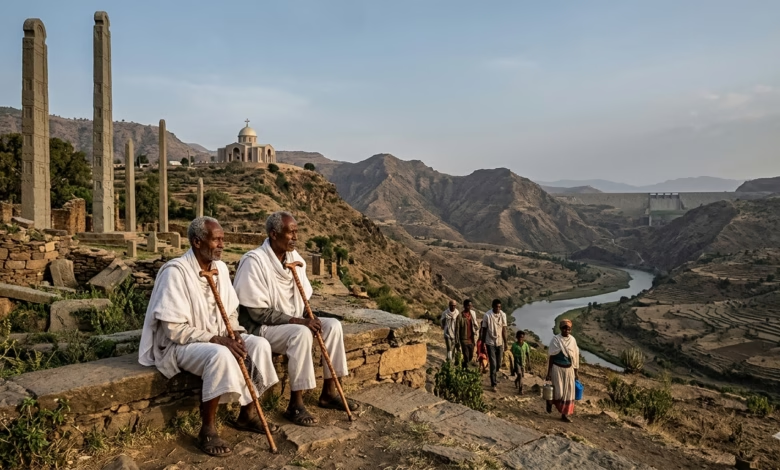
Tracing the historical roots and dismantling the complex geopolitical structures of the Horn of Africa is an urgent necessity for understanding the dynamics of conflict and the ongoing formation of identity in that strategic corner of the world, and it is into the depths of this that the historian Haggai Erlich dives through his prominent reference work Greater Tigray and the Mysterious Magnetism of Ethiopia, published by Oxford University Press. This intellectual work represents the culmination of a long investigative journey extending over more than fifty years that the researcher spent studying Ethiopian affairs, which began with a doctoral thesis at the University of London in 1973 centered on the biography of Ras Alula, the most prominent hero of Ethiopia and Tigray in the late nineteenth century. The book does not merely recount historical events as isolated facts but weaves an analytical reading that flows smoothly, linking the distant past with the bloody outcomes of the present and avoiding preconceived biases as much as possible, for the purpose of exploring the pivotal role played by the Tigrinya-speaking nationality in shaping both the Ethiopian and Eritrean spaces. Starting from the wisdom of the Italian philosopher Benedetto Croce, which states that all history is essentially contemporary history, the author affirms that his endeavor to excavate the past is motivated by the tragedy of the violent fraternal conflict that recently ravaged Ethiopia and made this ancient entity, which resisted extinction for two thousand years, appear threatened with disintegration.
Erlich borrows the title of his thesis from a precise observation recorded by the British intelligence officer Major Cheesman eighty-one years ago during the liberation of Ethiopia from the grip of Italian occupation. In that pivotal era, some British officers leaned toward a plan to detach Tigray and annex it to Eritrea, which was under their administration, relying on the then-common disintegration theory which assumed that the Ethiopian Empire was nothing more than a hybrid and obsolete entity on the verge of collapse. However, Cheesman, who was deeply versed in understanding the country’s historical composition, forcefully refuted this vision, affirming that this complex imperial edifice holds together thanks to a mysterious magnetism that eludes the comprehension of anyone who contents himself with looking at the political surface of Ethiopia. The days at that time proved Cheesman’s perspicacity, and Ethiopia remained united, for the author today to raise again the fundamental question of whether this hidden magnetism still possesses the ability to repel the current waves of disintegration.
The book builds its analytical approach on dismantling the status of Greater Tigray geographically and historically as the cradle from which Ethiopia emerged as a state and as an idea. This geographical space, according to the mid-nineteenth-century map, expands to include the provinces of Hamasien, Seraye, and Akele Guzay located beyond the Mareb River in present-day Eritrea, alongside the regions of Agame, Tigray, Adwa, Shire, Adiyabo, Tembien, and Enderta. In the heart of this strategic geography emerged the ancient civilization of Aksum, which represented an incubator in which local tribes fused with waves of migrants crossing the Red Sea from the Arabian Peninsula, such as the Habashat and Ag’azian tribes, during the first millennium BC. The Ag’azians brought with them the roots of the Semitic Ge’ez language, which developed and flourished locally to become the language of documentation and official communication in the kingdom. These roots combine with the foundational myth deeply rooted in the Ethiopian conscience, embodied in the figure of the Queen of Sheba, Makeda, who tradition says transferred the reins of rule to her son Menelik I, born to King Solomon in Jerusalem, thereby laying the spiritual and political foundation for the dynasty of Ethiopian emperors who derived their legitimacy from this Solomonic heritage, extending to the last emperor Haile Selassie.
In addition to being the cradle of departure, the Tigray region embodied the role of both an open gateway and an impregnable wall at the same time. Through the strategic port of Adulis, Aksum by the sixth century had turned into an active power in the Red Sea basin, registering its presence as a partner equal in importance to the Byzantine and Persian empires within the broader Eastern space, where its influence extended to include parts of southern Arabia and vast areas of the Horn of Africa. And in the halls of Aksum and under the patronage of its king was written the early historic encounter between Christianity, which Ethiopia adopted in the fourth century, and nascent Islam, when the Negus provided a safe haven for the pioneers of Islam fleeing the persecution of the pagans in Mecca, an interaction that still forms a central pillar in determining the course of Muslim-Christian relations and contemporary Ethiopian foreign policy. However, the expansion of Islamic influence in the Arabian Peninsula in the seventh century led to a gradual decline of the Ethiopian role in the Red Sea theater, so that the center of the Christian state crept deep into the interior mountain highlands and the sea, once a gateway, turned into a wall isolating the country from the currents of the outside world.
This geopolitical shift was accompanied by a linguistic and cultural labor of great importance, as the brilliance of Ge’ez as a daily spoken language faded, its sanctity becoming confined to religious texts and church rituals, taking a path similar to that of Latin in the West. From the womb of this receding language, between the seventh and tenth centuries, two essential languages branched off: Tigrinya, which retained its pure Semitic roots and took root in the traditional strongholds of the Aksumite kingdom, and Amharic, which arose in the southern regions influenced by its environment of local Cushitic languages. And with the continuous creep of the political center of gravity toward the south, the Amharic speakers seized the helm of leadership to reach the peak of their power in the Middle Ages during the era of the Solomonic dynasty, while the Tigrinya-speaking regions found themselves pushed for the first time in their long historical trajectory toward the margin and drained politically and economically.
This early marginalization laid the foundation for a fundamental rift in political culture and divergent approaches to state-building between the Amharas and the Tigrayans, a difference that still drives the whirlpools of conflict in Ethiopia to this day. While the Amharas adopted an approach seeking to fashion a centralist, unifying empire revolving around their language, which is called the Amhara thesis, the Tigrayans leaned toward adopting a pluralistic vision that recognizes the diversity of the Christian empire and guarantees the preservation of their distinct identity within its broader framework. Despite sharp internal divisions and their repeated exclusion from the seat of power, the sons of Tigray remained the trusted guardians of the country’s gateway and paid heavy prices in the great battles for survival that were waged on their lands. Then they soon returned to ascend to the seat of leadership in pivotal eras, as happened in the late nineteenth century or when they overthrew the dictatorship in 1991 to begin restructuring Ethiopia on the basis of ethnic federalism, before they were subjected to a new and harsh exclusion in 2018.
This dual positioning between a pure Tigrayan identity and comprehensive Ethiopian belonging remains one of the most complex dilemmas that this historic group has faced. While their tendency toward distinctiveness aroused the suspicion of partners inside and tempted invading powers with the possibilities of their secession, at critical junctures they demonstrated their organic cohesion with the larger Ethiopian project. Perhaps their retention of their hierarchical social and political system without radical structural changes until the late twentieth century reflects the solidity of this component and its ability to endure despite the vicissitudes of time and the internal intrigues that drained much of their energies.
Erlich continues to trace the threads of this intertwined historical narrative, delving into the dark eras that followed the setting of the Aksumite sun, where its remnants were subjected to widespread destruction in the tenth century at the hands of a queen called Gudit, plunging the region into a tunnel of obscurity that did not dissipate except with the rise of the Zagwe dynasty, which extended its influence as far as Eritrea and Tigray. However, the most prominent geopolitical transformation was embodied later with the rise of the Solomonic dynasty, specifically during the reign of Emperor Zara Yaqob, who laid the foundations of a new political entity in the north by bestowing the title ‘Bahr Negash,’ meaning king of the sea, on his local ally in Debarwa, and naming his kingdom ‘Medri Bahri’ or land of the sea. This founding represented an official rebirth of a genuine Tigrayan renaissance.
‘Medri Bahri’ was not merely an administrative entity, but was the protective shield that saved Christian Ethiopia from total extinction in the sixteenth century. In that era, the Red Sea turned into a grinding international conflict arena, coinciding with the advance of the armies of Imam Ahmad ibn Ibrahim, known as ‘Gragn,’ who swept the Ethiopian highlands supported by Ottoman reinforcements and destroyed most manifestations of Christian presence in the country. In the midst of this comprehensive collapse, and when the Ethiopian emperor was a fugitive in the mountains, Debarwa remained steadfast under the leadership of ‘Bahr Negash Isaac,’ who formed a strategic alliance with the incoming Portuguese force led by Cristóvão da Gama. Despite violent setbacks and the killing of da Gama himself, this Tigrayan-Portuguese alliance resulted in the elimination of Ahmad Gragn at the Battle of Zantara in 1543, so that Ethiopia regained its spirit after it had almost breathed its last.
However, survival from the southern advance did not mean settling into peace, as a new threat soon loomed from the north with the Ottomans landing their forces in Massawa and Debarwa in 1557 led by Özdemir Pasha, seeking to annex the region under the banner of their empire as a province they called the ‘Habesh Eyalet.’ Here emerges the complex contradiction in the political character of Tigray’s leaders, as ‘Bahr Negash Isaac’ found himself oscillating between loyalty to the Amhara Christian empire and alliance with the foreign Ottomans in retaliation against the central emperors who sought to undermine his autonomy. This continuous rebellion led to Isaac’s death on the battlefield in 1578 while fighting alongside the Ottomans against the army of Emperor Sarsa Dengel, who responded by abolishing the region’s autonomy and banning the use of local symbols of sovereignty such as war banners and drums.
With Ethiopia entering a voluntary isolation and its emperors ensconcing themselves in the new capital Gondar founded by Emperor Fasilides in the seventeenth century, the grip of the center began to loosen terribly. In contrast to this central decline, Tigray was accumulating exceptional elements of strength, benefiting from its location overlooking the Red Sea and the port of Massawa, which allowed it to monopolize the import of modern firearms and amass vast wealth from salt mines. It was helped in this by its deeply rooted social and agricultural structure, represented in the communal ‘rist’ system and the feudal ‘gult’ system, which provided a strict military hierarchy that enabled Tigray to absorb new military technology, such as firearms, without the need to carry out a social revolution that would undermine its class foundations.
These dynamics produced what is known in Ethiopian heritage as the ‘Era of the Princes,’ a period that extended for centuries and witnessed an almost complete marginalization of imperial authority in favor of regional warlords. Erlich rejects describing this era as ‘total chaos,’ affirming that the Ethiopian entity did not disintegrate, but continued within a framework of regional loyalties that competed to control the center without seeking to secede from it. In this arena, Tigrayan leaders emerged as kingmakers, beginning with Ras Mikael Sehul who marched with his massive army equipped with rifles to impose his terrifying control over Gondar in 1769, imposing himself as the strongest man in the empire.
After that, weighty Tigrayan names followed who played pivotal roles in drawing the map of power, such as Ras Wolde Selassie who succeeded in imposing his stability and expanding his diplomatic influence by hosting European envoys and signing early treaties with the British. However, the fires of internal competition continued to eat away at Tigray’s strength, which was manifested in the rise of Dejazmach Sabagadis Woldu, who despite unifying the region and his vast ambitions, ended up beheaded in 1831 after his defeat at the Battle of Debre Abbay before an alliance led by Oromo horsemen. This continuous internal bleeding left Tigray exhausted and divided, paving the way for the emergence of stronger central figures from outside it, such as Emperor Tewodros, to end the ‘Era of the Princes,’ and to begin a new and more dramatic chapter in which Tigray would return to ascend the imperial throne in its most splendid and harshest forms.
Erlich at this turn in his narrative moves to one of the most luminous and dramatic eras in modern Tigrayan history, the era that witnessed ‘Kassa Mercha’ ascending the imperial throne under the name Emperor Yohannes IV in 1872. Yohannes’s rise was not merely a change in the person of the ruler, but was the inauguration of what the author calls the ‘Tigrayan thesis’ in governance, which was based on the concept of federal union and decentralization, in contrast to the ‘Amhara thesis’ which tended toward absolute centralization. The features of this rise began in 1868, when Kassa Mercha played a pivotal role in assisting the British campaign led by General Robert Napier against Emperor Tewodros II, where he provided vital intelligence information and logistical support that enabled them to reach the fortress of Magdala. The British rewarded their Tigrayan ally by granting him a huge military arsenal including cannons and modern rifles, which gave him a decisive military superiority over his local competitors, specifically Emperor Tekle Giyorgis II whom Kassa defeated at the Battle of Assam near Adwa despite the latter’s large numerical superiority.
Yohannes IV’s legitimacy was embodied in his return to the roots, as he insisted on holding his coronation ceremonies in the historic city of Aksum, following religious and linguistic rituals (in Ge’ez) to link his kingship to the glory of the ancient Aksumite kings. Unlike his predecessor Tewodros who tried to crush regional powers, Yohannes adopted a policy of ‘supreme sovereignty’ that granted local leaders, such as Menelik in ‘Shewa’ and Tekle Haymanot in ‘Gojjam,’ the titles of kings while retaining their internal autonomy in exchange for loyalty to the imperial throne. Erlich sees that this model reflected the Tigrayan vision of Ethiopia as a diverse and interconnected entity, not as a rigid centralized state. However, this political decentralization coincided with strict religious rigidity; Yohannes sought to unify the country under the banner of Orthodox Christianity, exerting enormous pressure to convert Muslims in the regions of ‘Wollo’ and ‘the Oromo’ to Christianity, which led to the forced baptism of hundreds of thousands, in an attempt by him to restore the national fabric torn by previous religious wars.
In this golden age of Tigray, the name ‘Ras Alula Engida’ emerged, whom Erlich describes as ‘the hero of Ethiopia and Tigray in the late nineteenth century.’ Alula, who rose from humble origins to become the foremost military commander of Yohannes IV, represented ‘the shield and the spear’ in protecting the empire’s borders. Alula proved his military genius at the battles of ‘Gundet’ and ‘Gura’ (1875-1876), where the Ethiopian army equipped with firearms managed to crush the invading Egyptian forces that sought to control the sources of the Nile and the Eritrean plateau. These victories enabled Yohannes to extend his influence over the region of ‘Mareb Melash’ (present-day Eritrea), where Alula was appointed as its governor, to begin an era of direct Tigrayan administration of the coastal areas, an era that still inspires nationalist movements in the region to this day.
Nevertheless, Yohannes IV faced a major geopolitical dilemma represented by the ‘Hewett Treaty’ in 1884, by which he exchanged a weak enemy (Egypt) for two fierce enemies: colonial Italy and the Mahdist state in Sudan. While Alula was confronting the Italian expansion in the north, achieving a crushing victory at the Battle of Dogali in 1888, the Mahdist armies were sweeping the western borders. The emperor found himself in a tragic position, surrounded by enemies from outside and by aspiring competitors inside, at the forefront of them Menelik king of ‘Shewa’ who began stockpiling weapons and expanding his influence southward. And in a heroic and tragic moment, Yohannes led his army to confront the Mahdists at the Battle of Metemma in 1889, where he was struck by a fatal bullet in his chest while fighting in the front ranks.
The killing of Yohannes IV was like an earthquake that redrew the map of power in the Horn of Africa; his death led to the collapse of Tigray’s regional unity and its entry into a state of chaos and internal fragmentation, paving the way for Menelik II to ascend the throne and transfer the political center of gravity from the Tigrayan north to the center of the country in ‘Shewa.’ In the meantime, the Italians exploited the political vacuum to advance toward Asmara and declare the creation of the colony of Eritrea, thereby separating Tigray from its natural sea outlet, a historical wound that would remain open for long decades. Thus, the ‘most splendid era of Tigray’ concluded with the tragic end of its king, to begin an era of political marginalization and economic poverty, in which Tigray would face the challenge of survival within an empire that began to take on an increasingly Amhara-centric character.
The transfer of power from Tigray to ‘Shewa’ was not merely a shift in the ruler’s identity, but marked the beginning of an era of systematic dismantling of the sources of strength in northern Ethiopia, which Erlich reviews precisely under the name ‘the Tigray dilemma’ under the rule of Emperor Menelik II. After the killing of Yohannes IV, the Tigrayan leaders found themselves in a weak and scattered position, allowing Menelik to apply a ‘divide and rule’ policy by dividing the Tigray region into small zones of influence granted to competing leaders, such as Ras Mengesha Yohannes and Ras Alula, to ensure that no unified Tigrayan front would emerge to threaten the new throne in Addis Ababa. This rift deepened with the signing of the ‘Wuchale’ treaty in 1889, in which Menelik recognized Italian sovereignty over Eritrea, sacrificing Tigray’s natural extension toward the sea in exchange for consolidating the pillars of his rule in the center.
The Battle of Adwa in 1896 constituted a pivotal moment in Ethiopian national consciousness, but for Tigray it was a victory tainted with bitterness; although the battle took place in the heart of their lands and with the active participation of their fighters who formed the spearhead in confronting the invaders, the political fruits of the victory went entirely to the benefit of the Amhara center. Instead of regaining the lost Eritrean lands, the matter ended with the consecration of the colonial borders that separated Tigrinya-speaking families and tribes, and transformed Tigray from a beating heart of the empire into a border region isolated economically and politically. This marginalization pushed some Tigrayan elites to question the feasibility of belonging to an imperial entity that drains their blood and deprives them of their political rights, creating a fertile environment for the growth of the first seeds of ‘Tigrayan nationalism’ which began to form as a reaction to the rising Amhara hegemony.
With the rise of Emperor Haile Selassie and his orientation toward building a modern and absolutely centralized state, the relationship between Addis Ababa and Tigray entered a phase of escalating tension. In the 1930s, the Italians tried to exploit this resentment through the ‘Tigrayan policy’ that promoted the idea of ‘Greater Tigray’ under Italian patronage, a plan that aimed to entice local leaders to secede from Ethiopia in exchange for uniting them with their brothers in Eritrea. And although the vast majority of Tigrayans chose resistance and siding with Ethiopian sovereignty during the Fascist occupation (1935-1941), that period left a deep imprint on the collective memory, where Tigrayans realized for the first time the possibility of an alternative political project that goes beyond the borders of ‘Amhara Ethiopia.’
This latent resentment exploded after the departure of the Italians and Haile Selassie’s return to the throne, in what became known as the first ‘Weyane’ revolt in 1943. This revolt was not merely a military rebellion, but was a social and political cry of protest against exorbitant taxes, administrative corruption, and attempts at forced centralization that threatened the traditional social system in Tigray. The rebels managed to control vast areas of the region and defeated government forces in several confrontations, prompting the emperor to seek the help of the British Royal Air Force to bomb the rebels’ strongholds in the city of ‘Mekelle’ and neighboring villages. The suppression of the ‘Weyane’ revolt was bloody and decisive, followed by the imposition of harsh economic sanctions and the stripping of the region of its traditional weapons, turning Tigray into one of the poorest and most marginalized areas of the country for decades to come.
Erlich sees that this era witnessed the birth of the contemporary ‘dual identity’ of the Tigrayans; on one hand they consider themselves the ‘original Ethiopians’ and guardians of Orthodox history, and on the other hand they feel they are victims of an unjust centralism seeking to erase their cultural and political distinctiveness. This sense of historical grievance, coupled with the memory of the suppression of the 1943 revolt, would later represent the fuel that ignited the revolt of the ‘Tigray People’s Liberation Front’ in the mid-seventies. In the meantime, neighboring Eritrea was taking a completely different path under British administration then within the federation with Ethiopia, creating a civilizational and political gap between the two halves of the Tigrinya speakers, which increased the complexity of the ‘mysterious magnetism’ that Cheesman tried to explain, where the dream of unity and the bitter political reality remained in continuous conflict that would determine the features of the Horn of Africa in the second half of the twentieth century.
The era of the fifties and sixties of the last century witnessed a fundamental transformation in the course of the ‘Ethiopian magnetism’ toward the north, which Erlich monitors through a precise analysis of the dialectical relationship between Tigray and Eritrea. After the United Nations decision to link Eritrea to Ethiopia in a federal framework in 1952, the dream of ‘Tigray-Tigrinya’ revived anew; that old idea that called for uniting Tigrinya speakers in one political entity. However, this ambition collided with the rigidity of Emperor Haile Selassie, who saw in federalism nothing more than a transitional stage toward complete integration and absolute centralization. And with the official abolition of the federation in 1962, Eritrea turned from a partner into a rebellious province, while Tigray remained in an ambiguous position; it is geographically an ‘authentic’ Ethiopian region, but emotionally and linguistically linked to the escalating political movement in its northern neighbor.
Erlich believes that the seeds of revolution in Tigray did not sprout in the impoverished fields alone, but in the corridors of Addis Ababa University, where the educated elite from the region’s sons began formulating a new narrative of grievance. And with the fall of the monarchical regime in 1974 and the rise of the military ‘Derg’ led by Mengistu Haile Mariam, Ethiopia moved from ‘Amhara feudalism’ to ‘military dictatorship’ that donned the cloak of Marxism-Leninism, but retained its strict centralist essence. And in February 1975, the spark of the ‘second Weyane’ was launched from the remote town of ‘Dedebit,’ where the Tigray People’s Liberation Front (TPLF) was founded by a handful of intellectuals who realized that the liberation of Tigray could not be achieved except by dismantling the structure of the centralized state in Addis Ababa.
The book brilliantly analyzes how the Front managed within a decade and a half to transform from a small guerrilla movement into a sweeping military and political force. The Front combined a strict Marxist ideology with rooted Tigrayan nationalism, exploiting the great famine that struck the region in the mid-eighties as a tool for popular mobilization against the ‘Derg’ regime which it accused of using hunger as a political weapon. And while the world was watching images of the humanitarian tragedy, the Front was building an ironclad organization capable of managing the affairs of the population and providing a cohesive political alternative, which enabled it to win the loyalty of the peasants and transform them into an unyielding ideological army.
The historical paradox that Erlich highlights lies in the transformation of the Front’s goals; while its founding statement hinted at secession as a strategic option, its successive victories on the ground, and the alliances it wove with other ethnic forces under the umbrella of the ‘Ethiopian People’s Revolutionary Democratic Front’ (EPRDF), pushed it toward a larger goal which is ruling all of Ethiopia. Meles Zenawi, the mastermind of the Front, realized that ‘Greater Tigray’ could not flourish in isolation from the Ethiopian space, but on condition of reformulating this space according to the model of ‘ethnic federalism.’ This model was tantamount to the ‘Tigrayan thesis’ in contemporary garb: a federal state that recognizes the national rights of each ethnicity, and grants it the right to self-determination, with the Tigrayan elite retaining the real keys of power in the center.
And with the entry of the Front’s forces into Addis Ababa in May 1991, Tigray returned to ascend the throne of the empire after a full century of marginalization. But this new rise carried within it the seeds of future conflicts; other nationalities, especially the Amharas and Oromos, considered that ethnic federalism was nothing but a cover for the hegemony of a Tigrayan minority over the country’s resources. Erlich describes this era as a harsh test for the ‘Ethiopian magnetism’; while the country achieved remarkable economic growth and security stability, ethnic resentment continued to simmer beneath the surface, awaiting the moment when the central grip of the ‘Front’ would weaken.
The arrival of the Ethiopian People’s Revolutionary Democratic Front to power in Addis Ababa was not merely a military victory, but was a declaration of the beginning of the application of an ambitious and controversial political project at the same time, which Erlich analyzes as the most daring Tigrayan attempt to reformulate Ethiopian identity. This project crystallized in the constitution of 1995, which laid the foundations of ‘ethnic federalism,’ transforming Ethiopia from a solid centralized state into a union of nations, nationalities, and peoples. And the most worrying and controversial principle was Article Thirty-Nine, which grants any ethnicity the right to self-determination up to secession; an article the author sees as designed to be a safety valve for Tigray in case the federal project failed, but at the same time it planted seeds of apprehension among other nationalities who saw in it a threat to the country’s historic unity.
In this era, which Erlich describes as the ‘age of Meles Zenawi,’ Ethiopia witnessed amazing structural transformations; economically, the Front adopted the ‘developmental state’ model which achieved growth rates that are the highest in the African continent, and succeeded in building a giant infrastructure of dams and roads and universities, trying to erase the image of ‘the famine country’ that had stuck to it in the eighties. However, this economic success was proceeding in parallel with an iron security grip and increasing marginalization of political opposition, where the Tigray People’s Liberation Front party continued to hold the reins of vital joints in the army and intelligence and economy, creating an impression among the Ethiopian street that ‘Tigrayan nationalism’ had replaced ‘Amhara nationalism’ in dominating the center, without achieving the promised democracy.
The major dilemma that faced the ‘Ethiopian magnetism’ in this stage did not come from inside alone, but from the bitter brother in the north. After Eritrea’s official independence in 1993, it was thought that the historical conflict had ended, but Erlich dissects how the ‘dream of brotherhood’ between Meles Zenawi and Isaias Afwerki turned into a ‘bloody nightmare’ in the border war (1998-2000). That war was not merely a dispute over the barren town of ‘Badme,’ but was a conflict over identity and sovereignty between two competing projects; while Tigray sought to be the nucleus for a new and plural Ethiopia, Eritrea was trying to build its national identity through complete severance from the Ethiopian space. And this war, which harvested the souls of hundreds of thousands, led to the destruction of the sentimental idea of ‘Tigray-Tigrinya,’ and created an unhealable rift between the Tigrinya-speaking peoples on both sides of the border, making Tigray live in a tragic situation as a permanent confrontation front and an economically besieged region.
After Meles Zenawi’s sudden departure in 2012, the features of the gradual collapse of the system he built began to unfold. The Tigray People’s Liberation Front lacked a leader with his charisma and ability to maneuver, and massive popular protests began to escalate in the regions of ‘the Oromo’ and ‘the Amhara’ against what they described as decades of marginalization and despotism. And in 2018, in a pivotal moment that astonished observers, the Tigrayan elite was forced to retreat under street pressure and internal divisions within the ruling coalition, paving the way for Abiy Ahmed’s rise to the premiership. Abiy Ahmed’s rise represented a rebirth of the ‘centralist thesis’ in a new liberal garb, where he quickly began dismantling the Front’s influence and concluding a sudden peace with Isaias Afwerki in Eritrea, a peace which Tigray felt was an alliance directed against it to encircle it and stifle its ambitions.
This tension was crowned by the great explosion in November 2020, when war erupted in the Tigray region under the name ‘law enforcement operation.’ Erlich analyzes this war not as an isolated event, but as the culmination of the historical conflict between two visions for Ethiopia; the vision of unified centralism represented by Abiy Ahmed, and the vision of ethnic federalism to which Tigray clings. This war was catastrophic by all measures, as it witnessed the intervention of Eritrean forces alongside the federal army against Tigray, recalling the tragedies of the Middle Ages and campaigns of extermination and starvation. And the author sees that Tigray, which was always the ‘cradle of the empire,’ found itself in a paradoxical historical position, where it became fighting for its very existence against a center that it had been its maker and defender for centuries.
Erlich concludes this extensive reading by questioning the fate of that ‘mysterious magnetism’ that Cheesman spoke of. Does Ethiopia still possess that spiritual and historical power that enables it to absorb Tigray’s wounds and return it to its embrace? Or has the recent war burned the bridges of return permanently, pushing Tigray toward the bitter option of secession? The book leaves the reader before a painful truth, which is that Ethiopia without Tigray loses its roots and its historical identity, and Tigray without Ethiopia loses its strategic space and its civilizational depth. And between these two possibilities, the Horn of Africa remains hostage to the ability of current elites to draw lessons from the past and transcend the whirlpools of blood in search of a new formula for coexistence that preserves diversity without sacrificing unity.
This mysterious magnetism that Erlich elaborates in dissecting does not stem only from military power or fragile political arrangements, but derives its durability from a highly complex cultural and religious fabric in which the Ethiopian Orthodox Tewahedo Church plays the role of the backbone. The author sees that the Church was not merely a religious institution, but was the vessel that preserved the ‘Habesha’ identity across the centuries, and it provided a common language and sacred symbols that managed to transcend the violent rivalries between emperors and princes. For in moments when leaders from Tigray and the Amhara were fighting fiercely for power, they were at the same time sharing recognition of the sanctity of ‘Aksum’ as a holy city, and submitting to the same ritual traditions that consecrate the ruler’s legitimacy as ‘protector of the faith.’ This spiritual unity represented a central attractive force that reassembled the fragments of the state whenever it tended toward disintegration, and it is what made Tigray, as the first cradle of this Christianity, a part that cannot be extracted from the collective Ethiopian conscience, no matter the degree of political marginalization it was subjected to.
And Erlich expands in analyzing the ‘Eastern dimension’ of this magnetism, considering that Ethiopia’s unique position as a Christian island in an Islamic ocean created a kind of ‘besieged consciousness’ that enhanced internal cohesion. External challenges coming from across the Red Sea or from the Nile basin were not viewed merely as military threats, but as existential threats to religious identity and the historical connection to the land. And here Tigray emerges again as a pivotal player; it is the gateway that faced invasions and it is the cultural bridge that linked Ethiopia to the outside world. And the author points out that competition for control over trade routes and the Red Sea outlet was the main driver of political dynamics in the north, where Tigrayan elites realized that their strength lies in their ability to manage this complex interaction with regional powers, whether the Ottoman state or Khedival Egypt or later the European colonial powers.
In this context, the book elaborates on studying the personality of ‘Ras Alula’ not only as a military commander, but as a symbol of the transformation in the Tigrayan stance toward neighbors. Alula represented the generation that moved from passive defense to strategic offense, realizing that the security of Tigray and Ethiopia is linked to controlling the Eritrean highlands and ensuring freedom of movement toward the coast. However, this ambition collided with the colonial reality that tore apart this geographical unity, a tearing that Erlich sees as the origin of modern dilemmas; for the separation of Eritrea from Tigray was not merely drawing political borders, but was a forced surgical operation on the body of Tigrinya culture, creating two competing political entities (in Asmara and Mekelle) that share language and history but differ in national loyalty. This division is what made the ‘magnetism’ work in opposite directions, where Eritrea became a centrifugal force seeking to move away from the Ethiopian center, while Tigray remained oscillating between the desire to lead this center or to secede from it.
Erlich also pauses at the role of language as a tool of sovereignty and resistance, analyzing the hidden conflict between Tigrinya and Amharic. While Amharic imposed itself as the language of administration and forced modernization under Haile Selassie’s rule, Tigrinya transformed into a language of cultural and political resistance in the north. And the author sees that this linguistic conflict reflected a deeper conflict about the nature of Ethiopia: is it a ‘nation-state’ based on melting diversity into one mold, or is it a ‘state of nations’ based on recognizing plurality? The failure of monarchical and military regimes to answer this question is what paved the way for the model of ‘ethnic federalism’ that Meles Zenawi applied, which aimed in its essence to transform ‘coercive magnetism’ into ‘voluntary magnetism’ based on common interests and mutual recognition of sub-identities.
However, the book raises a critical question about whether this model led, in the long term, to the erosion of that mysterious magnetism instead of strengthening it. For by constitutionalizing ethnic identities, the Tigray People’s Liberation Front may have unleashed centrifugal forces that later became difficult to control. And Erlich points out that the rise of renewed Oromo nationalism and Amhara nationalism in recent years was nothing but a reaction to what those groups considered a ‘Tigrayan engineering’ of Ethiopian reality aimed at securing the supremacy of a certain minority. This mutual resentment eventually led to the erosion of trust in the federal project, and made ‘magnetism’ appear as a heavy shackle everyone seeks to free themselves from, rather than being a sacred bond that gathers the diaspora.
And in his reading of the current scene, Erlich sees that the war that erupted in 2020 represented the moment of truth for this historical magnetism. The cruelty that characterized the military operations, and the destruction that befell the infrastructure and historical sites in Tigray, and the heavy Eritrean intervention, all factors contributed to deepening the sense of alienation among Tigrayans toward the Ethiopian state. Nevertheless, the author remains attached to his historical vision that sees that the forces that push toward unity in this geographical space are still strong, albeit suffering from severe weakness. For common economic interests, and deep demographic intermingling, and the spiritual connection to the ‘Ethiopian land’ are elements that cannot be erased with a stroke of a pen or a gunshot, but they need a new social contract that moves away from the concepts of hegemony and control that marked past centuries.
Erlich’s book was not merely a cold historical narrative, but was the product of a cognitive journey that began more than half a century ago, when the author entered the world of Ethiopian studies through his doctoral thesis at the University of London in 1973 on the personality of ‘Ras Alula,’ that national hero who embodies in the Tigrayan conscience the spirit of resistance and pride. Erlich recounts with much emotion how his first book on Alula, published in the eighties, contributed to reviving pride among a generation of Tigrayan youth who suffered marginalization under Mengistu’s regime, to the extent that the military units that overthrew the dictatorship and entered Addis Ababa in 1991 named themselves the ‘Ras Alula Division.’ This intertwining between the author’s personal biography and the contemporary historical course of Ethiopia gives the work a human and philosophical tint, making the reader realize that history in this part of the world is not merely a past, but is a living force that shapes the present and directs rifles in battlefields, as happened in 2021 when Tigrayan forces named their counteroffensive ‘Operation Ras Alula.’
And in his attempt to define ‘Greater Tigray,’ Erlich goes beyond current political borders, describing it as the geographical and cultural space that includes Tigrinya speakers in both Ethiopia and Eritrea, who today number about ten million people. This space, which includes areas such as Hamasien and Seraye and Akele Guzay (in present-day Eritrea) and Agame and Tigray and Shire and Tembien and Enderta (in Ethiopia), represents in the author’s view the ‘cradle of Ethiopia’ as a state and concept. From Aksum the Habesha identity was born, and from it Christianity spread, and through it the first interaction with Islam took place. And Erlich sees that the Tigrayans, despite being subjected to impoverishment and political marginalization when the center of gravity shifted southward in favor of Amharic speakers, remained attached to a ‘pluralistic’ vision for the Christian kingdom, which the author calls the ‘Tigrayan thesis’ as opposed to the ‘Amhara thesis’ which seeks unity through absolute centralization and melting diversity into one mold.
And this conflict between the ‘two theses’ manifests itself in modern history through the personality of Meles Zenawi, whom Erlich describes as a tough intellectual inclined to show his mental superiority, and was obsessed with rebuilding Ethiopia on the basis of ‘ethnic federalism.’ The author sees that Meles drew inspiration from Ras Alula’s experience in dealing with regional powers, especially Egypt; while Haile Selassie feared Abdel Nasser, Meles did not hesitate to confront Mubarak over the Nile file. And Erlich sees that Meles succeeded in returning Tigrayans to the forefront of the leadership scene, but he failed to win the hearts of other groups, which eventually led to the erosion of the federal project after his sudden death, and the rise of other nationalist forces that saw in Meles’s model an attempt to secure the hegemony of an ethnic minority under the slogan of federalism.
The fundamental question that the book raises at its end is: does that ‘mysterious magnetism’ that British Colonel Cheesman spoke of in 1943 still have the ability to curb the momentum of disintegration? Erlich refuses to consider ethnic policies in Ethiopia as merely a failed ‘experiment,’ but sees them as a fundamental pillar of national identity that cannot be ignored. Nevertheless, the author acknowledges that violent centralist tendencies, whether in the era of Emperor Tewodros or Colonel Mengistu, always ended in national catastrophes. And in contrast, the failure of elites to reach a historic settlement that respects diversity, as happened in the case of the Ethiopian-Eritrean union, cost the country heavy prices in wars and destruction.
Erlich concludes that the key to restoring this lost magnetism may not lie in rifles or constitutions, but in the ‘Great Ethiopian Renaissance Dam.’ The author sees in this huge project on the Blue Nile the possibility of it being the ‘new magnet’ that gathers the fragments of Ethiopians around a common developmental goal that transcends ethnic divisions. But the question remains hanging: will the dam turn into a symbol of renaissance and unity, or will the wager on identity and blood remain stronger than the wager on the future and development? The history of Tigray, as Erlich narrates it, teaches us that ‘magnetism’ in Ethiopia is a force as mysterious as it is volatile, and that survival in this complex geographical space requires a huge amount of historical wisdom that many of the current actors lack.
Greater Tigray and the Mysterious Magnetism of Ethiopia
Haggai Erlich