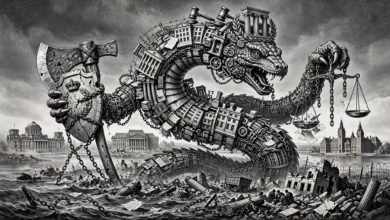

Constitution of deliberative democracy
The Inherent Tension Between Constitutionalism and Democracy


On the surface, the marriage between constitutionalism and democracy appears to be an ideal alliance championed by contemporary political systems. At its core, however, it conceals deep tensions that are revealed at the first real test of power. In his seminal book, “The Constitution of Deliberative Democracy,” legal and political thinker Carlos Santiago Nino dives into the depths of this tension. He provides a precise anatomy of the dilemma facing the structure of modern states: how can we reconcile the establishment of a limited government that respects individual rights and adheres to a historical document (constitutionalism), with guaranteeing the right of the majority to make decisions and actively participate (democracy)?
The book is distinguished by a rigorous analytical style that avoids superficiality and dry, descriptive approaches. Nino starts from the fundamental idea that democracy is not merely a set of procedural mechanisms or ballot boxes, but rather a normative and moral concept par excellence. The author does not settle for celebrating the spread of liberal democracies around the world; instead, he places the underlying contradictions at their core under the microscope. On the one hand, democracy seeks to unleash the popular will and majority rule; on the other hand, constitutionalism imposes strict limits on this very will, aiming to protect individual rights and avoid what is described as the “tyranny of the majority.”
The author’s brilliance is embodied in his ability to deconstruct this dual dialectic faced by any researcher examining the structure of international and political systems. He criticizes “hyper-realistic” trends that merely look at the stability of the system in isolation from its moral and objective legitimacy. Instead of surrendering to this contradiction, Nino presents an innovative vision to overcome the impasse, laying the foundation for the model of “Deliberative Democracy.”
The Epistemic Value of Democracy
The author argues that the true value of democracy lies not only in aggregating individuals’ self-interested preferences, as utilitarian theories suggest, nor in mere elite competition, as pluralist theories promote. Rather, it lies in its epistemic value. Through societal dialogue and open public debate based on rational justifications, selfish preferences are refined and transformed into more mature decisions. These decisions take the public good into account and respect the neutrality of social morality, thereby making democracy the most reliable tool for discovering just solutions for society.
Deconstructing the Historical Constitution
Carlos Santiago Nino continues his in-depth deconstruction of the structure of constitutional democracies by addressing a thorny issue represented by the historical constitution—that textual document drafted in a past foundational moment, which is interpreted and preserved throughout a nation’s history. In this context, the author posits two paradoxes that, at first glance, seem capable of undermining the power of this constitution:
-
The paradox of radical uncertainty.
-
The paradox of moral dispensability (or the idea that the constitution is a redundancy unneeded in logical and legal reasoning).
On the one hand, the constitutional text, like any natural language, suffers from semantic, syntactic, and logical gaps that render it incapable of providing conclusive answers on its own. This inevitably forces judges and legislators to resort to external normative and moral considerations to interpret it and overcome its contradictions. On the other hand, the paradox of dispensability emerges when we realize that the constitution’s legitimacy depends primarily on the extent to which it respects pre-existing moral principles, such as the fundamental rights of the individual. If the constitution truly adopts these principles, it seems like a mere repetition that adds nothing new to those self-standing moral justifications; if it contradicts them, it loses its legitimacy and its very raison d’être.
To escape this delicate theoretical predicament, Nino refuses to abandon or belittle the historical constitution. Instead, he redefines it in an innovative manner that transcends the traditional view of it as merely a written document. He considers it a social practice and an established custom that solves dilemmas of collective action and complex coordination problems in society.
To clarify this pivotal idea, the author employs a profound metaphor, comparing the construction of the constitutional legal system to the building of a massive cathedral, constructed collaboratively by successive generations over time. An architect tasked with completing the building at a certain stage might prefer the Gothic style for its aesthetics, but finds themselves faced with foundations already built in the old Romanesque style. In this case, rationality—or what Nino calls the rationality of the second-best option—dictates that the architect must adapt to what has already been built to avoid demolishing the cathedral entirely or causing its structure to collapse, recognizing that their work is merely a contribution to an extended collective project over which they lack absolute control regarding its final outcomes or foundational beginnings.
In this very same vein, the book argues that constitution-makers, legislators, and judges must view the historical constitution as a collective endeavor that requires preservation and continuous development within an interconnected historical context. Compliance with the historical constitution and the practices emanating from it becomes necessary, not because it represents absolute moral perfection, but because maintaining constitutional practice constitutes the best realistic alternative compared to the options of chaos or authoritarian governments that might arise upon the collapse of the legal framework regulating society. This enlightened, conscious compliance is what grants democratic decisions their efficacy and stability, while simultaneously allowing flexible space to interpret constitutional practice and gradually guide it to approach, step by step, the model of the ideal constitution based on rights and democracy.
The Ideal Constitution and Liberal Pillars
In this chapter of his intellectual journey, Nino transitions from the “historical constitution” as an existing social and legal practice, to the realm of the “ideal constitution” as a moral and normative horizon that political systems should aspire to. Here, his most profound philosophical contribution emerges, as he reformulates the relationship between individual rights and democratic will, rejecting the traditional view that sees rights merely as external “brakes” placed in the path of the majority. Instead, Nino argues that fundamental rights are, in fact, “conditions of validity” for the democratic process itself. Without guaranteeing freedom of expression, equality, bodily integrity, and access to information, deliberative practice loses its epistemic value and its capacity to reach just decisions.
Nino’s defense of this ideal constitution rests on three solid liberal pillars:
-
Personal Autonomy: The principle of autonomy necessitates that the state must remain neutral toward different visions of the good life, leaving individuals the right and freedom to choose and modify their own life plans and values without guardianship or coercion.
-
The Inviolability of the Person: This acts as an impenetrable dam against utilitarian approaches that might permit sacrificing an individual’s rights or well-being for the sake of achieving a “greater good” for the collective; Nino insists that individuals are ends in themselves and not merely means to achieve social or political goals.
-
Human Dignity: This principle serves to connect autonomy and responsibility, emphasizing the necessity of treating human beings as rational creatures capable of evaluating justifications and participating in public dialogue.
What distinguishes Nino’s vision here is his bold attempt to bridge the gap between “liberalism” and “democracy.” He believes that the ideal constitution of rights is not a restriction externally imposed on popular sovereignty, but rather the “grammar” or linguistic rules that make the “language of democracy” possible and sensible. Without this rights-based framework, democracy devolves from a deliberative process aimed at discovering truth and justice into a mere raw clash of wills or a statistical process of aggregating narrow interests. Through this connection, the book presents a powerful moral pleading, asserting that respecting rights is not just a legal luxury, but the sole guarantee for majority decisions to be morally binding upon the minority and society as a whole.
Constitutional Engineering
To crown this towering theoretical edifice, Carlos Santiago Nino moves in the concluding chapters of his book to the practice of “constitutional engineering,” transforming abstract concepts into practical proposals for reforming political institutions. Nino views institutional design not merely as a technical issue related to administrative efficiency, but as a material embodiment of the extent of the state’s belief in the value of deliberation and dialogue. In this context, the author directs a scathing critique at the presidential system, especially in its Latin American context, considering it a system that inherently tends toward concentrating power and marginalizing legislative institutions. This hinders the flow of public debate and turns democracy into a personal mandate for the president rather than a continuous consultative process.
Instead, the book proposes a vision that leans toward parliamentary or semi-parliamentary systems, where the political system is compelled to build broad coalitions and publicly justify policies beneath the dome of parliament. In a parliamentary system, the government’s legitimacy does not depend on a single, fleeting electoral moment, but on its continuous ability to convince the people’s representatives of the viability of its programs, which perfectly aligns with the core of the “deliberative democracy” sought by the author. The goal here is to create an institutional environment that prevents severe polarization and pushes political actors toward seeking “common ground” through rational dialogue.
As for the judicial branch, Nino offers a balanced and cautious approach to the role of constitutional courts. He rejects the idea of judges becoming “sages” who impose their own moral values on society, yet simultaneously grants them the role of “guardians of the deliberative process.” By virtue of this role, the judiciary has the right to intervene and strike down laws not merely because they contradict the judge’s opinion, but when it is proven that the legislative process has marginalized a specific group, restricted freedom of expression, or violated the conditions of fair dialogue that make the law a true expression of the general will.
Conclusion
Carlos Santiago Nino concludes his thesis by emphasizing that constitutional democracy is a permanent project under construction, not a finalized, complete state. It is a call to trust in the capacity of the collective mind to refine power through the word and moral justification. With the publication of this work, Nino did not leave behind just a book on international law or political theory; rather, he left a roadmap for anyone seeking to understand how constitutions can protect freedom without suffocating the spirit of democracy, and how societies can engage in dialogue to build a future where the voice of the majority does not drown out the groans of rights, and where rights do not turn into walls isolating the elite from the aspirations of the people.