
Capitalism: A Global History… A Thousand-Year Journey Through the Corridors of the “Super-Being”


It seems impossible to look at planet Earth today without noticing the mighty historical force of capitalism that has shaped its world. From this comprehensive perspective, the prominent historian Sven Beckert—author of “Empire of Cotton”—presents his latest and most ambitious work: “Capitalism: A Global History,” published by Penguin Press in New York in 2025. This work, described by the renowned economist Thomas Piketty as a “massive book and an indispensable read,” does not merely recount fragmented histories. Instead, it takes the reader on a meticulous journey spanning a thousand years, tracing the early roots and complex trajectories of this system that has engulfed the planet.
The Illusion of “Nature” and the Dominance of the Hyperobject
In the contemporary world, capitalism surrounds humanity much like water surrounds fish; it is a given, appearing so ordinary and familiar that it might not be noticed at all. Nevertheless, Beckert insists that what seems natural is, in reality, entirely recent and a purely human construct.
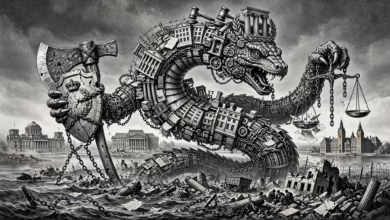
Beckert points out that capitalism operates as a “Hyperobject,” a term referring to entities with vast temporal and spatial dimensions that transcend traditional ideas about the nature of things. This hyperobject determines the way work is conducted, allows a massive number of people to engage in unprecedented levels of consumption, influences politics, and even shapes the surrounding geography.
To illustrate these astonishing global entanglements created by capitalism, Beckert provides simple daily examples: the shirt worn might have been sewn in Cambodia; the steaming cup of coffee in front of the consumer had its beans grown in Brazil; the television screen just turned off was assembled in South Korea; and the iPhone resting nearby was designed in California and assembled by women working in massive sweatshops in Shenzhen, southern China. Although trade is as old as human history, what is new here is the density of global connections forged by capitalism to produce an integrated global economy.
The Shock of the Beginnings: From a Moral Crime to a Market Law
To truly understand capitalism, the book demands stripping it of its natural characteristic and viewing it as something strange and unfamiliar. Beckert takes the reader to the autumn of 1639, before the General Court in Massachusetts, where the immigrant Robert Keayne, an English merchant, stood accused of a “very evil” and corrupt practice.
What was his crime? He was accused of raising the prices of his goods and placing profit above the needs of the community. Keayne confessed before the church to embracing “false principles,” which included the belief that a man might sell as dear as he can and buy as cheap as he can; that if a man loses on some of his commodities through accidents at sea, he may raise the price of the rest; and that a man has the right to take advantage of his own skill and ability, just as he takes advantage of another’s ignorance or necessity.
These principles, which the seventeenth-century society condemned and considered wrongful, greedy acts warranting punishment (he was fined 200 pounds, equivalent to 2,857 days’ wages for a skilled English worker), are the exact same logical and axiomatic rules that dominate the entirety of economic life today. It took two centuries for this new form of economic life to acquire a name: Capitalism.
Breaking the Eurocentric Perspective
One of the most prominent contributions of this book is the explicit and systematic rebellion against the Eurocentrism that has long dominated the writing of capitalism’s history. Beckert vehemently rejects the narrative that considers the rest of the world a mere failure and highlights European achievements as the result of exceptional cultural or religious characteristics.
The book emphasizes a fundamental truth: capitalism was not born in a single location, but rather within the connections between different places. Capital was never at any time entirely confined to a local region or enclosed by states; instead, the primary engine of capitalism was its ability to link distant places and draw unprecedented power from this diversity connected across continents and oceans.
“Unlike earlier forms of organizing economic life, which were local or perhaps regional, capitalism was born global—it has always been a global economy.”
To prove this, the book travels to what it calls “Islands of Capital” around the world, transcending familiar boundaries to focus on the early actors in the system: the merchants.
The Port of Aden: Millennium Merchants and the Genesis of Capital
In his journey to prove the universality of capitalism, Beckert sheds light on the Yemeni port of Aden in 1150. Nine hundred years ago, Aden—which is today a war-torn Yemeni city of about half a million inhabitants—was one of the greatest commercial centers in the world. It was the heart of a trade network that spanned three continents.
In that early period, merchants in Aden sent their ships to distant ports across dangerous oceans, bringing the wealth of Asia, Africa, the Arab region, and Europe to their warehouses. They then redistributed it to the farthest corners of the known world, buying cheap and selling dear. They did not stop there; they provided shipping services, exchanged currencies, offered credit, and sometimes even financed and organized the production of agricultural and manufactured goods.
Beckert cites the description of the traveler Ibn Battuta, who visited Aden in early 1330, noting the arrival of great ships from all over South Asia. Ibn Battuta pointed out the immense wealth of its residents, stating that a single man might own a massive ship with all its contents without anyone sharing it with him, due to the enormous volume of capital available to him.
Here, in these vibrant ports centuries before the Industrial Revolution, emerged the early capitalists who did not always travel with their goods but managed their trade from afar as sedentary merchants. They relied exclusively on investing capital to acquire more capital, embodying the continuous expansionist logic that would later become the defining feature of the modern world.
The Engine of the Holy Trinity: Capital, Credit, and Contract
Beckert argues that capitalism is not merely the exchange of goods, but a complex social system based on three main pillars he terms the Triple C: Capital, Credit, and Contract.
Capital is the wealth that is not hoarded for adornment, but permanently invested to produce more wealth. Beckert explains that capitalism is characterized by an infinite desire for expansion; the investor does not stop at sufficiency, but always seeks to transform profit into new capital that enters another production cycle.
Credit is described by the book as the fuel of the engine. Credit is the ability to dispose of future wealth that has not yet been realized; without it, trade would have remained hostage to direct physical liquidity, limiting its growth speed. Beckert highlights how credit instruments evolved from simple bills of exchange in Italy and the Islamic world to complex global banking systems.
The Contract represents the legal framework that ensures the flow of capital and credit. In capitalism, verbal promises and family obligations become insufficient; instead, there is a prominent need for strict laws that protect private property and ensure the execution of agreements across vast distances and for extended periods.
The Silent Revolution in the Countryside: Land as a Commodity
In Beckert’s narrative, cities and ports were not the sole arenas for the emergence of capitalism; rather, the countryside was the most decisive arena. Beckert rejects the common idea that capitalism was born only in factories; he argues that the transformation of land into a commodity to be bought and sold was the real earthquake.
In traditional societies, land was tied to identity, tribe, or sacred ownership, and was not easily for sale. However, with the penetration of capitalist logic, peasants were dispossessed, and lands were transformed into vast plantations to produce raw materials for the global market, such as sugar and cotton. This transformation did not merely create a surplus of agricultural products; it created an army of workers who had lost their lands and had nothing left to sell but their labor power.
The State: The Invisible Hand is Not Enough
Beckert corrects a major illusion in classical liberal thought, which posits that capitalism thrives in the absence of the state. On the contrary, the book asserts that capitalism would not have existed or persisted without the violent and organized intervention of the state.
States played pivotal roles that included imposing a legal system that protects property rights and legitimizes contracts; providing infrastructure, from roads and ports to railways, that facilitates the movement of goods; utilizing military force for colonization and protection to open new markets in Africa, Asia, and the Americas while securing access to raw materials at cheap prices; and creating a unified currency, thereby facilitating trade exchange and reducing exchange risks.
Beckert states clearly: “The state was not the enemy of capitalism, but its primary partner, and its fortress protecting capital accumulation from popular revolts or external competitors.”
The Rise of “Islands of Capital”: From Baghdad to Florence
The book returns to trace the spread of Islands of Capital around the world. Beckert notes that the Islamic world during the Abbasid era, and China during the Song dynasty, witnessed early and impressive capitalist experiments. Baghdad, Cairo, and Hangzhou were financial centers utilizing checks and credit centuries before Europe.
However, Beckert poses the fundamental question: why did the center of gravity later shift to Europe? He argues that the Great Divergence did not occur due to European cultural superiority, but because of the ability of emerging European states to integrate military power with trade—what he sometimes calls “war capitalism.” While Asian empires focused on internal stability and protecting their land borders, European nations like the Netherlands and England were building armed merchant fleets that imposed their logic upon the oceans.
Forced Labor: The Dark Side of Innovation
One of the most painful and detailed chapters of the book is the one discussing capitalism’s relationship with slavery and forced labor. Beckert demolishes the claim that capitalism is necessarily a system of free labor.
The book explains that the growth of global capitalism in its early centuries relied absolutely on the blood of millions of enslaved people on the sugar plantations in the Caribbean and cotton fields in America. Enslaved people were not merely remnants of an old system, but rather an integral, organic part of the modern capitalist chain. Their unpaid, grueling labor is what provided the liquidity and raw materials that financed the Industrial Revolution in Liverpool and Manchester.
The freedom advocated by capitalist philosophers in Europe walked hand in hand with the most extreme forms of enslavement in the colonies.
The Earthquake of the Factory: When the Machine Married Capital
Beckert points out that the end of the eighteenth century witnessed a radical transformation; the capitalist was no longer merely a merchant buying and selling goods produced by others, but became a producer owning the means of production itself. The Industrial Revolution, in Beckert’s view, was not just the invention of the steam engine or the spinning jenny, but a comprehensive reorganization of humanity and time.
This era introduced strict industrial discipline, where for the first time in history, work was separated from the home, and humans were forced to follow the rhythm of the clock and the machine rather than the rhythm of nature and the seasons. It inherently required the creation of the working class, transforming millions of peasants displaced from their lands into a proletariat in smoky industrial cities like Manchester and Birmingham, where their survival became entirely dependent on the wage received from the capitalist. Furthermore, it ushered in the intensification of production, as factories allowed the production of massive quantities of goods—especially cotton textiles—at a very low cost, which led to the flooding of global markets and the destruction of traditional handicraft industries in India, Egypt, and China.
The Nineteenth Century: The Golden Age and the First Globalization
Beckert describes the nineteenth century as the century in which the world swallowed capitalism, and capitalism swallowed the world. During this period, three technological innovations converged to redraw the geography of the planet. These included railways, which linked the depths of continents to ports, transforming remote areas into sources of raw materials; steamships, which shrank the oceans and made the movement of goods faster and cheaper than ever before; and the telegraph, which allowed the instantaneous transmission of information, prices, and financial orders across continents, creating for the first time a true unified global market.
During this era, giant transnational corporations emerged, and banks in London, Paris, and Berlin began financing massive projects at the ends of the earth, from diamond mines in Africa to wheat fields in Argentina.
The Explosion of Consumption: The Citizen as Consumer
Beckert discusses how capitalism succeeded in transforming human desires into an engine for growth. Goods were no longer produced solely to satisfy basic needs, but were produced to create new wants.
By the late nineteenth and early twentieth centuries, department stores and commercial advertising emerged, promoting a lifestyle based on continuous consumption. The individual came to be defined by what they own and consume, not just by what they produce. This transformation was necessary for the survival of the system; without widespread consumption, the system would drown in crises of overproduction.
The Era of Crises and Major Wars
Beckert does not overlook the heavy price of this expansion. The book explains that the frenzied competition between capitalist powers over markets, raw materials, and colonies was the primary driver for the outbreak of World War I.
Beckert also pauses at length on the Great Depression of 1929, describing it as the moment the system almost collapsed entirely. This crisis exposed the fragility of capitalism when financial markets are left unregulated, and led to the emergence of the welfare state and Keynesian policies, where governments intervened to save capitalism from itself by providing social insurance and protecting workers.
The Cold War and the Emergence of “Late Capitalism”
In the aftermath of World War II, capitalism entered an existential struggle with socialism. Beckert argues that this competition forced Western capitalism to make historical concessions to the middle classes and workers to ensure their loyalty. This period, from 1945 to 1970, witnessed stunning economic growth in the West, but it also saw the beginning of the shift of industrial weight towards East Asian countries.
Towards the end of the twentieth century, specifically since the 1980s, Beckert explains the rise of Neoliberalism. This represents a return to savage capitalism that rejects state intervention, sanctifies privatization, and allows financial capital to move with absolute freedom across borders, which led to the widening of the inequality gap to unprecedented levels not seen since the nineteenth century.
Digital Capitalism: From the Factory to the Platform
Beckert points out that capitalism in the twenty-first century has taken a new, more pervasive form. If the nineteenth century was the age of cotton and iron, and the twentieth century was the age of oil and automobiles, then our era is the age of data and digital platforms.
This era is characterized by hyper-complex supply chains; the book highlights the iPhone as a stark symbol of contemporary capitalism, as it is designed in California, its parts are assembled by thousands of women in massive factories in the Chinese city of Shenzhen, its minerals are extracted from mines in Africa, while its profits are funneled through complex tax havens. The era is also marked by fading boundaries; thanks to technology, financial capital is now able to escape state oversight in fractions of a second, leaving nations in a frantic race to attract investors by slashing taxes and weakening labor protection laws.
The Inequality Gap: A Return to the Era of “Robert Keayne”
Beckert loops back to connect the past and the present through the issue of inequality. He argues that capitalism today has returned to producing levels of extreme wealth and crushing poverty the world has not witnessed since the peak of the nineteenth century.
Beckert emphasizes that this massive concentration of wealth in the hands of a few not only threatens economic stability but also undermines the very foundations of democracy. Capital transforms into a political force capable of drafting laws to its advantage, exactly as early merchants did, but on a global scale from which no state can escape.
The Inevitable Clash: Capitalism and Planet Earth
The climate crisis is considered the greatest challenge facing the hyperobject in Beckert’s narrative. The book explains that capitalism’s logic based on infinite growth collides today with the wall of planet Earth’s limited resources.
This clash involves a changing geography, as the capitalism that shaped the world’s geography through ports and railways is today changing the geography of the climate through carbon emissions resulting from intensive consumption. It also exposes the illusion of technology, with Beckert warning against relying on the belief that technology alone will solve the climate crisis without altering the core of the capitalist system. The problem is structural; the system requires continuous consumption to avoid collapse, and this very consumption is what is depleting the planet.
The End of Western Centrality?
Beckert pauses at the major geopolitical shift: the rise of China and East Asia. Beckert observes that the Great Divergence that allowed the West to dominate the world for two centuries is beginning to shrink. However, this does not mean the end of capitalism, but rather the shifting of its center of gravity. The Chinese model, at its core, is an advanced form of state capitalism that integrates free markets with centralized political control—a model that proves capitalism’s resilience and its ability to adapt to different cultures and political systems.
Conclusion: Capitalism is Not an Inevitable Fate
In its final pages, Beckert offers a message of cautious hope. He reminds us that capitalism, with all its might, is a human construct and not a natural law like gravity. There were other forms of organizing economic life before it, and it is possible to imagine fairer and more sustainable forms after it.
Beckert concludes that understanding the global history of capitalism is the first step toward regaining control over the future. If capitalism was shaped over centuries of political decisions, wars, innovations, and labor struggles, then shaping post-capitalism will require a global political will that places human dignity and the safety of the planet above the sanctity of profit.