
The return of “The Prince” in a time of mediocrity
A detailed reading of Peter Sloterdijk's book "The Prince and His Heirs"


In the spring of 2026, the prominent German philosopher and intellectual provocateur, Peter Sloterdijk, threw a new stone into the stagnant pond of contemporary political thought, publishing his simultaneously controversial and profound book: “The Prince and His Heirs: On Great Men in the Age of Ordinary People” (Der Fürst und seine Erben: Über große Männer im Zeitalter der gewöhnlichen Leute). Released by the prestigious Suhrkamp publishing house, and spanning 180 dense pages, Sloterdijk returns to his favorite pastime: dismantling axioms, provoking the collective mind, and dissecting the infrastructures of power. This time, however, he approaches it through a highly sensitive historical and philosophical gateway—the gateway of “leadership” and “chieftaincy” in a world that seems to have lost its moral and political compass.
The Simulation Syndrome and the Question of the Model
Peter Sloterdijk opens his book with a question that seems simple on the surface but carries within it a cognitive earthquake: “Alexander the Great imitated Achilles, and Julius Caesar imitated Alexander… But whom do today’s strongmen take as their model?”
This opening question is not merely a rhetorical play; it is the cornerstone upon which the entire thesis is built. In ancient times, authority and power were closely linked to the “myth” and the “ideal.” The leader sought to be an extension of a lineage of greats, imitating their virtues (even if they were martial or cruel virtues), and aspiring to immortalize his name in the pantheon of gods or the pages of immortal epics. “Greatness” was a standard that went beyond the mere acquisition of power, extending to how it was exercised and embodied in the popular and historical imagination.
However, when we look at the global political scene in the third decade of the twenty-first century—dominated by figures described as “strongmen” or neo-autocrats in capitals stretching from Moscow and Beijing to other parts of the world, whose shadows even seep into the heart of deeply rooted Western democracies—we find ourselves facing a stark paradox. Today’s strongmen do not seek Olympian glory, nor do they read the Iliad before bed. They are, as Sloterdijk brilliantly describes them, the product of the “age of ordinary people”; an age where the classical standards of greatness have disappeared, replaced by other mechanisms that rely on polarization, populism, and the art of manipulating the masses through screens and social media.
Embodiment of Power: Have We Truly Moved Beyond the Idea of the “King”?
Among the central issues boldly raised by the book is the revival of the question concerning the “embodiment of power.” Political modernity, since the French Revolution and the Enlightenment, has been built on a fundamental promise: the depersonalization of power. The modern state, constitutional democracy, institutions, and bureaucracy (in the Weberian sense) are all mechanisms designed to transcend the idea of the “king” or the “prince” in whom the state is reduced (as in Louis XIV’s famous saying: “I am the state”).
The prevailing belief was that the modern world had definitively moved past the solution of the “monarchical system” of embodying power in individuals, and that institutional rationality had irrevocably triumphed. But Sloterdijk, with his sharp analytical scalpel, dissects this illusion. He sees in the new pattern of “princes” (populist politicians and new charismatic leaders) a glaring declaration of the failure of liberal democracies to satisfy the psychological and anthropological need of the masses to see power “embodied” in a tangible human face.
People, according to Sloterdijk’s profound reading of political anthropology, cannot always pledge allegiance to mere cold “institutions” or abstract “constitutions” devoid of life. In times of crisis, major transformations, and fear of the unknown, the masses regress to their primal desire to search for the “hero,” the savior, or the “prince” who bears the burden of decision-making, even if that decision is disastrous. This regression is not merely an accidental flaw in the democratic system; rather, it is—as the book suggests—a structural loophole in the human mindset, brilliantly exploited by the new heirs of Machiavelli in our current era.
Between the “Great” and the “Absurd”: Dissecting the Age of Mediocrity
In a chapter tellingly titled “Das Große und das Absurde” (The Great and the Absurd), the German philosopher delves into the stark contradiction experienced by humanity today. We live in an era that possesses technology capable of exploring Mars, editing genes, and connecting continents in the blink of an eye; meaning we possess all the tools of material “greatness.” Yet, conversely, we surrender our leadership and destinies to political figures characterized by mediocrity, superficiality, and absolute absurdity.
How, then, can we reconcile the “greatness” of immense technical and scientific capabilities with the “absurdity” of the political scene and the degradation of public discourse? Sloterdijk here does not merely lament and weep over the ruins of the past, but analyzes this phenomenon as the inevitable and historical consequence of the “age of ordinary people.” Mass democracy, in its contemporary consumerist and media-driven version, no longer produces leaders who elevate themselves with their morals and culture to uplift the masses. Instead, it has come to produce leaders who compete in descending to the lowest common denominators of human instincts to secure the votes of the angry and frustrated.
Today’s new “prince” does not need to be an intellectual, wise, or even brave in the classical sense of chivalry. All he needs is an extraordinary ability to capture the fears of “ordinary people” and rebroadcast them, magnified and amplified, through media megaphones. He practices what Sloterdijk calls “Telemalignität” (tele-malignancy or malice at a distance), where screens transform into weapons of mass destruction against political rationality. The contemporary prince is an expert in anger management and an architect of vulgarity, fully aware that the masses are no longer looking for objective “truth,” but for “political entertainment,” schadenfreude, and revenge against the elites they believe despise them.
The Enduring Machiavellian Legacy: The Ability Not to Be Good
Sloterdijk’s comprehensive thesis cannot be understood without returning to the philosophical and historical roots of power. Therefore, the author dedicates a broad and central space to rereading Niccolò Machiavelli and his foundational book The Prince. Under the title “Vorüberlegung: Machiavellis Buch vom Fürsten – noch einmal aufgeblättert” (Preliminary Consideration: Machiavelli’s Book of the Prince – Paged Through Once Again), Sloterdijk dusts off classical concepts to forcefully redeploy them in reading the current reality.
The terrifying, foundational Machiavellian principle of modern politics: “Potere essere non buono” (The ability not to be good), or the art of “not being virtuous,” is dissected here with extreme precision. Sloterdijk argues that in Machiavelli’s time, this principle served as a “cruel necessity” to preserve the state and its survival (the supreme interest of the state) amidst the chaos of a torn Italy surrounded by enemies. However, the pressing question is: what does this principle look like today in the “age of rocket artillery,” nuclear weapons, and cyber warfare?
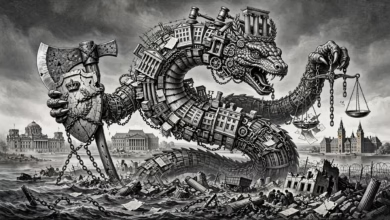
When the “ability to commit evil” or the “systematic abandonment of morality” lies in the hands of an Italian Renaissance prince, the damage, no matter how severe, remains geographically and technically limited by the reach of his sword and his horse. But when this ability—and this heavy Machiavellian legacy—passes into the hands of “heirs” who possess the buttons for human annihilation, and who control artificial intelligence algorithms that steer public opinion and manipulate elections, the equation changes radically and terrifyingly.
Here manifests what Sloterdijk describes as “the fall into the state” as a true anthropological catastrophe for the political animal. We are no longer facing mere tactical political manipulation; we are facing a comprehensive existential threat, because the new “prince” practices his tactics in an infinitely dimensional cyber and military space, where a small mistake could mean the end of civilization.
Savage Verticality: When Hierarchy Awakens from Its Slumber
In the second part of his book, Peter Sloterdijk moves to a highly sensitive area in the Western democratic conscience, namely the idea of “Verticality.” Political modernity, as he explains, was founded on the promise of absolute “horizontality”; that is, complete equality, the dismantling of ranks, and the transformation of society into a single, level playing field of rights and duties. But Sloterdijk argues that this horizontal project collided with a solid anthropological fact: that humans, as social animals, instinctively tend to look for an “above” and a “below.”
Under the title “Sacred Hierarchy and Neo-Autocracy,” the author analyzes how contemporary societies, despite their democratic claims, have begun to experience a kind of “horizontal vertigo.” This vertigo results from the absence of moral and political authority that provides direction. Here emerge the “prince’s heirs”—the new strongmen—who do not rebuild verticality through competence or wisdom, but through what Sloterdijk calls “savage verticality.”
This verticality is not based on “divine right” as in the Middle Ages, nor on “rational delegation” as in classical liberalism; rather, it is based on the “charisma of vulgarity.” The new leader proves his superiority not by being “better” than the masses, but by “most embodying the worst in them.” He is the prince who dares to say what “political decorum” prevents them from saying, and who dares to shatter the rules that the ordinary person feels are suffocating them. His elevation stems from his ability to be a “magnifying glass” for the instincts of the grassroots level.
The Psychology of the “Strongman” in the Age of Fragility
In an astonishing analytical chapter, Sloterdijk links the increasing existential anxiety in the twenty-first century (due to climate change, artificial intelligence, and economic instability) with the desire to “throw oneself into the arms of the prince.” The author believes that democracy is a system for “adults,” for those who can bear the burden of individual responsibility and constant doubt. But today’s world, with its immense pressures, drives people toward “Collective Regression.”
The “heirs” Sloterdijk talks about are experts in the art of “pseudo-paternity.” They present themselves as protectors against a mysterious and threatening external world. Here we touch upon Sloterdijk’s profound psychological insight: he believes that the modern prince does not rule by fear alone (as Machiavelli suggested), but rules by “alleviating the burden of reality.” The prince tells his audience: “Do not worry, I will think for you, I will decide for you, and I will determine for you who the enemy is and who the friend is.”
This exchange—relinquishing freedom in return for psychological security and identity clarity—is the grand bargain upon which the “prince’s heirs” rely today. They realize that the “ordinary person” in our era is overloaded with information and distracted by choices; therefore, “authoritarian clarity” becomes a highly attractive and luxurious commodity, regardless of its exorbitant moral price.
Media as the Space for the “Digital Prince”
Sloterdijk is well aware that the “prince” in the sixteenth century needed palaces, horses, and mercenary armies to display his power. As for his “heir” today, his real army is the “algorithms,” and his battlefield is the “digital platforms.”
The book analyzes how politics shifted from the “art of the possible” to the “art of drawing attention.” The contemporary prince is essentially a high-class “influencer.” Sloterdijk describes this transformation as the “dissolution of politics into spectacle.” In this space, logical argument or a detailed electoral program no longer have any value; the only value lies in the ability to “occupy the screen.”
Sloterdijk goes even further, stating that the “digital prince” does not need honesty; rather, he needs “density.” Honesty is a moral issue, while density is a technical one. A dense, resounding lie repeated a thousand times across social media platforms creates a “parallel reality” in which followers find their refuge. Here Machiavelli meets “Silicon Valley”: the ability to camouflage and pretend (Dissimulazione) advised by Machiavelli has reached its technical peak today through deepfakes and targeted digital propaganda.
The State as a Protection Apparatus… or a Hostage?
In the final part of this section of the book, Sloterdijk raises a frightening question about the fate of the “state” itself. If the prince of old was the “head of the state,” the new “heirs” treat the state as a “hostage” or as a “tool for plunder.”
Sloterdijk argues that there is a kind of “internal colonialism” practiced by these leaders over the institutions of their countries. They build a “state within a state” based on personal loyalty, family allegiances, or political “cliques,” returning us to medieval patterns of governance but with a thin modernist veneer.
This Machiavellian “legacy,” when mixed with savage capitalism and modern technical capabilities, produces an unprecedented political monster. It is a system that combines the control efficiency of mega-corporations with the brutality of old autocratic regimes. Sloterdijk warns us: “We are not returning to the past; rather, we are creating a future in which the darkest past is the only available model.”
Between Laughter and Trembling: Sloterdijk’s Language
What distinguishes this book, as is customary for Sloterdijk, is his style that blends biting wit with sober philosophical depth. He does not write with the seriousness of a scowling academic, but with the flexibility of an intellectual who sees the farce at the heart of the tragedy. He sometimes describes the “prince’s heirs” as “bloody clowns,” considering that laughter might be the only remaining means to face the absurdity of the scene, yet it is a laughter mixed with bitterness and trembling for what is to come.
He uses terms like “Anabolische Politik” (Anabolic or Amplified Politics) to describe how new leaders attempt to artificially pump up the muscles of the state to hide structural weakness and a lack of vision. Politics, in their eyes, is not about building the future; it is a continuous “injection” of the masses with doses of adrenaline and hostility toward the other.
The Economy of “Thymos”: When Anger Becomes Fuel for Governance
In this part of the book, Peter Sloterdijk returns to one of his most important philosophical concepts developed in his previous works (such as Rage and Time): the concept of “Thymos.” Thymos, according to the Platonic tradition, is that part of the human soul responsible for dignity, self-esteem, and the search for recognition; it is also the source of “righteous anger” when this dignity is violated.
Sloterdijk argues that the “prince’s heirs” in our current era have realized what cold procedural democracies have failed to grasp: that human beings do not live by bread (the economy) alone, but by dignity and recognition. Under the title “Anger Management: The Prince as a Banker of Thymos,” the philosopher presents a revolutionary idea; the successful politician today does not offer economic programs, but offers “emotional loans.” He opens bank accounts for the anger of frustrated people and promises them to “cash out” this anger in the form of vindictive policies against imagined elites or external enemies.
The modern prince, according to Sloterdijk, is a “manager of grand emotions.” He knows that the modern human, in both the West and the East, feels humiliated by savage globalization that has reduced them to a mere number in a massive equation. Here the “heir” steps in to say: “I see you, I hear your anger, I will restore your prestige.” This shift from the “Welfare State” to the “State of Wounded Dignity” is what grants new autocrats their legitimacy, which seems incomprehensible to traditional liberal analysts.
The End of the “Cold Era”: Farewell to State Neutrality
Political modernity has long heralded the “neutral state”; that state which stands at an equal distance from all values, contenting itself with regulating exchange and protecting property. Sloterdijk describes this era as the “cold era,” where politics was merely the technical administration of interests.
However, the book The Prince and His Heirs frankly announces the end of this era. The world today is entering a state of “boiling,” where people demand a “hot” state, a state that takes sides, a state that possesses a “worldview” (Weltanschauung), even if this view is distorted or based on superstition.
Sloterdijk analyzes how the “heirs” have managed to “heat up” the political scene once again. They have restored politics to its “theological” character; the battle is no longer between different tax programs, but has become between “good and evil,” “us and them,” “patriots and traitors.” This sharp polarization is not a failure in political communication, but an intentional “technique of governance” aimed at eliminating the critical distance the citizen needs to think. When emotions heat up to the boiling point, reason disappears, and the “prince” emerges as the sole leader of a raging herd.
Between “Will” and “Representation”: The Prince as a Film Director
In a chapter bearing Sloterdijk’s aesthetic signature, titled “Political Dramaturgy: Power as a Theatrical Performance,” the book discusses how the exercise of power has turned into a kind of “film directing.” The old prince used to appear on major occasions to dazzle his subjects; the contemporary prince, however, is in a state of constant “live broadcasting.”
Sloterdijk explains how the “heirs” use “augmented reality” techniques in politics. They do not change reality (poverty, pollution, crises); instead, they change our “perception” of reality through a continuous injection of images, stories, and illusory heroics. Power today is the “power of the narrative.” Whoever holds the strongest story, and whoever can make the masses live in a heroic “movie” directed by him, is the one who wins the bet.
This shift turns the concept of “political representation” upside down. In a democracy, the representative represents the interests of their constituents. But in the “new principality,” the leader does not represent the interests of the masses, but represents their “fantasies.” He embodies the hero they wish to be, or the strongman they wish to take shelter in. It is a “theatrical representation” more than a political one.
The Revenge of Geography… and the Challenge of “Returning Empires”
Sloterdijk does not settle for psychological analysis but links his thesis to major geopolitical shifts (and here the book’s importance for students of international relations becomes apparent). Sloterdijk argues that we are witnessing the “revenge of geography” against ideology. The “prince’s heirs” are often leaders seeking to reclaim “lebensraum” (living space) or bygone “imperial glories.”
Under the title “Sovereignty and Soil: The Return of Geopolitical Ghosts,” the book analyzes how the concept of absolute “sovereignty,” which many thought had been eroded by globalization and international organizations, is returning today forcefully and violently. The new prince is the one who dares to draw borders in blood, and who challenges the rules-based “international order,” considering it a mere “conspiracy” to weaken strong states.
This inclination toward “empire” is not just a political ambition; it is an expression of the desire to exit the unified “global time” and return to specific “national times.” Sloterdijk sees the world currently tearing into “sovereign islands” ruled by princes who acknowledge no higher authority above them, foreshadowing an era of major conflicts that may reshape the global map in the coming decades.
Between “Mental Aristocracy” and Demagoguery: The Elite’s Dilemma
At this juncture of the book, Peter Sloterdijk raises an issue that may seem shocking to modern egalitarian consciousness: the necessity of a kind of “mental aristocracy” to protect democracy from collapsing into the trap of demagoguery. Sloterdijk points out that the “prince” of the past used to surround himself with wise men, philosophers, and artists (as the Medici did in Florence), not just for court decoration, but to create a balance between “brute force” and “transcendent wisdom.”
As for the “prince’s heirs” today, they practice what Sloterdijk describes as the “liquidation of the elites.” They declare war on experts, scientists, and critical intellectuals, labeling them the “corrupt elite” or the “deep state.” Under the title “The Treason of the Intellectuals and the Surrender of Reason,” the book analyzes how “proud ignorance” has become a badge of honor in contemporary political struggle. The new prince does not need advisors to review his decisions, but “cheerleaders” to justify his whims.
Herein lies the danger of the situation: a democracy that abandons the standards of “intellectual quality” and “moral excellence” under the pretext of equality throws its doors wide open for the most mediocre and lethal elements to seize power. Sloterdijk calls here for a “rebellion of the nobility” (in the spiritual and intellectual sense), those who refuse to be dragged into the mud of prevailing populist discourse and insist on maintaining “critical distance” as a final act of resistance.
The Impossible “Humanization”: Can the Heirs Be Tamed?
The book poses a fundamental question regarding the possibility of “humanizing” these new leaders. Can democratic institutions “tame” the prince who has come to power by shattering the rules of the game? Sloterdijk believes that betting on “institutional taming” is mostly a losing bet because the “prince’s heirs” do not enter the political system to manage it, but to alter its DNA. They work to transform the “state of law” into a “state of will” (Voluntarism).
In a chapter titled “Willpower and Techno-Megalomania,” the German philosopher links the voluntaristic tendency of the new leaders with immense technical capabilities. In the past, the prince’s will collided with the limits of geography, the slowness of messages, and the weakness of supplies. Today, however, the “digital” prince’s will is executed with the push of a button. This “illusion of omnipotence” that technology grants to rulers makes them more arrogant and less willing to compromise. Politics is no longer the “art of the possible” but has become “imposing the impossible” through force and media coercion.
Europe in the Shadows of Princes: The Anxious Continent
In this part, Sloterdijk moves to specifically scrutinize the European situation, being a thinker long preoccupied with the fate of the Old Continent. He describes Europe as an “island of fragile rationality” amidst an ocean of “savage principality.” Europe, which tried to build a political system based on “transcending sovereignty” and “quiet bureaucratic cooperation,” finds itself today surrounded by “princes” from the East, West, and South, and even from within its own house.
Under the title “The European Dilemma: Between Cold Bureaucracy and Hot Leadership,” Sloterdijk analyzes how the European project failed to create an “emotional appeal” that parallels the appeal of nationalist leaders. Brussels represents the “head” (cold reason), while the “heirs” address the “heart” and the “guts” (Thymos). The author believes that if Europe wishes to survive, it must reinvent the “democratic prince”; a leader who combines institutional wisdom with the ability to inspire the masses with a moral vision that goes beyond mere economic growth figures.
This desired European leader must not be an “heir to Machiavelli” in his cunning, but an “heir to the Enlightenment” in his courage. But Sloterdijk asks bitterly: “Is there still enough fertility in the soil of Europe to grow such great men, or have we entered the long autumn of civilization?”
“Exercises” as a Political Act: Sloterdijk’s Own Way Out
For those who know Sloterdijk’s philosophy, the book would not be complete without returning to his concept of “exercises” or “asceticism” (Askesis) in its philosophical sense. In the face of the “prince” who wants to turn us into mere “consumers of anger” or “props in his theatrical show,” Sloterdijk proposes “politics as self-training.”
True politics, in the author’s view, starts with the individual who refuses to be a “member of a herd.” Sloterdijk calls for a kind of “productive isolation” and “mental independence.” Resistance does not solely begin in public squares; it begins in a person’s ability to “train themselves” not to be dragged behind digital provocations, and to reclaim the capacity for deep reading, meditation, and methodical doubt.
The “prince” fears the human being who possesses an impenetrable “inner center.” Therefore, the best way to confront the “prince’s heirs” is to build “sovereign individuals” who cannot be easily manipulated. Sovereignty here is not the sovereignty of the state, but the sovereignty of reason over the instincts that the new leaders try to exploit.
The Exception as the Rule: Political Theology in a Technical Guise
In the conclusions of his book, Peter Sloterdijk arrives at a philosophical deduction that connects ancient history with the cybernetic future, in what he calls the “new political theology.” If Carl Schmitt had previously argued that all the concepts of the modern state are secularized theological concepts, Sloterdijk argues that the “prince’s heirs” are “re-deifying” power through technology.
The “decision”—which is the essence of power for Machiavelli and Schmitt—has today acquired an absolute character thanks to the tools of mass surveillance and artificial intelligence. The contemporary prince is not just a ruler; he is a “supreme algorithm” seeking to condense the will of the people into a mathematical formula of absolute support. This transformation turns the “state of exception,” which was resorted to in major crises, into a “permanent state” under the rule of these heirs. They live and rule in a continuous crisis, because the crisis is the only environment that justifies the existence of the “prince” and grants him the right to bypass boring “bureaucratic” laws.
Beyond the “Prince”: Exploring the Horizons of the 21st Century
In the concluding section of the book, which comes under a telling title: “Towards a Planetary Politics: Is There a Chance for Cosmic Consciousness?”, Sloterdijk opens a small window of hope. The author sees that the existential challenges facing humanity (such as ecological collapse or the risks of unbridled technology) are challenges that no local or “national” “prince” can solve, regardless of his power or charisma.
Sloterdijk calls for what he terms “climate politics” in its broadest sense; that is, a politics that realizes we all live in one “greenhouse” (an extension of his theory in his famous book Spheres/Foams). The current heirs, by turning inward and building walls, are in a state of “historical denial.” The future, according to Sloterdijk, does not belong to the princes who draw borders, but to those who can think of the “Earth as a whole.”
This shift requires a new kind of “sovereignty”; a sovereignty not based on controlling others, but on “controlling the collective self” of humanity. It is a call to return to the values of “global citizenship,” not as a romantic slogan, but as a technical and vital necessity for survival.