

In 1833, the historian and politician Thomas Macaulay stood up to declare with absolute confidence that the British were a “people blessed with a disproportionate share of political liberty and intellectual light.” This statement seemed logical at a time when Britain had just emerged victorious from its long wars with France and was preparing to build the greatest empire modern history had known. But today, reading historian A.G. Hopkins’ latest book, “The Land Where Nothing Works: How Britain Lost the Plot,” we find ourselves facing a scene characterized by humility and brokenness instead of the claims that try to mask reality. Britain today is ranked, according to the Fragile States Index, in lower tiers, approaching countries like Costa Rica and Mauritius, and clearly lagging behind its Western European neighbors—a decline that has received almost no serious debate in Parliament or the press. This book is not merely a recounting of post-1945 history; it is a deep and resolute anatomy of a state failing its citizens and regressing on all economic, political, and social fronts.
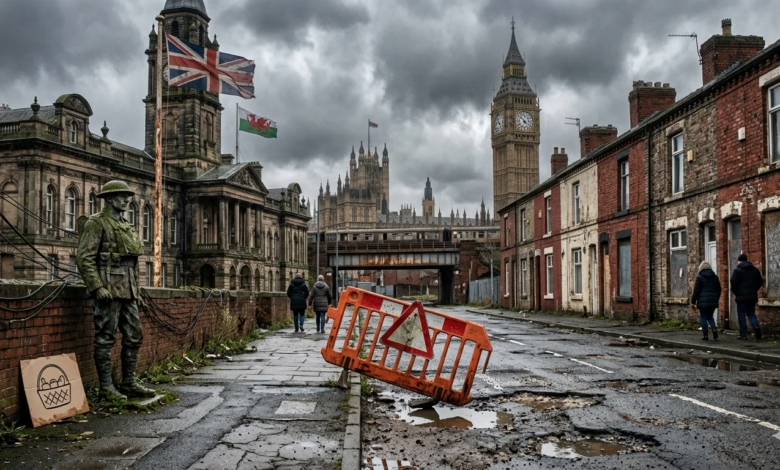
Hopkins begins his book by observing the tangible physical collapse that surrounds Britons everywhere. The greatest evidence of the deterioration accompanying this decline manifests in the near-total collapse of public services. Just driving on the roads is enough to shock any observer; the UK has become the “pothole capital” of Europe, a sole distinction in which no continental country can compete. Once-beautiful cities have become hotbeds of weeds, peeling paint, and broken public benches, in a shameful contrast with well-kept German cities. If a citizen decides to abandon their car and risk taking the train, they will face a system fragmented by privatization, plagued by prolonged labor strikes, an incomprehensible mix of tariffs, and sudden trip cancellations. This is not to mention that only eight of Britain’s major cities have light rail or subway networks, a minuscule percentage compared to countries like Denmark and Germany.
This erosion extends to vital infrastructure such as hospitals and schools. The National Health Service (NHS), once the pride of Britain, is now brought to its knees. Hopkins compares health spending, bed numbers, and doctors in Britain with its European counterparts to find the country lagging severely; the number of hospital beds has halved over the past thirty years despite population growth. As for schools, they have literally become a threat to students’ lives. Official reports have revealed that thousands of children are educated in buildings constructed with substandard, expired concrete containing deadly asbestos. Despite this catastrophic reality, the government still operates with a mentality of addressing momentary crises while ignoring long-term problems.
But how did things reach this point? Hopkins puts his finger on the wound when he describes the cultural and economic shift from the veneration of “public service” to the worship of “private profit.” In the past, public sector jobs were respected and considered an essential contribution to national welfare. However, after the 1980s, the idea that state employees are nothing but a burden took root, and their status and salaries deteriorated. Conversely, privatization created a series of near-total monopolies operating under the supervision of lenient “regulators.” The water sector provides the most prominent example of this failure; since state-owned companies were sold to the private sector in 1989, shareholders and executives have reaped massive fortunes, while old Victorian pipes have been left to leak and discharge sewage into rivers, leaving consumers to bear the burden of accumulated debt.
This systemic corruption culminated in the 2017 Grenfell Tower tragedy, which claimed the lives of 72 people. Hopkins asserts, drawing on the inquiry committee’s report, that the disaster was the result of a ruthless focus on cost, systemic deception by companies supplying substandard materials, and the exploitation of Britain’s weak regulatory system. A culture of cynicism and sarcasm, which knows the price of everything but the value of nothing, has become the dominant doctrine whose power no one challenges. This has been accompanied by an unprecedented decline in the caliber of the political elite. Parliament, once a symbol of democracy, has turned into a place for personal advancement and the exploitation of state resources, and the revolving door phenomenon between government posts and private sector companies has accelerated, leading to a sharp decline in standards of integrity and public trust.
This drift towards unbridled market individualism has produced a fractured society suffering from a massive wealth gap. Hopkins points out that Britain today suffers from the highest income inequality rates in Europe. Half of the wealth in Britain is owned by a tenth of the population, concentrated primarily in the South East, while other regions suffer from poverty and a lack of assets. The gap between London and the rest of the country is staggering; if London were carved out of the map, Britain’s GDP per capita would drop below that of Mississippi, the poorest US state. With economic decline and austerity measures, extreme poverty, reliance on food banks, and homelessness have become “normal” to the extent that the United Nations considered Britain in violation of international human rights law—a claim successive governments have rushed to deny.
To answer the question of decline, Hopkins refuses to confine his analysis to the past few years, taking us on a deep historical journey. In the nineteenth century, Britain faced three simultaneous revolutions: modern economic development, the formation of nation-states, and the spread of democracy. The ruling elite at the time, consisting of the aristocracy and nobility, succeeded in absorbing the new interests of industry and commerce within a hierarchical system based on “deference” and loyalty. This elite drew its worldview from the classics of Greece and Rome, viewing the British Empire as an extension of the Roman Empire, and instilled the values of “duty” and “honor” to justify its privileged position and alleged civilizing mission around the world. This blend of slow adaptation and imperial expansion is what protected Britain from the violent revolutions that swept continental Europe, but at the same time, it entrenched a highly unequal class structure that continues to cast its shadow over the country today.
After the widespread devastation left by World War II, Britain stood, alongside the rest of Europe, at a crucial crossroads determining the shape of its future. In 1945, in a manner that surprised Winston Churchill himself—who had led the country through the war—the Labour Party under Clement Attlee won a landslide victory in the general election. This victory was not merely a routine change of political faces, but an expression of an overwhelming popular desire to turn the page on two grinding world wars and the intervening period of depression and mass unemployment. Britain at that time did not in any way resemble the modern welfare state we are familiar with today; 80 percent of children left school at the age of fourteen, and a very meager percentage, not exceeding 3 percent, enrolled in any form of higher education in the immediate postwar years. In 1947, less than half of British households had indoor bathrooms, and rationing of food, clothing, and necessities remained in effect until the 1950s.
In the midst of this harsh and austere reality, the British social democratic experiment was born, where “big government” came to be viewed not as a burden to be discarded, but as an indispensable solution. The Labour Party adopted an ambitious and bold plan based on economic planning, nationalization, full employment, the provision of comprehensive social welfare, and the establishment of the National Health Service (NHS). The ultimate goal was to eradicate the “Five Giants” identified by the famous Beveridge Report of 1942: Want, Disease, Ignorance, Squalor, and Idleness, which stood as obstacles to reconstruction. The government earnestly sought to establish a new “moral economy” that rewarded citizens and linked rights with duties to serve society as a whole, moving away from absolute individualism and relying on the principle of “fair shares” to foster cooperation between the government, employers, and employees.
A bleak picture of this period, extending from 1945 to 1979, has long been painted in contemporary political discourse as an era of continuous economic decline and mismanagement—a narrative and term (“Declinism”) later adopted by Margaret Thatcher’s supporters in the 1970s to justify their violent abandonment of interventionist policies. But A.G. Hopkins, in his book, strongly refutes this political “myth” with conclusive historical evidence, asserting that this era was actually a true “golden age” for Britain. During that period, economic growth rates, measured by GDP, were higher than they had been in the early twentieth century or what they would later become between 1973 and 1979. Unemployment was reduced to near-negligible levels, inflation remained low, and citizens’ real incomes rose. Most importantly, income and wealth inequality rates dropped significantly between the late 1930s and 1980, regional disparities shrank, and child poverty rates fell. These gains included tangible improvements in the quality of life, ranging from increased life expectancy and vacation rights to the expansion of educational opportunities and the proliferation of travel. It was this growing prosperity that prompted Conservative Prime Minister Harold Macmillan in 1957 to utter his historically immortalized phrase: “Most of our people have never had it so good.”
This success was not exclusive to the Labour Party or born of chance, but was the product of a broad political and social “consensus” that lasted for decades. When the Conservative Party returned to power in 1951, they did not launch a counter-revolution to dismantle the nascent welfare state. The popularity of these reforms protected them from any political attack, and the progressive taxation system that compelled the wealthy to pay their fair share to fund social welfare and defense remained intact. The Conservatives, dominated by the “One Nation Tories” faction, maintained the essence of the postwar settlement, attempting to find a delicate balance between private enterprise and the government intervention necessary to regulate markets and support employment. Macmillan embodied this approach in his book The Middle Way, where he advocated for a mixed economy combining private institutions and government intervention to reorganize and finance industry.
However, this social democracy was not built in a perfect vacuum; rather, it faced massive and persistent international geopolitical and economic challenges. Britain emerged from the war burdened with massive debts to the United States, and simultaneously had to maintain its crumbling imperial influence and finance its costly Cold War commitments. Initially, politicians believed they could revive and develop the Empire to be a lifeline for the British economy, relying on the “Sterling Area” to provide protection for their markets and secure dollar revenues. However, this imperial project soon collided with the rock of reality, represented by the rise of anti-colonial nationalist movements, mounting American pressure, and the decline of expected economic returns from the colonies.
The Suez Crisis of 1956 came to deliver a fatal blow to British prestige, starkly revealing the truth that the Empire was no longer capable of standing toe-to-toe with Washington, which threatened to destroy the value of the sterling if British forces did not withdraw. With the wheel of decolonization accelerating in the late fifties and concluding in the sixties, Britain’s share of global manufactured goods trade shrank significantly, prompting its leaders to shift their compass towards continental Europe in search of new growth opportunities and more dynamic markets. In 1961, Britain submitted an ambitious application to join the European Economic Community, a pivotal step that represented a clear acknowledgment that the old imperial ties had lost their value, although actual accession did not materialize until 1973 after General de Gaulle lifted the French veto.
Parallel to this geopolitical shift, hidden and far more cunning forces were forming behind the scenes within London’s financial district (the City), forces that would later play a pivotal role in undermining the social settlement. After London lost its empire and the pound sterling’s role as a global reserve currency declined, “the City” found its salvation in a new financial innovation in the late 1950s known as “Eurodollars” and Eurobonds. These instruments were a clever means of circumventing the capital controls established by the Bretton Woods agreement, allowing banks to operate with complete freedom outside the umbrella of American and British regulations. This was accompanied by a parallel and equally dangerous development: the exploitation of former colonial territories and transforming them into “Tax Havens,” starting with the Bahamas in 1955, with the aim of evading British taxes and exchange controls. This quiet financial rebellion, which expanded under the watch of lenient governments, opened the door to unprecedented forms of financial globalization that escaped the control of the democratic state and began gradually pulling the rug from under the competitive industrial economy.
As the Empire’s footprint shrank abroad, and the idea of “Great Britain” receded to become merely “Little England” at home, deep fissures began to appear in the structure of national identity. Citizens from Commonwealth countries were flocking to Britain, sparking racial tensions exploited by politicians like Enoch Powell in his famous and inflammatory 1968 “Rivers of Blood” speech, warning that the “new Rome” was under threat from arrivals labeled as “barbarians.” By the end of this era, Britain had transformed from a dominant, confident global power into a state desperately trying to find a new role for itself, torn between an unequal alliance with America and a hesitant, cautious accession to Europe.
Britain entered the 1970s burdened with a sense of malaise and confusion; the social settlement that had endured for decades was beginning to show signs of fatal fatigue. Inflation was rising, growth was slowing, and frequent labor strikes paralyzed essential services. In this charged atmosphere, the compromise solutions offered by previous governments, whether Labour or Conservative, were no longer sufficient to satisfy the streets or calm the markets. In 1976, Britain, the former great power, was forced to seek a bailout loan from the International Monetary Fund—a humiliating moment the press described as a “surrender of national sovereignty.” This crisis was the historic moment awaited by the hard-right wing within the Conservative Party, led by a figure who would change the face of Britain forever: Margaret Thatcher.
“Thatcherism” was not merely an austere economic program, but was, as Hopkins brilliantly explains, a “comprehensive ideological crusade” aimed at uprooting social democracy and replacing it with the “neoliberal” model. For Thatcher, the problem did not merely lie in mismanagement, but in the very philosophy of the “nanny state,” which she saw as killing the spirit of individual initiative and creating an impotent citizen dependent on handouts. Thatcher proceeded from the principle that “Economics are the method; the object is to change the heart and soul,” and sought to reshape British identity to center around the “individual” rather than “society,” captured in her famous and controversial statement: “There is no such thing as society. There are individual men and women and there are families.”
The first pillar of this revolution was “Monetarism,” a policy aimed at curbing inflation by shrinking the money supply and raising interest rates, even if this led to a massive surge in unemployment rates and the bankruptcy of traditional industrial companies. Indeed, the early 1980s witnessed the widespread destruction of the British manufacturing base, especially in the North, Scotland, and Wales, where factories and mines that were once the pillars of imperial power were shuttered. These economic losses were not merely unintended side effects, but were part of a “shock therapy” to break the power of the trade unions, which Thatcher considered the “enemy within.” This confrontation culminated in the historic miners’ strike (1984-1985), which ended in a crushing defeat for the unions, paving the way for a radical restructuring of the labor market, the elimination of employee protections, and the imposition of labor flexibility that later gave rise to the “Gig Economy” and job insecurity.
As for the second pillar, and the most enduring in her legacy, it is “Privatization.” It started with selling off telecommunications, gas, electricity, and water companies, eventually reaching the railways. The goal was not purely financial to replenish the state treasury, but rather overwhelmingly political; Thatcher wanted to create a “shareholder democracy” where ordinary citizens owned shares in these companies, tying their personal interests to the success of capitalism and reducing their loyalty to the state or the union. However, Hopkins argues that the result was not an economic democracy, but a shift from public monopolies subject to parliamentary accountability to private monopolies aiming for quick profit, where long-term investments in infrastructure were neglected in favor of distributing dividends to shareholders and massive bonuses to executives, which explains why “nothing works” today in the transport and water sectors.
At the heart of this transformation, London emerged as a “financial island” separated from the reality of the country. In 1986, Thatcher launched what became known as the “Big Bang,” a massive deregulation of the financial and business district (the City). This measure opened the doors for international banks, particularly American ones, to dominate the financial scene in London, and shifted the British economy from relying on “making things” to relying on “trading assets and debt.” “The City” became the sole engine of growth, and money flooded into real estate in London and the South East, creating an illusory boom that masked a continuous decline in the rest of the Kingdom’s regions. This “subservience to finance” created a fragile economy dependent on global market fluctuations, and eroded the productive base that had ensured a kind of social and spatial equilibrium.
The change was not limited to economics and politics, but extended to redefining “public service” in educational and health institutions. “Market mechanisms” were introduced into hospitals and schools, and patients and students came to be viewed as “clients” or “consumers.” This new managerial culture, reliant on quantitative targets and paper reports rather than actual quality, led to the burnout of professionals and corrupted the spirit of volunteerism and duty that characterized the British bureaucracy. Public spaces were privatized, and British cities became arenas for real estate marketing, where public land was converted into luxury housing projects that the average citizen could not afford, leading to a suffocating housing crisis that continues to batter the country to this moment.
This internal upheaval coincided with Thatcher’s attempt to restore “imperial prestige” abroad, which manifested in the Falklands War in 1982. Thatcher exploited the military victory to fuel fierce British nationalist sentiments, portraying herself as the “Iron Lady” who would restore greatness to Britain. But Hopkins sees this “new patriotism” as a kind of flight forward; Britain, which was selling off its national assets and destroying its industrial base, was trying to compensate for the loss of real power with military parades and invocations of past imperial glories. By the end of her era in 1990, Britain had become a completely different country: wealthier for a lucky few, but more divided, poorer in its public services, and more subservient to the fluctuations of a global financial system that no one had the power to control anymore.
When Tony Blair ascended the winner’s podium in 1997 to the tune of the song “Things Can Only Get Better,” it seemed as though Britain had finally found the magic formula to reconcile with itself and the world. Blair presented what was known as the “Third Way,” an ambitious attempt to blend the market dynamism established by Thatcher with the social justice long championed by the Labour Party. The promise dictated that Britain would no longer have to choose between efficiency and equality; by embracing globalization and financial innovation, immense wealth could be generated and later used to fund a major renaissance in education and health. But, as Hopkins reveals in his anatomy of this era, this “new consensus” carried the seeds of its own destruction, as it continued to deepen the subservience to the financial sector while adding a thin veneer of public spending that did not address the deep structural imbalances in the British economy.
Under the rule of “New Labour,” Britain saw an actual increase in spending on public services, and performance indicators in schools and hospitals improved significantly. However, this prosperity relied on an “implicit deal” with the financial and business district (the City); the government allowed banks and financial companies to conduct their activities with minimal oversight, and in return, the state reaped lucrative taxes from the profits of those institutions to fund its social programs. Hopkins describes this model as having been a “sandcastle” built on the assumption that financial growth would continue forever unimpeded. To make matters worse, there was an expansion in the use of “Private Finance Initiatives” (PFI), where hospitals and schools were built with private sector money in exchange for long-term debts that burdened the state budget for an entire generation, in a disguised privatization whose catastrophic effects only became apparent later.
This sandcastle collapsed with the resounding explosion caused by the global financial crisis in 2008. Britain, due to the bloating of its financial sector and its close ties to American markets, was one of the hardest-hit countries. Suddenly, the state that had prided itself on the “end of boom and bust cycles” turned into a savior of collapsing banks with billions of pounds of taxpayers’ money. Hopkins argues that this moment was the major turning point; instead of the crisis leading to a comprehensive review of the model of financial capitalism, it was exploited by the new Conservative coalition that came to power in 2010 to impose a harsh “austerity” agenda. It was claimed that Britain had “run out of money” and that everyone had to tighten their belts to fix the budget, but the burden was not distributed equally; the poor, the middle class, and public services paid the heaviest price, while the financial sector remained shielded from true accountability.
Austerity was, at its core, an ideological project aimed at completing what Thatcher started: shrinking the size of the state to the maximum extent possible. Local councils were starved of funding, leading to the closure of thousands of libraries and youth centers and halting road maintenance. Social care for the elderly collapsed, and hospital waiting lists grew alarmingly. Hopkins analyzes how this “systematic erosion” led to the creation of a state of suppressed anger in regions that felt “forgotten” and left to their fate while London continued to accumulate wealth. This deep sense of injustice and futility is what prepared the fertile ground for the 2016 earthquake: the decision to leave the European Union (Brexit).
“Brexit” was not merely a dispute over tariffs or legal sovereignty, but was, as Hopkins portrays it, a “cry of protest” against a system that no longer worked for the majority. Proponents of leaving exploited nostalgia for the imperial past and promised a “Global Britain” that would regain control of its borders, laws, and money. However, the reality after the exit proved disappointing; Britain found itself stuck in a gray area, losing the privileges of access to the largest single market in the world without being able to compensate for that with magical trade agreements with distant powers. Brexit increased bureaucracy, deepened labor shortages, and led to a decline in investment, making Britain the only G7 country whose economy struggled immensely to recover its pre-pandemic size.
Hopkins concludes in this part of his analysis that Britain today lives in a state of “losing the plot”; it is no longer the great imperial power, it is no longer the leading partner in Europe, and its neoliberal model has failed to provide sustainable prosperity or decent infrastructure. The country is stuck in a vicious cycle of low productivity, anemic growth, dilapidated public services, and a political elite that seems incapable of presenting a vision beyond hollow nationalist slogans. Britain has not only lost the “plot” in its national story, but it seems to have forgotten how to build a future that does not rely solely on the glories of the past or the speculations of the City.
A.G. Hopkins’ journey dissecting “The Land Where Nothing Works” reaches its final station, a station that does not merely survey the ruins, but attempts to understand the deep causes behind Britain’s inability to fix itself. The fundamental question the book raises in its concluding chapters is not “What broke?” but “Why isn’t it being fixed?”. Hopkins believes that the contemporary British crisis is not just a series of technical failures in running trains or funding hospitals, but a crisis of “political imagination” and an institutional failure that strikes at the roots of the “unwritten constitution” the country has long boasted about. For centuries, Britain relied on the “Good Chaps Theory,” a premise assuming that the ruling elite would adhere to unwritten rules and personal integrity out of class belonging and elite education. But, as the years of Boris Johnson’s and Liz Truss’s rule revealed, this system collapses entirely when an elite that lacks a sense of public responsibility comes to power and exploits constitutional loopholes to achieve narrow factional or ideological gains.
Hopkins puts his finger on a painful paradox; while Britain was chasing the mirage of “Global Britain” post-Brexit, it was ignoring the simple truth that the external power of any state is a direct reflection of its internal cohesion and real economic strength. Trying to play the role of a great power in the Pacific or intervening in major international conflicts seems a kind of “geopolitical fantasy” for a country where children in miserable schools in the North suffer from malnutrition, and its streets overflow with sewage due to dilapidated pipes. Hopkins argues that the British political elite, in its attempt to escape the reality of decline, resorted to invoking the glories of World War II and imperial language, which misled the public instead of confronting them with the harsh facts that require sacrifices and serious institutional work.
One of the most interesting aspects of Hopkins’ concluding analysis is his focus on the “moral erosion” of the public sphere. Turning every public service into a profit center, and turning every citizen into a consumer, has destroyed the concept of “community” that long protected Britain from violent tremors. The British state today resembles a “holding company” managing a portfolio of contracts awarded to private firms, rather than a protector of collective interests. This shift created a massive gap of distrust between the people and institutions; when a citizen sees taxes rising while services collapse and private companies reap record profits, they lose faith in the entire democratic process, which explains the rise of populist movements and hostility toward traditional institutions.
So what is the way out of this dark tunnel? Hopkins does not offer an easy “magic prescription” because he understands that the crisis is structural and not circumstantial. However, he sketches the outlines of a “roadmap” that begins with the necessity of returning to a “productive economy.” Hopkins believes that Britain needs a revolution in public investment, particularly in the fields of green energy, biotechnology, and digital infrastructure, away from its subservience to the financial services sector in London. This requires political courage to reimpose progressive taxation, close the tax havens used by elites to smuggle their wealth, and direct those resources toward revitalizing the neglected industrial regions in the North and the Midlands.
Furthermore, the book emphasizes the necessity of undertaking a “radical constitutional reform.” It is no longer possible to run a state in the twenty-first century based on Victorian traditions and vague concepts about parliamentary sovereignty. Britain needs a written constitution that clearly defines citizens’ rights and the limits of government power, and grants the regions (Scotland, Wales, Northern Ireland, and the English regions) genuine autonomy that ends the suffocating centralization of London. Restoring the “plot” in the British story requires building a new national identity, not based on nostalgia for an empire on which the sun has set, but on the idea of Britain as a modern democratic European state that takes pride in the quality of its services, the fairness of its wealth distribution, and the strength of its productivity.
In the end, A.G. Hopkins leaves us with a cautionary message wrapped in hope; historically, Britain has possessed an astonishing ability to “reinvent itself” in moments of major crisis. But this time, the challenge is different because the enemy is not external, but rather internal inertia and the elite’s failure to acknowledge reality. “The Land Where Nothing Works” can work again, but only if its leaders and its people possess the courage to admit that the old model is completely finished, and that the time has come to write a new chapter in the country’s history—a chapter that abandons illusions of global grandeur in favor of building a state that truly and effectively works for the benefit of all its citizens. Reading Hopkins’ book is, in this sense, a call for national awakening before the decline turns from a temporary condition into an eternal fate.
The Land Where Nothing Works: How Britain Lost the Plot A.G. Hopkins