

Dams of power and policies of renaissance: Ethiopia’s “developmental state” project

Here is the complete English translation of the text provided, formatted for clarity and readability:
The book “Dams, Power, and the Politics of Ethiopia’s Renaissance” by Tom Lavers (co-authored with a group of researchers) represents one of the most important political and economic studies published recently to decipher the code of the contemporary Ethiopian rise. It is a work that does not merely observe the technical aspects of dams but dives deep into the core of the “developmental state” and its geopolitical transformations.
Zenawi’s Prophecy Turned into a Concrete Reality
On April 2, 1996, the late Ethiopian Prime Minister Meles Zenawi made a statement that, at the time, seemed closer to a dreamy ambition than a realistic plan. He said: “Ethiopia is just beginning to walk, but one day it will run… Fifteen or twenty years from now, you might think of doing what Turkey is doing on the Euphrates River [by building unilateral dams]… We are building our economy and fostering growth so that one day we can dispense with international funding for mega-projects.”
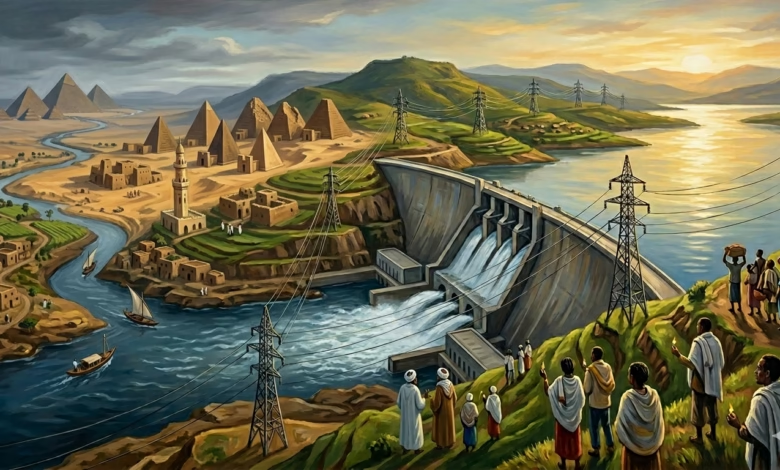
Exactly fifteen years later, on April 2, 2011, Zenawi laid the foundation stone for what would be known as the “Grand Ethiopian Renaissance Dam” (GERD). This dam was not merely a hydroelectric power generation project with a capacity of 5,150 megawatts; it was a physical embodiment of the “running” journey Zenawi promised, and an explicit declaration of the birth of a regional power seeking to break the geopolitical and historical chains that had bound it for centuries.
In his recently published book by Oxford University Press (2024), researcher Tom Lavers, in collaboration with a specialized team of researchers, presents a precise anatomy of the Ethiopian “dam boom.” The book argues that the GERD is not simply a “sudden idea” in response to the circumstances of the Arab Spring in Egypt, as some have suggested. Rather, it is the culmination of a long-term process rooted in ancient imperial ambitions, centered around the “developmental state” strategy adopted by the Tigray People’s Liberation Front (TPLF) and the ruling coalition (EPRDF) since they came to power in 1991.
The Developmental State as a Strategy for Political Survival
Lavers goes beyond simple engineering or economic explanations; he views dam building in Ethiopia as an inherently “political project,” stemming from a deep sense of vulnerability and political fragility. The Ethiopian People’s Revolutionary Democratic Front (EPRDF) governed within a context of instability, representing an ethnic minority leadership that lacked broad popular support outside the Tigray region. Consequently, rapid economic transformation was the only “ticket” to consolidate the regime’s pillars and ensure its survival.
Meles Zenawi formulated a vision that saw economic growth, the provision of agricultural livelihoods, and industrial employment as a means to tie the masses to the existing regime and achieve political stability. In this context, dams were not just power generation facilities; they were the cornerstone of this project. They provide cheap energy for emerging industries, serve as a tool for collective services, and represent a vital source of hard currency through electricity exports to neighboring countries.
The Center-Periphery Challenge: Dams as a State-Building Tool
The book explains how dams in Ethiopia were linked to the “state-building” project and the consolidation of control over territories annexed by the empire at the end of the 19th century. While these projects are justified in the language of “modernization” and “national development,” Lavers points out a stark paradox: the benefits flow to the “center” (cities and industrial zones), while the environmental and social burdens and consequences fall on politically marginalized populations in the “peripheries” or margins.
This tension between broad national ambition and complex local reality is the unifying thread that connects the era of Emperor Haile Selassie, who first dreamed of taming the Blue Nile, to the Marxist “Derg” regime, all the way to the contemporary era. However, what distinguishes the recent era is the “capacity to execute.” While previous regimes failed due to internal divisions, financial weakness, and Ethiopia’s limited strategic importance to major powers, the EPRDF regime managed to exploit shifts in the global political economy to build the “dam boom.”
The Political Economy of the “Green Renaissance”
An interesting point raised by the book is how the Ethiopian regime marketed its dam projects under the banner of the “Green Economy.” By focusing on hydroelectric power, Ethiopia managed to present itself as a leader in global climate negotiations and as a nation seeking to bypass the traditional carbon-intensive path taken by major industrialized countries. This strategic positioning served not only the environment but also acted as a clever diplomatic tool to attract funding and alleviate international pressure, even though the true motive was always national sovereignty and energy independence.
However, this “run” towards development was not without major stumbling blocks. Lavers analyzes how the obsession with speed and the sheer scale of the projects led to “exceeding the technical and financial capacities” of the state. While the political leadership pushed for larger and more complex dams, a growing gap emerged between political ambition and available technical expertise, leading to massive delays, cost overruns, and an accumulation of debt that today threatens the sustainability of the entire Ethiopian developmental model.
The Engineering of Circumvention: How the “Renaissance” was Financed Away from Washington’s Eyes
Financing has always been the “Achilles’ heel” of the Nile Basin countries’ ambitions to build mega-dams. For decades, the World Bank and international financial institutions imposed an unspoken “veto” on funding any water projects on the Blue Nile unless a comprehensive agreement was reached with downstream countries, specifically Egypt. Here, Tom Lavers reveals one of the most brilliant financial and political maneuvers in modern African history: the strategy of “self-financing and Asian alternatives.”
-
1. The Alliance of Necessity: “Salini” and Ethiopia The book explains how Ethiopia found an ideal partner in the Italian company “Salini Impregilo.” The relationship was not just a contracting agreement; it was a “strategic marriage” that allowed Ethiopia to bypass strict international procurement rules. Instead of launching global tenders that take years and require approvals from international donors, Addis Ababa relied on the “direct assignment” of the project to Salini. This model, which Lavers describes as a “preferential partnership model,” provided the Ethiopian regime with two advantages: lightning speed in initiating implementation to impose a “fait accompli” on the ground, and flexibility in dealing with technical difficulties without interference from World Bank “experts” who tend to be politically cautious. Salini was willing to take the risk in exchange for billion-dollar contracts, essentially becoming the “engineering arm” of Ethiopian sovereignty.
-
2. The Chinese Dragon: The Unseen Engine in the “Concrete” The book meticulously corrects a common misconception: China did not directly finance the construction of the “body” of the GERD, fearing a diplomatic clash with Egypt. However, Lavers reveals that China’s role was crucial in the “technical core” of the project. While Ethiopia financed the dam’s civil works (cement and labor) through national donation campaigns and salary deductions from employees (described by the book as “sometimes forced national mobilization”), Chinese banks pumped billions of dollars to finance the turbines, power stations, and giant power transmission lines. This “smart division of financial labor” allowed Ethiopia to tell the world that “the dam is built entirely with Ethiopian money,” while the technology and electrical grid that would make the dam economically valuable relied entirely on Chinese credit. The book views this as evidence of the Ethiopian developmental state’s ability to maneuver between major powers and transform economic dependence into a tool for enhancing national sovereignty.
Chapter Three: From “Initiative” to “Framework Agreement”.. Overturning Geopolitical Traditions
In the middle chapters, Lavers transitions to analyzing Ethiopian “hydro-diplomacy,” and how it shifted from the role of a “historical victim” of colonial agreements to the role of a “dominant player” rewriting the rules.
-
1. The Death of the “Nile Basin Initiative” (NBI) For years, Ethiopia engaged in the “Nile Basin Initiative” launched in 1999, aimed at achieving technical and developmental cooperation among all basin countries. However, the book offers a critical view of this period, arguing that Ethiopia used the initiative as a “smokescreen” to buy time and build its internal capacities while preparing to withdraw from the principle of “consensus” insisted upon by Egypt and Sudan. The watershed moment was the signing of the “Cooperative Framework Agreement” (CFA) in 2010. Here, the book analyzes how Ethiopia successfully led upstream countries (Uganda, Kenya, Rwanda, Tanzania) to form a voting bloc rejecting Egypt’s “historical rights” and replacing them with the principle of “equitable and reasonable utilization.” It was a “legal rebellion” brilliantly orchestrated by Meles Zenawi, transforming the conflict from a bilateral dispute between Cairo and Addis Ababa into a struggle between the “upstream countries group” and “downstream countries.”
-
2. The GERD as an Indisputable “Material Fact” The book asserts that Ethiopia’s strategy relied on the concept of “material hegemony.” While political negotiations stalled in hotels and closed rooms, drilling machines in “Benishangul-Gumuz” were operating around the clock. Lavers argues that the Ethiopian leadership realized early on that the world only recognizes facts on the ground; once the dam’s wall rose to a certain level, the options of “prevention” or “destruction” would become politically and militarily exorbitant, shifting the debate from “Will the dam be built?” to “How will it be filled?”.
Chapter Four: The Military-Industrial Complex (METEC).. The Ambition That Almost Killed the Dam
One of the most fascinating parts of Tom Lavers’ book highlights the “Metals and Engineering Corporation” (METEC), an economic conglomerate run by the Ethiopian military establishment. The book recounts how Meles Zenawi wanted to turn the GERD into a school for “national industrialization,” assigning the military complex the responsibility for the dam’s electromechanical works.
However, the result was disastrous. The book documents cases of massive corruption, mismanagement, and delays that stalled the project for years. This particular point exposes the “dark side” of the developmental state, where ethnic and political interests intersect with national projects, undermining state efficiency. The failure of “METEC” was the spark that later led to major political shifts within the Ethiopian regime, culminating in the rise of Abiy Ahmed, who was forced to “purge” the project of Tigrayan generals to save the dam from administrative collapse.
From “Zenawi’s Legacy” to “Abiy Ahmed’s Symbolism”.. The Dam in the Crosswinds of Political Transformations
The GERD was not merely an engineering project; it was a “political doctrine” formulated by Meles Zenawi to bind Ethiopia’s various nationalities to a centralized project. But, as Tom Lavers explains, Zenawi’s departure in 2012 left the project in a state of “political orphanage” and administrative stagnation. With Abiy Ahmed’s rise to power in 2018, the dam faced an existential challenge: would it remain tied to the legacy of the deeply unpopular “Tigray People’s Liberation Front,” or would it be transformed into a unifying national symbol?
The book brilliantly analyzes how Abiy Ahmed “nationalized” the dam’s symbolism. Instead of viewing it as an achievement of the old party, he reintroduced it as an Ethiopian dream transcending ethnic divisions. His first step was to “purge” the project from the military complex (METEC)—a move that struck a double blow: curtailing the influence of Tigrayan generals and correcting the dam’s technical trajectory, which suffered from serious structural flaws in the turbines. Lavers argues that Abiy Ahmed used the dam as an “adhesive” for national identity at a time when the country was sliding into a grueling civil war, turning the reservoir-filling process into national celebrations aimed at masking internal political fractures.
Chapter Six: The Price of “Renaissance”.. The Other Face of Dams in the Margins
While global media coverage focuses on the conflict between Cairo and Addis Ababa, Lavers directs his lens toward the “silent victims” within Ethiopia. The book devotes significant space to analyzing the social impact on the “Benishangul-Gumuz” region, where the dam is located. Here, the cruelty of the “developmental state” is vividly manifested; thousands of residents from the “Gumuz” and “Berta” tribes were displaced from their historical lands to make way for the dam’s reservoir, which will span an area of 1,875 square kilometers.
The book points out that the state’s “modernization” discourse portrays these populations as obstacles to progress. Their traditional lifestyles, based on simple farming and hunting, are treated as “backward” patterns that must be replaced by “forced resettlement.” Lavers argues that this marginalization of local communities in dam areas is not just a side effect but an integral part of Ethiopia’s state-building structure, which transfers resources from geographic peripheries to fuel growth in the civic and industrial center. This “internal colonialism,” as some might call it, creates pockets of security and ethnic tension that threaten the long-term stability of the dam itself.
Chapter Seven: “The Battery of Africa”.. Will the Prophecy of Prosperity be Fulfilled?
At the core of the economic vision analyzed by the book is the idea of turning Ethiopia into the “Battery of East Africa.” Ethiopia aims not only for electricity self-sufficiency but aspires to become the main energy exporter to Sudan, Kenya, Djibouti, and potentially Tanzania and South Africa in the future via “continental interconnection.”
However, Tom Lavers places these ambitions under the microscope of economic critique, highlighting several challenges:
-
The Debt Trap: Building this giant grid cost billions of dollars in foreign loans. With the dam’s delay in generating actual profits, Ethiopia found itself in a severe liquidity crisis.
-
The Shift Toward the “Standard Model”: The book explains how Ethiopia, under pressure from international institutions, began abandoning the state monopoly over the energy sector (which characterized Zenawi’s era) and shifted toward privatization, attracting foreign investment in wind and solar sectors to supplement hydropower shortages during drought seasons.
-
The Geopolitics of Export: The book poses a fundamental question: Will neighbors accept total reliance on Ethiopia for their economic lifeblood (electricity)? Lavers believes that “interconnection power” is a double-edged sword; it grants Ethiopia political influence but makes its economic stability hostage to volatile diplomatic relations with neighboring countries.
Chapter Eight: Dams and the Environment.. A Gamble on the Unknown
The book also critiques the environmental assessments conducted by the Ethiopian government, describing them as “superficial” and subordinate to political decisions. While official discourse promotes the GERD as a “green” act that protects against floods and regulates water flow, the researchers contributing to the book warn of radical changes to the Blue Nile’s ecosystem. They point to unstudied impacts on silt deposition, which could lead to soil erosion in downstream areas and reduce the lifespan of Sudanese dams themselves if tight coordination is not established.
“Hydro-Hegemony” in the Balance.. Breaking the Egyptian Status Quo
In this section, Tom Lavers transitions to analyzing the conflict through the lens of “Hydro-Hegemony” theory. The book argues that the GERD was not merely an energy generation project but an explicit “act of geopolitical rebellion” against the regime established by the 1929 and 1955 agreements.
Lavers illustrates how Ethiopia succeeded in shifting the balance of power by exploiting moments of “political fluidity” in the region. While Egypt was preoccupied with its complex internal transformations after 2011, Addis Ababa worked to build alliances with other upstream countries, transforming the dispute from a conflict over “water quotas” to a struggle for “sovereignty and historical justice.” The book astutely notes that Ethiopia managed to market the dam in Africa as a tool for “liberation from the colonial legacy,” making Egypt’s opposition to the dam appear to some as an attempt to maintain old colonial privileges. This diplomatically isolated the Egyptian position in the corridors of the African Union for a period of time.
Chapter Ten: The Dragon in the Basin.. China as a Strategic Change Agent
Here, the book intersects with major shifts in the international system. Lavers dedicates an important chapter to analyzing the Chinese role, not just as a commercial contractor, but as a “strategic enabler” of the developmental state model in Ethiopia.
The book posits that China’s rise provided Ethiopia with the alternative it needed to break the West’s monopoly on financing. China did not impose conditions related to “political reform” or “consensus with neighboring countries” as the World Bank did. Instead, Beijing offered a “Renaissance package”: soft loans for infrastructure, high-tech turbines, and engineering expertise in building mega-dams. Lavers analyzes this role within a broader context related to China’s desire to create “success models” for its partners in Africa, making the GERD a project that tests the ability of emerging powers to reboot geopolitics in vital regions away from traditional Western hegemony.
Chapter Eleven: “Day After” Scenarios.. Is it a Zero-Sum Game?
The book outlines three future scenarios for the trilateral relationship (Ethiopia, Egypt, Sudan):
-
The “Forced Cooperation” Scenario: Downstream countries realize the dam has become an immovable reality and pivot towards technical agreements that guarantee a minimum water flow during drought years in exchange for economic and commercial advantages in the energy sector.
-
The “Permanent Attrition” Scenario: The status quo persists; meaning the dam operates without a binding legal agreement. This keeps the region in a state of perpetual political tension that could explode during the first extended drought cycle, with the dam being used as a political “pressure card” in all regional files.
-
The “Broad Regional Integration” Scenario: This is the most optimistic (and least likely according to the book’s current data) scenario, where the dam turns into the nucleus of a common energy and food market in East Africa, making mutual interests outweigh the risks of water shortages.
Chapter Twelve: Methodological Critique.. Reading into the “Toolbox”
At the conclusion of the book, Tom Lavers provides a self-review of his methodology. The book relied on hundreds of interviews with officials, experts, and engineers, some conducted under highly sensitive security and political conditions.
The book’s strength lies in its ability to connect the “internal political economy” (elite struggles in Addis Ababa) with “international relations.” However, the critical review might point out that the book, despite its high objectivity, focused intensely on the “institutional” perspective of the Ethiopian state. It perhaps needed more space to analyze the “dynamics of anxiety” in Cairo and Sudan more deeply to understand the other side of the water security equation.
Conclusion: The Dam as a Mirror of Power Shifts
The book “Dams, Power, and the Politics of Ethiopia’s Renaissance” concludes that the Renaissance Dam is not the end of the road, but rather the beginning of a new era of hydro-geopolitics in Africa. It represents the “concrete” that translates the ambition of an emerging state to become a regional “center,” but at the same time, it tests the limits of the national state’s capacity to manage internal diversity and external pressures.
Tom Lavers believes that the success or failure of the dam project will not only be measured by the kilowatts it generates, but by Ethiopia’s ability to transform this material power into “political stability” and “international legitimacy.” Without a fair settlement with its neighbors, and without social justice for displaced local communities, the dam could turn from a “symbol of renaissance” into a “strategic burden” weighing heavily on future generations.