
“The Meanings of Timbuktu”: The epics of clay and ink that reshaped the history of the African mind

The name “Timbuktu” has long been associated in the global imagination, particularly in Western literature, with mystery and isolation, to the point that the word has become a proverb referring to the farthest reaches of the earth and places that are difficult or impossible to reach. However, the book The Meanings of Timbuktu, edited by Shamil Jeppie and Souleymane Bachir Diagne, published by the Human Sciences Research Council (HSRC) Press in collaboration with the Council for the Development of Social Science Research in Africa (CODESRIA) in 2008, comes to deconstruct this antiquated Orientalist narrative. This academic work, based on research papers presented at the Timbuktu Manuscript Project conference at the University of Cape Town in August 2005, presents a highly significant historical vision that repositions Africa at the heart of global intellectual history.
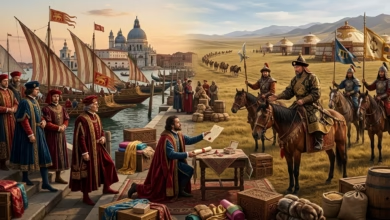
The book sets a strategic goal that goes beyond a mere review of ancient manuscripts, moving towards rewriting the region’s history, cloaked in the spirit of the “African Renaissance,” which seeks to shatter the stereotype that Africa is merely a “continent of orality.” The written heritage revealed by Timbuktu’s libraries represents irrefutable proof of active diplomatic, cultural, and economic interactions in the African Sahel region and beyond, where Timbuktu was a pivotal meeting point and a magnet that attracted merchants, scholars, and travelers, such as the famous traveler Ibn Battuta, who visited it in 1353, and the Andalusian diplomat Al-Hasan Al-Wazzan (Leo Africanus) in 1526.
The Politics Behind the Rediscovery: From Oblivion to the Forefront
The story of this book, and the broader project it is based upon, begins with a defining political and diplomatic moment. In November 2001, the then South African President, Thabo Mbeki, made an official visit to the Republic of Mali. Although standard diplomatic protocols are often confined to the capital, Bamako, steeped in its modern French colonial legacy, the Malian President at the time, Alpha Oumar Konaré—a historian and archaeologist by academic background—insisted on taking his South African counterpart on a grueling journey to the historic city of Timbuktu in the north of the country.
This visit served as the starting spark for a purely African project, where Mbeki pledged to support Mali in preserving thousands of valuable manuscripts languishing in the Ahmed Baba Institute of Higher Learning and Islamic Research, which was suffering from a lack of resources and modern preservation tools. This cooperation was not merely a cultural initiative but a tangible geopolitical embodiment of the “I am an African” discourse, aimed at reclaiming African agency away from the guardianship of Northern institutions. The book points out that this bilateral project broke the isolation of a region that had long suffered from developmental marginalization and political rebellions, particularly during the droughts of the 1970s and the Tuareg rebellions in the 1990s.
Deconstructing the Colonial Narrative and Establishing a New Intellectual History
The first section of the book poses a direct challenge to classical European philosophies that denied Africa a history. The writer Bachir Diagne points to the positions of Enlightenment philosophers, such as Immanuel Kant and Georg Wilhelm Friedrich Hegel, who stripped the African continent of any capacity to produce reason or philosophy, considering it to languish in the “mantle of the dark night.” These philosophical claims provided the moral cover for the colonial project, which sought to erase the historical memory of colonized peoples.
In countering this, the book highlights how “Africanness” does not exclusively mean “orality.” With the advent of Islam in the region, many African peoples, such as the Wolof, Fulani, Hausa, and Bambara, adopted the Arabic script to write their local languages, a practice known as “Ajami” literature. This radical shift was not merely a change in alphabet; it was a complete reformulation of identity and societal existence. The historical origins of these peoples were linked to the universal narratives of Islam, acquiring new legitimacy and establishing a written history that documents lineages, legislation, and mystical poetry.
The Corridors of Science in Timbuktu: More Than Just a City
The book does not present Timbuktu as a museum of the past, but rather as a vital center for knowledge production. Even though philosophy, in its classical Greek sense, might not have been present as an independent discipline during the eras of its decline after Averroes (Ibn Rushd), philosophical thought was deeply rooted in the study of scholastic theology (‘Ilm al-Kalam), Sufism, Islamic jurisprudence (Fiqh), and logic. The book cites prominent figures and scholars from the region, such as Ahmad Baba al-Timbukti (1556–1627), who left a massive intellectual footprint by authoring over 50 works, and his strict confrontation of racist ideas that attempted to justify the enslavement of Black people, clearly asserting in his writings that “there is no difference between one race and another.”
The chapter on the region’s settlement history, written by Roderick J. McIntosh, indicates that urbanization in the Middle Niger Basin predates the dates set by Western narratives by a wide margin. Excavations reveal an indigenous urban existence dating back to the first millennium BCE, making Timbuktu the heir to an ancient and expansive world, rather than a fleeting anomaly.
The Knowledge Economy: When Books Became More Precious Than Gold
One of the most prominent themes discussed in the book, based on solid research papers, is the “knowledge economy” in the African Sahel region. Traditional historical narratives have long focused on Timbuktu’s role as a commercial hub for exchanging salt from the Sahara mines (like Taghaza) for fine gold from the southern African forests, alongside the ivory trade. However, the book sheds light on highly significant historical testimonies, perhaps the most famous being that of the Andalusian traveler Al-Hasan Al-Wazzan (Leo Africanus), who clearly noted that “books brought from the land of the Berbers (North Africa) were sold at prices exceeding any other merchandise, and the profits from the manuscript book trade surpassed those of the gold trade.”
This “knowledge economy” was not random; it necessitated the establishment of a complex network of professions related to bookmaking. The Timbuktu manuscripts discussed in the book were not written on just any paper; high-quality papers (with distinct watermarks) were imported from Venice, Italy, Spain, and sometimes the Middle East, via trans-Saharan caravans. This created a massive demand for the professions of copyists (scribes), binders who excelled in crafting ornate leather covers using local tanning techniques, and calligraphers who developed distinctive African Maghrebi and Sudanese scripts (such as the Sahili and Suqi scripts). This economic vitality entirely refutes the idea of intellectual stagnation or isolation, proving that Timbuktu was robustly integrated into early medieval and early modern globalization.
Beyond Religious Sciences: Secular and Scientific Curricula
In several chapters, the book inventories and analyzes the content of these manuscripts, estimated at hundreds of thousands, distributed across the Ahmed Baba Institute, the Mamma Haidara Library, the Fondo Kati Library, and other private family libraries. The most significant result presented by researchers is the shattering of the stereotype assuming these manuscripts are exclusively confined to the Holy Quran, the Prophet’s Hadith, and commentaries on Maliki jurisprudence.
Naturally, Islamic sciences and Sufism were the cornerstone, but the Timbuktu library was par excellence “encyclopedic.” The book dedicates space to discuss manuscripts on astronomy (for sighting crescents, determining prayer times, and tracking agricultural seasons), mathematics (used for calculating inheritances and precise commerce), alternative medicine and pharmacology (combining prophetic medicine with knowledge of local African herbal remedies), botany, and geography.
Alongside this, the libraries contained highly important “secular” documents for understanding the sociology and history of the region, including:
-
Fatwas on Emerging Issues (Nawazil): Judicial and jurisprudential decisions related to commercial and economic disputes, marriage and divorce cases, and grazing water rights, reflecting the complex and active daily life of the region’s inhabitants.
-
Diplomatic Correspondence: Letters between the rulers of the Mali and Songhai empires, extending to the Sultans of Morocco, reflecting the complexity of international relations in that era.
-
Bills of Sale and Purchase: Which today constitute a treasure trove for economic anthropologists to study the prices of commodities, slaves, books, and real estate.
Scholarly Families: Fortresses of Institutional Memory
How did all these manuscripts survive the ravages of time, invasions (such as the Moroccan invasion of 1591, which led to the exile of Timbuktu’s elite scholars, headed by Ahmad Baba al-Timbukti), and French colonialism, which attempted to confiscate this heritage?
The book answers this fundamental question by reviewing the phenomenon of “Patrician Scholarly Families.” Knowledge in Timbuktu was not founded on the idea of a “university” in its physical, Western architectural form; rather, it was based on the form of the Zawiya and the backyards of the homes of major scholars. Families such as the “Aqit” family (to which Ahmad Baba belongs), the “Mahmoud Kati” family, and the “Bagayogo” family formed educational institutions passed down generation after generation.
These families considered the manuscripts a “sacred inheritance” and part of their identity and family honor. When these families sensed danger, whether from ancient invaders or the French colonial administration (which saw these manuscripts as evidence contradicting its claims of “civilizing” or Mission Civilisatrice), they resorted to extraordinary methods to protect this legacy. Manuscripts were hidden in the cavities of mud walls, placed in wooden and leather chests and buried in the desert sands, smuggled across the river to remote villages, or hidden in caves. This popular resistance effort is what made the revival of this heritage possible in the twenty-first century.
Ajami Literature: When Africa Speaks with Its Own Voice Through the Arabic Script
The researchers in The Meanings of Timbuktu devote special attention to the phenomenon of “Ajami” literature. This is the practice of using the Arabic alphabet to write local African languages such as Songhai, Fulani (Fulfulde), Tamasheq (the language of the Tuareg), Hausa, and Bambara.
The analysis of Ajami texts in the book dismantles another colonial claim; Orientalists had long asserted that knowledge in Timbuktu was elitist and confined to a minority fluent in Arabic, and that the rest of the populace was “illiterate.” However, the spread of Ajami proves that the Arabic script was “localized” and Africanized. Both commoners and scholars alike used Ajami to write Sufi poetry chanted in markets and villages, to record commercial accounts, to log medical prescriptions, and to write incantations and amulets. Ajami acted as a “democratic bridge” that transferred knowledge from the closed halls of scholars into the open public space.
Historical Documentation and the Authority of Science – How Did “The Sudan” Write Its Own History?
The book’s editors, Shamil Jeppie and Souleymane Bachir Diagne, focus on a core historical truth represented by the existence of an authentic local historiographical school in Timbuktu, meaning the region’s inhabitants did not need foreign travelers to document their civilizational trajectories. The city’s scholars took up this task by producing major encyclopedic works that are today considered the backbone for understanding West African history, foremost among them the book Tarikh al-Sudan (History of the Sudan) by Abd al-Rahman al-Sadi, authored in the mid-seventeenth century. This work does not stop at the boundaries of traditional political narratives of the glories and rulers of the Songhai Empire; it goes beyond that to provide precise and systematic details about social life, epidemics, and climate, making it irrefutable material evidence for researchers that the region possessed a written institutional memory far exceeding the limits of oral myths. With equal depth comes Mahmoud Kati’s Tarikh al-Fattash as one of the oldest records documenting the history of the Mali and Songhai empires, distinguished by being the product of a family effort that continued for successive generations. This solidifies the concept of scholarly families as incubators of knowledge and reveals the civilizational depth of the region through documenting pivotal events, such as King Mansa Musa’s legendary pilgrimage and its global economic repercussions.
In a related context, the book presents a fascinating analysis of the relationship between the “pen” and the “sword,” demonstrating that Timbuktu was not merely a city subordinate to political authority, but rather enjoyed a type of “cultural autonomy” that made its scholars a civilian class capable of curbing the ambitions of sultans. These scholars, especially those belonging to ancient families like “Aqit” and “Bagayogo,” were not merely court jurists; they maintained an independence that enabled them to exercise political oversight and legitimate boldness in criticizing rulers. This role transformed the city into a “safe sanctuary” and an oasis of intellectual and social stability, where scholars would intervene to prevent bloodshed and protect property during military conflicts. The position of “Judge of Timbuktu” commanded respect and reverence that sometimes surpassed the authority of military commanders, with their rulings—derived from Maliki jurisprudence—serving as the ultimate reference for regulating the affairs of commerce and society.
This section of the analysis concludes by affirming that Timbuktu was a crossroads for what could be described as “Islamic globalization,” which entirely refutes the colonial narrative that attempted to depict it as an isolated city in the heart of the desert. Through the analysis of the manuscripts, the book proves the existence of a dense and effective network of communications and correspondence that connected Timbuktu’s scholars with their counterparts in Egypt, Palestine, Morocco, and all the way to Istanbul. This network was not exclusively for the exchange of commercial goods, but functioned as an “information highway” across which philosophical, jurisprudential, and linguistic ideas traveled with astonishing speed between continents. This epistemic concept is the core upon which the book builds its vision of the “African Renaissance,” affirming that Africa was never a passive recipient, but was always an active and authentic partner in the comprehensive global dialogue.
The Struggle for Survival in the Digital Age – Preservation Techniques and Contemporary Challenges
In its later chapters, the book The Meanings of Timbuktu transitions from reviewing past intellectual glories to addressing a contemporary existential issue: how to protect this fragile legacy from natural and political agents of destruction. The book details the “Timbuktu Manuscript Project,” initiated by the University of Cape Town in South Africa, which represented a qualitative shift in how the continent handles its written memory. This project was not merely an academic data collection initiative; it was a race against time to save rare paper folios whose edges had been eroded by the severe drought in the Sahara Desert, termite attacks, and fluctuating humidity, not to mention the threats posed by political instability in Mali.
The book details the complex technical aspects faced by experts and archivists, as the manuscripts suffered from chemical deterioration caused by the type of traditional ink used in the past, which in some cases began to “eat” the paper from the inside. Here, the role of close cooperation between Mali and South Africa emerges, as local Malian personnel were trained in advanced laboratories on precise manual restoration techniques using acid-free paper and natural adhesives that do not harm the original document. This technical effort reflects the book’s philosophy, which views manuscript preservation as an act of “cultural sovereignty,” where these papers are transformed from mere family heirlooms hidden in chests into scientific material accessible to researchers through comprehensive “digitization” processes.
The narrative in the book takes a dramatic turn when discussing field challenges. The project did not limit itself to working within the walls of the modern Ahmed Baba Institute built by South Africa in Timbuktu, but penetrated into the heart of the private family libraries that hold the lion’s share of this heritage. The book describes, with extreme caution and sensitivity, the process of building trust with the Timbuktu families, who historically feared that “documentation” or “restoration” operations would be a smokescreen for confiscating their treasures—a fear rooted since the French colonial era. The project succeeded in overcoming these obstacles by involving the local community and making them authentic partners in the preservation process, affirming that the manuscript is not merely a text, but a living bond connecting the present to the roots of the “African Renaissance” championed by President Thabo Mbeki.
The book also touches upon the international political dimensions of this knowledge effort, clarifying how Timbuktu, at the dawn of the twenty-first century, became a symbol of “South-South” cooperation. The manuscript project was not just a technical operation; it was a powerful political message to the world stating that Africa is capable of managing its most complex heritage with its own tools and funded by its own resources, away from traditional aid models that often imposed conditions dictating how history should be written. This chapter concludes by warning that risks still remain, whether through direct security threats in northern Mali or through a lack of sustainable funding to maintain digital archiving equipment, making the cause of Timbuktu a global issue requiring continuous intellectual and technical vigilance.
The Philosophy of Place and the Architecture of the Spirit – The Scientific Mindset in the Embrace of Mud
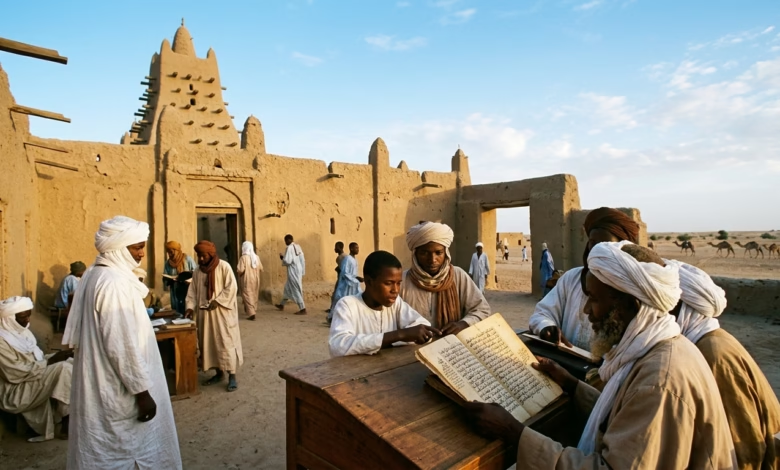
Our intellectual journey in the book The Meanings of Timbuktu brings us to one of its most poetic and profound chapters, the chapter that deals with the “philosophy of place” and how mud architecture intertwined with the scientific mindset of the city’s inhabitants. The book’s editors, Shamil Jeppie and Souleymane Bachir Diagne, put forth a vision that Timbuktu is not merely a repository for manuscripts, but is in itself an “architectural text” that explains the nature of the knowledge produced within it. The unique Sudano-Sahelian architecture, embodied in its great historical mosques, was not just a shelter for worshippers and students; it was an expression of perfect harmony between humanity and the desert environment—an architecture whose apparent simplicity and spiritual depth formed the essence of the Timbuktu scholarly persona.
The book takes us on a visual and cognitive tour inside the Djingareyber Mosque, built by the Andalusian architect and poet Abu Ishaq al-Sahili, commissioned by Emperor Mansa Musa after his famous pilgrimage. The researchers explain that this mosque, with its pyramidal minarets and protruding wooden beams used as scaffolding for annual restoration, represents a model of permanence through renewal. The fragile mud materials from which the mosque is built impose on the community a kind of “cognitive and practical solidarity” to restore it after every rainy season. This continuous interaction with the place reflected on the scholarly mindset, as Timbuktu’s scholars realized that knowledge, just like mud architecture, requires continuous “restoration” through teaching, copying, and reviewing, so that it is not blown away by the winds of oblivion.
As for the Sidi Yahya Mosque and the Sankore Mosque, the book presents them as university corridors that buzzed with philosophical and logical dialogues. In these spacious areas open to the sky, the boundaries between religious and secular sciences blurred; a student would move from a circle learning the foundations of jurisprudence to another observing the stars or studying Arabic grammar. The architecture in Timbuktu, with its layout providing quiet and natural coolness in the heart of the sweltering heat, provided an ideal “psychological environment” for contemplation and long scientific research. The book notes that the simplicity of the materials used in construction (mud, straw, and local wood) reinforced the values of humility and asceticism among the scholars. The scholar saw himself as part of this earth, writing its history and defending its dignity with the ink of his pen.
In the final conclusion of this work, the book The Meanings of Timbuktu cements a central message that transcends the boundaries of pure academic work to become a political and cultural manifesto directed to the entire world. The ultimate goal behind this project is to restore Africa’s “historical agency” and shatter those intellectual shackles imposed by Eurocentrism for a long time. The book affirms that Timbuktu, with its manuscripts, its architecture, and its scholars, is irrefutable proof that the “African Renaissance” is not merely a modern political slogan, but an invocation of a civilizational legacy in which the African was an authentic partner in shaping the human mind.