
Belt And Road Cities
How China is Reshaping The Global Order Through Concrete And Steel

In September 2013, Chinese President Xi Jinping Stood Behind The Lectern At Nazarbayev University In The Kazakh Capital, Astana, To Announce A Strategic Vision That Would Change The Face Of Twenty-First-Century Geopolitics. His Speech Was Not Merely A Dreamy, Romantic Invocation Of The Echo Of Camel Bells In The Mountains Or The Columns Of Smoke Rising From Ancient Desert Caravans, But Rather An Explicit Declaration Of The Launch Of The “Belt And Road Initiative,” A Grand Strategy Aimed At Connecting The Eurasian Landmass And Its Surrounding Maritime Routes. In This Complex Geopolitical Context, The Book “The Belt And Road City: Geopolitics, Urbanization, And China’s Search For A New International Order” By Researchers Simon Curtis And Ian Klaus, Published By Yale University Press, Offers A Precise And Innovative Dissection Of How China Uses Infrastructure And Urbanization As Tools To Establish An Alternative World Order.
Infrastructure As The Dark Matter Of International Relations The Authors Start From A Strong And Compelling Central Thesis: That Infrastructure And The Urban Landscape Are Not Mere Neutral Backdrops Upon Which Politics Is Played Out, But Are The “Exoskeleton” Of Power And Its Indispensable Material Repository. Mainstream International Relations Theories Often Ignore This Material Dimension, Treating Infrastructure As If It Were “Dark Matter” In The International System; An Invisible But Fundamental Mass In The Cohesion Of Any Successive World Order. Throughout History, The Ability To Build And Reshape Cities Has Been Accompanied By Imperial Expansion And The Projection Of Influence. When Alexander The Great Pushed Eastward To Conquer Half Of The Ancient World, He Left Behind A Series Of Cities That Immortalized Greek Culture For Centuries. Similarly, The Roman Empire Left An Immense Urban And Infrastructural Legacy That Extended Across Vast Swaths Of The Ancient World, Reaching Northern England And The Middle East. Later, Britain Connected Its Empire, On Which The Sun Never Set, With Networks Of Railways And Ports, Reshaping Cities Around The World Such As New Delhi And Mumbai. In The Late Twentieth Century, The United States Played The Most Prominent Role In Building A Global Economy That Produced A New Urban Pattern Known As The “Global City,” Cities Connected To Each Other Through Networks Of Digital Technology And Global Capital. Today, China Is Following In The Footsteps Of Those Great Powers. Not Since The U.S.-Led “Marshall Plan” After World War II Has The World Seen An Infrastructure Investment Program Led By A Great Power Of The Scale And Scope Of The “Belt And Road Initiative.” Indeed, The Chinese Initiative Far Exceeds The Marshall Plan; It Today Touches More Than 140 Countries Representing More Than Two-Thirds Of The World’s Population, With An Estimated Cost That Could Reach $8 Trillion By The Middle Of This Century. Through This Initiative, China Does Not Seek To Impose Its Hegemony Through Direct Military Force Alone, But Through Laying The Material Foundations Of Its Political And Economic Model, And Introducing A New Form Of Urban Life To The World, Which The Authors Term “Belt And Road Cities.”
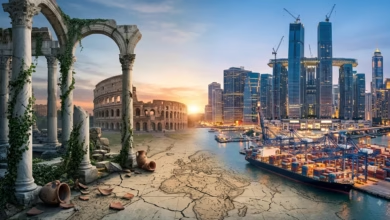
From The “Global City” To The “Belt And Road City” The Book Provides A Deep Critical Comparison Between The “Global City” Era That Has Dominated Over The Past Four Decades And The “Belt And Road City” Era Whose Features Are Taking Shape Today. The Global City—Such As New York, London, Tokyo, And Dubai—Is The Product Of A Unique Historical Intersection Between Globalized Financial Capital And American Geopolitical Hegemony After The Cold War. These Cities Are Characterized By Dynamism And Openness, Functioning As Hubs For Global Networks That Absorb Talent And Capital Under A Liberal World Order Characterized By Reducing The Role Of The State In Favor Of Free Market Forces. However, This Neoliberal Model Is Today Facing Intersecting Existential Crises; Starting From Environmental Degradation And The Collapse Of Ecosystems, Through Recurring Financial Crises (Such As The 2008 Crisis), To Stark Social Inequality, And The COVID-19 Pandemic Which Reinstated The Role Of The Interventionist State. China Has Exploited These Cracks In The Western Liberal System As A Geopolitical Opportunity To Build Long-Term Foundations For An Alternative International Community. In Contrast To The Global Cities That Relied On Privatization And The Partitioning Of Urban Spaces, The Belt And Road Cities (Such As Khorgos, Gwadar, Colombo, And Piraeus) Reflect A Completely Different Set Of Values And Approaches, Based On The Model Of “State Capitalism.” Belt And Road Cities Are Characterized By Their Massive Focus On Logistics, Trade, And Emerging Urban Corridors. They Are Experiencing Growth In Central Business Districts And Urban Hubs Designed And Built To Link Local Economies To Global Supply Chains Managed And Directed By China. The Chinese State’s Footprint Is Prominent In These Cities Through Explicit Bilateral Agreements, Massive Government Funding, And Infrastructure Projects That Seek Not Only Quick Profit, But The Establishing Of Long-Term Rules Of Power.
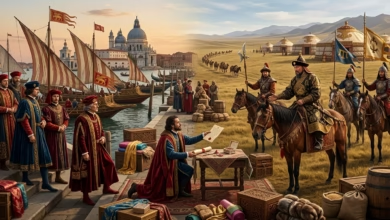
Selective Invocation Of History: The Myth Of The Silk Roads The Book Analyzes How The Chinese Leadership Employs History As A Geopolitical Tool. Just One Month After His Speech In Astana, Xi Jinping Traveled To Jakarta, Indonesia, To Announce The Maritime Component Of The Initiative, The “Maritime Silk Road.” There, Xi Invoked The Memory Of The Muslim Admiral Zheng He, Whose Massive Fleet Sailed The Seas Of Southeast Asia And The Indian Ocean, Reaching The East Coast Of Africa In The Fifteenth Century During The Ming Dynasty. Curtis And Klaus Emphasize That This Use Of Silk Road History Is Not Merely Nostalgia For The Past, But A Strategy Aimed At Displacing Western Centrality From The World Map And Offering An Alternative Historical Narrative In Which China Has The Role Of Leader And Center. Invoking This Era Aims To Portray China’s Current Rise As A Continuation Of A Historical Era Characterized By Peaceful Coexistence And Commercial And Cultural Exchange, While Overlooking Periods Characterized By Imperial Violence. Xi Jinping Seeks To Reassure His Neighbors And Partners That The New Chinese Order Is Not Like Western Imperialism Based On Colonialism And Conquest, But Rather Draws Inspiration From The Historical “Tribute” System Model And China’s Technological And Civilizational Superiority. However, This Chinese Narrative Faces Challenges On The Ground; For The Belt And Road Initiative Is An Explicit Attempt To Solve A Structural Crisis That Great Powers Have Long Faced Under Capitalist Modernity: The Tension Between A Political System Built On The Borders Of The Territorial State And A Transnational Economic System That Constantly Seeks To Overcome These Constraints. During The Period Of “Reform And Opening-Up,” China Accumulated A Huge Surplus Of Capital And Foreign Exchange Reserves, And Faced The Problem Of “Excess Production Capacity” In Multiple Industrial Sectors, Which Threatened Its Growth Slowdown And Internal Political Stability. In This Context, The Initiative Represents A “Spatial Fix”; That Is, A Massive Geographical Outlet To Drain This Surplus Through Investments In Infrastructure And Cities Outside Its Borders.
Exporting “Chinese Modernity”: Technology In Service Of The Urban System The Authors Argue That Belt And Road Cities Act As “Communicating Vessels” Through Which Chinese Surveillance Technology And Digital Governance Are Transferred. In Many Of These Cities, Chinese Projects Are Not Limited To Building Bridges Or Energy Grids, But Extend To Establishing “Smart Cities” Relying On Facial Recognition Cameras, Big Data Analysis Systems, And Technological Platforms Provided By Giant Companies Like Huawei And ZTE. Curtis And Klaus Note That This Trend Raises Fundamental Questions About “Digital Sovereignty.” While The Western Global City Model Preached Freedom And The Free Flow Of Information, The Chinese Model—Which Is Being Tested And Developed In Belt And Road Cities—Offers A Vision Based On “Urban Security” And Strict Control. For Many Political Regimes In The Global South, These Chinese Tools Seem Highly Tempting; They Provide An Effective Means To Manage Rapid Urbanization, Tighten Security Balances, And Enhance Public Service Efficiency Without The Need To Accept The Political Or Rights-Based Demands That Western Institutions Used To Impose As A Condition For Financing. However, The Researchers Warn That These “Emerging Chinese Cities” May Lead To The Creation Of “Urban Enclaves” That Are Separated From Their Local Social And Economic Surroundings. They Are Often Designed To Be Export-Oriented Logistics And Commercial Platforms, Making Them Appear As “Chinese Islands” Within Sovereign States, Where Their Laws And Administration Are Subject To The Logic Of Long-Term Partnerships Between The Chinese Government And The Host Governments, Far From Local Democratic Interactions.
Sustainability Challenges: When Ideology Collides With Reality The Book Does Not Overlook The Dark Economic And Environmental Aspects Of This Massive Expansion. The “Belt And Road” Project Has Not Always Been A Resounding Success Story; Rather, It Has Faced A Series Of Setbacks That Critics Call The “Debt Trap.” The Authors Analyze Case Studies Such As The “Hambantota” Port In Sri Lanka, Which Has Become A Symbol Of The Financial Challenges Facing Partner Countries. They Indicate That China Has Become The “Lender Of Last Resort” In Many Regions, Giving It Extraordinary Leverage Over The National Policies Of Those Countries. From A Geopolitical Point Of View, The Book Poses A Fundamental Question: Does China Really Aim To Build A “Multipolar” And Fair International Order, Or Is It Replacing “American Centrality” With A More Rigid “Chinese Centrality”? Curtis And Klaus Argue That The Initiative Is, In Its Essence, An Attempt To Redefine International Rules To Serve China’s Strategic Interests. Instead Of Seeking To Topple The Current Order, China Is Working To Build It From Within By Creating A Parallel To Existing Institutions (Such As The Asian Infrastructure Investment Bank), Which Lends New Legitimacy To The Pattern Of “State Capitalism.” As For The Environmental Aspect, The Chinese Approach—Which Long Relied On Coal Projects And Carbon-Intensive Hard Infrastructure—Faces Increasing Pressures. Despite Recent Shifts In Chinese Rhetoric Towards A “Green Silk Road,” The Gap Remains Large Between Ambitious Promises And The Reality Imposed By Giant Construction Projects That Consume Huge Amounts Of Natural Resources And Change The Environmental Landscape Of Urban Areas.
Between Integration And Collision: The Workforce And Migration Flows Curtis And Klaus Note That One Of The Initiative’s Most Organizational Advantages Is Its Ability To Move Massive “Human Masses” In Parallel With The Flow Of Capital. In Locations Such As The Ports And Industrial Zones Developed By China, A Special Organizational Model Emerges, Where Specialized Chinese Labor Is Brought In To Operate The Infrastructure In The Early Stages, Creating Direct Contact—Sometimes Harmonious And Sometimes Tense—With The Local Labor Force. This Human Meeting In Work Spaces, And Then Housing, Imposes Cultural Challenges That Developing Countries Have Not Been Accustomed To Before; For China Does Not Only Offer The Loan Or Technology, But Exports With Them Administrative And Social Systems That Reflect Chinese Hierarchy And Control. The Book Analyzes How This Human Presence Changes The “Urban Culture” Of These Cities. For Example, Local Markets In Cities Like Colombo Or Nairobi Have Begun To Witness The Appearance Of Chinese-Style Services And Shopping Centers, Raising Questions About The “Cultural Sovereignty” Of The Host Cities. The Researchers Ask: Will These Cities Turn Into A Version Of “Chinese Modernity” That Sacrifices Local Privacy For The Sake Of Efficiency And Growth? This Cultural Clash Is Not Merely A Marginal Detail, But The Essence Of The Transformation Led By Beijing, Where Local Elites Are Convinced That The Chinese Path—Represented By Rapid Development Under Strict Management—Is The Only Possible Path To Escape Poverty.
Strategies Of Resistance And Local Empowerment The Book Does Not Portray Host Populations As Passive Recipients Of The Chinese Vision. On The Contrary, The Authors Highlight The Existence Of “Dynamics Of Resistance” Or “Negotiation” By Local Communities. In Some Cases, Labor Unions, Environmental Groups, Or Even Local Municipalities In Initiative Countries Have Managed To Impose Their Conditions On Chinese Companies. This Interaction Leads To The Emergence Of A Form Of “Urban Hybridity”; Where China Does Not Fully Succeed In Imposing Its Model, And Locals Do Not Succeed In Preserving The Shape Of Their Old City, But Rather New Patterns Of Cities Are Born That Blend Chinese Bureaucracy With Local Traditions. This Interaction Highlights A Truth That Many Analysts Ignore: That The Belt And Road Initiative Is A “Living Political Process” And Not Just A Static Map. Every City That Enters This Network Redefines The Terms Of Its Connection With China Based On Internal Power Balances. This Means That The International Order Being Drawn By Beijing Is Not As Hard As Steel, But Is A “Flexible System” That Must Adapt To The Specificities Of Each Urban Geography.
Global Governance From The Bottom To The Top In Concluding This Part, The Book Emphasizes That These Small Changes In Cities Are What Will Shape “Global Governance” In The Coming Decades. When Dozens Of Cities Around The World Adopt Chinese Traffic Systems, Surveillance Technologies, Or Construction Methods, This Leads To The Standardization Of Global Norms Under Beijing’s Technical Leadership. It Is An Invisible, Yet Highly Effective, “Urban Standardization” Process, Making It Difficult For Host Countries To Separate From The Chinese System Once They Are Involved In This Infrastructure. The Authors Argue That China’s Power Lies Not In The Ability To Military Coercion, But In The Ability To Make “Chinese Norms” The Easiest And Most Logical Choice For Cities Seeking Growth In The Twenty-First Century. Thus, “Belt And Road Cities” Become The Real Laboratory That Will Decide Whether The World Will Head Towards Further Fragmentation Or Towards A New “Chinese World Order” Managed Through A Digital Dashboard Centered In Beijing.
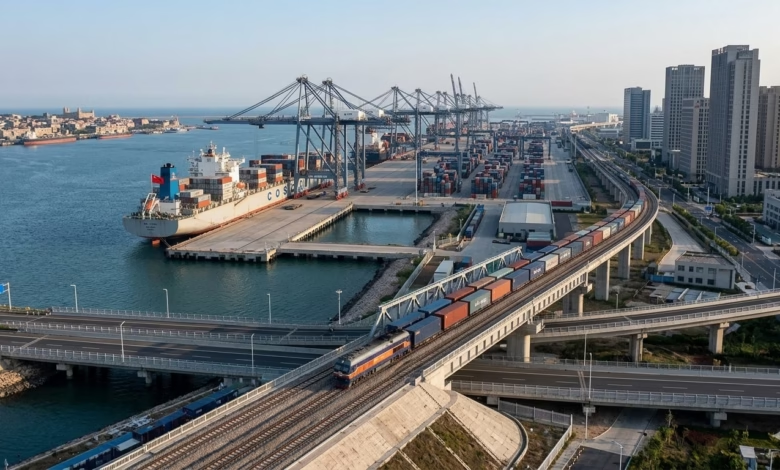
Ports As Tools For Sovereignty And Control The Authors Indicate That China Uses An Innovative Model For Managing Global Ports, Which Is The Model Of “Long-Term Investment For Operational Rights.” In Cities Like “Piraeus” In Greece Or “Gwadar” In Pakistan, China Does Not Only Inject Funds, But Imposes Entirely Chinese Technical And Logistical Standards. This Grants Beijing What The Book Calls “Geospatial Sovereignty”; Where Ports Become Islands With A Special Legal And Administrative Nature Linked To The Center In Beijing More Than To The Host State. Intersection Of Interests: The Authors Explain That These Ports Function As Dual-Use Platforms; They Are Civil Commercial Hubs In Appearance, But Are Designed To Be Convertible Into Logistical Facilities To Support The Chinese Naval Fleet When Needed. Redrawing Maps: Through This Control Of Ports, China Is Reshaping Global Trade Maps, Where The Flow Of Goods And Data Is Directed To Pass Through The Terminals It Controls, Reducing Its Reliance On Maritime Corridors Controlled By The West. Political Influence: Curtis And Klaus See That Host Countries Often Fall Into A “Strategic Dependency” On Chinese Ports, Where This Infrastructure Becomes An Integral Part Of Their National Security, Limiting Their Diplomatic Options And Deepening Their Reliance On Beijing.
Urban Corridors And Digital Logistics This Vision Is Not Complete Without Linking Ports With Internal Urban Centers. The Researchers Confirm That “Belt And Road Cities” Act As Relay Stations Ensuring The Smoothness Of Goods. In These Cities, China Imposes “Digital Protocols” For Customs And Logistics Services, Meaning Data Flowing Through Ports And Free Zones Is Subject To Chinese Standards Of Surveillance And Analysis. The Book Indicates That This Coordination Is Not Merely A Technical Act, But Is An “Infrastructure Policy” Seeking To Turn The Geographical Space Of Host Cities Into Space Of Chinese Standards. When You Use A Local Port, You Are Not Using Merely A Dock For Ships, But You Are Using A System For Data Management, Security Standards, And Entirely Chinese Operational Regulations, Which The Authors Call “Localization Of Infrastructure.”
Restoring Strategic Depth At The End Of This Section, The Authors Conclude That China Has Succeeded In Building A Geopolitical “Ecosystem” That Extends Beyond Its Regional Borders. It Is Not Building An Empire Based On Colonizing Lands In The Traditional Sense, But An Empire Based On Controlling Global “Choke Points.” By Connecting Its Cities With Other Global Cities Via Ports And Corridors, Beijing Ensures That The Lifeblood Of The Global Economy Remains Under Its Supervision And Management. This Transformation Means That The Twenty-First Century Will Witness A Struggle Over Who Owns The “Urban Map” Upon Which Global Trade Moves. China, As The Book Portrays It, Has Already Drawn Its Map, And Is Implementing It Slowly And Steadily By Pouring Concrete And Laying Railways, Transforming Ports And Urban Areas Into Digital And Economic Fortresses That The World—Until Now—Cannot Bypass Or Do Without Their Services.
Dismantling Western Centrality: Birth Of “Global Chinese Urbanism” Curtis And Klaus See That The Initiative Represents An Existential Challenge To The Concept Of The Liberal “Global City.” While Global Cities In The Western Era Were Centers Managed By Market Forces And Transnational Corporations, “Belt And Road Cities” Offer A Model Led By “State Capitalism.” State Sovereignty Versus Market Liberation: China Seeks To Prove That Rapid And Effective Urban Development Does Not Necessarily Require Liberal Democracy Or Full Privatization, But Rather Requires A Strong And Planned State. Chinese Normativity: Through Exporting Its Standards In Construction, Smart Technology, And Facilities Management, Beijing Establishes A “Normative System” That Makes Partner Cities Technically And Administratively Dependent On Chinese Technology, Creating A Structural Dependency That Is Hard To Escape. Geographical Repositioning: The Initiative Works On Shifting The Center Of Economic Gravity From The Atlantic Coasts And Central Cities In The West To New Pathways In The Heart Of Eurasia And Africa, Making The Global System Revolve Around A New Asian Axis.
Risks And Stakes: A Divided Or Integrated World? In Concluding Their Analysis, The Researchers Do Not Overlook The Grave Challenges Facing This Chinese Ambition. Transforming The World Into A “China-Linked Urban System” Faces Internal Resistance In Host Countries Due To Political, Environmental, And Social Costs. Debt And Sovereignty Dilemma: Excessive Reliance On Chinese Loans To Execute Infrastructure Projects May Place Host Countries In A State Of Strategic Deficit, Transforming “Belt And Road Cities” Into Arenas For Geopolitical Competition. Climate Change: The Book Poses A Critical Question About The Extent Of This Initiative’s Ability To Transform Towards A Real “Green Silk Road,” Where Intensive Urban Activities Are Still Linked To Massive Resource Consumption. Geopolitical Competition: Curtis And Klaus Conclude That The Struggle Over “Infrastructure” Is The Real Face Of The Struggle Between The Great Powers Today, Where Ports, Railways, And Smart Cities Are Used As Chess Pieces To Redefine Maps Of Global Influence.
Forward-Looking View: Concrete As Policy The Authors Confirm That “Belt And Road Cities” Are Not An Inevitable Fate, But A Chinese Strategic Choice Subject To Critique And Amendment. The Importance Of This Book Lies In It Pulling The Rug From Under The Analyses That Shorten International Relations Into Foreign Policy Or Military Power, To Draw Attention To The “Dark Matter” Upon Which These Relations Are Built: Land, Construction, And The City. In The End, The Authors Conclude That The World Is Heading Towards A New Pattern Of International Order—A “Chinese Urban System”—In Which Physical And Logistical Space Reshapes The Traditional Borders Of States. If Concrete And Steel Are The Language Of The Age, Then China Has Already Begun To Write The Rules Of The New Game, Leaving The World The Task Of Adapting To An Urban, Technical, And Geopolitical Reality Designed In Beijing. Thus, We Conclude Our Analytical Journey Through The Chapters Of This Book Which Offers A Unique Window To Understand How Empires Are Built In The Twenty-First Century: Not Through Invading Lands, But Through Linking Them With A Global Network Of Ports, Railways, And Cities That Do Not Sleep.