
The Search For The Animating Spirit Of Modernity
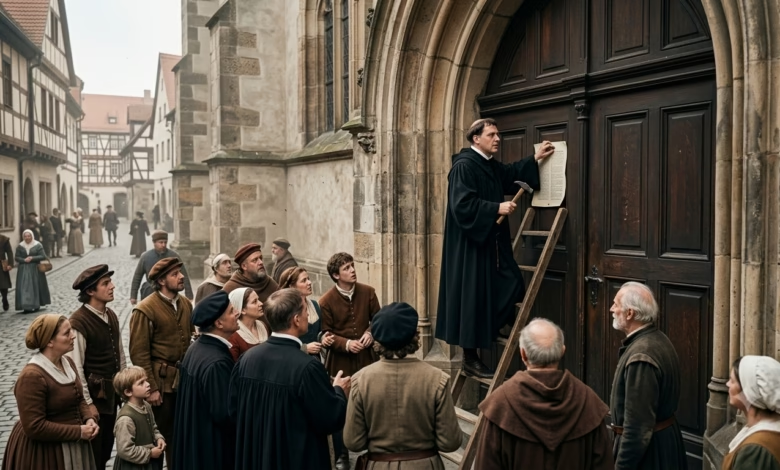
In The Heart Of The Philosophical And Historical Debates That Attempt To Explain How Our Contemporary World Was Formed —With Its Democratic Institutions, Its Transcontinental Capitalism, Its Strict Individualism, And Its Chronic Existential Anxiety— The Religious Question Remains Present As An Invisible Root That Cannot Be Bypassed. For Many Decades, And Under The Dominance Of Rigid Secularism Theories, Modernization Was Treated As An Inevitable Path That Begins Exactly Where Religion Ends, Or As A Gradual Retreat Of The Sacred Before The Sacred March Of Material Rationalism. However, Historical Readings That Are More Profound And Disengaged From Stereotypes Prove Quite The Opposite; Speaking About The “Modern World” Is In Its Essence A Tracking Of The Winding Paths That Religious Emotions Took When They Abandoned Their Old Institutional Molds And Set Out To Colonize The Public Space. In This Intertwined Research Space, Comes The Book Of The British Historian Professor Alec Ryrie, Professor At Durham University And Specialist In Church History, Titled “Protestants: The Faith That Made The Modern World”, To Present What Can Be Described As A “Comprehensive Historical Biography” Of One Of The Most Radical Religious And Political Transformations In Human History. Ryrie Does Not Write Here A Mere Dry Chronological Narrative Tracking The History Of The Reformist Churches Since The Moment Martin Luther Hung His Ninety-Five Theses On The Door Of Wittenberg Church In 1517, But Rather He Offers A Sociological And Philosophical Thesis Wrapped In A Highly Fluid And Precise Journalistic Language. He Investigates The “Spiritual Spark” That Turned A Local Religious Movement In The Depths Of Isolated Germany Into A Mighty Geopolitical Engine Whose Shrapnel Extended To Shape North America, Kindle The Flames Of Revolutions In Europe, And Ultimately Reshape Societies In East Asia And Sub-Saharan Africa In The Twenty-First Century. The Core Advantage From Which Ryrie Departs, Which Grants His Thesis An Extraordinary Cohesion, Is His Refusal To Reduce Protestantism Into A Mere “Set Of Fixed Theological Doctrines” Or An “Administrative Schism From Papal Authority.” Instead, The Author Defines Protestantism As An “Anxious Emotion And A Continuous Revolution”, A Kind Of Spiritual Adventure Based On A Relationship Of Love, Fear, And Internal Agitation Between The Servant And His Creator, A Relationship That By Its Nature Rejects Mediation, Does Not Settle For Stagnation, And Carries Within Its Genetic Codes The Seeds Of Permanent Rebellion. From This Foundational Definition, The Author Departs To Unravel A Mystery That Has Long Haunted Historians: How Could A Faith That Began With A Theological Obsession With Sin And Otherworldly Spiritual Salvation End Up Establishing Political Pluralism, Freedom Of Expression, And The Empirical Scientific Method?
The Legacy Of The Great Anxiety: Martin Luther And The Discovery Of “Wild Freedom”
Ryrie Begins His Journey By Returning To The Moment Of The Big Bang, A Moment That Cannot Be Understood Without Diving Deep Into The Psychological Depths Of The Augustinian Monk Martin Luther. In The First Chapter, Which Carries A Telling Title, “Luther And The Fanatics,” The Author Brilliantly Transports Us With Vivid Journalistic Scene-Setting Into The Atmosphere Of The Sixteenth Century, Where Europe Lived Under The Weight Of An Omnipotent Spiritual System Represented By The Catholic Church. In That World, Faith Was A System Of Transactions; Sins Were Washed Away By Indulgences, And Salvation Was Purchased With The Currency Of Ecclesiastical Obedience And Strict Liturgical Rituals. Yet Luther Was Not A Man Searching For Compromises. Ryrie Describes Him As A “Man Of Volcanic Emotions,” Suffering From An Incurable Case Of Existential Anxiety (Anfechtung), Terrified Of The Idea Of Absolute Divine Justice That A Finite Human Effort Could Never Satisfy. This Deep Psychological And Spiritual Agitation Is What Led Luther To His Revolutionary Discovery Upon Reading Paul’s Letter To The Romans: “The Just Shall Live By Faith.” This Concept, Known Theologically As “Justification By Faith Alone” (Sola Fide), Acted As Defusing The Time Bomb Monopolized By Rome. For If Salvation Is A Free Gift From God Granted To Man Based On His Internal Faith And Absolute Trust, Then The Entire Administrative And Ritual Structure Of The Church, From The Pope To The Smallest Monk, And From Indulgences To The Confessional, Suddenly Transforms Into An Unnecessary Demographic And Spiritual Burden. Ryrie Demonstrates Skill Here In Analyzing The Unexpected Consequences Of Ideas. Luther Was Not Seeking To Establish A Democracy, Nor Did He Believe In Freedom Of Thought In The Modern Sense; Rather, He Was Searching For “True Bondage To Christ.” Yet, Without Knowing It, When He Declared Before The Diet Of Worms In 1521 His Famous Statement: “My Conscience Is Captive To The Word Of God.. I Cannot And I Will Not Recant Anything, For To Go Against Conscience Is Neither Safe Nor Right,” He Was Laying The Foundation Stone For Modern Individualism. Luther Elevated “Individual Conscience” To Become The Supreme Court That Judges Kings, Popes, And Ecumenical Councils. This Liberation Of Conscience, As Ryrie Explains With Fluidity And Flow, Soon Escaped From The Hand Of Its Author. For As Soon As The Lock Securing The Door Of Interpretation Was Broken, Commoners, Peasants, And Radicals Rushed To Reread The Holy Bible With Their Own Eyes, Not Through The Eyes Of The Church, Nor Luther’s Himself. Here The Writer Pauses Lengthily At The Phenomenon Of “False Prophets” And Radicals Like Thomas Müntzer, Who Saw In The Gospel A Call Not Just For Spiritual Reform, But For Turning Social And Political Conditions Upside Down, Leading To The Outbreak Of The “German Peasants’ War” (1524-1525). Luther Faced Terrified The Fruits Of His Own Idea, Where The Spiritual Flow Turned Into A Torrential River Of Armed Rebellion, Compelling Him To Take Fierce And Cruel Positions Against The Peasants, Asserting That His Protestantism Was An Ally To Order, Not A Child Of Chaos. Nonetheless, The Arrow Had Spent, And “The Restless Faith” Was Born.
Institutionalizing The Revolution: John Calvin And The Engineering Of An Ordered World
If Luther Was The Volcanic Poet Who Sparked The First Flare Of Protestantism With His Agitated Emotions, John Calvin Was The Architect And Cold Legal Mind Who Granted This Emotion A Structure And Institutions Capable Of Surviving And Competing With The Empire Of Rome. Ryrie Shifts In His Analysis To Focus On Calvinist Geneva, Considering It The Real Laboratory Of Organized Modernity. Calvinism Was Founded On The Principle Of God’s Absolute Sovereignty And The Doctrine Of “Predestination.” According To This Doctrine, God Had Already Chosen, Since Eternity And Before Creating The World, Who Would Receive Salvation (The Elect) And Who Would Meet Damnation, Without Any Intervention From Human Will. At First Glance, This Doctrine Appears Bound To Plunge Man Into A State Of Utter Paralysis And Fatalistic Nihilism. But Ryrie, Tracking The Trail Of Max Weber’s Famous Sociological Thesis While Developing And Critiquing It Flexibly, Explains How This Doctrine Transformed Into A Restless Dynamical Engine. Since Man Does Not Know Certainty Whether He Is Among The Elect Or The Damned, The Only Way To Calm The Raging Internal Anxiety Was To Search For “Signs” Indicating This Divine Selection. These Signs Manifested In Strict Moral Conduct, An Ironclad Self-Discipline, And Success In Worldly Work Deemed A “Divine Calling.” Work Was No Longer A Mere Means Of Living, But Became An Act Of Worship, And Failure Turned Into A Form Of Spiritual Curse. From This, Ryrie Sees That Calvinism Created A New Type Of Human Being: A Rational, Organized Individual, Who Monitors Himself With Obsessive Precision, Possessing An Internal Drive For Productivity And Wealth Accumulation While Abstaining From Pomp And Luxury Consumption. This Calvinist Discipline Was Not Restricted To The Individual, But Extended To Reshape The City. Geneva Under Calvin Transformed Into A “Republic Of Saints,” Where Societal Moral Surveillance Intersected With Governing Public Affairs. Despite The Authoritarian Character That Stained This Experience In Its Beginnings (Such As The Execution Of The Heretical Scientist Michael Servetus), It Was Pregnant With A Major Paradox: For Calvinism, By Emphasizing That Kings And Rulers Are Sinners Like All Other Humans And That Their Obedience Is Conditioned By Their Adherence To God’s Command, Granted Peoples The Theological Justification To Resist Tyranny. Calvinism Transformed Into A Transnational Revolutionary Ideology, Feeding The Huguenots In France, The Rebels In The Netherlands Against The Spanish Throne, And The Puritans In England Who Would Cut Off The Head Of King Charles I In The Following Century.
The Theology Of Text And Word: Iconoclasm And The Rise Of The Reading Mind
In The Medieval Catholic World, Religion Was Visual, Tangible, And Audible; It Was Embodied In Statues, Icons, Relics Of Saints, Towering Gothic Cathedral Architecture, And Latin Liturgical Music Whose Words Commoners Did Not Understand, Yet They Melted Within Its Invisible Majesty. Protestantism Launched A Relentless War Against This Visual World. Ryrie Describes In An Affecting Scene-Setting Style The “Iconoclasm” Campaigns That Swept Through Churches In England, Germany, And Switzerland; Where Statues Were Smashed, Golden-Colored Murals Scraped, And Paintings Burned. This Was Not Mere Savage Destruction, But Rather A Radical Process Of “Spiritual Cleansing” Aimed At Displacing Everything That Distracts The Eye Away From “The Word.” The Printed Word Replaced The Icon. The Holy Bible, Translated Into National Languages (German, English, French), Became The Real And Only Presence Of The Sacred In The World. This Shift From A “Culture Of Eye And Ritual” To A “Culture Of Text And Word” Carried Civilization Statistics That Cannot Be Measured. To Be A Good Protestant, It No Longer Sufficed To Attend Mass And Watch The Priest; It Became Mandatory For You To Read. This Theological Necessity Led To A Massive Leap In Literacy Rates In Countries That Adopted The Reformation. Protestant Homes Transformed Into Mini-Schools, Where The Household Head Sat In The Evening To Read The Gospel To His Wife And Children. This Obsession With Reading And Writing Did Not Only Contribute To Spreading Education, But It Altered The Cognitive Structure Of The Human Mind. Reading Is An Individual Operation, Demanding Solitude, Nurturing Critical Thinking, And Driving The Individual To Build His Independent Judgment On The Text. Through This Entrance, Ryrie Explains How The Protestant Theology Of The Word Paved The Way, In The Long Run, For The Rise Of Journalism, Independent Public Debate, And Even The Skeptical Scientific Method That Rejects Inherited Truths Without Examination And Scrutiny In “Documents And Evidence.”
The Paradox Of The Sword: When Conscience Turns Into A State Ideology
The Spiritual Adventure Launched By Martin Luther Would Not Have Survived The Historical Guillotine Of The Catholic Imperial Church Had It Remained Mere Ideas Trapped In Cloisters Or Whispers Within Individual Consciences. Alec Ryrie Captures The Critical Moment Where Spiritual Desires Intersected With Power Interests; That Moment When German Princes Realized That The Theology Of Justification By Faith Could Be Translated Politically Into A Declaration Of Full Independence From Rome’s Financial And Political Hegemony. Here, The Anxious Theology Transformed, Quite Against Its Owners’ Intentions, Into A Geopolitical Engine That Redrew The Maps Of Power On The Old Continent, Unleashing A New Pattern Of Conflicts Unprecedented In Human History: Wars Founded On Comprehensive Ideological Ideas Rather Than Limited Dynastic Ambitions. Ryrie Paints A Highly Complex And Bloody Canvas Of The Sixteenth And Early Seventeenth Centuries, Where Europe Became A Theater For A Grand Slaughter That Found Its Climax In The Thirty Years’ War (1618-1648). This War, In The Author’s View, Was Not A Mere Military Dispute Over Spheres Of Influence, But A Cosmic Test Of Protestantism’s Capacity To Stand Resilient Against The Fierce Counter-Attack Launched By Catholicism Via The “Counter-Reformation” Movement And The Jesuits. In This Scorching Crucible, Faith In Individual Salvation Transformed Into A “Combative Political Theology.” Protestants Learned, Under The Weight Of Military Siege And Systemic Persecution, That Conscience Cannot Be Protected Unless It Wields A Sword, And That The Survival Of The Believing Community Requires An Unforgiving Political And Military Organization. The Ultimate Historical Paradox That Ryrie Explodes In This Context Is That This Military Necessity Drove Protestantism To Gradually Abandon Its Early Utopian Tendency And Settle For The Logic Of The “Modern Nation-State.” With The Signing Of The Peace Of Westphalia In 1648, The Famous Principle Dictating That “The Religion Of The Ruler Determines The Religion Of The Province Or State” Was Established. This Practical Solution, Which Seemed Like A Cold Political Compromise, Was In Reality The Final Nail In The Coffin Of The Concept Of A Unified “Christendom” Guided By Rome For Centuries. The Spiritual Empire Fragmented Into Independent Political Blocs, And The State, Not The Global Church, Became The Sole Framework Within Which The Believer Moves, A Core Structural Shift Deemed The Foundation Stone In Building The Contemporary International Order.
The Puritans And The Reinvention Of England: Rebellion Against The Crown
Ryrie Then Transports Us To Britain, To Study One Of The Most Exciting And Captivating Manifestations Of Protestantism, Namely The Puritan Movement (Puritanism). The English Reformation Initiated By King Henry VIII Was Not Prompted By A Fit Of Spiritual Anxiety Mocking What Happened To Luther, But Was Ruffled By A Royal Desire For Divorce And Political Sovereignty, Producing A Hybrid Anglican Church That Preserved Complex Catholic Rituals While Replacing The Pope With The King. However, This Middle Solution Was Not Bound To Satisfy Those Who Drank From The Well Of Strict Calvinist Theology In Geneva. Ryrie Describes The Puritans As “Radicals Of Religious Emotion” Who Saw In The Official Church Remnants Of Papal Filth That Must Be Wholly Purged. These Were Not A Mere Isolated Religious Group, But A Sweeping Cultural And Social Current That Invaded Urban Middle Classes, Small Landowners, And Parliamentarians. For The Puritan, Life Is A Continuous Battle Against Sin, Laziness, And Royal Revelry. Because They Believed The Holy Bible Is The Only Valid Constitution For Regulating Human Life, They Found Themselves Quickly In An Inevitable Collision With The Theory Of “The Divine Right Of Kings” Adhered To By The English Throne. This Clash Led To The Outbreak Of The English Civil War In The 1640s, The Exact Moment When The Puritans, Under The Leadership Of The Mysterious Charismatic Figure Oliver Cromwell, Transformed Into The “New Model Army.” Ryrie Analyzes This Army Not Just As A Military Force, But As A Unique Religious Phenomenon; Where Soldiers Fought Battles While Chanting Psalms, Carrying Bibles In Their Pockets, Driven By An Absolute Certainty That They Were Instruments In The Hand Of Divine Providence To Cleanse The Earth From Tyranny. When This Movement Proceeded To Behead King Charles I In 1649 And Proclaim The Republic (The Commonwealth), It Was Not Just A Political Coup, But A Thunderous Theological Declaration Signaling That Kings Are Not Above God’s Judgment, And That The Believing People Are The Real Source Of Legitimacy On Earth, An Idea That Would Send Shivers Through The Thrones Of Europe For Centuries To Come.
The Sails Of The “Mayflower” And The Journey To The New Canaan
Despite Cromwell’s Temporary Success, The Puritan Republican Experience In England Soon Collapsed With The Restoration Of The Monarchy, Causing Radical Currents To Feel That The Old Continent Had Become A Corrupt Land Hopeless For Reform. Here Ryrie Opens A Spectacular Chapter Of His Book, Tracking The Migration Of These “Saints On Pilgrimage” Across The Atlantic Ocean Aboard The Ship “Mayflower” In 1620, Heading Toward The Unknown Wilderness Of North America. This Migration Was Not Merely Escaping Persecution, But Was A Theological Exodus Journey Mimicking The Exodus Story Of The Children Of Israel From Egypt Toward The Promised Land. The Writer Explains Brilliantly How This Spiritual Background Formed The American National Consciousness Since Its Earliest Embryonic Moments. When John Winthrop Delivered His Famous Sermon Aboard The Ship, Declaring That Their New Society Must Be As “A City Upon A Hill” Watched By The Eyes Of All Humanity, He Was Laying The Groundwork For American Exceptionalism. America For These Immigrants Was Not A Mere Geographical Spot For Investment, But A Divine Project, And A Spiritual Laboratory To Build A Pure Christian Society Uncontaminated By The Stains Of European History. In Those Harsh Wildernesses, Rigid Calvinist Inclination Concurred With Primitive Conditions Of Life To Produce A Unique Culture Whose Mainstay Was Absolute Reliance On Self, Hard Work As A Religious Duty, And Voluntary Social Contracting. Given That They Lived In Isolated Communities Bereft Of A Central Royal Or Ecclesiastical Authority Ruling Them, These Immigrants Were Obliged To Administer Their Affairs Via Local Associations Where They Elected Their Leaders And Pastors. From This Puritan Religious Root, Ryrie Argues, American Local Democracy And The System Of Self-Governance Were Born; Electoral Practice There Did Not Begin As An Enlightened Philosophical Thesis Born In Paris Salons, But As A Practical And Organizational Necessity For Religious Groups Who Wanted To Live According To Their Independent Consciences.
The Paradox Of Freedom And Enslavement In The New World
Ryrie Does Not Fall Into The Trap Of Blind Praise Or Historical Romanticism While Analyzing The American Ascent; Rather, He Confronts With Journalistic And Critical Boldness The Dark Side Of This “Driven Puritan Theology.” The Absolute Certainty That They Are “God’s Chosen People” Possessing A Divine Mandate To Build The New Canaan In The Wilderness Led, Naturally, To Catastrophic Consequences For The Continent’s Indigenous Population. Native Americans Were Frequently Treated, Through An Old Testament Theological Lens, As The “Evil Canaanites” Who Must Be Displaced Or Exterminated To Cleanse The Land For The Elect. This Tofeed Analysis Extends To Cover The Dilemma Of Slavery And Bondage That Stained American History. Ryrie Illustrates How Slave Owners In The American South Utilized Biblical Texts To Justify Enslaving Africans, Considering That This System Fell Within The Hierarchical Divine Dispensation Of The World. Yet, At The Very Time Protestantism Was Providing A Theological Shield For Enslavement, It Was Itself Creating The Antithetic Antidote To It. For Since Black Slaves Were Allowed To Hear And Read The Gospel, They Immediately Caught The Message Of Freedom Embedded In The Exodus Story, Identifying Intimately With The Agonies Of Christ And The Hopes Of The Underprivileged. This Afro-American Adoption Of Protestantism, As Ryrie Details Later, Produced The Fierce Abolitionism Movement In The North, Led By Evangelical Christians Who Considered Slavery A Grand National Sin Angering God and Demanding Repentance And Fighting To Eradicate It. Thus, Protestantism Surfaces In The New World As A Mighty Divisive And Vital Force All At Once; It Is The Faith That Justified Enslavement And Is The Word That Inspired Rebellion Against It, Paving The Earth For A Devastating American Civil War That Would Remake The Concept Of Freedom And Citizenship, Proving Anew That This Faith Can Never Settle In Stagnation, And That Its Internal Anxiety Is The Permanent Fuel For The Train Of Modernization.
The Charm Of The Reasonable Secular: Beyond Max Weber’s Thesis
When The German Sociologist Max Weber Formulated His Classic Famous Thesis At The Turn Of The Twentieth Century Regarding “The Protestant Ethic And The Spirit Of Capitalism,” He Was Opening A Stunning Cognitive Window To Explain The Genesis Of Modern Economic Rationalism. Yet Alec Ryrie In His Book Does Not Content Himself With Recycling Weber’s Concepts, But Grants Them A Fresh Historical And Psychological Depth That Outsteps Dry Monotony. Ryrie Posits That The Economic Miracle Accompanying The Rise Of Protestant Nations, Headed By The Netherlands, England, And Then The United States, Was Not A Mere Automatic Yield Of Faith In Predestination, But Was A Titanic Psychological Defense Mechanism To Tame The “Raging Existential Anxiety” Left By The Absence Of Indulgences And The Catholic Church’s Mediation. In The Ancient World, Secular Labor And Pursuit Of Wealth Were Observed, Mostly, As A Lower Biological Necessity Inferior To Ascetic Life And Spiritual Contemplation Inside An Isolated Monastery. Protestantism Blew Up This Hierarchy Completely; For Luther And Calvin Declared That The World Is The Real Cloister For The Believer, And That Every Honest Profession, Be It A Peasant Tilling The Earth, A Merchant Running A Shop, Or A Weaver Spinning Wool, Is A “Divine Calling” Through Which Man Glorifies The Creator. This Theological Shift Radicalized The Human Perspective Of Daily Activity; Excellence In Work Was No Longer A Method To Amass Wealth Only, But Became The Sole Tangible Spiritual Proof That Calms The Believer’s Terror, Reassuring Him That He Lies Within The Orbit Of Divine Satisfaction And Those Chosen For Salvation. Ryrie Explains Sharply And Eloquently How This Coupling Between High Productivity And Consumptive Asceticism Birthed “Grand Industrial Capitalism.” Strict Calvinist Morals Outlawed Pomp, Excessive Luxury, And Squandering Time, Which Was Accounted The Greatest Sin. Since The Believer Attained Immense Profits By Virtue Of His Dedication And Discipline, While Being Forbidden At The Same Time From Expending Them On Material Appearances And Sumptuous Ecclesiastical Rituals As Occurred In Rome, The Inevitable Consequence Was The Accumulation Of Capital And Its Systematic Reinvestment In New Production Lines And Transoceanic Trade. Thus, From The Heart Of Spiritual Preoccupation With Salvation, Materialized A Cold Economic Rationalism That Regulated Markets, Established Modern Banks, And Formed The Earliest Joint-Stock Companies Globally.
Smashing The Enchantment And The Age Of The Empirical Mind
The Unexpected Influences Of Protestantism Do Not Halt At The Frontiers Of Economy, But Reach Deeply Into The Structure Of Human Scientific Thought. Ryrie Advances A Highly Critical Thesis Pertaining To What He Terms “The Disenchantment Of The World.” In The Medieval Catholic Outlook, The Universe Was Overflowing With Direct Miracles, Symbols, And Spiritual Secrets Latent In Matter; Relics Of Saints Possessed Healing Capacities, Holy Water Repelled Demons, And Nature Was A Theater For Perpetual Metaphysical Interventions. When The Protestant Reformation Assailed These Conceptions, Evaluating Them As Pagan Superstitions And Remnants Of Sorcery, It Executed A Broad “Cognitive Cleansing” Process For The Universe. By Confining The Sacred To “The Word And The Text” And Isolating The Creator Behind His Absolute Transcendent Sovereignty, Nature Suddenly Mutated From A Book Of Mysterious Spiritual Codes Into A “Grand Divine Machine” Operating Consistent With Immutable Stable Laws Put Forth By The Supreme Engineer. This Theological Mutation Transformed Contemporary Man With Absolute Courage To Scrutinize Nature, Dissect It, And Question Its Regulating Laws Free From Terror Of Desecrating The Sacred Or Sliding Into Heresy. Ryrie Contends That The Electric Ascent Of The Scientific Revolution In The Seventeenth Century, And The Founding Of The Royal Society In London Guided By Scientists Endowed With Strict Puritan Tendencies, Were Motivated By A Protestant Certainty Observing That Studying The Laws Of Nature And Disclosing The Secrets Of Physics And Astronomy Form A Mode Of Worship, Highlighting The Creator’s Wisdom And Majesty. The Paradox Here Inheres In That The Theology Of The Word, Which Mandated For Each Single Individual To Read And Scrutinize The Sacred Document Himself, Moved Fluidly To Science Laboratories; The Governing Principle Turned Into The Rejection Of Any Inherited Cognitive Authority (Be It Aristotle Or Ptolemy) Destitute Of Examining Evidence And Experiencing It Laboratorially Independently. The Celebrated Shingle Of The British Royal Society “On The Word Of No One” (Nullius In Verba) Is In Its Essence A Secularization Of The Lutheran Principle That Diminished Papal Authority Holding Fast To Proof And Evidence. Hence, The Theology Of Conscience Translocked The Door For The Enlightenment And Newtonian Mechanics, Prompting The Emergence Of The Empirical Scientific Mind That Steered The Primary Technological Transmutations Of Modernity.
The Conundrum Of Individualism And The Loss Of Collective Sanctuary
Ryrie Addresses In A Sharp Critical And Psychological Style The Expensive Human And Social Cost Paid By The Modern World In Recompense For These Material And Scientific Gains. Protestantism, By Inaugurating Strict Individualism, Deserted Man Lonely And Wholly Responsible For His Spiritual And Secular Destiny; There Lay No Longer A Priest To Offer Him The Final Indemnity Certificate For Absolution, Nor A Unitary Society Within Which He Dissolved, But Rather He Stands Solitary Facing A Vast Universe And Unbending Divine Justice. This Existential Segregation, As Interpreted By The Author, Is The Authentic Matrix Whence “Contemporary Anxiety” Was Birthed. The Absence Of Collective Formations And Safe Refuges Of The Historic Traditional Church Propelled Modern Man To Forage For Secular Alternates Supplying Him A Sense Of Affiliation And Spiritual Shielding; Hence Massive Political Ideologies Solidified, Shovinist Nationalisms Formed, Reaching Down To Today’s Consumption Culture Through Which The Individual Attempts To Satiate The Spiritual Void Generated By The Departure Of Harmony With The Cosmos. The “Wild Spiritual Freedom” Heralded By Luther Shifted Into A Heavy Psychological Payload Appointing Continual Daily Exertion To Vindicate Self And Realize Accomplishment, Resembling A Contemporary Daily Rite For Validating Existence. Ryrie Discloses That Modernity, In Its Most Material And Secular Shapes, Stays Haunted By The Spiritual Phantoms Of Protestantism. The Anxiety Impelling The Modern Clerk To Work For Long Hours Behind Computer Monitors, The Compulsion For Incessant Self-Evaluation, The Fierce Self-Criticism Manifested In Social Media Streams, And The Fresh Moral Purging Currents Overrunning Contemporary Western Societies Relative To Environmental Claims And Social Justice, Are All Declared Transmuted Forms Of The Passions Of Ancient Puritans Who Handpicked Their Lodgings And Souls Hunting For The Diminest Blemish Of Sin. The Modern World, In Ryrie’s All-Inclusive Argument, Discharged Not Religion But Executed Its “Liquefaction” And Anchorage Within Secular Superstructures That Render Perpetual Revolution And Incessant Anxiety The Everyday Lifestyle Of Mankind.
The Paradox Of Missions: Between Imperial Hegemony And Seeds Of Liberation
When The Main Tides Of Protestant Missionary Delegations Set Forth In The Eighteenth And Nineteenth Centuries, They Frequently Accompanied The Distension Of Western Colonial Empires Searching For Untapped Markets And Geopolitical Thresholds. Nonetheless, Alec Ryrie Dismisses The Predominant Simplification Viewing The Protestant Missionary As A Bare Cultural Vanguard Or A Faithful Attendant To The White Colonizer. The Thesis Interwoven By The Writer In This Segment Installs On Dismantling That “Troublesome Paradox” Tailoring The Reunion Between The Theology Of The Word And Colonized Populations; For Missions Conveyed Within Their Portmanteaus The Germs Of Exterminating Colonial Hegemony Itself Unwittingly. The Exact Instant Protestant Evangelists Resolved, Commanded By Their Traditional Theological Fixation On Navigating “The Written Word” To The Core Of Each Soul, To Translate The Holy Scriptures Into Local Vernaculars And Dialects of Colonized Communities —Be It In The Depths Of Africa Or Indian Hamlets— They Were Executing An Explosive Operation Inside Authoritarian Configurations. Religious Lore Forfeited Monopolization By The White Man Or His Imperial Tongue; Texts Spoke In The Populace’s Dialect, Accounting For Their Pining And Victimization. Ryrie Expounds With Plentiful Influx And Transparency How These Populations Caught The Liberation Notice Inherent Within The Old And New Testaments, Matching Intensely With Emancipation Chronicles From Bondage And Spiritual Resistance Confronting Giants, Steering The Protestant Theology Of The Word Speedily From An Implement For Taming Societies To A Searing Fuel For National Independence Outbirths And Nascent Ethnic Awareness Combating Colonization Itself. This Convergence Engineered A Variant Of “Spiritual Escape” That Parent Churches In London Or Boston Failed To Bridle. For Once The Word Anchored In The Organs And Intellects Of Native Denizens, They Exercised Their Historic Lutheran Prerogative In Interpretation And Autonomic Conscience, Organizing Independent Churches Accommodating Their Heritages And Personas Vacant Of Sanction From Anyone. This Spiritual Insurgency, Portrayed By Ryrie With Journalistic Scenic Artistry, Signaled The Primordial Obligatory Foothold Toward Political Insubordination; From The Matrix Of These Protestant Academies And Missions Triumphed The Primary Ancestry of African And Asian Sovereigns Who Directed Their Sovereign States To Autonomy, Employing The Matching Intellectual And Structural Tools Instilled By Missionaries, Securing History’s Testimony Anew That Protestantism Defies Domesticity To Rest An Obedient Instrument For Governing Command.
The Pentecostal Earthquake: Explosion Of The Spirit In The Twentieth Century
Ryrie Transitions Thereupon To Regulate The Most Radical Fluid Metamorphosis In Contemporary Christian Chronicles, Namely The Ascent Of Pentecostalism At The Threshold Of The Twentieth Century. This Movement Commenced As A Modest Religious Awakening Tide At Azusa Street In Los Angeles In 1906, Staging Intersection Between Marginalized Ethnicities And Socioeconomic Strata, Yet Suddenly Turned Into The Quickest Sprouting Spiritual Typhoon In Human Chronicles, Alternating The Religious Coordinates Of The Southern Hemisphere Wholly. Ryrie Diagnoses The Pentecostal Phenomenon Observing It As The Contemporary Fluid Incarnation Of The Restless Protestant Sentiment. If Luther Concentrated On Faith And Calvin On Intellectual Rigor, Pentecostalism Resituated The Anchor To “Immediate Spiritual Encounter” And The Indwelling Of The Holy Ghost, Articulating Self Via Speaking In Unknown Tongues, Divine Restoration, And Emotive Dancing Worship. This Stream, Inherently, Interdicted Fully The Imperative For Intricate Theological Erudition Or Aristocratic Ecclesiastical Arrangements; For Any Communicant, Regardless of Modesty, Poverty, Or Illiteracy, Can Transition Into A Minister Or Prophet Should The Spirit Brush Him. This Unconditioned Spiritual Democratic Equilibrium Rendered Pentecostalism Propagated Like Wildfire In The Crammed Slums of Latin America and Metamorphosing Ecosystems of Sub-Saharan Africa. It Cancelled Alienage As An Imported Cult From The West, Upstepping Into An Authentic Mirror Reflecting Sufferings And Aspirations Of Millions Existing Under The Vagaries Of Severe Materialistic And Societal Transmutations Of Modernity. In Social Frameworks Where Tribal and Customary Alignments Fractured Under Prompt Urbanization, Pentecostal Sanctuaries Volunteered A Spiritual Asylum And A Titanic Social And Psychological Solidarity Grid, Recasting The Conception Of The Faithful Body In A Layout Installing The Global South, Not Europe, As The Palpitating Nucleus Of Protestantism Today.
South Korea And The Chinese Reformation: Modernization Through The Spirit
Ryrie’s Register Of Southern Protestantism Keeps Imperfect Without Pausing Substantially Over The Astonishing Asian Paradigm, Categorically In South Korea And China. In South Korea, The Author Charts How The Flash Capitalist and Technological Ascension of the Country in the Latter Half of the Twentieth Century Coincided With An Unprecedented Protestant and Pentecostal Mutation, To The Degree That Seoul Cooped Up A Few Of The Largest Churches Globally In Census Population. Protestantism There Transpired As No Pure Religious Code, But Accompanied Modern Secular Civic Affinity, Stamping Extrication From Japanese Colonial Vestiges, Conducting A Cultural Train Accruing Rigor, Education, and Labor Perseverance Pledged By Manufacturing Capitalism. As Regarding China, Ryrie Unbolts Our Vision To Encompass One Of The Most Confidential Massive Spiritual Activities Contemporaneously: The Growth Of Unregistered “House Churches.” For In Spite Of Decades Of Rigorous Communist Rule And Ideological Excision Campaigns Spanning The Cultural Revolution, Protestantism Cultivated In China Silently And Titanically Subterraneanly. The Writer Deciphers This Concealed Growth By Protestantism’s Exceptional Genius For Sustenance Minus Altars Or Management Edifices; A Gathering Of Stray Units In A Domestic Flat Reading Scriptures Suffices To Structure The Church Body. Ryrie Assesses That Chinese Citizens Joining This Track Discerned In Protestantism A Theological Anti-Toxin Satiating The Spiritual Emptiness Resulting From The Ebbing Of Maoist Ideology, Bestowing A Mode Of Private Ethical Solidification Enabling Navigation In The Raging Turbulent Oceans Of Aggressive Chinese Capitalism. This Asian And African Dynamics Corroborates The Sovereign Argument Of The Book: Protestantism Resided Not An Isolated Idea That “Made The Modern World” In The Occident And Expired, But Endures An Incessant Historical Impulsion, Recast And Liquefied Day-To-Day In Southern Lands To Generate Diversified Modernities, And Forward Trajectories Resisting Definitive Forecast By Anyone.