

The Threshold Of The Economic Unseen: From Primitive Anxiety To Market Rationality
Modern Humans Live In A Massive Existential Paradox; While Digital Technology Surrounds Them From Every Side, And Complex Algorithms Predict Their Movements And Stillness, And Artificial Intelligence Systems Almost Count Their Breaths And Consumer Preferences, The Actual Future Remains, In Its Deep Essence, A Locked Mystery Shrouded In Dense Fog. This Fog Is Not Merely A Transient Obstacle That Can Be Dissipated With More Data, But Is Rather The Core Of The “State Of Uncertainty” That Has Accompanied Humanity’s Footsteps Since The First Mind Sketched Its Conceptions Of Tomorrow. In Their Recently Published And Intellectually and Economically Controversial Book, “Contingent Expectations: Uncertainty, Risk, And Economic Behavior In Historical Perspective,” The Prominent Economic Historians Alexander Nützenadel And Jochen Streb Take Us On A Lavish And Deep Epistemological Journey Spanning Centuries To Deconstruct The Genetic Code Of How Human Decision-Making Is Manufactured When Vision Is Nonexistent, And How Expectations Transformed From Mere “Prophecies” Or “Instinctive Fears” Into Science, Politics, Institutions, And Financial Markets That Shake The Thrones Of Nations.
The Book, Which Came As The Fruit Of An Extended And Intensive Research Project That Took Approximately Eight Years (From 2016 Until 2024) With Generous Support From The German Research Foundation, Starts From A Fundamental, Highly Important, And Challenging Thesis For Traditional Economic Schools: That “Economic Expectations” Are Not Merely Cold Mathematical Equations Conducted By Rational Actors Possessing Complete Information, As Assumed By The Theory Of “Rational Expectations” That Dominated Neoliberal Thought For Decades. Instead, The Authors Present An Alternative Concept, More Flexible, Humane, And Engaged With Historical Reality, Which Is “Contingent Expectations.” This Concept Assumes That Humans, Across The Ages, Did Not Rely On A Single Formula Or A Fixed Predictive Ruler, But Rather Developed An “Arsenal” Of Diverse Methods, Contingent Upon The Cultural, Institutional, And Social Contexts In Which They Live, To Adapt To The Unknown And Contain Crises.
Knight’s Dilemma: On The Crucial Distinction Between “Risk” And “Uncertainty”
For The Authors To Establish A Solid Ground For Their Work, They Return To The Pivotal Epistemological Point Formulated By The Unique American Economist Frank Knight In The 1920s, Specifically In His Classical Book “Risk, Uncertainty, And Profit” (1921). This Distinction, Which Was Long Lost Behind The Dust Of Complex Mathematical Models In The Second Half Of The Twentieth Century, Is Brought Back To The Forefront By Nützenadel And Streb As The Magic Key To Understanding Economic History.
Risk, According To This Perspective, Represents Situations Whose Outcomes We Do Not Know Precisely, But We Can, Through Historical Data And Statistics, Calculate The “Probabilities” Of Their Occurrence. It Resembles A Game Of Roulette Or Rolling Dice; You Do Not Know The Coming Number, But You Know For Certain The Limits Of Available Chances (One Out Of Six In Dice). This Type Of Calculable Risk Is What Made The Contemporary Insurance Industry Possible, And It Is What Financial Markets Are Based On During Their Periods Of Stability. As For “Uncertainty,” It Is The True Ravaging Beast; It Represents Situations In Which We Are Ignorant Of The Outcomes, And We Are Entirely Unable To Set Any Meaningful Probability Distribution For Them. It Is The “Absolute Unknown” Or What Can Be Called Events That Fall Outside The Scope Of Previous Human Experience, Such As Sudden Epidemics, Stormy Political Revolutions, Or Unexpected Technological And Environmental Collapses.
Herein Lies The Brilliance Of The Book’s Historical Thesis: Capitalism, In Its Depth, Is Not Merely A Mechanism For The Exchange Of Commodities Or The Accumulation Of Capital, But Is A System Dedicated To Managing This Permanent Tension Between Measurable Risk And Hard-To-Control Uncertainty. True Entrepreneurial Profit, As Knight Argued And Was Followed By The Authors Of The Book, Does Not Arise From Bearing “Risks” (Which Can Be Hedged Against Via Insurance), But Rather Arises From The Existential And Economic Courage To Face “Uncertainty” And Take Decisive Decisions In The Absence Of Vision.
The Psychology Of Prediction And Transcending Cold Models
Nützenadel And Streb Strongly Criticize, Through Language Charged With Historical Facts, That Dry View Which Tries To Mold Human Behavior Into The Templates Of Highly Rational “Homo Economicus.” Actual Historical Practice Reveals That Expectations Are Distinctly “Psycho-Sociological” (Psychological And Social) Phenomena. When Individuals, Corporations, Or Even Governments Face Ambiguous Situations, They Do Not Sit To Calculate Complex Matrices Of Probabilities; Rather, They Resort To What The Book Calls “Institutional Routines,” “Accumulated Experience,” And “Narrated Stories” (Narratives).
“Contingent Expectations” Means That Our Minds Are Conditioned By The Stories We Tell Ourselves About The Past. If There Is A Collective Memory Of Hyperinflation (As Happened In Germany In The 1920s), Then People’s Expectations And Their Economic Behavior Toward Any Slight Increase In Prices Will Be Conditioned By That Fearful Memory, Which Drives Them To Behaviors That Might Seem Irrational In The Eyes Of An Economist Sitting In His Closed Room, But Are Entirely Rational In Their Historical And Psychological Context. The Book Argues That The Real Economy Does Not Move According To Straight Graphic Lines, But Rather Swings Violently On The Waves Of Human Emotions: From Blind Greed And Rushing That Create “Economic Bubbles,” To Extreme Panic And Dread That Detonate Crises And Depressions.
The Structural Architecture Of The Book: A Journey Through Time And Ideas
The Book Is Distributed Across Well-Constructed Chapters That Move The Reader From Theoretical And Conceptual Grounding To Concrete Historical Applications. The Authors Do Not Content Themselves With Observing The Scene From Above, But Rather Dive Into Extended Archives, Minutes Of Corporate Meetings, Government Reports, And Old Newspapers to Document How Decision-Makers Were Thinking, Wary, And Writing Down Their Expectations.
The Book Begins By Tracing What They Call The “Probabilistic Revolution” In The Early Modern Eras, And How The Human Mind Began Attempting The “Quantification” Of The Unseen And Transforming Fate Into Numbers. Then The Following Two Chapters Move To Explore How Societies And Corporations In The Nineteenth Century And The Turn Of The Twentieth Century Dealt With The Highly Violent, Dynamic Environment Imposed By The Industrial Revolution And The Expansion Of Global Markets. Here, The Book Studies In Detail Vital Sectors Such As Emerging Financial Markets, Real Estate Speculation, And The Development Of The Insurance Sector, Which Represented The Zenith Of Human Attempt To Institutionalize Risks.
But The Great Advantage That Gives This Book Its Uniqueness Is Its Categorical Rejection Of “Presentism” Or The Belief That Prediction Is A Modern Invention. Therefore, The Book Brings Us Back, In Comparative Historical Flashes, To Pre-Modern And Ancient Eras To Observe How Expectations Shaped The Features Of Major Empires And Protected Agricultural Societies From Annihilation. It Is A Unique Historical And Philosophical Treatment That Restores Consideration To Time As An Active Element Fashioning Economic Consciousness, Rather Than Just A Horizontal Axis In A Graph. This Book Is Not Merely A History Of The Economy, But It Is Rather A History Of The Human Mind In Facing Its Deepest Fears: Fears Of The Unknown Tomorrow.
Engineering Prophecy And Rationalizing Fate.. From “Joseph’s Storehouses” To The Probabilistic Revolution
Expectation Was Never The Product Of Coincidence, And Thinking About Tomorrow Was Not An Intellectual Luxury Brought By Western Modernity With The Dawn Of The Age Of Steam Engines And Giant Factories; Rather, It Is A Survival Instinct Ingrained In Human Consciousness Since Early Humans Realized That The Sun Hanging In The Middle Of The Sky Would Inevitably Set, To Be Followed By A Dark And Cold Night. Alexander Nützenadel And Jochen Streb Bring Us Back, In Their Fascinating Historical Thesis, To Deconstruct That Condescending View Adopted By A Wide Sector Of Contemporary Economists, Who Assume That Traditional Or “Pre-Modern” Societies Were Living In A State Of Monotonous Stillness, Where Daily Affairs Were Managed By Absolute Reliance On Fates, Without The Slightest Attempt To Form Systematic Expectations Or Build Long-Term Hedging Strategies. The Book Refutes This Short-Sighted Vision By Returning To Ancient Times, Taking From Grand Historical And Religious Narratives, Foremost Of Which Is The Story Of The Prophet Joseph In Egypt, A Unique And Early Model Of How To Manage “Uncertainty” And Extreme Economic Emergencies Through Building An Integrated System Of Contingent Expectations.
The Philosophical And Economic Reading Presented By The Authors For The Story Of The Seven Lean Years And Seven Plentiful Years Does Not Deal With The Event As Merely A Metaphysical Miracle Isolated From Human Context, But Rather Analyzes It As A “Paradigm” Of How To Transform Prophecy And Future Vision Into A Strict Institutional Plan Of Action. In That Historical Era, The Agricultural Civilization In The Nile Valley Stood At The Mercy Of Climate Fluctuations And River Floods That Could Not Be Predicted Accurately, Representing A Classic Case Of “Absolute Uncertainty” In Frank Knight’s Concept. Here, The Mechanism Of Contingent Expectation Intervenes: Vision Defines The Features Of The Coming Danger, But The Human And Institutional Response Is What Makes The Difference Between Annihilation And Survival. Instead Of Passive Surrender To The Fatalism Of Famine, A Giant Central Storage System Was Established, And The Consumer And Productive Behavior Of The Entire Society Was Adjusted Based On Expectations Conditioned By The Adequacy Of Storage And The Extended Time Of The Crisis. This Clever Treatment Reveals That Ancient Humans Were Not Incapable Of Predictive Thinking, But Rather Possessed Their Own Tools Suited To Their Era, Where Prophecies, Interpretation Of Dreams, Reading Stars, And Religious Rituals Represented The Socially Accepted Institutional Channels For Passing Expectations And Formulating Collective Economic Decisions.
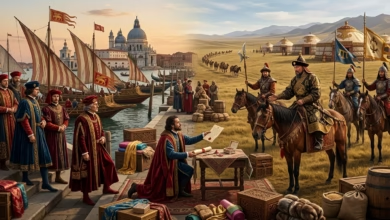
With The Movement Of The Clock Of History Toward Modern Eras, These Traditional Channels Began To Recede Gradually To Make Way For A Massive Epistemological Transformation Known In Intellectual Circles As The “Probabilistic Revolution.” The Authors Describe This Transformation As The Greatest Attempt Made By The Human Mind To Strip “Fate” Of Its Metaphysical Ambiguity And Transform It Into Numbers And Calculable Mathematical Ratios. This Revolution Began In Flamboyant Italian Cities During The Renaissance, Where Maritime Trade Across The Mediterranean Faced Immense Risks, From Pirates To Raging Storms That Could Swallow Entire Fortunes In The Blink Of An Eye. Here, The Need To Rationalize Risks Was Born, So The Earliest Forms Of Marine Insurance Contracts Appeared, And Mathematics Continued To Develop Slowly Until The Seventeenth Century When Thinkers Like Blaise Pascal And Pierre De Fermat Laid The Foundations Of Probability Theory. Managing The Future No Longer Depended On Appeasing Gods Or Waiting For Prophecies, But Became Dependent On Calculating Chances, Recording Mortality Tables, And Monitoring The Statistical Frequency Of Accidents.
This Transition From Incomprehensible “Uncertainty” To Calculable “Risk” Changed The Face Of Entire Human Existence And Represented The Foundation Stone For The Rise Of Commercial, Then Industrial Capitalism. However, Nützenadel And Streb Draw Our Attention To A Theoretical Trap That Subsequent Economic Thought Fell Into; As Those Confident In The Power Of Numbers Believed That The “Probabilistic Revolution” Had Entirely Eliminated Uncertainty, And That Everything In The Universe Could Be Reduced To A Normal Distribution Equation. This Epistemological Illusion Is What The Book Criticizes Fiercely, Showing That Rationalizing Fate Through Mathematics And Finance Created A Sort Of False Stability, Because It Ignored Fluctuation-Prone Human Behavior, And Continued To Assume That The Future Is Nothing But A Mechanical Repetition Of Past Data. Expectations, Even In The Most Scientifically Advanced Eras, Remain Conditioned By The Psychological And Social Context In Which They Are Born, And They Are Not Formed In A Laboratory Vacuum, But In The Midst Of Conflicts, Aspirations, And Fears Of Living And Moving Societies.
The Essence Of The Thesis In This Part Of The Book Manifests In Revealing The Stark Contradiction Between Cold Attempts To Institutionalize Risks And The Chaotic Nature Of Historical Crises. When The Authors Talk About The Development Of The Insurance Sector, They Do Not See It Merely As A Financial Tool, But Rather Read It As A “Psychological Institution” That Grants Investors And Individuals The Existential Daring To Move Forward With Their Projects Despite The Foggy Nature Of Tomorrow. Insurance Is The Mechanism That Transforms The Fear Of Catastrophe Into A Known Monthly Financial Premium, And Thereby The Economic Mind Is Able To Tame Anxiety And Turn It Into A Line Item In The Budget. But, What Happens When A Catastrophe Occurs Outside The Scope Of All Available Statistical Tables? What Happens When Markets Collapse Due To A Unique Event With No Origin In Old Records? Here, The Model Of “Risk” Crumbles, And Humanity Returns To Face Face-To-Face Its Eternal Adversary: Absolute Uncertainty.
The Book Links These Historical Shifts To Contemporary Crises That Our World Witnessed Recently, Confirming That Major Financial Collapses, Such As The 2008 Crisis, Were Not Because Of A Shortage In Mathematical Models, But Because Of Overconfidence In Them. Huge Investment Banks And Regulatory Institutions Forgot That Expectations Are Living Creatures Affected By Psychological Contagion, Rumors, And Prevalent Stories In Society. When A Certain Story Controls The Minds Of Economic Actors, Such as The Story Saying “That Real Estate Prices Can Never Decrease,” Expectations Become Conditioned By This Narrative, And Everyone Acts Based Upon It, Leading Ultimately To The Inflation Of The Bubble And Its Inevitable Explosion. Hence, The Book “Contingent Expectations” Restores Consideration To History As A True Laboratory For Economics, Showing That Studying The Behavior Of Humans In The Past When Facing Crises Is The Only Way To Understand The Mystery Of Decision-Making In The Present, And To Avoid Repeated Falling Into The Abyss Of Blind Trust In Silent Digital Models That Claim To Possess The Keys To Tomorrow.
The Industrial Earthquake And The Birth Of Speculative Capitalism.. The Nineteenth Century And The Invention Of Tomorrow
If The Probabilistic Revolution Had Placed The First Theoretical Seeds For Quantifying And Framing The Future, Then The Nineteenth Century Was Like The Stormy Practical Laboratory That Hurled Humanity Into The Furnace Of A Dynamic Economic Environment Of Which History Had Witnessed No Equal Before. Alexander Nützenadel And Jochen Streb Dedicate This Part Of Their Book To Monitoring That Massive Transformation That The Industrial Revolution Brought In The Minds Of Individuals And Institutions Alike, Where Expectation Was No Longer Merely A Tool To Protect Capital From The Calamities Of Time, But Transformed Into A Essential Engine For Producing Wealth And Multiplying It Through Financial and Future Channels Simultaneously. With The Appearance Of Railroads That Folded Distances, The Telegraph That Transmitted News And Prices Across Continents In Mere Seconds, And Giant Factories That Were Devouring Raw Materials And Pumping Out Commodities In Astronomy-Like Quantities, The Stable Old World With Its Agricultural Monotony Collapsed, And In Its Place Came An Industrial and Commercial Capitalism That Feeds On Constant Motion, And Relies Strongly On Formulating Continuous Bets Around What The State Of Markets Will Be In Coming Days.
The Authors Take Us On A Deep Archival Tour To Explore Major Speculative Markets That Were Born And Reared In Cities Like London, Paris, And New York During That Rowdy Century. Emerging Stock And Commodity Exchanges Were Not Merely Courtyards For Exchanging Deeds And Shares, But Were In Their Essence Farms For Producing and Trading “Contingent Expectations.” Here, Corporations And Governments Began Learning How To Sell And Buy Things That Did Not Exist Yet; Such As Cotton And Wheat Crops That Are Still Seeds In The Ground, Or Profits Of Gold And Silver Mines Whose Depths Have Not Been Dug Yet. In This Particular Environment, The Concept Of Expectation Became Conditioned By The Flow Of Information and Speed Of Catching It, And The Economic Actor Transformed From A Mere Traditional Merchant Comparing Supply And Demand In His Local Market, Into A Professional Speculator Trying To Read Global Trends, And Expecting Decisions Of Wars, Commercial Agreements, And Cross-Border Climate Fluctuations, To Formulate Based On Them Immediate Investment Decisions.
The Book Focuses On Two Vital Sectors That Witnessed An Unprecedented Boom In The Nineteenth Century, Real Estate Speculations And Financial Markets, To Show How Contingent Expectations Can Transform From A Driving Force For Building and Development Into A Demolition Tool Detonating Violent Crises. With Massive Urban Expansion And The Migration Of Millions From Rural Areas To Bloated Industrial Cities, Urban Lands Transformed Into A Grand Arena For Speculation. Investors Were Buying Vast Spaces On The Outskirts Of Cities Not Based On Their Current Value, But Based On “Contingent Expectations” Of The Extension Of Railroad Lines Or Growth Of Neighboring Factories Toward Them. When These Expectations Were Feeding On Excessive Optimism And Enthusiastic Stories Promoted By The Press and Financial Institutions, Land Prices Rose To Imaginary Levels That Reflect No Concrete Economic Reality, Creating Huge Real Estate Bubbles That Soon Burst To Leave Behind Waves Of Bankruptcy And Ruin, As A Living Example Of Expectations Slipping From The Rationality Of Risk Into The Chaos Of Uncertainty.
In Parallel To That, Nützenadel And Streb Trace The Astonishing Development Of The Modern Insurance Industry During This Epoch, Considering It The Institutional Zenith Of Human Attempt Aiming To Institutionalize and Domesticate Risks. Insurance Was No Longer Limited To Maritime Voyages As It Was In The Past, But Extended To Include Factories Against Fire, Workers Against Accidents, And Even Life Insurance Which Brought An Intellectual and Moral Revolution In Western Societies. The Authors Analyze How Major Insurance Companies Succeeded In Transforming Accumulated Statistical Data About Fires, Illnesses, And Deaths Into A Mighty Tool To Reduce The Level Of Uncertainty Among Employers And Families. Through Paying A Specific Financial Premium, The Investor Was Buying Peace Of Mind and Protecting His Project From Catastrophic Surprises, And Thereby Insurance Transformed Into A “Buffer For Existential And Economic Shocks” That Allowed Industrial Capitalism To Dash Forward Without Fear Of Paralysis Resulting From Anxiety Over Tomorrow. Nevertheless, This Institutional System Was Standing Helpless Every Time Collective Consciousness Was Reshaped By Virtue Of A Major Structural Crisis That Surpassed The Capacity Of Historical Data To Predict, Which Reveals The Autogenous Boundaries Of The Market Rationalization Process.
The Authors Clarify, Through Meticulous Examination Of Minutes Of Board Meetings And Corporate Financial Reports In The Nineteenth Century, That Decision-Makers Were Not Human Calculators, But Were Rather Humans Falling Under The Influence Of Institutional Routine, Social Norms, and Psychological Contagion Of Markets. When Storms Of Financial Panic Were Blowing, Like The Famous 1873 Crisis That Entered The World Into A Long Period Of Stagnation, All Predictive Models Available At That Time Were Collapsing Like Houses Of Cards, Because People’s Expectations Became Suddenly Conditioned By Total Fear and Absolute Loss Of Trust In The Banking System. History, In Nützenadel And Streb’s Treatment, Proves Time And Again That Rationalizing Economic Behavior Is An Extremely Thin Crust, And That The Desire To Predict Tomorrow Remains Governed By An Eternal Dialectic Between Human Ambition In Control and The Untamed, Sudden Nature Of Historical And Social Transformations That Refuse To Comply With Any Rigid Theoretical Molds.
Tests Of The Stormy Twentieth Century.. Cracking Of Normative Models And Explosion Of Crises
If The Nineteenth Century Represented The Golden Age For Inventing and Constructing Expectation Systems And Manufacturing Institutional Peace Of Mind, Then The Twentieth Century Came As A Shocking Epistemological and Historical Shock, Reflecting With Harsh Brutality The Limits Of Human Capacity To Predict and Control The Paths Of The Global Economy. Alexander Nützenadel And Jochen Streb Move Us, At This Crucial Juncture Of Their Book, To Studying The Twentieth Century As A True Minefield, In Which Exploded All Mathematical Certainties That Capitalism Believed It Settled Upon, Where Crises Were No Longer Merely Passing Business Cycles Whose Shocks Could Be Absorbed Via Mechanisms Of Insurance And Organized Speculation, But Rather Transformed Into Violent Catastrophes Connected To Major World Wars, Conflicting Totalitarian Ideologies, And Cross-Continent Financial Collapses. In This Foggy And Complex Scene, The Thesis Of The Book Reveals How Normative Economic Models That Assume Rationality Of Actors and Stability Of Human Behavior Faltered, To Prove Anew That Expectations Always Remain Living Creatures, Conditioned By Fear, Collective Memory, And Political Disruption That No Mathematical Equation Can Be Large Enough To Hold.
The Authors Focus On Two Pivotal Events That Changed The Face Of The World, The First World War And The Wave Of The Great Depression In 1929, To Show How Absolute Uncertainty Emerges To Dash All Previous Attempts Of Rationalization. Before The Summer Of 1914, Economists And Bankers Believed That The First Globalization And The Intertwining Of Commercial And Financial Interests Among Great Powers Made The Outbreak Of A Comprehensive War An Almost Impossible Matter, Or At Least A Highly Excluded Risk According To Calculations Of Probabilities Prevalent At The Time. But, As Soon As The First Bullets Were Fired In Sarajevo, This Optimistic Expectation Collapsed Within A Few Weeks, And The World Found Itself In Front Of An Entirely New Pattern Of Economy; Which Is The “War Economy” Where Expectations Are Managed Based On Decisions Of Military Mobilization, Blockade Of Ports, And Total Destruction. Here, The Book Explains How States And Corporations Were Forced To Abandon Their Traditional Plans And Develop Emergency Mechanisms For Contingent Expectation, Governed By Purely Political And Military Variables That Lie Entirely Outside The Boundaries Of Traditional Economics And Its Statistical Tables.
With The Recess Of The Dust Of War, The World Scarcely Caught Its Breath Until It Was Blind-Sided By The Crisis Of The Great Depression In 1929, Which Nützenadel And Streb Analyze As The Greatest Historical Condemnation For The Arrogance Of Cold Normative Models. The Sudden Collapse Of The Wall Street Stock Market Was Not Merely A Technical Flaw In Trading Mechanisms, But Was Rather A Reflection Of The Vanishing Of Collective Confidence And The Explosion Of A Bubble Of Expectations Conditioned By Blind Optimism And Narratives Of Quick Wealth That Characterized The Rowdy Twenties Era. When Excessive Optimism Shifted Suddenly Into Absolute Panic, All Traditional Economic Models And Monetary Policies Failed To Contain The Crisis, Because Human Behavior Became Governed By The Instinct of Survival And Fear Of Tomorrow, Driving Everyone To Withdraw Their Monies From Banks And Halt Consumption, Which Were Behaviors That Seemed Rational And Individual To Protect One’s Self, But Guided Collectively To A Complete Paralysis In The Arteries Of The Global Economy And Economies Of Nations. This Deep Historical Treatment Reveals That Economic Expectations Do Not Move In Straight Linear Paths, But Rather Subside To Sudden Psychological And Institutional Jumps And Shifts Imposed By The Context Of The Crisis Itself.
The Book Then Traces How These Successive Shocks Led To The Birth Of A New Economic Thought That Attempted To Institutionalize Expectations In A Different Way, Specifically With The Rise Of Keynesian Theory And The Growing Interventionist Role Of The State In The Economy. John Maynard Keynes Realized, As The Authors Explain, That Investment Is Not Led By Cold Mathematical Calculations Of The Future, But Rather By What He Called “Animal Spirits,” Which Are Those Psychological Impulses Of Trust, Fear, Initiative, And Retreat That Move Investors In Conditions Of Uncertainty. Based Upon This, The State Transformed In The Second Half Of The Twentieth Century Into A “Maker Of Strategic Certainty,” Through Adopting Social Welfare Policies, Guaranteeing Bank Deposits, And Managing Aggregate Demand, Aiming To Create A Stable Institutional Environment That Allows Individuals And Corporations To Form Positive Expectations Conditioned By The Guarantee Of The State And Its Protection. Nevertheless, This Keynesian Institutional Structure Faced In Turn A Stormy Test In The 1970s With The Appearance Of The Stagflation Dilemma, Which Was The Crisis Exploited By The Chicago School And Neoliberalism To Re-Market The Theory Of “Rational Expectations” That Assumed Anew That Markets Are Capable Of Correcting Themselves By Themselves If The Hand Of The State Is Lifted Off Them, An Illusion That Continued To Dominate Until The Crisis Of The Great Recession Exploded In 2008.
The Great and Central Lesson That Nützenadel And Streb Extract From The Fluctuations Of The Twentieth Century, and Offer As A Solid Intellectual Contribution, Is That The Attempt To Reduce Economics Into Mere Technical Equations That Ignore The Historical And Social Dimension Is A Confirmed Recipe For Disasters. Economic Expectations, In The Final Analysis, Are Not Merely Neutral Scientific Predictions Of The Future, But Are Rather Active And Influential Forces Participating In Making This Future And Shaping It.