

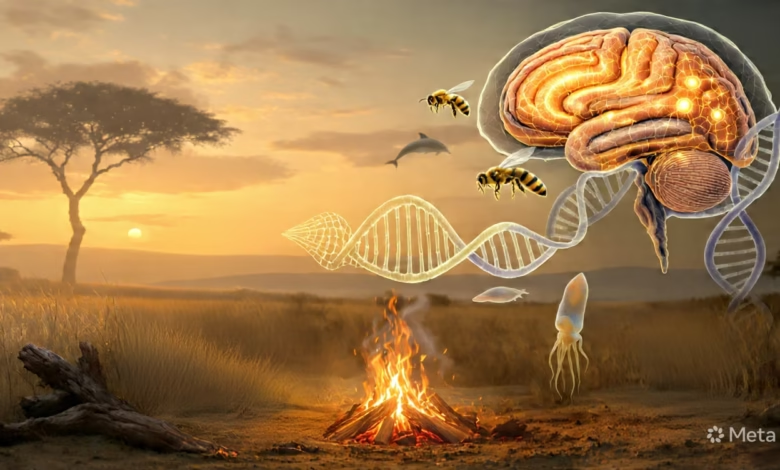
It Seems That The Search For Our Human Origins And The Story Of Our Evolution Inevitably Passes Through The Gateway Of The Word. In The Book “The Dawn Of Language: How We Came To Talk” By Author Sverker Johansson, Translated From Swedish To English By Frank Perry In A MacLehose Press Edition, We Are Before An Amazing And Profound Investigative Journey Attempting To Decipher One Of The Most Complex Riddles In The History Of Human Evolution.
What Makes Us Human? We Like To Think Of Ourselves As Distinct, Unique Beings, Different From All Other Animals. Over The Years, Scientists And Philosophers Have Proposed Long Lists Of Traits Supposedly Unique To Humans, Whether In Terms Of Body Or Soul. Although “Possessing A Soul” Is A Type Of Trait Supposedly Unique To Humans, There Are No Clear Scientific Answers As To Whether We Possess A Soul While Other Animals Do Not. However, The Trait That Has Formed A Decisive And Clear Difference, Which This Book Investigates With Passion, Journalistic Skill, And Scientific Mastery, Is Our Amazing Ability To Communicate: “Language.”
From Particle Physics To The Riddle Of The First Word, The Story Begins With An Inexhaustible Childhood Curiosity. Most Children Go Through A Phase Around The Age Of Four Where They Ask “Why” About Everything, And Are Not Satisfied Even When They Get An Answer, But Each Answer Leads Them To A New “Why.” Johansson Was One Of These, But He Never Got Tired Of Asking Questions, And Continued Doing So For More Than Fifty Years. The Credit For This Goes To His Father, Who Never Tired Of Answering And Explaining Through Investigation. This Curiosity Initially Led Johansson To A Respected Scientific Career As A Particle Physicist. But After Obtaining His PhD In 1990 For His Work At The Particle Collider In Switzerland, He Discovered Something More Exciting For Him Than Exploring Physics: Language. Through An Evening Course In General Linguistics He Initially Took For Pleasure, The Author Discovered The Excitement Inherent In Studying Language And The Huge Number Of Questions That Still Remain Unanswered About How It Works. “The Origin Of Language,” In Particular, Was A Subject Still Shrouded In Darkness, Which Ultimately Led Him To Change His Research Path Entirely To Eventually Bear Fruit In This Profound Book.
What Is Language: The Dividing Lines Between Us And The Animal Kingdom. To Research The Origins Of Language, The Author Had To First Establish What Language Itself Is. In The 1960s, Linguist Charles Hockett Published A List Of “Design Features” That He Considered Distinctive To Human Languages, Which Could Be Used To Define What Language Is And Deconstruct Its Structure. This List Included Features Such As:
-
Vocal-Auditory Channel: Communication Is Primarily Through Sound And Hearing.
-
Broadcast Transmission: Transmission Is Not Directed (Meaning Anyone Nearby Can Hear The Message), Although Reception Is Directed To The Receiver.
-
Rapid Fading: The Sound Disappears Immediately, Unlike The Olfactory Or Chemical Trails Left By Some Animals.
-
Interchangeability: Anything That Can Be Heard Can Be Said And Reproduced.
-
Semanticity: Every Signal In Language Is Specifically Tied To A Specific Meaning.
-
Arbitrariness: There Is No Specific Or Logical Inevitable Pattern Connecting Signals To Their Meanings; The Relationship Between A Word And Its Meaning Is A Relationship Of Social Agreement.
-
Discreteness: Language Is Built From Components Seen As Separate Elements, With Two Levels Of Composition: From Scattered Speech Sounds To Words, And From Words To Organized Sentences.
-
Displacement: Linguistic Communication Can Revolve Around Things Not Present In The Present, Or About Events In The Past And Future.
-
Learnability: Language Can Be Learned And Passed On As A Tradition Within The Group, Where Children Learn From Adults And Adults Can Learn New Languages From Each Other.
-
Prevarication (The Ability To Deceive): You Can Simply Lie Using Language.
Although Hockett Noted That Many Individual Features In The List Could Be Found Scattered In The Communication Systems Of Different Animals, Only Human Language Shares And Combines All These Features Into One Integrated System. However, Johansson Points Out That This List Suffers From Some Weaknesses; Hockett’s List Focused Clearly On The Surface Features Of Language Rather Than The Deep Aspects Of Its Content And Structure, Or How It Is Processed And Understood In Our Brains. For Example, The Almost Limitless Expressive Capability Of Human Language, And Its Unique Ability To Express An Infinite Number Of Different Messages, Is The Primary Aspect. Without The Combinatorial Arrangements Of Sounds Into Words, Every Word In Spoken Language Would Be Its Own Unique Sound, And The Human Throat Is Completely Incapable Of Producing The Tens Of Thousands Of Different And Distinct Sounds Necessary To Cover All The Meanings Of Life.
The Power Of Lying As An Evolutionary Weapon: One Of The Interestingly Clear Points In Johansson’s Analysis Is Our Ability To Lie. The Ability To Deceive Is A Decisive Feature Of Language And Requires Special Attention Regarding The Evolution Of The Human Ability For Language. Animals Communicate In Various Ways, But Their Communications In Most Cases Are Considered “Honest” Communications; Not Because Animals Are More Honest Or Morally Committed Than We Are, But Because Animal Signals Evolved Mostly In A Way That Makes Lying Biologically And Evolutionarily Impossible. Take, For Example, Male Elk; They Convey A Clear Message Through Their Antlers, As A Male With Twelve Points Tells Others How Big And Strong He Is To Be Able To Carry This Heavy And Costly Crown Throughout The Summer. An Elk Cannot Lie And Claim To Be Strong And Fit, As The Only Way To Grow Large Antlers Is To Have A Lot Of Muscle And A Lot Of Surplus Food That Enabled Him To Do So. Costly Signals That Cannot Be Used For Deception Are The Only Evolutionarily Stable Evolutionary Path For Elk. But Human Language Does Not Work In This Direct Way. Speech Is “Cheap” (It Does Not Cost Enormous Biological Energy To Produce) And We Lie Whenever We Want, Yet The Human Communication System Does Not Collapse. We Listen To Each Other And Trust Each Other Enough For The System To Continue, Which Raises A Deep Evolutionary Question About Why Our Language Does Not Collapse Under The Weight Of Potential Lies, Which Leads Us To Understand The Complex Social Composition Of Human Trust.
The Communication Conflict: Talking Animals And Lab Monkeys. The Book Also Takes Us On An Interesting Tour Comparing Our Abilities With Our Partners On This Planet To Attempt To Understand The Exclusivity Of Our Language. The Author Touches Upon The “Waggle Dance” Performed By The Scout Bee To Tell Her Colleagues The Location Of Flowers And Nectar Through Complex Dance Movements And Patterns That Determine Distance And Direction With Extreme Precision Based On The Angle Of The Sun. This Communication Is Amazing, But It Is Not A Flexible Language That Can Be Adapted. Similarly, Male Nightingales Sing Complex Songs And Mix Sounds To Attract Females, And Although The Nightingale’s Song Theoretically Possesses The Ability To Be Expressive Like Human Languages Thanks To Its Complex Structures, What It Lacks Is The Flexible Link Between Form And Message. Indeed, The Cuttlefish Dances Changing Its Colors In Flashy Patterns To Communicate Under The Sea, And Dolphins Possess “Signature Whistles” Specific To Each Dolphin (Like Names) And Use Sonar To Warn Each Other In An Advanced Manner. Even Vervet Monkeys Possess Specific Warning Screams; A Scream For Leopards That Pushes Them To Climb Thin Branches, And A Different Scream For Eagles That Pushes Them To Hide In The Bushes. However, All These Systems Are Closed, Restricted, And Tied To Their Immediate Environment. They Lack The Ability For Infinite Abstraction Or Displacement From The Context Of “Here And Now.”
Attempts To Teach Language To Monkeys Are Another Interesting Part Of Johansson’s Review. There Have Been Many Attempts To Teach Animals Speech, With Varying And Often Very Modest Success. Parrots Naturally Have A Talent For Mimicking Language, And They Are In Fact The Animals Closest To The Ability To Learn To Speak Like People Outwardly. But When It Comes To Great Apes, Our Closest Relatives, All Attempts To Teach Them Spoken Speech Have Ended In Failure, Because They Totally Lack The Flexible Control Over Their Vocal Organs Necessary To Produce Speech Sounds, Shape Them, And Merge Them Into Words. Even The Attempt To Raise A Chimpanzee Named “Gua” In A Human Family In The Early Thirties As An Adopted Child Did Not Make Any Significant Difference; Gua Was Able To Keep Pace With Her Human Adoptive Brother In Almost Everything Except Language. Later, Scientists Moved To Use Sign Language With The Chimpanzees “Washoe” And “Nim Chimpsky,” And Although They Learned Some Symbols And Signs And Communicated In Certain Contexts, The Lack Of Initiative To Invent Words Or The Complex Understanding Of Hierarchical Rules Made The Gap Between Them And Human Ability Wide And Deep.
Communication As A “Puzzle” Rather Than A “Code”: Among The Most Prominent Features Of Johansson’s Approach In This Presentation Is His Proposal Of The Concept Of Communication As “Puzzle Communication” In Contrast To Classical Communication As A “Code.” The Author Sees That Living, Daily Linguistic Communication Between Humans Depends On Two Basic Principles: The “Ostensive” Aspect By The Speaker Who Shows Their Intention To Communicate, And The “Inferential” Aspect By The Listener Who Tries To Decipher The Intent. The Literal Meaning Is Not Determined By Pure Linguistic Expression Alone, But By All The Circumstances Surrounding The Statement, And The Listener Must Put The Pieces Of The Puzzle Together To Reconstruct The Speaker’s Intended Message. Therefore, The Spoken Language We Use In Natural Daily Conversations Differs Radically From Formal, Rigid Written Language. Speaking Face-To-Face With People With Whom We Share Context And History Creates An Ideal Environment For “Puzzle Communication,” Where Words Can Be Shortened Or Large Parts Deleted With Total Confidence That The Listener Will Efficiently Assemble The Rest Of The Picture. In Contrast, Written Language Or Television Advertisements Must Operate As A “Code,” Where The Entire Message Must Be Strictly Contained In The Words Themselves.
Johansson Rejects The Idea That Language Emerged Suddenly As A Result Of One Magic “Genetic Mutation” In Homo Sapiens, And Instead Adopts A Gradual Darwinian View That Sees That Language Was Formed Over Hundreds Of Thousands Of Years. This Path Begins With “Homo Erectus” About A Million And A Half To Two Million Years Ago; These Ancestors Who Made Complex Stone Tools, Controlled Fire, And Perhaps Crossed Water Bodies, Needed A Level Of Cooperation And Knowledge Transfer That Could Not Be Achieved By Mere Primitive Grunts, But Required A Kind Of “Protolanguage.” This Evolutionary Development Extends To Include Neanderthals, Where Johansson Fiercely Refutes The Myth That Portrayed Them As Stupid Creatures Who Only Knew How To Scream, Presenting Archaeological And Genetic Evidence Indicating Their Possession Of Large Brains And Their Practice Of Complex Rituals Like Burial And Making Jewelry, Which Strongly Suggests Their Possession Of A Developed Linguistic System Matching Our Early Language.
To Explain This Development, The Book Dives Into The Anatomy Of Speech To Answer A Fundamental Question: Why Can We Pronounce Thousands Of Words While A Chimpanzee Chokes If It Tries To Do So? The Answer Lies In The Combination Of Several Biological Factors, First Of Which Is The Anatomical Change Represented In The “Lowered Larynx.” Unlike Apes, Human Throats Possess A Low Position In The Neck, A Design That Created A “Resonance Chamber” Allowing Us To Produce A Huge And Precise Range Of Sounds, Although It Came At An Evolutionary Tax That Increases The Risk Of Choking On Food. This Is Accompanied By The Role Of The FOXP2 Gene, Which Is Not A Ready-Made Genetic Dictionary As Rumored, But Rather The Gene Responsible For Precise Motor Control Of The Mouth, Face, And Tongue Muscles, And Remarkably, We Share This Gene With Neanderthals. This System Is Completed By The Neural Networks In Our Brains That Developed To Include Specialized Areas That Not Only Process Sounds, But Also Analyze “Intent” And “Grammatical Rules” And Grant Us The Deep Ability To Read The Thoughts Of Others.
However, This Complex And Costly Biological System Could Not Have Developed Without The Existence Of Enormous Social And Environmental Pressures That Forced Humans To Absolute Cooperation For Survival. Johansson Proposes Here The “Shared Care” Hypothesis, Pointing Out That The Birth Of Human Children With Large Brains But Incomplete Development Requires Intensive And Long-Term Care That Is Not Limited To The Mother Alone, But Includes The Father, Grandmothers, And The Entire Tribe, Which Requires A Precise Language To Coordinate These Educational Efforts. The Author Also Relies On Research By Anthropologist Robin Dunbar To Explain How “Gossip” Became A Substitute For The “Grooming” Process (Mutual Fur Cleaning) Used By Apes To Build Their Alliances; With The Increase In The Size And Expansion Of Human Groups, Time Was No Longer Enough To Clean Everyone, So Gossip And Sharing News Emerged As A Fast And Effective Way To Build Social Alliances And Know Who Could Be Trusted. This Extreme Cooperation Required By Hunting Large Animals, Making Tools, And Facing The Harsh Climate Made It Imperative To Have A Language That Possesses The Property Of “Displacement,” That Is, The Ability To Plan And Talk About The Past And Future, Rather Than Just Settling For Immediate Reactions.
In The Midst Of This Intertwined Social Development, The Book Suggests That Our Ancestors Began Communicating Through A Mix Of Physical Gestures And Single Sounds To Represent Objects And Actions. With The Increasing Complexity Of Social Life, It Was No Longer Enough To Pronounce Scattered Single Words, But The Urgent Need Arose To Arrange Them To Know The Details Of Events And Their Doers Precisely. Thus, Grammatical Rules Were Born, Not As A Conscious Invention Or Intentional Engineering, But As A Pragmatic Tool Necessary To Organize Thoughts And Reduce Ambiguity In The Human “Communication Puzzle,” To Become Fossilized Over Time And Turn Into The Complex And Established Rules We See In Thousands Of Languages Today.
In The End, Johansson In “The Dawn Of Language” Presents An Amazing Scientific Panorama That Combines Linguistics, Anthropology, And Evolutionary Biology. Despite The Inevitable Absence Of Fossils That Record Spoken Words, The Book Weaves A Cohesive Network Of Evidence That Confirms That Our Language Was Not A Sudden Gift, But Rather The Product Of A Long And Amazing Journey Of Biological Adaptation And Exceptional Social Cooperation That Made Us, In The End, Talking Humans.
In Johansson’s Proposals, A Vital Issue Emerges That Has Not Received Its Due Of Research, Which Is The Influence Of Language On The Way We Think, Or What Is Known As The “Linguistic Relativity” Hypothesis. The Author Does Not Stop At Reviewing How And Why We Spoke, But Questions With Scientific Curiosity Whether The Different Languages We Speak Impose Upon Us Different Mental “Glasses” To See The World. Johansson Discusses Intelligently How Language Classifications, Such As How We Divide Colors Or Determine Geographical Directions In Space, Affect The Shaping Of Our Sensory Perception. Instead Of Considering Language A Mere Neutral Means To Convey Ideas, He Presents It To Us As An Organizational Framework That Contributes To Building Our Cognitive Models Of Reality, Which Reinforces The Idea That Linguistic Diversity Is Not Merely Diversity In Sounds, But Rather A Wealth In The Ways Of Living The Human Experience Itself.
The Book Also Sheds Light On The Future Of Language In Light Of The Digital Age And Artificial Intelligence, Which Represents A Logical Extension Of The Development Process We Began Millions Of Years Ago. Johansson Proposes A Reflective Vision About How Technology Changes Our Ways Of Communication; Just As We Invented Language To Overcome The Limitations Of Limited Physical Communication, We Are Today Inventing New “Languages” With Machines. The Author Questions Whether These Tools Will One Day Become An Integral Part Of Our Cognitive Structure, Just As Written Language Became An Extension Of Our Memory And Thinking. This Question Puts Us Before An Amazing Paradox: Are We On Our Way To Developing A New Form Of “Post-Linguistic” Communication, Or Will Human Language, With Its Flexibility And Superior Ability To Adapt, Remain The Only System Capable Of Absorbing The Complexities Of Our Intelligence And Our Collective Feelings?
Johansson Continues To Deconstruct The Prevailing Theories About Our Communicative Origins, Presenting In His Chapters A Bold Intellectual Confrontation With One Of The Pillars Of Modern Linguistics: Noam Chomsky. For Long Decades, Chomsky’s “Universal Grammar” Theory Dominated, Which Assumes That Humans Are Born With A “Language Organ” Or An Innate Brain Unit Containing The Basic Rules For All Languages, And That Children Only Need To Adjust Some Settings To Learn Their Native Language. Johansson Strongly Rejects This Vision, Considering It Inexplicable From The Perspective Of Darwinian Evolution; It Is Very Unlikely That A Sudden Genetic Mutation Would Arise That Plants Complete And Complex Grammatical Rules In The Human Brain. Instead, The Author Offers An Alternative Based On Gradual Biological And Cultural Evolution, Where Our Brains Did Not Evolve To Fit Grammar, But Languages Themselves Evolved Over Time To Fit The Way Our Brains Work And Learn.
In This Context, The Book Strongly Adopts The Approach Based On “Usage” To Explain How Children Acquire Language. The Human Child Is Not Born Equipped With A Genetic Dictionary Or Ready-Made Grammatical Rules, But Is Born With An Amazing Cognitive Machine Capable Of Distinguishing Patterns And Reading The Social Intentions Of Others. Children Learn Language Through Constant Practice, Imitation, Understanding The Context Of Situations, And Storing Blocks Of Words And Phrases They Hear In Their Surrounding Environment. With The Accumulation Of These Phrases, Their Brains Gradually Begin To Extract General Rules And Patterns. This Explanation Returns Language To The Bosom Of Living Social Interaction, Far From The Black Boxes Of Virtual Genes, Making The Language Learning Process A General Cognitive Skill That Intertwines And Interacts With Our Capabilities To Learn And Solve Problems In All Areas Of Life.
The Investigative Journey Does Not Stop At The Origin Of The First Language Or The Mechanism Of A Child Learning It, But Extends To Include How Languages Diversify And Develop Culturally. Johansson Explains How Languages Behave As Living Beings Subject To The Laws Of Cultural Evolution, Where They Branch, Interbreed, And Go Extinct. He Cites Wonderful Examples From Reality, Such As Hybrid Languages That Arise When Groups That Do Not Speak A Common Language Are Forced To Communicate In Work Or Trade Environments, And How Children In The Next Generation Transform Them Into “Creole” Languages Complete With Rules And Pillars. He Also Highlights Nicaraguan Sign Language, Which Was Invented By Deaf Children Who Gathered Together In One School In The Eighties, To Create A Completely New Language From Scratch Without Any Intervention Or Indoctrination From Adults. These Living Examples Stand As Irrefutable Proof That The Human Drive For Communication And Building Shared Meanings Is An Innate And Collective Force That Cannot Be Restrained.