

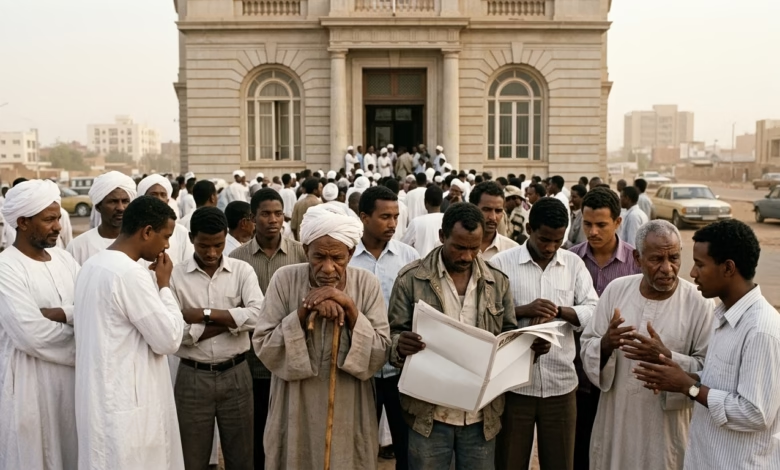
In The Modern Political History Of East Africa And The Arab World, Sudan Remains An Exceptional Case That Defies Simplistic, Stereotypical Understanding. It Is A Continent-Sized Country Whose Early Signs Of Independence Promised That It Would Become The Most Rational Model For Democratic Governance In The “Third World”; A Country Possessing Ethnic Diversity, Cultural Richness, And Early Trade Union And Political Awareness That Qualify It To Be A Beacon For The Peaceful Transition Of Power. However, These Wide Hopes Quickly Collided With The Rock Of Reality, And Its Governance Experience Transformed Into A Vicious Circle Between A Nascent Democratic Ambition And Military Coups Lurking In Wait For The Country At Every Historical Turning Point.
Within This Context Comes The Book “Parliamentary Elections In Sudan (1953–1986): A Historical-Analytical Approach,” Jointly Authored By Two Prominent Figures Of Sudanese Thought And Academic Research: Dr. Ahmed Ibrahim Abu Shouk And Dr. Al-Fatih Abdullahi Abd Al-Salam. This Massive Volume, Whose First Edition Was Published By The “Abdel Karim Mirghani Cultural Center” In Omdurman, Does Not Represent A Mere Dry Chronological Narration Of Voting Processes Or A Collection Of Mute Figures And Statistics; Rather, It Is A Meticulous Dissection, Conducted With A Surgeon’s Scalpel And A Scholar’s Expertise, Of The Structural, Social, And Cultural Framework That Shaped The Path And Evolution Of The Sudanese State From Before Independence Until The Eve Of The Third Military Coup In 1989.
The Philosophy Of Elections Between Legitimacy And Cosmetic Makeup
The Authors Open Their Study With A Highly Important Methodological Introduction Regarding The Philosophy Of The Electoral Process In Contemporary Political Science. The Book Presents A Conscious Deconstruction Of The Duality That Governs Elections As A Functional Mechanism; In Democratic Systems, They Represent The Ultimate Embodiment Of The People’s Will and The Institutional Means Through Which The Ruler Derives Legitimacy Via A Temporary Popular Mandate That Is Accountable And Revocable. In This Positive Paradigm, Elections Achieve A Decisive Separation Between The Personal Presence Of The Ruler And The Authority He Exercises On Behalf Of The Community.
On The Other Hand, The Book Turns Its Attention To The Negative Utilization Of Elections In Totalitarian Systems. Here, The Ballot Boxes Are Transformed Into What The Authors Call “Electoral Makeup,” Which Autocratic Regimes Attempt To Use To Conceal Their Permanent Structural Defects and Absorb Pressure From Opponents Calling For Reform and Democratic Transition. These Sham Elections Fundamentally Lack The Three Normative Criteria Governing Any True Democratic Practice: Efficacy, Freedom, And Integrity. Because Of This Foundational Grounding, The Authors Made A Strict Methodological Choice To Exclude The Parliamentary Elections And Councils Established During The Eras Of Lieutenant General Ibrahim Abboud (1958–1964) And Field Marshal Gaafar Nimeiry (1969–1985), On The Grounds That They Aimed To Confer Fake Legitimacy On Totalitarian Military Regimes That Had Confiscated Basic Rights And Liberties.
Based On This Methodological Sorting, The Book Confines Its Analytical Scalpel To The Five Major Democratic Milestones Experienced By Sudan In Modern Times: The 1953 Elections (Which Paved The Way For Independence), Followed By The Elections Of 1958, 1965/1967, 1968, Leading Up To The Final Milestone In 1986.
The Methodological And Documented Pillars For “Dissecting The Sudanese Case”
What Grants This Book Its Status As A “Peer-Reviewed” Work and Scientific Leadership Is Not Merely The Grandeur Of The Subject Matter, But The Documentary And Methodological Arsenal Upon Which The Two Researchers Relied. This Study Brought Together Four Complementary Scientific Methods: The Descriptive-Analytical Method, The Inductive Method, The Historical Method, And The Statistical Method. Through This Methodological Network, The Authors Successfully Provided Four Comprehensive Study Focuses:
The First Focus: It Deals With A Detailed Tracking Of The General Political Scene, The Constitutional And Legal Frameworks In Which Electoral Laws Were Drafted, The Distribution Of Constituencies, And The Eligibility Of Voters And Candidates.
The Second Focus: It Dives Into The Space Of Freedom, Addressing The Nature Of Political Parties, Their Programs, And The Propaganda Mechanisms They Utilized To Win Over Public Opinion, Including Cultural Dimensions Such As Political Jokes And Popular Slogans.
The Third Focus: It Evaluates With High Efficiency The Administrative And Organizational Aspects Of The Electoral Process, Starting From Registration, Passing Through Voting, All The Way To Counting And The Announcement Of Results.
The Fourth Focus: It Is The Most Academically Valuable, As It Documents Results Using Statistical Tools And Detailed Tables Broken Down By Directorates And Constituencies, Allowing These Mute Figures To Submerge Into An Analytical Reading That Connects Them To The Human And Social Demographics In Sudan.
Sudanese Political Thought Has Long Suffered From A Gap In Documentation And In-Depth Analysis; Most Previous Studies Were Either Cold Documentary Collections That Gathered Figures And Data Lacking Interpretation And Contextual Accommodation Within Social Realities—Such As The Works Of Mohamed Ibrahim Tahir And Mohamed Mohamed Ahmed Karrar—Or They Were Studies That Focused On The Development Of Constitutional Systems In General, Such As The Book By Dr. Ibrahim Haj Musa. The Distinctiveness Of This Book, However, Stems From Its Reliance On Highly Confidential And Critical Primary Sources, Chief Among Which Are “The British Documents On Sudan (1940–1956),” Translated Into Arabic By Mr. Mahmoud Saleh In His Massive Project. The Authors Utilized Five Full Volumes Of These Documents To Unravel The Secrets Of The 1953 Elections, Relying On The Minutes Of Joint Committees, Confidential Reports By British Administrators, And Contemporary Partisan Newspapers Of That Era.
The Sudanese Mosaic: Diversity As A Blessing And A Curse
The Fundamental, Shocking Idea That The Book Places Before The “Guardians Of Strategic Thinking In Sudan” Is That This Country Does Not Belong To The Political Elite Alone; Rather, It Is A Vast Geographical And Human Space That Carries Within It A Sharp Binary Diversity. It Is A Mosaic Diversity Between Rural And Urban Areas, Between Tribe And Party, And Between Sufi Religious Loyalty And Modern Civic Awareness.
The Authors Believe That This Diversity Could Have Been A Lever For Civilizational Advancement And A Unique Cultural Cross-Pollination Had It Been Positively Utilized Within Stable Constitutional Frameworks That Respect Pluralism And Other Opinions. However, The Selfish And Narrow Political Exploitation Of This Diversity By Traditional And Modern Political Parties Alike Led The Country Into The Trap of Fragmentation And Division, Transforming Honest Democratic Competition Into Partisan Animosities, Sectarian Mmahcations, And Fractured Regional Strife. Instead Of Ballot Boxes Being A Tool For Nation-Building, They Often Became A Reflective Mirror Of Ethnic And Sectarian Polarization, Which Repeatedly Paved The Way For The Intervention Of The Military Establishment To Impose The Silence Of The Graveyard In The Name Of Preserving National Unity.
The Self-Government Agreement: A Leap Into The Dark Of Condominium Rule
The Authors Begin By Deconstructing The Complex Constitutional And Political Background That Preceded The Voting Process. On February 12, 1953, The British Government And The Egyptian Government (Which Had Just Witnessed The Revolution Of July 23, 1952, Led By The Free Officers) Signed The “Self-Government and Self-Determination Agreement for Sudan.” This Agreement Served As The Historical Compromise That Ended Decades Of Colonial Procrastination and Recognised The Right Of The Sudanese People To Exercise Self-Government For A Transitional Period Not Exceeding Three Years, Followed By The Process Of Self-Determination.
However, The Biggest Dilemma Facing The Two Colonial Powers (Britain And Egypt) Lay In The Total Lack Of Mutual Trust. Britain, Through Its Colonial Administration In Khartoum (Sir Robert Howe And His Staff), Feared The Rise of The Pro-Egyptian Unionist Current and Viewed The Independentist Umma Party As A Natural Ally That Would Preserve British Interests. Conversely, Cairo, Under The Leadership Of Major General Muhammad Naguib And Staff Major Salah Salem, Was Pumping Mass Funds And Immense Political Propaganda To Support The Unionist Parties, Considering The Battle Of Sudan To Be A Battle For Egyptian National Security In The Depths Of The Nile Valley.
The Supervising International Commission: India Manages Sudanese Democracy
In The Face Of This Sharp Polarization, The Agreement Stipulated The Formation Of The “International Electoral Commission” To Ensure Its Integrity And Impartiality. Here, The Review Of The Minutes Of This Commission, Chaired By A Neutral Indian Judge, Mr. Sukumar Sen, Emerges Prominently. The Commission Included In Its Membership Representatives From Britain, Egypt, The United States, And Two Sudanese Members.
This Commission Faced Logistical And Geographical Challenges Akin To Miracles; How Could Modern Elections Be Conducted In A Vast Country Whose Terrain Swallow Forests And Swamps, Suffering From An Illiteracy Rate Exceeding 90% At That Time, Alongside The Total Absence Of Road And Communication Networks? Here, The Book Describes With Great Admiration How The Commission Devised Innovative Solutions, Such As Using Animal And Plant Symbols To Identify Candidates (The Elephant, The Lion, The Camel, The Tree), And Using Different Colors For Ballot Boxes To Facilitate The Process For Illiterate Voters, And Even Adopting Alternative Voting Methods Like “Raising Hands” Or “Oral Voting” In Some Remote Areas of The South And Peripheral Directorates Of Purely Tribal Nature.
The Map Of Alliances: The Clash Of Great Currents
The Book Paints A Highly Accurate Sociological Portrait Of The Political Forces That Entrenched Themselves In Those Elections. The Scene Was Divided Into Two Main Currents Driven By Sectarian Religious Leaders Possessing Overwhelming Spiritual Influence Over The Masses:
The Unionist Current: It Was Embodied In The “National Unionist Party” Led By The Leader Ismail Al-Azhari. This Party Succeeded In Merging Several Small Unionist Factions Under One Banner, Relying On Massive Egyptian Financial And Media Support, And The Sweeping Spiritual Loyalty Of The “Khatmiyya Order” Led By Sayyid Ali Al-Mirghani, Who Maintained Historical Enmity Toward The Umma Party.
The Independentist Current: It Was Embodied In The “Umma Party,” The Political Arm Of The “Ansar Movement” (Followers Of The Mahdi) And Under The Direct Sponsorship Of Sayyid Abd Al-Rahman Al-Mahdi. The Party Raised The Slogan of Full Independence and Was Highly Apprehensive Of Egyptian Intentions, But It Fell Into The Trap Of Counter-Propaganda That Accused It Of Collaborating With Britain and Desiring To Restore The Monarchy By Crowning Sayyid Abd Al-Rahman As King Of Sudan.
A Historical-Analytical Note From The Book: “The Electoral Battle In 1953 Was Not A Struggle Over Economic Programs Or Development Plans For The Reconstruction Of The Country; Rather, It Was A Radical, Bone-Crushing Battle Over ‘Direction and Loyalty’, Where The Sanctity Of The Sufi Prayer Rug Intertwined With The Pragmatism Of Modern Political Action.”
The Earthquake Of Results And The Shock Of The British “Mister”
When The Election Results Were Announced In December 1953, The Outcome Fell Like A Thunderbolt Upon The Heads Of The British Administrators In Khartoum, Coming As A Complete Disappointment To The Estimates Of British Intelligence and Political Attachés. The National Unionist Party (Pro-Egyptian) Achieved A Sweeping, Clear Victory.
Let Us See How The Authors Documented These Results Through The Analytical Figures Presented In The Book For A Parliament Consisting Of 97 Seats For The “House Of Representatives”:
The National Unionist Party (Unionists): 51 Seats (52.5%)
The Umma Party (Independentists): 22 Seats (22.6%)
The Southern Liberals (Southern Block): 9 Seats (9.3%)
Independents And Small Parties: 15 Seats (15.6%)
The Book Reveals, Relying On Recently Declassified Secret British Reports, How A State Of Bewilderment And Gloom Prevailed In The Offices Of Sir Robert Howe. One British Administrator Wrote In His Diaries Words To The Effect: “Sudan Has Been Handed Over As An Easy Morsel To The Egyptians, and The Efforts Of Fifty Years of British Administrative Building Have Been Ruined In A Single Night Thanks To Ballot Boxes.”
The Genius Of Transformation: How The Magician Turned On The Sorcerer
Despite The Fact That Ismail Al-Azhari And His Party Reached The Pinnacle Of Power Thanks To Unlimited Egyptian Support And Loud Unionist Slogans, Al-Azhari—As A Statesman Endowed With Shrewd Pragmatic Senses—Cleverly Caught The Pulse Of The Sudanese Street And The Shifting Internal Balance Of Power Following The Removal Of Major General Muhammad Naguib From Power In Egypt And The Rise Of Gamal Abdel Nasser.
Al-Azhari Realized That “Unity With Egypt” Might Lead To The Dissolution Of The Sudanese Entity, and That The Khatmiyya Order Which Supported Him Did Not Favor True Unity But Was Using It Merely Out Of Spite For The Ansar. Here, Al-Azhari Shifted The Direction Of His Political Train 180 Degrees; He Led His Country With Tremendous Boldness Toward Absolute Independence, Declaring Sudan’s Independence On December 19, 1955, From Within The Parliament (Which Was Produced By The 1953 Elections), A Declaration That Received Historical Consensus and The Endorsement of Both Sectarian Poles (Al-Mahdi And Al-Mirghani).
The 1953 Elections Were—According To The Lucid Reading Of The Authors—The Legitimate And Institutional Vessel Through Which The Sudanese State Crossed From The Narrowness Of Condominium Colonial Dependence To The Expanses Of National Sovereignty. At The Same Time, However, It Carried Within Its Womb The Seeds Of Structural Crises That Would Explode Later: The Exclusion Of Modern Forces, The Deepening Gulf Between The North And The South, And Total Reliance On Sectarian Signals.
The Book Takes Us Back To The Immediate Post-Independence Atmosphere, Where The National Unionist Party, Led By Ismail Al-Azhari, Found Itself A Victim Of Its Own Success. After The Party Accomplished The Miracle Of Independence, Its Fragile Alliances Crumbled and The Khatmiyya Order, Led By Sayyid Ali Al-Mirghani, Abandoned It, Feeling That Al-Azhari Had Begun To Rebel Against Their Spiritual Influence And Was Seeking To Build An Independent, Charismatic Leadership. This Apprehension Resulted In The Birth Of A New Political Entity That Split From The Mother Party, Named The “People’s Democratic Party,” To Serve As The Direct Political Arm Of The Khatmiyya Order. In A Pragmatic Move Dictated By The Desire To Restrain Al-Azhari, The Two Historical Rivals, Sayyid Abd Al-Rahman Al-Mahdi And Sayyid Ali Al-Mirghani, Met and Their Respective Sects (Ansar and Khatmiyya) Agreed To Form A Coalition Government Bringing Together The Umma Party And The People’s Democratic Party. Consequently, Al-Azhari Was Ousted From The Prime Ministership, Which Was Taken Over By Miralai Abdullah Khalil, The Secretary-General Of The Umma Party and A Former Military Man Of Firm Disposition.
Under This Crisis-Ridden And Discordant Scene, The 1958 Elections Emerged As A Constitutional Necessity To Renew The Legitimacy Of Governance And Draft A Permanent Constitution For The Country. The Authors Explain In Vast Detail The Legal And Administrative Procedures That Preceded These Elections, Highlighting How The Ruling Sectarian Forces Manipulated The Electoral Law And Redrew Constituencies To Secure Their Numerical Superiority At The Expense Of Modern Forces and Al-Azhari’s Party In Urban Cities. Many Rural Constituencies Were Merged And Expanded To Ensure The Inflow Of Purely Tribal-Sectarian Loyalty Votes, A Pre-Engineered Electoral Scheme Described By The Free Press Of That Era As An Attempt To “Nationalize Democracy” In Favor Of The Masters Of Religious Houses.
The Challenges Were Not Confined To Constituency Engineering Alone; Rather, Regional And International Factors Entered These Elections With Unprecedented Weight. This Electoral Event Coincided With The Zenith Of The Nasserist Rise In Egypt And The Growth Of Arab Nationalism, A Matter That Deepened The Fears Of Prime Minister Abdullah Khalil And The Umma Party Regarding Egyptian Interventions Aimed At Toppling His Government. This Conflict Expanded To Reach Cold War Horizons When Abdullah Khalil’s Government Accepted The Controversial “American Aid,” Which The Unionist Opposition, Technical, Labor, And Trade Union Forces Considered A Departure From The Line Of Positive Neutrality And A Submission To Western Axes. Thus, Sudanese Citizens Entered Polling Stations In February And March Of 1958 Voting Not On Local Programs For The Reconstruction And Development Of Their Sprawling Country, But Rather Within A Sharp Polarization Of International And Regional Axes.
The Ballot Boxes Produced A Fragmented Parliamentary Scene That Confirmed The Success Of The Sectarian Strategy In Containing The Civil Current Eager To Modernize The State. The Umma Party Won The Majority Of Seats, Followed By The People’s Democratic Party, While Al-Azhari’s National Unionist Party Retreated To The Opposition Benches Despite Achieving A Huge Voting Block In Urban Centers And Major Cities Along The Railway Line. This Numerical Outcome Led To The Reproduction Of The Same Crisis-Ridden Coalition Government Between The Umma Party and The People’s Democratic Party Under The Leadership Of Abdullah Khalil. However, This Coalition Carried Within It The Seeds Of Its Own Destruction; Deep Dissension Soon Errupted Between The Two Partners Regarding Relations With Egypt and The Acceptance Of American Aid, And Things Reached A Dead End That Completely Paralyzed The Dynamics Of The State.
Prime Minister Abdullah Khalil Found Himself Besieged Between A Fierce Opposition Led By Al-Azhari In Parliament, Backed By A Roaring Trade Unionist Street, And A Coalition Partner (The People’s Democratic Party) Flirting Secretly And Openly With Cairo To Overthrow The Government. In A Step Reflecting Utter Political Despair And A Total Lack Of Faith In The Democratic Process And Its Outcomes, Abdullah Khalil Turned Toward The Military Establishment, Making Secret Arrangements And Coordination With The Commander Of The Army, Lieutenant General Ibrahim Abboud, To Hand Over Power To Him. On November 17, 1958, The Sudanese People Woke Up To A Military Statement Announcing The Suspension Of The Constitution, The Dissolution Of Parliament, And The Banning Of Political Parties, Ending The First Democratic Experience With A “Voluntary Suicide” Executed By The Executive Political Leadership Formed By The Ballot Boxes Only A Few Months Prior.
The Authors Conclude Their Dissection Of The 1958 Milestone With A Highly Significant Outcome Stating That The Sudanese Political Elite At The Dawn Of Independence Failed The Test Of “Institutional Democratic Awareness.” This Elite Viewed Elections And Ballots Not As A Principled Commitment To The Peaceful Transfer Of Power And Acceptance Of The Rule Of Law, But Rather As A Pragmatic Tool To Reach Office. If The Ballot Boxes Failed To Secure Their Survival In Power, Or If The Parliamentary Game Threatened Their Sectarian Interests, They Found No Shame In Appealing To The Gun And Introducing The Army Into Politics, Opening A Wide Breach In The Wall Of The Nation Through Which The Military Dictatorship Of Abboud Entered To Settle Heavily Upon The Country For Six Continuous Years, Establishing A Lasting Legacy Of Military Coups That Continued To Interrupt The Natural Development Of The Sudanese State Whenever The Sun Of Freedom And Pluralism Appeared On The Horizon.
The Return To The Second Democratic Space Was Not Pathed With Roses; Rather, It Was Fraught With Severe Structural Crises And Political Developments That Upended Old Power Balances and Threw The Country Into The Furnace Of A Complex and Controversial Electoral Experience Conducted In Two Stages Between 1965 and 1967, Amidst Escalating Armed Conflict In The Southern Part Of The Country and Raging Intellectual and Political Conflict In Its North.
The Authors Begin Their Reading Of This Stage By Deconstructing The General Mood Following The Fall Of Lieutenant General Ibrahim Abboud’s Regime, Where A State Of Loud Revolutionary Awareness Developed, Led By The “Front Of Bodies” Representing Modern Forces From Trade Unions of Doctors, Lawyers, Engineers, And University Professors, Who Attempted To Fashion A New Political Reality To Diminish Traditional Sectarian Influence. However, This Civic Ascent Speedily Faced Violent Resistance And A Counter-Revolution From The Historical Traditional Parties (The Umma Party and The National Unionist Party) That Realized That Extending The Transitional Period Would Enable Modern And Leftist Forces To Arrange Their Ranks And Change The Rules Of The Political Game. Consequently, Those Parties Pressed For Holding General Elections As Soon As Possible, Relying On Their Absolute Confidence In Their Massive Voting Stock In The Sudanese Countryside, Which Is Precisely What Took Place In April 1965.
These Elections Witnessed The Emergence Of New Political Forces That Shook The General Scene, Most Prominent Of Which Was The Rise Of The “Islamic Charter Front,” Which Represented The Organized Political Awareness Of Sudanese Islamists Led By Dr. Hassan Al-Turabi, Who Succeeded In Managing A Modern and Impactful Propagandist Campaign Focusing On The Islamic Identity Of The State and Combating Leftist and Communist Ideas. Conversely, The Umma Party Entered The Elections Suffering From Silent Internal Fractures Between Two Factions: The Faction Of Imam Al-Hadi Al-Mahdi, Who Represented The Traditional Spiritual Leadership Of The Ansar, And The Faction Of His Nephew Sadiq Al-Mahdi, The Ambitious Young Man And Oxford Graduate, Who Sought To Modernize The Party And Offer Political Proposals That Aligned With The Aspirations Of The Post-Revolution Generation, Paving The Way For The Party’s Official Split Later On.
The Greatest And Deepest Dilemma In The 1965 Elections Was The Boycott Of Vast Parts Of Southern Sudan Due To Terrorizing Security Conditions and The Outbreak Of Civil War Led By The “Anyanya” Movement Demanding Secession Or Self-Government. The Authors Analyze How The Political Elite In The North Insisted On Moving Forward With The Electoral Process Despite The Absence Of The South, Leading To The Election Of A Paralyzed and Amputated Parliament Lacking Comprehensive National Legitimacy, Deepening The Sense Of Marginalization and Exclusion Experienced By Southern Citizens. To Remedy This Constitutional Deformity, The State Was Later Forced In 1967 To Conduct By-Elections In Southern Constituencies Where Security Rested Relatively, Entering The Country Into A Unique State of Fragmented Elections Extended Over Years.
The Results Of The Ballot Boxes In 1965 Demonstrated A Strong Return For Traditional Parties, As The Umma Party Topped The Scene Followed By The Unionist Block, Whereas Modern Forces And The Front of Bodies Suffered A Sweeping Defeat In Geographical Constituencies. However, They Compensated For This By Achieving A Striking Victory In “Graduates’ Constituencies,” Which Were Allocated To Holders Of High School and Higher Degrees As A Positive Discrimination For Dynamic Forces In Society. This Numerical Distribution Led To The Formation Of A New Coalition Government Between The Umma Party And The National Unionist Party Headed By Mohamed Ahmed Mahgoub, The Brilliant Poet And Diplomat. Yet, It Was A Government Beset By Crises And Disputes That Reached Their Climax In The Case Of Dissolving The Sudanese Communist Party And Expelling Its Deputies From Parliament, An Incident Described By The Book As A Fatal Blow To The Flank Of Sudanese Democracy And The Principle Of The Rule Of Law, Since The Coalition Government Refused To Comply With The Supreme Court’s Ruling Declaring The Dissolution Decree Unconstitutional.
Political Tremors Continued With The Ouster Of Mohamed Ahmed Mahgoub And The Rise Of Sadiq Al-Mahdi To The Prime Ministership Before Even Turning Thirty, Bringing Him Into Direct Confrontation With His Uncle Imam Al-Hadi, Whch Accelerated The Fall Of His Government and The Return Of Mahgoub Once More Via Volatile and Weak Parliamentary Alliances. Abu Shouk And Abd Al-Salam Conclude In This Section That The Second Democracy Fell Into The Trap Of “Copying And Pasting” The Crises Of The First Democracy; The Mutilated Parliament Failed To Draft A Permanent Constitution, and The Exploitation Of Religious and Sectarian Emotions Continued To Mobilize The Masses Without Providing True Solutions To The Crushing Economic Crisis Or Treating Radically The Constitutional Question Of The Relations Between The Center, The Margins, And The South. This Absolute Political Sterility And Chronic Parliamentary Deadlock Transformed The Democratic Space Into An Exhausted Body Awaiting A Bullet Of Mercy, Leaving The Sudanese Public That Revolved In October To Fall Into A State Of Indifference and Disappointment, Paving The Ground For The Appearance Of A New Military Adventurer Lurking For Power In The Dark Of The Night, Turning The Clock Backward And Sending The Country Into A New Totalitarian Tunnel That Lasted For Sixteen Years.
After Sixteen Years Of The Totalitarian May Regime Led By Field Marshal Gaafar Nimeiry, The Fog Of Tyranny Cleared Away Thanks To The Glorious March/April Intifada In 1985, Allowing The Country To Breathe The Air Of Freedom and Enter The Thresholds Of The Third Democratic Space.
We Reach The Most Mature Electoral Milestone In Terms Of Organization And Logistics, And The Most Complex and Polarized Culturally And Politically: The 1986 Elections, Well-Managed By The Transitional Military Council Led By Lieutenant General Abdel Rahman Swar Al-Dahab And His Temporary Civilian Government Headed By Dr. Al-Gizouli Dafaallah, Showing A Rare Loyalty To Oaths And Strict Commitment To The Democratic Transition Schedule.
The Authors Sail Through The Details Of This Unique Milestone, Explaining How The National Elections High Commission Received A Legacy Heavy With Enormous Challenges, Chief Among Which Was The Escalation Of The Civil War In The South Under The Banner Of The Sudan People’s Liberation Movement And Sudan People’s Liberation Army (SPLM/SPLA) Led By Dr. John Garang De Mabior, Which Announced Its Boycott Of The Electoral Process and Considered It A Reproduction Of Traditional Northern Elites. Despite This Highly Dangerous Security And Political Challenge, Which Led To Full Paralysis In Dozens Of Southern Constituencies, Khartoum Decided To Proceed With The Constitutional Obligation To Avoid Any Extension Of The Transitional Period That Might Re-Awaken Military Appetites For Power. Thus, The April 1986 Elections Served As A Battle To Establish The Legitimacy Of The Present State Amidst The Absence Of The Inflamed Margins.
These Elections Were Characterized By A Radical Change In The Structure Of The Sudanese Partisan Map And The Appearance Of New Players Who Wholly Changed The Rules Of Traditional Politics. The Fragmented Unionist Factions Unified Under The Title “Democratic Unionist Party” Led By Sayyid Ahmed Al-Mirghani, Recapturing The Luster Of The Old National Movement, While The Umma Party Entered The Electoral Battle With A Modern Vision Engineered By Sadiq Al-Mahdi Through Advancing The “Islamic Awakening” Program, Which Attempted To Present A Renewable Alternative Merging Contemporary Modernity With The Sectarian Depth Of The Ansar. However, The Most Striking Event That The Authors Examined With Substantial Analysis And Investigation Was The Astounding and Roaring Rise Of The “National Islamic Front,” The Legitimate Successor Of The Islamic Charter Front, Which Exploited Its Years Of Alliance With The Nimeiry Regime Before Its Fall To Build A Financially, Informally, And Organizationally Meticulous and Pervasive Empire, Enabling It To Penetrate Deeply Among Youth, Students, Women, And Regular Forces.
When Polling Boxes Opened And Numbers Flowed, The New Political Map Manifested In A Fragmented Parliament Where No Single Party Held Absolute Majority Dominance To Form A Government On Its Own. The Umma Party Achieved First Place By Acquiring One Hundred And Two Seats, Followed By The Democratic Unionist Party In Second Place, Whereas The National Islamic Front Scored A Huge Surprise By Seizing Third Place and Winning Fifty-One Seats, With Total Control Over Graduates’ Constituencies, Proving That The Educated Elite And Urban Middle Class Had Swung Toward The Organized Islamic Current At The Expense Of The Traditional Left And The Communist Party, Whose Influence Decreased Noticeably.
This Critical Numerical Distribution Led To Entanglement In Fragile And Unstable Government Coalitions That Marked The Years Of The Third Democracy With Weakness And Turbulence. Sadiq Al-Mahdi Assumed The Prime Ministership And Formed A Coalition Government With The Democratic Unionist Party, But This Alliance Suffered Continually From The Absence Of A Unified Vision Regarding Critical Issues, Atop Which Stood The Dilemma Of “September 1983 Laws” (The Sharia Laws Imposed By Nimeiry), Which Islamists Insisted On Retaining While The SPLM In The South and Progressive Forces In The North Demanded Their Abolition As A Primary Condition For Comprehensive Peace. The Scene Grew More Complicated When The National Islamic Front Joined The Ranks Of Fierce Opposition, Utilizing Its Parliamentary Platform and Strong Media Outlets To Shake Government Stability, Before Joining Brief Government Coalitions That Did Not Last Long.
The Authors Put Their Hands Upon The True Tragedy Of The 1986 Democracy, Showing How Parliament Turned Into An Arena For Verbal Disputes and Emotional Speeches Without Making Decisive Decisions To Save The Collapsing Economy, Stop Bloodshed In The South, Or Contain The Raging Inflation That Crushed Sudanese Citizens. Amidst This Civil Lostness, The Democratic Unionist Party Signed The “Sudanese Peace Initiative” With John Garang In Addis Ababa In 1988, An Agreement That Received Substantial Popular Welcome But Faced Outright Rejection By The National Islamic Front And Reservations From The Umma Party, Triggering A Great Political Crisis Where The Army Responded By Submitting The Famous “Armed Forces Memorandum” In February 1989, Offering Political Forces The Choice Between Fixing Governance And Providing Equipment Or Facing The Unknown.
Those Conditions, Heavily Charged With Anticipation, Despair, and Total Deadlock, Weakened The Democratic Immunity of The Sudanese State For The Third Time In Its Modern History. On June 30, 1989, The Tanks Of Brigadier General Omar Hassan Ahmad Al-Bashir Moved In Complete Coordination With The National Islamic Front Led By Dr. Hassan Al-Turabi, Folding The Page Of The Third Democratic Experience and Confiscating The Outcomes Of The 1986 Elections. Abu Shouk And Abd Al-Salam Conclude This Authoritative Historical Dissection By Indicating That The Absence Of National Will and Falling Into The Trap Of Narrow Partisan Gain And Short-Term Political Tactics At The Expense Of Strategic National Nation-Building Are What Allowed Sudanese Democracies To Repeatedly Terminate At The Gates Of The Army General Command, Transforming Ballot Boxes From A Tool For Balanced Sustainable Advancement Into Mere Passing, Short Oases In The Lengthy Desert Of Military Totalitarianism.