
Africa Between The Stakes Of Sovereignty And The Test Of Strategic Transformation

The annual report issued by the Brookings Institution under the title “Foresight Africa 2026: Top Priorities for the Continent” (Foresight Africa 2026) cannot be viewed as merely a periodic academic document added to library shelves already crowded with developmental literature. It is, by all measures, a “Manifesto.”
The report, produced under the editorial direction of Professor Pierre Nguimkeu and with the participation of an elite group of senior continental and international experts, economists, and political figures—such as Ibrahima Sory Coulibaly, Raymond Gilpin, Landry Signé, Louise Fox, and Omar Zhang—provides a precise diagnosis of a complex reality in which successive structural shocks intertwine with extraordinary opportunities whose underlying foundations the continent has never before possessed in such an integrated manner.
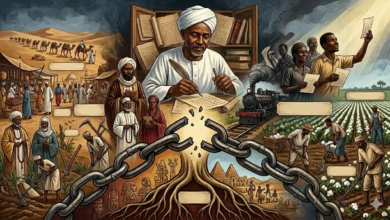
The release of this reference document comes at a critical juncture characterized by what might be termed the “Great Contraction” of traditional financing mechanisms; Official Development Assistance (ODA) is witnessing a sharp historical decline, alongside rising commercial borrowing costs and the suffocation of the fiscal space for most African nations under the weight of sovereign debts and compound interest. However, the report does not succumb to a catastrophic tone portending ruin; rather, it takes a radically rational turn: the decline in foreign aid is not a tragedy, but rather a “Virtuous Crisis” that must not be wasted, because it liberates the African will from the historical chain of financial dependence and strictly forces a return to self-reliance, rediscovering and mobilizing the continent’s immense internal resources.
The Great Contraction of Aid and the Moment of Fiscal Truth
The report begins in its first chapter with the structure of development finance in Africa, pinpointing the bleeding wound: the continent suffers from an annual financing gap estimated at no less than $245 billion during the period between 2025 and 2029 merely to maintain the minimum level of investment required to achieve sustainable development. This figure is not just an abstract statistic, but the decisive difference between a continent capable of absorbing millions of youth into the labor market and a continent threatened with sliding into social unrest and fragility.
-
The Collapse of the Traditional Aid Umbrella Authors Ibrahima Coulibaly and Wafa Abedin confirm in their opening article that the global aid framework is passing through an unprecedented turning point. According to projections by the Organisation for Economic Co-operation and Development (OECD), Official Development Assistance fell by 9% in 2024 and is heading toward an additional decrease ranging between 9% and 17% during 2025.
Perhaps the most symbolic and impactful event in this context is the historic decision to dismantle and dissolve the United States Agency for International Development (USAID)—which was considered for consecutive decades the largest artery of direct aid globally—in addition to the reduction of development budgets in Germany, France, and the United Kingdom due to domestic fiscal consolidation pressures and the redirection of spending toward defense and internal crises.
This tactical shift in traditional donor behavior has stripped many African countries, especially the poorest and least developed, of a vital lifeline they had relied upon for decades. However, the Brookings report considers that this structural shock brings an end to a long path of “financial addiction” that paralyzed the ability of African governments to build real taxation systems and fiscal sovereignty.
-
The High Wall of Capital Markets and the Debt Crisis With the decline in direct aid, African nations found no refuge in international capital markets. The era of ultra-low interest rates that followed the 2008 global financial crisis has come to an end. Today, the continent finds itself facing very high interest rates that render the issuance of Eurobonds an ill-considered financial gamble.
More than 50% of low-income countries in Africa are already in debt distress or on the verge of it. Annual debt service amounts in the region have exceeded $101 billion, a figure that surpasses the combined spending on health, education, and social protection sectors in several countries. This harsh crowding out between debt service and essential social spending creates a vicious cycle of developmental retreat.
Domestic Resource Mobilization: The Alternative Equation for Sovereignty
Faced with this complete blockage in external financing channels, the report presents the core alternative: Domestic Resource Mobilization as the sole necessary and strategic choice.
-
The Dilemma of Low Savings Rates The report’s data shows that gross domestic savings rates in Sub-Saharan Africa hover around an average of only 20% of GDP, which directly reflects on investment rates that likewise do not exceed 20%. This percentage is considered extremely fragile given that maintaining sustainable developmental growth requires an investment rate of no less than 30% of GDP. Closing the annual $245 billion gap cannot be achieved through foreign aid or loans, because the structural conditions of global markets no longer permit it, and because continuing external borrowing exacerbates the current account deficit and exposes national currencies to successive collapses.
-
Reforming Tax Systems and Combating Illicit Financial Flows The report reveals a stark paradox: research by the Brookings Institution shows that the tax capacity of Sub-Saharan African countries reaches about 20% of GDP, but actual tax collection does not exceed 15% on average. This 5 percentage point gap is mainly due to the expansion of the informal economy, corruption pressures, and the weak efficiency of collection agencies.
If African governments manage to improve tax governance, enhance transparency, and combat corruption in revenue administration, they could raise tax revenues by 3.9 percentage points, pumping approximately $94 billion annually into public treasuries over the next five years.
In addition, the report highlights another bleeding wound no less dangerous: Illicit Financial Flows (IFFs). Estimates by the United Nations Conference on Trade and Development (UNCTAD) indicate that Africa loses roughly $89 to $90 billion annually due to tax evasion, trade misinvoicing, and profit shifting abroad by multinational corporations. Activating the OECD Inclusive Framework agreements and the UN Framework Convention on International Tax Cooperation represents an existential interest for the continent to ensure it receives its fair share of taxes on multinational corporate profits.
Natural Wealth: The Unexploited Engine of Development
The Sub-Saharan Africa region possesses natural resource wealth valued at over $6 trillion (according to World Bank 2020 data), divided between over $5.17 trillion in renewable natural capital (agricultural land, forests, fisheries, hydropower) and over $840 billion in non-renewable resources (oil, gas, minerals).
However, the report stresses that these figures are modest compared to reality, because they do not take into account recent and extensive discoveries of critical minerals. The continent holds at least 30% of the world’s total direct reserves of minerals essential for the energy transition (such as cobalt, lithium, copper, nickel, and platinum).
-
Added Value Versus Raw Exports Africa’s historical tragedy is summarized in exporting these minerals as low value-added raw materials, and then importing them back as manufactured products at multiplied prices. The report puts forward a decisive economic argument: if African countries build local processing and beneficiation infrastructure, they will not only raise their GDP by $24 billion annually, but will also transform their position in global value chains.
The International Monetary Fund expects total global revenues from the extraction of cobalt, copper, nickel, and lithium to reach $16 trillion over the next 25 years. The African continent is poised to capture more than 10% of these revenues (nearly $2 trillion). But truly benefiting from these projected financial flows requires a comprehensive and rigorous renegotiation of extraction and mining contracts. The report reveals that the mining sector alone loses between $470 and $730 million annually in lost taxes due to profit shifting practices employed by global corporations.
-
Dual-Track Energy Strategy In one of its most courageous and rational visions, the report tackles the global decarbonization agenda that is sometimes forcibly imposed on developing nations. Africa holds 7.2% of global proven oil reserves and 7.5% of natural gas reserves. Although Africa accounts for nearly 20% of the global population, its contribution to global carbon emissions does not exceed 3% to 4%.
From this premise, the report rejects calls for an absolute ban on fossil fuel investment in Africa in the name of the green transition. Instead, it advocates adopting a “Dual-Track Energy Strategy”: Developing and exploiting their oil and gas resources to meet local manufacturing and development needs, while achieving stable financial income. Reinvesting a portion of fossil revenues into building advanced renewable energy infrastructure (solar, wind, hydro, and geothermal energy), as Africa possesses the potential to generate over 80% of its future needs through renewables.
This rational balance is the only way capable of securing the transition plan toward net-zero without sacrificing the fundamental right to growth.
Sovereign Wealth Funds: Managing the Future
To ensure that extractive revenues are not wasted on daily consumer spending, the report emphasizes the vital necessity of establishing well-managed Sovereign Wealth Funds (SWFs).
Currently, the continent possesses only a limited number of sovereign wealth funds in Sub-Saharan Africa, with total assets under management reaching only about $100 billion, a very modest figure compared to the available potential. Most resource-rich countries still lack this investment mechanism.
The report explains the threefold importance of sovereign wealth funds: Shock Absorption: Stabilizing the local economy against severe fluctuations in primary commodity prices. Exchange Rate Control: Curbing local currency appreciation resulting from sudden dollar inflows (avoiding “Dutch Disease”). Transforming Depletable Wealth into Permanent Assets: Converting non-renewable resources into long-term investments that benefit current and future generations.
Most importantly, the report recommends a shift in the doctrine of these funds: instead of investing their total assets in financial markets abroad (as is currently prevalent), a certain percentage should be allocated for investment in local infrastructure and high-development-return projects, in partnership with independent institutional investors and national development banks, provided these funds are subject to strict governance and independent oversight to prevent corruption.
The Financial Collapse of the Continental Health Sector and the Challenges of Pharmaceutical Independence
The document opens in its second chapter a file no less important than direct financial stability, which is the file concerned with the healthcare system and human capital, where the report courageously touches upon the destructive consequences resulting from the decline in international health funding directed to Africa. Researchers, led by Ibrahima Sory Coulibaly in his analytical contributions within the document, believe that the African health sector currently faces its toughest test since the outbreak of the COVID-19 pandemic, but the crisis this time does not come in the form of an incoming virus, but rather in the form of a cessation of funding and aid flows that covered the largest percentage of prevention and treatment programs against endemic and deadly diseases.
The financial withdrawal of a number of international donors, and the reduction of budgets for programs to combat AIDS, tuberculosis, and malaria, has created a massive funding vacuum in the budgets of continental ministries of health. Historical heavy reliance on external medical relief has rendered health systems in most Sub-Saharan African countries extremely fragile and near collapse once political priorities change in Western decision-making capitals. The report explains that the funding gap in the health sector alone now threatens to waste the past three decades of gains achieved in raising life expectancy and combating premature maternal and child mortality.
-
The Local Pharmaceutical Manufacturing Crisis and the Import Chain Dilemma The gravity of the health crisis increases when looking at the continent’s near-total reliance on importing pharmaceutical products and finished medicines from abroad. Documented data in the report indicates that Africa imports more than ninety percent of its pharmaceutical needs, and more than ninety-nine percent of essential vaccines and sera from outside its borders, particularly from India, China, and European countries. This situation leaves African health security hostage to global exchange rate fluctuations, supply chain shocks, and nationalist tendencies that might drive manufacturing countries to ban medicine exports in times of global crisis.
The absence of an industrial infrastructure capable of producing active ingredients and generic medicines inside the continent is not only a health obstacle, but also a continuous financial drain causing billions of dollars in hard currency—sorely needed to build hospitals and train medical personnel—to leave annually. Therefore, the report proposes the rapid transition from a “Donation and Import” model to a “Production and Regional Integration” model, taking advantage of the African Medicines Agency unifying regulatory frameworks and facilitating the registration of medical products at the continental level.
-
Transforming Healthcare into an Attractive Investment Sector The report does not settle for a discouraging diagnosis of health challenges; rather, it puts forward a decisive conceptual shift involving viewing the health sector as an economic engine and a promising investment sector, rather than treating it as a financial burden consuming the public budget. The report holds that attracting private capital and launching public-private partnerships represent the only way to bridge the massive deficit in health infrastructure. Establishing regional hospital networks, advanced diagnostic laboratories, and factories for basic medical supplies provides an investment opportunity with a lucrative return and a noble developmental mission at the same time.
Building an innovative financing model based on health bonds and redirecting a portion of mining and extraction revenues toward sustainable health financing would grant African governments an adequate margin of maneuver to build comprehensive health safety nets. The report stresses that any developmental strategy that marginalizes investment in the health of the African citizen is a strategy doomed to failure in advance, because sick labor or labor threatened by epidemics cannot build an economy that competes in the twenty-first century.
Technology, Artificial Intelligence, and the Youth Job Creation Dilemma
The report moves on to address one of the most sensitive and pressing topics on the continental stage: digital transformation and the demographic explosion coinciding with the rise of artificial intelligence technologies. The report discusses how a continent experiencing the largest youth population growth in the world can deal with a technological revolution that contributes to eliminating many traditional jobs and restructuring labor markets entirely.
-
The Digital Leap Between Abundant Opportunities and the Structural Gap The report acknowledges that Africa has achieved tangible successes in adopting digital technology and mobile payment services, allowing broad segments of the unbanked population to integrate into the economic cycle. However, the report warns against being deceived by these surface successes, pointing out that the hard digital divide remains vast between Africa and the rest of the world, and even within African countries themselves between urban and rural areas.
Low internet network efficiency, the high cost of data relative to average individual income, and the lack of cloud computing infrastructure and local data centers are all factors hindering the continent from truly benefiting from the global digital economy. Artificial intelligence requires massive energy infrastructure and high-speed communication networks, requirements that most African nations still lack, threatening to deepen the technological divide and transform the continent once again into a mere consumer of applications and data rather than a producer of them.
-
Betting on Human Capital and Reskilling The real challenge facing decision-makers in Africa is not to prevent the entry of artificial intelligence, but rather how to bridge the gap between traditional educational curricula and the requirements of the future labor market. The report presents deep analyses indicating that millions of African youth enter the labor market annually without receiving appropriate training in science, technology, engineering, and mathematics (STEM). This structural imbalance leaves youth labor vulnerable to rising unemployment or to working in informal sectors with low productivity and meager wages.
The report calls for a comprehensive revolution in educational curricula and the launch of continental programs to reskill and train youth in modern technologies, such as data analysis, digital manufacturing, network management, and AI applications in agriculture and healthcare. Participating experts in the report view focusing on advanced technical and vocational education as the only bridge that can transition Africa from a “demographic problem” status to a “demographic dividend” status, where youth transform from a burden on the state into the driving force for growth and innovation.
-
Innovative Manufacturing Versus the Illusion of Pure Digital Transformation The report warns in a strict analytical tone against drifting behind the idea that the African continent is capable of bypassing the traditional manufacturing phase and moving directly to a digital services economy. The report holds that technology and digital transformation must emerge from the framework of financial and entertainment services to take root in the real physical sectors, foremost among them manufacturing and agriculture.
Developing the African industrial sector using modern technologies is the only avenue capable of absorbing vast numbers of unskilled and qualified labor, and creating added value for continental raw materials. Factory automation and artificial intelligence must be used to raise local production efficiency and render African products competitive in global markets, rather than replacing national labor with imported machines manufactured abroad. The report presents practical models of how to integrate technology to improve agricultural supply chains, reduce post-harvest losses, and facilitate small farmers’ access to markets and finance, thereby achieving the dual objectives of food security and job creation.
Climate Change and Food Security Between Environmental Fragility and Agricultural Sovereignty
The report touches upon one of the most severe crises linked to the social and economic existence of the African continent: the sharp intersection between climate change shocks and the national nutrition crisis. Experts and analysts at the Brookings Institution view the African continent as being driven toward critical points of unprecedented fragility, as manifestations of drought, rainfall variability, and severe floods increase, threatening the productive foundation of millions of smallholder farmers who form the backbone of the rural economy in most countries across the continent.
The issue of climate change in Africa is not merely a high-level environmental matter discussed in the halls of international conferences; it is a matter of livelihood, national security, and a direct source of local conflicts over water resources and fertile land. The report highlights the painful historical paradox that makes the continent most affected by global thermal emissions the least contributor to them and the least capable of accessing climate adaptation funding, placing local communities in direct confrontation with the resulting environmental disasters.
The report draws an analysis of the reality of the African agricultural sector, pointing out that continuing to treat agriculture as a traditional subsistence activity relying on rainfall involves a major strategic risk. The African region annually imports food and basic crops worth billions of dollars, while the continent holds about sixty percent of the unexploited available arable land worldwide. This stark contradiction is a direct result of decades of neglecting government investment in rural infrastructure, storage, and modern irrigation networks.
The report calls for reshaping agricultural policies so that agriculture transforms into an integrated industrial and commercial sector. Expanding land reclamation and supplying farmers with modern technology and appropriate fertilizers, alongside developing value-added chains and local food factories, will enable African countries to close the persistent food gap and transform the nutrition crisis into an opportunity for regional and international export. Fighting hunger and securing food sovereignty are the first step toward building a healthy economy capable of withstanding global economic crises.
Regarding the financing of climate adaptation projects, the report clearly criticizes current international mechanisms characterized by slowness, complexity, and bureaucracy, pointing out that only a small percentage of the financial pledges approved at global climate summits have materialized on the ground. This reality requires African countries to innovate in developing their own financial instruments, such as issuing continental green bonds, directing debt-for-climate-investment swap mechanisms, and capitalizing on voluntary carbon markets.
The report reveals that Africa enjoys immense potential to be a leader in nature-based solutions, such as protecting tropical forests, reclaiming degraded lands, and developing sustainable agriculture. Investing in these environmental assets is no less important than extracting minerals and oil, as it enables the continent to negotiate with international blocs to obtain fair and sustainable financial compensation redirected toward building dams, coastal protection networks, and renewable energy projects that guarantee the continuity of developmental growth.
African Continental Free Trade Area and the Stake of the Single Market
The report dedicates space to analyzing developments related to the African Continental Free Trade Area (AfCFTA), which is considered the most ambitious economic initiative in the continent’s modern history. The report views this agreement not as a mere customs arrangement to reduce tariffs and cross-border trade, but as the comprehensive strategic project to rebuild the African economic structure and rid the continent of colonial fragmentation legacies.
The report reviews, with figures and facts, the reality of intra-African trade, which still hovers around low levels not exceeding fifteen to eighteen percent of the continent’s total trade with the world, a very small percentage compared to intra-regional trade in Europe or Asia. This situation is due to weak land, maritime, and air transport networks, administrative and customs complexities, in addition to the extreme disparity in laws and regulatory frameworks among member states.
The report emphasizes that the real success of the free trade area hinges on the continent’s ability to build integrated regional value chains. Instead of each country exporting its raw materials individually to external markets, African countries must exchange industrial inputs among themselves, such that some countries specialize in mineral extraction and others in processing and manufacturing final products. This pattern of integration is the only way to increase domestic productivity, attract foreign direct investment, and achieve self-sufficiency in basic goods and equipment.
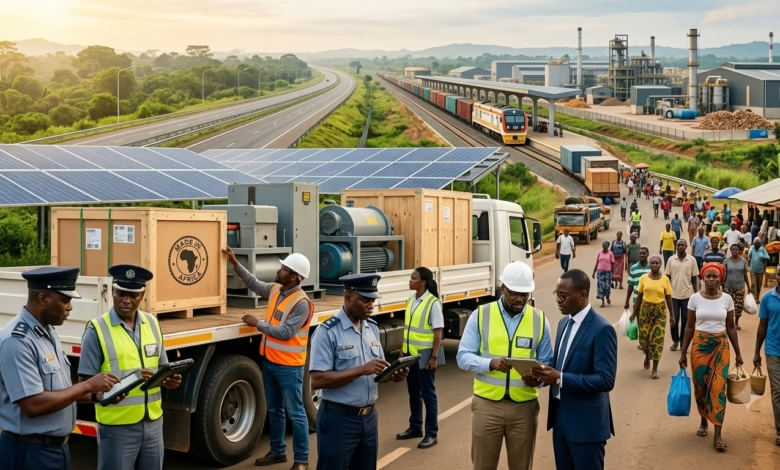
No trade agreement can bear fruit without the presence of a physical and regulatory infrastructure capable of moving goods and services efficiently and quickly. The report discusses how the acute deficit in modern ports, cross-border railway networks, and logistical corridors raises the cost of transporting goods inside Africa to levels where locally manufactured goods become higher priced than goods imported from the far ends of the earth.
Alongside hard infrastructure, the report stresses the importance of soft infrastructure, which includes the Pan-African Payment and Settlement System (PAPSS), facilitating visa and mobility procedures for individuals and businesses, and unifying standards and specifications for goods and products. Activating these regulatory tools reduces logistical and temporal costs, providing an encouraging environment for small and medium enterprises—which represent the largest fabric of the African economy—to expand and access a continental market comprising more than 1.4 billion people.
The comprehensive vision of this pillar demonstrates how the food security file interacts with climate adaptation and intra-regional trade in a single system. Food security requires transforming agriculture into an industrial sector to achieve nutritional sovereignty and confront reliance on imports. Climate adaptation demands developing self-financial tools and expanding carbon markets to overcome delays in international pledges. Regarding intra-regional trade, overcoming the current low percentage requires elevating trade between countries and establishing a unified market, alongside building regional value chains that raise added value and move beyond the solitary export of raw materials. This system is completed by focusing on logistical infrastructure and activating the continental payment and settlement system to reduce high costs and accelerate intra-regional transactions.
Africa at the Heart of Global Geopolitical Competition and Emerging Multipolarity
The report addresses Africa’s strategic position amid growing global polarization and the decline of international unipolarity. Researchers and analysts participating in the report hold that the African continent is no longer merely a backyard for receiving policies or a marginal theater for superpower spoils; rather, it has become a pivotal player possessing immense strategic leverage that makes it the focus of intense attention and competition among traditional and emerging powers, starting from the United States and the European Union, reaching China, Russia, India, and the Gulf States.
This fierce competition is primarily attributed to the world’s overwhelming need for natural resources and critical minerals essential for the energy transition and advanced technological industries, in addition to the demographic advantage and geographic location extending across the most vital maritime and commercial corridors. However, the report issues a strong warning to African decision-makers against slipping once again into the trap of ideological alignments or rigid alliances that characterized the Cold War period, calling for adherence to a policy of “Strategic Self-Alignment” that places continental interests above the calculations of external parties.
The report explains how growing Chinese influence in infrastructure and industrial investments, alongside increasing Russian presence in security and military domains, forces Western powers to reshape their strategies toward the continent. Western countries can no longer rely solely on humanitarian aid files and political conditionalities to maintain their position; rather, they are now required to offer equal economic partnerships and tangible investments in energy, manufacturing, and technology transfer sectors.
The report asserts that the true strength of African nations lies in their ability to manage these international contradictions with diplomatic dexterity, and to negotiate collectively with multiple partners to obtain the best financing and technological terms. The diversity of options available to African nations grants them unprecedented bargaining power to build balanced relationship networks and avoid over-reliance on a single creditor or a single security ally, thereby enhancing political independence and national sovereignty in decision-making.
The economic future of the continent cannot be considered without addressing the security stability crisis in vital regions such as the African Sahel, the Lake Chad Basin, and the Horn of Africa. The report discusses how the continuation of cross-border armed group activities, the increased frequency of military coups, and the fragility of state institutions in some regions consume a large portion of national budgets and divert limited financial resources away from health, education, and infrastructure.
The report stresses that individual security and military approaches have proven insufficient to address the root causes of conflicts. Achieving sustainable security requires comprehensive African solutions that link political governance, local economic development, and rebuilding the social contract between the citizen and the state. The report also warns that uncoordinated external security interventions often complicate the field situation and fuel conflicts rather than ending them, making the activation of the African Standby Force and security mechanisms affiliated with the African Union an inescapable necessity for preserving peace and development.
Institutional Governance and Restructuring the Global Financial System
This stage concludes by focusing on the core issue linking all dimensions of development and stability in Africa: institutional governance and fairness in the international financial system. The report holds that the inefficiency of certain national institutions, weak transparency, and administrative corruption represent structural obstacles that weaken the continent’s ability to benefit from available opportunities and hinder the flow of developmental investments.
The report devotes an extensive analysis to the importance of reforming public institutions and strengthening the rule of law, pointing out that a stable investment environment requires not only encouraging laws, but fundamentally independent judicial institutions, transparent financial control and management bodies, and efficient tax administrations. Building national institutional capacities reduces the risks of sudden policy shifts, protects investment contracts, and curbs capital flight and financial corruption.
It also touches upon the role of transparency in managing mining and extraction contracts, stressing the necessity of public disclosure for all agreements and licenses granted to foreign companies, to ensure local communities obtain their fair share of development and to prevent the illicit enrichment of political elites. Sound institutional governance is not merely an administrative requirement, but the solid foundation for building trust between the African public and governing institutions.
The report presents a tight formulation of the continent’s growing demands to reform international financial institutions, such as the International Monetary Fund and the World Bank, which were designed in the middle of the last century in the absence of most independent African states. The report criticizes the unfair credit ratings imposed by Western assessment mechanisms on African countries, which raise borrowing costs and inflate perceived risks in a manner disproportionate to actual economic reality.
The report calls for amplifying the continent’s voice in international decision-making halls, especially after the African Union officially joined the Group of Twenty (G20). This accession represents a historic opportunity to push toward reshaping the global debt system, establishing transparent and fair mechanisms for sovereign debt restructuring, allocating Special Drawing Rights (SDRs) in a manner that considers the needs of developing nations, and combating international tax evasion. Africa is not asking for charity; rather, it demands equal global rules of the game that guarantee its participation in global economic growth on an equal footing.
The dimensions of this comprehensive vision converge to confirm how geopolitical files intersect with issues of security, governance, and the financial system; fierce international competition over minerals and strategic regions requires avoiding polarization, adopting the principle of strategic self-alignment, and diversifying alliances. At the same time, security deterioration in conflict zones necessitates moving beyond individual approaches and budget depletion in favor of African solutions that integrate development with governance and peacekeeping. Domestically, institutional governance emerges as a necessity to build strong institutions and ensure transparency in the extractive and mining sector to overcome administrative challenges and corruption. Meanwhile, international financial discrimination manifests in unfair credit ratings that double borrowing costs, mandating the reform of rating agencies and adjusting financial power balances. This system is completed by leveraging the continent’s influence following its accession to the G20 toward reforming the traditional structure of Bretton Woods institutions and developing a fair system for debt restructuring and Special Drawing Rights.