

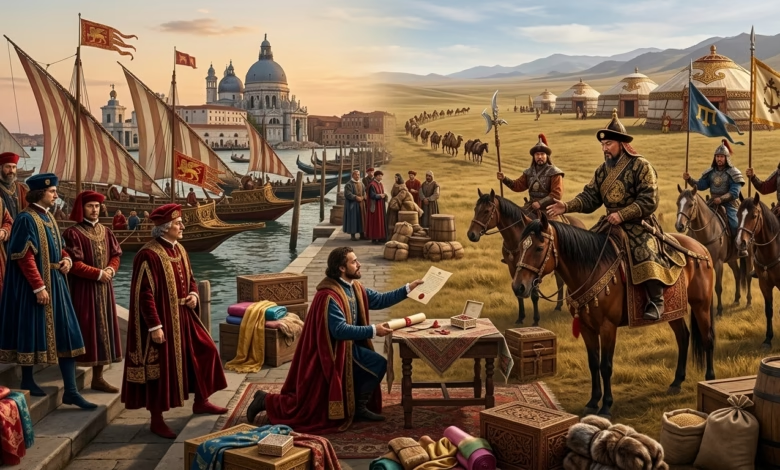
The Myth Of “Primitive Savagery”
In Both Western And Eastern Historical Culture, The Image Of The Mongols Settled For Long Decades Within A Framework Of Apocalyptic Terror; They Were Depicted As Barbaric Hordes Sweeping Civilizations, Destroying Libraries, And Leveling Cities To The Ground, Making Hills Of Skulls From Baghdad To Kraków. However, The Reference Book Issued By Princeton University Press (2026) Entitled Venice And The Mongols: The Eurasian Exchange That Transformed The Medieval World By Historians Nicola Di Cosmo And Lorenzo Pubblici Comes To Turn This Vision Upside Down. The Two Authors Do Not Deny The Military Brutality Of The Initial Conquests, But They Go Beyond It To Pose A Fundamental Question: What Happened After The Storm Calmed Down?
The Researchers Reveal, Through A Precise Documented Study, That The Mongol Empire Was Not Merely A War Machine, But Was An Architect Of An Early Global System The Likes Of Which Eurasia Had Never Witnessed. At The Heart Of This System, The Republic Of Venice (The Most Serene Republic – La Serenissima) Was Not Merely An External Observer Or A Passing Merchant, But Was The Most Astute Trading And Diplomatic Partner Capable Of Adapting To This New Geopolitical Architecture. The Book Offers An Extensive Reading Of The Undeclared Alliance Between The “Republic Of The Sea” That Possessed No Agricultural Land, And The “Steppe Empire” That Possessed No Naval Fleet, Explaining How This Interaction Formed A Global Network Of Commercial, Diplomatic, And Cultural Exchange That Changed The Face Of The Middle Ages Forever.
Venice: From The Shadows Of The Byzantines To Maritime Dominance
To Construct The Context In Which Venice Met The Mongols, Di Cosmo And Pubblici Return To The Earliest Roots Of Venice’s Rise From Mere Island Communities In The Basins Of The Adriatic Coast Living Under Byzantine Dominance, To A Regional Power And Then A Superior Commercial Empire. Since The Ninth Century, Venice Invested In Building A Strong Military And Commercial Fleet, Exploiting The Treaty Of Aachen (812 AD) Which Left It Nominally Within The Byzantine Sphere Of Influence While Granting It Exceptional Freedom Of Movement Between East And West.
By The Eleventh Century, Venice Had Turned Geopolitical Threats Into Investment Opportunities. When The Normans Besieged The Outskirts Of The Byzantine Empire, Emperor Alexios I Komnenos Enlisted The Venetian Fleet To Defeat Them. The Price Was An Imperial Edict, The “Golden Bull” (Chrysobull) In 1082, Which Granted Venetians Complete Customs Exemptions And Absolute Freedom Of Movement In All Ports Of The Empire, As Well As A Special Quarter In The Heart Of Constantinople.
These Privileges Eliminated Any Ability Of Local Or Foreign Competitors To Compete With Venice, Enabling It To Lay The Foundations Of A Monopolistic System That Aroused The Resentment Of Byzantine Emperors And Italian Rivals Alike (Especially Genoa And Pisa). However, The Greatest Transformation That Shaped The New Contact Lines Occurred In 1204, During The Fourth Crusade.
The Earthquake Of 1204 And The Transformation Of The Face Of The Mediterranean
The Fourth Crusade Was Not Originally Destined For Constantinople, But Was Targeting Ayyubid Egypt, The Primary Economic Engine Of The Islamic East At That Time. However, The Financial Inability Of The Crusader Knights To Pay The Maritime Transportation Costs To The Venetian Fleet, Along With Political Intrigues Within The Byzantine House, Prompted The Elderly And Blind Doge, Enrico Dandolo, To Divert The Course Of The Campaign.
The Result Was The Sacking Of Constantinople, The Eradication Of The Byzantine Empire, And The Partition Of Its Lands Through What Was Known As Partitio Romaniae. Venice Seized Three-Eighths Of The Former Empire, And Laid Its Hands On The Most Critical Naval Bases And Islands Extending Across The Aegean Basin, Such As Crete (Candia), Negroponte, Modon, And Coron. The Doge Came To Bear The Title “Lord Of A Quarter And Half A Quarter Of The Roman Empire”.
The Establishment Of This System Called Stato Da Màr (State Of The Sea) Was Not Merely A Display Of Military Force, But Was An Economic Necessity To Preserve The Security Of Food Supplies For Venice, Especially Wheat, And To Secure Trade Routes Extending Towards The Levant And Egypt. However, Despite This Sweeping Victory, The Venetians Found Themselves Facing A New Geopolitical Dilemma: They Had Destroyed The Ancient Byzantine Rampart That Served As A Buffer Between Europe And The East, Creating A Power Vacuum Into Which New Forces Soon Infiltrated.
The Mongol Shock: Rising Eurasian-Wide And Changing The Rules Of The Game
While Venice Was Fighting Its Geopolitical Conflicts In The Eastern Mediterranean, The Military Machine Of The Unifier Of The Tribes, Genghis Khan, Was Reshaping The Entire Map Of Asia. Starting From The Second Decade Of The Thirteenth Century, Mongol Armies Rushed Towards China In The North, And Khwarazm In The West, Reaching The Caucasus Region And The Volga River Basin.
In 1241, The Mongol Campaigns Led By Batu Khan Reached The Heart Of Eastern Europe, Sweeping Through The Lands Of Russia, Hungary, And Poland. These Campaigns Sent Waves Of Panic Through European Courts And The Catholic Church, Which Saw In The Mongols “The People Of Gog And Magog” Or A Divine Punishment Descending Upon Humanity.
However, This Initial Stun Did Not Last Long; Mongol Leaders And European Kings, Especially Commercial Powers, Soon Realized That There Was Common Ground For Interests. The Division Of The Mongol Empire After The Mid-Thirteenth Century Led To The Emergence Of Four Main Khanates:
-
The Khanate Of The Golden Horde (Jöchi Ulus) In The Volga Basin Region And The Black Sea.
-
The Ilkhanate Of Persia In The Arab East, Iran, And Anatolia.
-
The Chagatai Khanate In Central Asia.
-
The Yuan Dynasty In China And The Mongolian Plateau.
This Political Fragmentation Did Not Weaken The Comprehensive Imperial Idea, But Instead Produced What Is Called Pax Mongolica (The Mongol Peace). For The First Time In Human History, The Distance Extending From The Port Of Tana On The Sea Of Azov To The Port Of Zaiton In China Came Under A Single Legislative And Security Umbrella.
Nymphaeum 1261: The Setback That Opened The Gates Of The Black Sea
In 1261, A Geopolitical Event Occurred That Shook The Economic Foundations Of Venice; Emperor Of Nicaea, Michael VIII Palaiologos, Exploited An Alliance With Venice’s Traditional Rival — The Republic Of Genoa — And Signed With Them The Treaty Of Nymphaeum. Under This Treaty, Genoa Provided Naval Support To Michael VIII To Recapture Constantinople and Overthrow The Latin Empire Established By The Venetians. In Return, The Restored Byzantine Emperor Granted The Genoese An Absolute Monopoly Over Trade In The Black Sea (Which Was Known As Mare Maius), Expelled The Venetians, And Prevented Their Ships From Crossing The Bosphorus Strait.
It Seemed That Venice Had Completely Lost Its Imperial Gamble; Its Merchants Were Expelled From Constantinople, And Vital Wheat Supply Lines Were Cut. But This Stormy Crisis Was The Primary Engine That Drove Venice To Reinvent Its Economic And Diplomatic Strategy. Venice Could Not Afford To Lose Access To The Black Sea, Not Only Because Of Wheat, But Because The Mongols Had Established Huge Commercial Centers In The Crimean Peninsula And The Volga Basin Directly Linked To The Silk Road.
The Venetians Realized That The Solution Would Not Lie Merely In Concluding Truces With The Byzantines, But In Establishing Lines Of Direct Communication And Understanding With The Real, Equipped, And Dominant Power Controlling The North And South Of The Black Sea: The Mongol Princes And Sultans. From Here Begins The True Epic Documented By Di Cosmo And Pubblici; The Epic In Which Venice Became The Primary European Partner For The Mongols, And The Commercial Interpreter Of The Unified Eurasian Network.
Medieval Globalization Engineering: “The Mongol Plan” And The Establishment Of The Strategic Colony Of “Tana”
“The Mongol Plan” (The Plan)
The First Part Of The Book By Di Cosmo And Pubblici Offers A New Conceptual Historical Contribution That Changes Our View Of The Economic Management Of The Mongols: The Concept Of “The Mongol Plan” (The Plan). The Two Authors Reject The Simplistic View That Assumes The Mongols Encouraged Trade Merely To Collect Quick Taxes, Or That They Were Passive Pastoralists Leaving Merchants To Do As They Pleased. Instead, The Book Proves That Mongol Rulers — Whether In Sarai (Capital Of The Golden Horde), Tabriz (Capital Of The Ilkhanate), Or Khanbaliq (Beijing) — Possessed A Clear And Highly Complex Strategic Vision To Turn Trade Into A Primary Engine Of Imperial Building.
This Multi-Dimensional Mongol Plan Rests On Four Strategic Pillars:
-
Advanced Logistic Infrastructure: Expanding The System Of Postal And Service Stations Called Yam, A Vein-Like Network Extending Across Eurasia Providing Horses, Supplies, And Rest For Merchants And Messengers Bearing Imperial Passports (Paiza).
-
Financial Innovation: Attempting To Unify Monetary Systems, Introducing Paper Currency (Jiaochao) In China And Iran, And Relying On Silver As An International Standard For Exchange, Which Facilitated Commercial Transactions Between Regions With Entirely Different Monetary Environments.
-
Strategic Production Stimulation: Encouraging And Developing Export-Oriented Industries, Such As Chinese Silk, Luxurious Golden Textiles (Nasij), And The Extraction Of Furs And Slaves In The North, While Providing Secure Markets For Their Sale.
-
Legal And Diplomatic Frameworks: Drafting Explicit Treaties (Privilegia) With Commercial Powers, Guaranteeing Merchant Rights, Setting Customs Duties Accurately, Providing Mutual Protection, And Establishing Special Judicial Courts To Resolve Disputes.
Clash Of Peaks: Stabilization In The Black Sea And The Foundation Of “Tana”
The Venetians Realized With Their Pragmatic Sense That Access To This Eurasian Network Required A Firm Foothold At The Final Station Of The Northern Caravan Routes. This Station Was The Mouth Of The Don River On The Sea Of Azov, Branching From The Black Sea, Where The City Of Tana (Modern Azov) Was Located.
Venice Fought A Bitter Multi-Dimensional Struggle To Carve Out Its Share In Tana. It Had First To Bypass The Genoese Monopoly Intoxicated By The Victory Of 1261. Second, To Deal With The Fluctuating Policies Of The Khans Of The Golden Horde Who Balanced Between The Two Italian Powers To Achieve The Greatest Amount Of Financial And Political Gains.
The Relationship In Tana Began As Abstract Numbers For A Temporary Trading Port, Where Ships Docked In Summer And Departed In Autumn. However, By The Third And Fourth Decades Of The Fourteenth Century, Specifically Between 1332 And 1343, Tana Transformed From A Mere Seasonal Station Into A Permanent Fortified Colony For Venetian Settlers. Archival Documents Cited By The Book Indicate That Venice Appointed A Consul (Consolo Di Tana) Answering Directly To The Venetian Senate, And Constructed Quarters Equipped With Warehouses (Fondaco), Churches, Bakeries, And Private Docks.
Standing Firm In The Face Of Storms: The Crisis Of 1343 And The Peace With Jani Beg
The Partnership Between Venice And The Mongols Was Not A Smooth Path Bedded With Roses, But Was Interspersed With Serious Political And Military Tensions, Which The Book Reveals In Detail In Chapter Five. The Primary Source Of These Tensions Lay In A Clash Of Two Concepts Of Sovereignty: The Venetian Concept Based On Acquired Legal Rights And Partial Territorial Control To Protect Trade, And The Mongol Concept That Saw The Khan As Absolute And Supreme Leader Of The Land And Whatever Was Upon It, Considering Merchants’ Privileges To Be Royal Grants Revocable At Any Moment Upon Any Infringement.
This Clash Was Embodied In Its Most Vivid Form In The Famous Crisis Of 1343. Following A Brawl In Tana Between An Italian Merchant And A Muslim Merchant That Led To The Latter’s Death, Khan Jani Beg — The Powerful And Religiously Committed Khan Of The Golden Horde — Was Enraged. Jani Beg Ordered A Comprehensive Siege On The Venetian And Genoese Colonies In Tana And Caffa, Expelling Italian Merchants And Confiscating Their Money.
This Siege Severely Affected The Venetian Economy; Food And Raw Material Supplies Ceased. However, Venice’s Stance Displayed High Degrees Of Institutionalism And Diplomacy. The Republic Of Venice Sent High-Level Ambassadors To Negotiate With Jani Beg In His Capital, Sarai. After Arduous Negotiations Lasting Years, A Peace Agreement Was Reached In 1347, Reopening Tana To Venetian Merchants In Exchange For Increased Customs Duties And Strict Rules For Managing Judicial Disputes Between The Khan’s Subjects And Venetian Citizens.
The Black Death And Its Geopolitical Repercussions
In The Midst Of The Mongol Siege Of The Genoese City Of Caffa In 1346, An Incident Occurred That Threatened All Of Humanity, As Bubonic Plague (The Black Death) Outbroke Among The Ranks Of The Besieging Mongol Army. The Mongols — According To Historical Accounts Analyzed By The Book — Catapulted The Corpses Of The Dead Over The Crowded Walls, And Fleeing Italian Ships Carried The Disease To Constantinople, And From There To Venice, Genoa, And Various Parts Of Europe.
The “Black Death” Reduced Europe’s Population By Percentages Ranging Between 30% To 50%, Causing Severe Economic And Structural Crises. Nevertheless, The Unexpected Result Highlighted By Di Cosmo And Pubblici Is That This Demographic Disaster Did Not End The Partnership Between Venice And The Mongols! On The Contrary; The Scarcity Of Labor In Europe Caused A Huge Rise In Prices Of Luxury Products And An Increased Demand For Slaves And Tropical Fabrics, Making The Re-Operation Of The Tana And Black Sea Lines More Profitable And Vital For Venice To Compensate For Its Direct Financial Losses.
Disintegration Of The Golden Horde And The Rise Of Tamerlane
At The Beginning Of The Second Half Of The Fourteenth Century, The Mongol Empire Began Suffering From Severe Internal Disintegration Known As The “Jöchid Crisis”, Named After Jöchi Son Of Genghis Khan. Mongol Factions Fought For Power, And Dozens Of Khans Alternate On The Throne Within Short Time Intervals.
Venice Showed Exceptional Political Flexibility During This Phase; It Did Not Bet On A Single Ruler, But Established A Network Of Communications With Various Steppe Leaders, Such As The Powerful Atabeg Mamai, And Later With Khan Tokhtamysh Who Succeeded In Temporarily Reunifying The Golden Horde With Support From The Victorious Conqueror Tamerlane.
However, The Emerging Clash Between Tokhtamysh And His Former Benefactor Tamerlane Brought Destruction Again. In 1395, Tamerlane Launched His Devastating Military Campaign Against The Golden Horde, Wiping The City Of Tana Off The Face Of The Earth, Destroying Venetian And Genoese Warehouses, And Crushing The Infrastructure Of The Northern Silk Road.
Despite The Severity Of This Disaster And The Complete Destruction Of The Tana Colony, The Venetians Returned Again After A Few Years To Rebuild Their Colony From Amidst The Rubble. Tana Continued Operating And Producing Until The Final Fall Of The East Into Ottoman Hands In The Second Half Of The Fifteenth Century, Proving The Structural Resilience Of The Institutional Investment Model Constructed By Venice In Eurasia.
Marco Polo: A Historical And Geographical Re-Evaluation
Di Cosmo And Pubblici Devote The Second Part Of The Book To Evaluating The Structural And Operational Aspects Of Eurasian Trade, Designating Chapter Eight To Examining The Enduring Legacy Of The Most Famous Venetian Merchant: Marco Polo. The Authors Move Away From The Mythological Novelistic Presentation Of Polo’s Journey, Offering An Analysis Connecting Him To The Commercial And Institutional Environment Of Venice.
The Book Highlights The Efforts Of Historian Hans Ulrich Vogel, Who Definitive Proved Polo’s Presence In China Through Precise And Stunning Matching Of Financial, Monetary, And Administrative Information Mentioned By Polo In His Book Il Milione With Official Chinese Historical Sources Of The Yuan Dynasty.
Polo Was Not A Romantic Explorer, But A “Commercial Eye” Conscious Of Extremely Precise Details: How Salt Was Manufactured, How Taxes Were Imposed, How Paper Currency Was Circulated, And The Weights And Measures Used In Major Cities Such As Khanbaliq (Beijing), Guangzhou, And Hangzhou.
The Exceptional Observations Of Marco Polo And His Family’s Business (His Father Niccolò And His Uncle Maffeo) Provided A Clear Picture Of The Enormous Opportunities Available To The European Merchant In The Farthest Reaches Of Asia. However, The Book Posits An Important Conclusion: Polo’s Journey Was A Unique Individual Experience That Did Not Translate Into A State Strategy For Venice. The Republic Of Venice As A “State” Preferred Concentrating Its Official Resources In The Black Sea And The Arab East, Establishing The Boundaries Of Its Institutional Intervention There, While Leaving Adventurers And Private Merchants To Penetrate Asian Depths Under The Protection And Care Of Direct Mongol Authorities.
Commercial Geography And Navigational Technologies
Chapter Nine Of The Book Reviews The Intertwined Network Of Eurasian Trade Routes, Showing How Freight Transport Was Upgraded Thanks To Italian Ships And Technologies. Venetians Used Fleets Of Galleys Designated For Trade, Known As Galee Di Romània, Ships Combining The Use Of Sails And Oars, Granting Them High Speed And Excellent Defensive Capabilities Against Piracy.
The Book Maps Out In Detail The Logistic Map Traversed By Venetian Merchants Across The Black Sea:
-
The Northern Route: Departing From Tana Towards The Volga River, Then Sarai, Reaching Khwarazm, And From There Across The Almaty Mountains To The Tarim Basin And China.
-
The Southern Route: Starting From Trebizond On The Anatolian Coast, Penetrating Ilkhanid Lands Reaching Tabriz, Which Was The Economic And Financial Capital Of Mongol Iran.
From Tabriz, Caravans Headed Either East Towards The Delhi Sultanate And Central Asia, Or South Towards The Persian Gulf To Meet Maritime Trade Routes Across The Indian Ocean.
Monetary And Financial Tools: The Battle Of Silver And Paper Currency
Commercial Connection Was Not Possible Without Finding Solutions To The Dilemma Of Differing Monetary Systems And Weights Between Regions. The Authors Devote Chapter Ten To Investigating Monetary And Exchange Means, Explaining How Silver Played The Role Of “Universal Equivalent”.
The Mongols In The Golden Horde Khanate And The Ilkhanate Dealt In Silver Ingots Known As Sommo, Which Weighed About 200 Grams Of Pure Silver. Venetian Merchants Integrated This Ingot Into Their Financial Accounts, Relying On Their Reliable Silver Coin The Grosso, And Later Their Famous Gold Coin The Ducat Minted For The First Time In 1284, Which Became The Undisputed “Dollar Of The Middle Ages”.
The Book Also Demonstrates The Role Of Diplomatic And Commercial Interpreters Called Turcimanni Or Dragomanni. Their Job Was Not Merely Translating Words; They Were Legal And Financial Experts Fluent In Vital Eurasian Languages: Cumanic Turkish, Persian, And Mediterranean Latin. The Famous Manuscript Codex Cumanicus (Preserved In The Marciana Library In Venice) Stands As Shining Testimony To This Linguistic Exchange, Containing A Trilingual Dictionary (Latin, Cumanic Turkish, And Persian) Designed By Merchants And Missionaries To Facilitate Their Operations In Mongol Lands.
Commercial Contracts And The Emergence Of Modern Institutionalism
Penetrating These Vast Markets Required Flexible Legal Tools Enabling Capital Aggregation And The Sharing Of Severe Risks. Famous Investment And Partnership Contracts Developed In Venice, Such As The Colleganza Or Comenda. Under This Contract, The Investor Staying In Venice (Stans) Provided Capital, While The Traveling Merchant (Tractor) Undertook The Risky Journey To Tana Or Tabriz. Profits Were Divided At A Fixed Ratio (Usually 3/4 For The Investor And 1/4 For The Traveling Merchant), While The Investor Bore Financial Loss In The Event Of Maritime Or Military Disasters.
These Navigational And Financial Innovations Transformed The Venetian Merchant From A Mere Individual Adventurer Into An Institutional Business Manager Operating Within Extended Family And Banking Networks, Allowing The Republic To Endure, Flourish, And Continuously Adapt To Geopolitical And Military Shocks Arising From Deep Within Eurasia.
The Eurasian Basket Of Goods: Raw Materials And Luxury Goods
The Eleventh And Final Chapter Of The Book Maps Out In Detail The Goods And Commodities That Flowed Through The Eurasian Trade Arteries Between Venice And The Mongols. This Trade Was Not Limited To Luxury Items Intended For Aristocratic Elites, But Included Strategic Commodities Touching Daily Life And National Security Of States.
Goods Arriving From The Mongol East Varied To Include:
-
Wheat And Grains: The Primary Strategic Commodity That Drove Venice To Penetrate The Black Sea. Lands In Modern Southern Russia And Ukraine (Territories Of The Golden Horde) Produced Huge Quantities Of Excellent Hard Wheat, Carried On Venetian Ships To Meet Chronic Food Deficits In Italy.
-
Silk And Textiles: Flowing Chinese Silk Fabrics, Gilani Silk (From Iran), And Textiles Inlaid With Gold Fibers (Nasij), Which Became Symbols Of Luxury And Status In European Royal And Papal Courts.
-
Spices And Drugs: Pepper, Ginger, Cinnamon, Cassia, And Musk, Arriving Via India, The Persian Gulf, And Anatolia.
-
Industrial Raw Materials: Wax, Wool, Precious Furs (Such As Beaver And Squirrel Coming From Siberian And Russian Forests), And Alum Used As A Vital Mordant For Textile Dyes In Florentine And Venetian Woolen Industries.
In Return, Italian Merchants Exported To Mongol Markets Luxurious Woolen Fabrics Manufactured In Northern Italy And Flanders, Weapons, Silver, And Famous Venetian Glassware.
The Dark Tragedy: The Slave Trade In Tana
Among The Most Painful And Revealing Chapters In Di Cosmo And Pubblici’s Book Is The Exceptional Documented Analysis Of The Slave Trade That Took Place In The Black Sea, Specifically In The Tana Colony And Black Sea Region Between The Fourteenth And Fifteenth Centuries. The Book Provides Rare Graphs And Statistics Extracted From Notarial Records Of Venetian Notaries.
The Colony Of Tana Was The Primary Supplier Of Slaves Directed To Southern European Markets (Italy, Spain) And To The Mamluk Sultanate In Egypt And The Levant. The Primary Source Of These Slaves Was The Inhabitants Of The Caucasus Regions, Slavs, Tatars, Circassians, And Kipchaks.
Statistical Data Cited By The Book In Appendix (D) Reveals The Following Facts:
-
Geographical Origin: The Vast Majority Of Slaves Sold In Tana Were Tatars, Circassians, Russians, And Alans.
-
Gender Distribution: Female Percentages Were Higher In Sales Directed To Italy (Reaching 60–70%) To Be Used As Domestic Servants And Nannies In Venetian And Florentine Aristocratic Homes; While Male Percentages Were Higher In Contracts Directed To Mamluks In Egypt For Use As Military Mamluks.
-
Age Groups: Records Showed That Individuals In This Trade Were Children And Youths, With Ages Of Most Slaves Ranging Between 8 To 20 Years.
-
Prices: Average Slave Prices In Tana Fluctuated Based On Famine Crises And Wars In The Steppes; During Times Of Famine, Parents Sold Their Children To Preserve Their Lives, Leading To Lower Prices And Huge Flows Of Slaves Toward The Ports.
The Paradox Of The Church And Ethical Commerce
This Human Trading Activity Created A Deep Moral And Religious Dilemma. The Papacy In Rome Repeatedly Issued Decrees Prohibiting The Sale Of Christians As Slaves, Especially To Muslims (Mamluks). However, Venetian Merchants Employed Legal And Conceptual Subterfuges To Circumvent These Decisions; They Classified Eastern Orthodox Slaves Or Recent Pagans As “Unbaptized” Or “Heretics”, Legalizing Their Sale.
Indeed, Venetian Slave Trade Towards Mamluk Egypt Became A Geopolitical Constant; Venetians Supplied Mamluk Sultans With The Human Element Upon Which Mamluk Military Might Was Built (Circassian And Bahri Mamluks) That Repelled The Mongols Themselves At Ain Jalut And Damascus! Here Venice Appears As An Engine Unconcerned With Religious Ideologies; A Merchant Selling Tatar Slaves To Mamluks To Face The Mongols, While Buying Wheat From The Mongols To Save Italy!
Transformation And The Decline Of The Golden Age
By The Mid-Fifteenth Century, Factors Of The End Began Gathering To Conclude This Golden Age Of Eurasian Exchange:
-
The Ottoman Rise: The Ottoman State Under Sultan Mehmed The Conqueror Transformed Into A Major Imperial Power; Seizing Constantinople In 1453, Testing The Maritime Lifeline Of Venice And Genoa.
-
The Fall Of Caffa And Tana (1475): The Ottoman Sultan Sent His Fleet To Control The Crimean Peninsula, Storming Caffa And Tana, Ending Directly And Definitively The Direct Presence Of Italians In The Black Sea.
-
Final Fragmentation Of The Mongol Khanate: The Golden Horde Collapsed Into Small Weak Khanates (Crimean Khanate, Kazan Khanate, Astrakhan Khanate), Leading To The Loss Of Comprehensive Security Previously Provided By Pax Mongolica.
With The Closure Of The Black Sea And Its Transformation Into An “Ottoman Lake”, Venice Was Forced To Withdraw, Leaving The Global Center Of Gravity To Shift Soon From The Mediterranean And Eurasian Sphere To The Atlantic Ocean, Where New Naval Powers (Spain, Portugal, Netherlands, Britain) Would Begin Writing The Next Chapter Of Modern Globalization.