


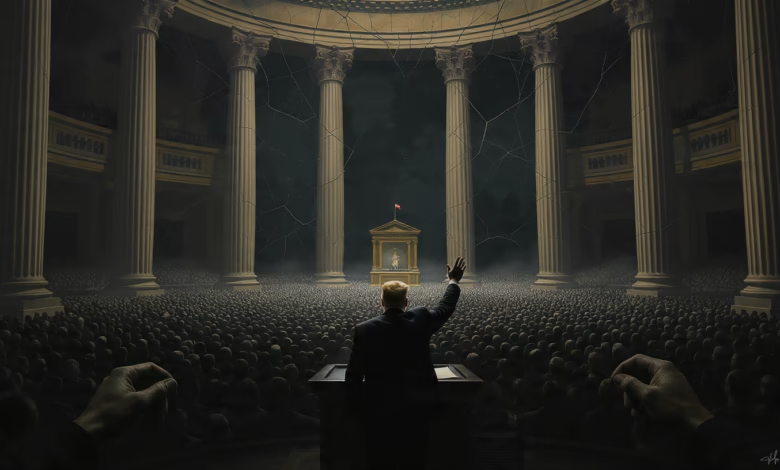
Of The International System, Attention Is Often Directed Toward External Threats That May Undermine The Stability Of States And The Balance Of Power. But The Paradox Posed By The Present Age Is That The Greatest Danger Threatening Contemporary Democracies Does Not Stem From External Totalitarian Ideologies Seeking To Undermine Them, But Rather Stems From Within. Here The Thinker And Political Scientist Jan-Werner Müller Intervenes Through His Highly Important Book ‘What Is Populism?’ To Provide A Precise Dissection Of A Phenomenon That Has Become A ‘Specter Haunting The World.’
This Book, Published By The University Of Pennsylvania Press, Offers A Rigorous Theoretical Framework For Deconstructing A Term That Has Been Overused Until It Has Become Like An Empty Vessel Into Which Everything Disliked By Political Elites Is Thrown. Understanding Populism, As Müller Presents It, Is Not Merely An Academic Luxury, But An Imperative Necessity For Grasping The Nature Of The Political Conflicts That Are Reshaping Concepts Of Sovereignty And Political Representation In Our Contemporary World.
Conceptual Chaos: Is Everyone A Populist?
The Major Problem Begins With The Chaos Of Terminological Usage; In Electoral Campaigns And Media Discourse, The Accusation Of ‘Populism’ Is Attached To Every Political Rebellion Movement Or Current Opposed To Traditional Institutions. We Have Reached A Stage Where The Term ‘Populism’ Is Used As A Synonym For The Anger And Frustration That Afflicts Voters, Without Considering The Actual Intellectual Or Political Content.
In This Context Müller Recalls A Historic Conference Held At The London School Of Economics In 1967, Which Gathered A Group Of Academics With The Aim Of Formulating A Unified Definition Of Populism. The Striking Result Was The Failure Of The Participants To Reach Any Agreement On The Nature Of This Concept. Today, The Same Scene Is Repeated; We See Political Commentators Applying The Label ‘Populist’ To Far-Right Figures Such As Marine Le Pen In France And Geert Wilders In The Netherlands, And Simultaneously Applying It To Radical Left Movements Such As Syriza In Greece And Podemos In Spain. Indeed, The Conceptual Flattening Has Reached The Point Of Equating The Discourse Of Donald Trump With That Of Bernie Sanders Under The Same Umbrella, Considering Them Merely Rebellious Voices Against The Ruling Establishment.
This Confusion Raises A Fundamental Question That Challenges Our Ability For Political Distinction: Is A Populist Simply Any Successful Politician We Dislike? Or Has The Use Of This Term By Elites Itself Become A Populist Practice Aimed At Excluding Opponents?
The Methodological Impasse: Dead Ends In Understanding The Phenomenon
Before Formulating His Own Definition, Müller Dismantles Three Traditional Approaches That Have Proven Sterile In Understanding Populism:
The Psychological Perspective (Reliance On Crowd Psychology): Müller Rejects Explanations That Reduce Populism To Being A Product Of ‘Anger’ Or ‘Frustration’ Or ‘Resentment.’ Reducing The Positions Of Millions Of Voters To Psychological Diagnoses – As If They Were Patients Needing A Political Sanatorium – Is Not Merely Elitist Condescension, But A Blind Disregard For The Fact That This Anger Is Often Based On Reasons And Rational Justifications That Citizens Can Express. This Paternalistic View Repeats, Ironically, The Same Exclusionary Gestures Of Some Nineteenth-Century Thinkers Who Opposed Expanding Suffrage On The Grounds That The Masses Were ‘Too Emotional.’
The Sociological Perspective (Class Determinism): Müller Refutes The View That Populism Is The Preserve Of Specific Classes, Such As The Petty Bourgeoisie Or Less-Educated Workers. Survey Studies Show That Support For Populist Parties Is Not Always Linked To The Voter’s Personal Socioeconomic Status, But Sometimes Stems From A Deeper Assessment Of National Decline Or The Threat To State Identity. Indeed, There Are Economically Successful Citizens Who Support The Populist Right Based On Social Darwinist Positions.
The Policy Evaluation Criterion (The Rationality Ruler): Many Err When They Consider ‘Irresponsible’ Or Simplistic Policies To Be The Exclusive Indicator Of Populism. Although Some Leaders, Such As Nicolás Maduro In Venezuela, Have Adopted Economically Disastrous Policies, Dividing The Political Arena Into ‘Responsible’ And ‘Irresponsible’ Policies Ignores The Fact That These Evaluations Ultimately Depend On The Fundamental Values Adopted By Society.
The Theoretical Core: Exclusive Representation And Exclusionary Morality
After Closing These Misleading Paths, Müller Puts His Hand On The True Core Of Populism. The Book Argues That Populism Is Not A Codified Doctrine, But A Specific ‘Moral Imagination’ Of Politics. It Is A Way Of Perceiving The Political World That Places An Imaginary, Pure, And Morally Homogeneous People In Confrontation With Elites Considered Corrupt Or Morally Inferior.
But Opposition To Elites Alone Does Not Make A Populist; Opposing The Status Quo Is A Legitimate Right In Any Democracy. The Decisive Condition Set By Müller Is ‘Anti-Pluralism.’
Populists, Exclusively, Are Those Who Claim That They, And Only They, Represent The Real People. Turkish President Recep Tayyip Erdoğan Expresses This Logic In Its Clearest Form When He Shouted At His Opponents: ‘We Are The People… Who Are You?’ This Claim Is Not Based On Empirical Or Statistical Representation, But Is A Claim Of Purely Moral Nature. The Populist Does Not Say, As Movements Like ‘Occupy Wall Street’ Did, ‘We Are The 99 Percent,’ But Says Implicitly And Explicitly: ‘We Are The 100 Percent.’
And What About The Rest Of The Citizens Who Disagree With Them? Here Lies The Grave Danger: In Populist Logic, Any Remaining Remainder Or Opposing Minority Has Its Legitimacy Immediately Revoked, And Is Classified As An Immoral Entity, And Therefore Does Not Constitute Part Of The ‘Real’ People At All. For This Reason, Müller Agrees With Philosopher Jürgen Habermas In His Golden Rule That The Idea Of A Single Homogeneous People Is Merely An Illusion, And That ‘The People’ Can Only Appear Politically And Socially In The Plural And In Plurality.
Populism, Then, Is An Extreme Form Of Exclusionary ‘Identity Politics.’ Populists Claim Their Ability To Extract The Essence Of The ‘Authentic People’ From The Totality Of Actual Citizens, To Speak In The Name Of This Infallible Pure Entity. This Assumption Undermines The Foundations Of Representative Democracy, Which Is Based On Mutual Recognition, Balancing Of Interests, And Acknowledgment Of A Diversity That Cannot Be Reduced To A Single Voice Or Sole Leader.
The Myth Of Inevitable Failure: Does Populism Fall On The Test Of Power?
There Is A Traditional And Comforting Wisdom That Always Circulates In The Corridors Of Conventional Political Analysis, To The Effect That Populist Parties Are Essentially Protest Movements, And Naturally, One Cannot Protest Against Oneself. Based On This Logic, It Is Assumed That Populists Will Inevitably Fail Once They Reach Power; Charisma Will Dissipate In The Routine Of Parliamentary And Daily Work, Simplistic Policies Will Collide With The Complexities Of Economic And Bureaucratic Reality, And Once They Become The Ruling ‘Elite’ Themselves, They Will Lose Their Raison D’Être Of ‘Anti-Elitism.’
Jan-Werner Müller Describes This Assumption As A ‘Comforting But Dangerous Illusion.’ Populists Can Govern, And More Importantly, They Govern As Populists. Their Administrative Or Economic Failures Do Not Necessarily Lead To Their Downfall, As They Possess A Superb Ability To Recycle Crises. Any Failure Is Immediately Attributed To ‘Hidden Elites’ Or Deep State Forces Or Foreign Conspiracies Trying To Sabotage The Popular Will. Thus, The Populist Ruler, Even While At The Peak Of Power, Continues To Play The Role Of The ‘Victim’ And The Rebel. Hugo Chávez Embodied This Model Brilliantly; Whenever His ‘Bolivarian Revolution’ Faltered, He Would Point Fingers At The Old Oligarchy Or At American Imperialism. The Crisis, In The Populist Mind, Is Not An Objective Condition Needing Resolution, But A Continuous ‘Theatrical Performance’ And A Permanent State Of Siege That Justifies Further Concentration Of Power.
The Triad Of Hegemony: How Is The Populist Governing Machine Run?
Populists Do Not Settle For Resonant Speeches; When They Seize The Reins Of Power, They Apply Specific Techniques Entirely Consistent With Their Moral Claim To Be The Exclusive Representatives Of The People. Müller Identifies Three Basic And Interconnected Techniques Of Populist Rule:
First: Colonization Of The State (Hijacking Institutional Apparatuses): Once In Power, Populists Seek To Dismantle The Dividing Line Between Party And State. What Democrats Consider A Neutral Bureaucracy And An Independent Civil Service, Populists See As An Obstacle To Implementing The ‘Authentic Popular Will.’ In Hungary And Poland, For Example, The First Moves Of The Fidesz And Law And Justice (Pis) Parties Were To Purge The Civil Service, Seize Control Of Official Media, And Neutralize Or Paralyze The Judiciary. The Moral Justification Here Is Always Ready: Why Should These Neutral Institutions Stand As An Obstacle Before The People Who Have Finally Reclaimed Their State Through Their True Representatives?
Second: Mass Clientelism And Discriminatory Legalism: Populist Regimes Are Based On Exchanging Material Grants And Jobs For Sustained Political Support, Which Is Known As Clientelism. But What Is Striking Here, As Müller Points Out, Is That Populists Do This Openly And With A Clear Moral Conscience. Since Their Supporters Alone Are The ‘Real People,’ They Alone Deserve The Care And Resources Of The State. In Contrast, What Is Known As ‘Discriminatory Legalism’ Is Practiced Against Opponents; The Law Is Applied Strictly And Even Harshly To Opponents And Minorities, While It Is Folded Or Ignored When It Comes To Allies. This Explains Why The Popularity Of Populist Leaders Is Usually Unaffected By Financial Corruption Scandals; The Masses See That This ‘Corruption’ Is Managed For The Benefit Of ‘Us’ (The Authentic People) And Not For ‘Them’ (The Corrupt Elites Or Enemies).
Third: Systematic Repression Of Civil Society: Independent Civil Society, Especially Non-Governmental Organizations, Constitutes An Existential And Symbolic Threat To The Populists’ Claim To Be The Sole Representative Of The People. Opposition Coming From Within Civil Society Undermines The Myth Of The ‘One Homogeneous People.’ Therefore, Populists, As We Have Seen In The Policies Of Vladimir Putin And Viktor Orbán, Demonize These Organizations, Portraying Them As Foreign-Funded Agents And ‘Enemies Of The Homeland.’ Through This Repression, Populists Actually Create On The Ground That Passive And Homogeneous People They Had Spoken Of From The Beginning.
The Trap Of ‘Illiberal Democracy’
One Of The Most Important Critical Contributions In This Book Is Müller’s Stringent Attack On The Term ‘Illiberal Democracy,’ Which Was Popularized By Writer Fareed Zakaria In The 1990S And Has Become Common In Western Analyses.
Müller Sees The Use Of This Term As A Grave Mistake; It Offers A Free Gift To Populist Leaders. When Viktor Orbán Proudly Declares That He Is Building An ‘Illiberal State,’ He Exploits The Growing Hatred Of The Concept Of ‘Liberalism’ (Which Has Become Associated In Minds With Savage Capitalism And Unregulated Markets), While At The Same Time Retaining The Prestigious Label Of ‘Democracy.’
Müller Affirms That Basic Political Rights, Such As Freedom Of Expression And Assembly And Freedom Of The Press And Protection Of Minorities, Cannot Be Separated From Democracy On The Pretext That They Are Merely ‘Liberal’ Additions. These Rights Are The Foundations That Make Democratic Competition Possible. Striking These Foundations Is Not Merely A Retreat From Liberalism, But A Distortion And Destruction Of The Very Essence Of Democracy Itself. Populist Regimes That Undermine The Rule Of Law And Abolish Pluralism Are Simply Defective Democracies Or Authoritarian Projects In The Making, And Must Be Called By Their True Names Without Hiding Behind Softened Terms.
Populist Constitutions: The Apparent Contradiction
It May Seem Contradictory To Speak Of A ‘Populist Constitution’; Constitutions, In Their Essence, Were Designed To Curb Majority Will, Establish Checks And Balances, And Protect Minorities. How Can A Movement Claiming To Represent Absolute Popular Will Submit To A Constitution?
Müller Corrects This Misconception, Showing That Populists Are Not Enemies Of Institutions Or Constitutions Per Se; They Are Only Enemies Of Institutions They Do Not Control, And Constitutions That Do Not Reflect Their Ideology. When They Come To Power With A Sufficient Majority, They Rush To Draft New Constitutions, Or Radically Amend Existing Ones, Not With The Aim Of Expanding Free Democratic Participation, But To ‘Constitutionalize’ Their Hegemony.
The Populist Constitution (As Happened In Hungary Or Venezuela) Is An ‘Exclusionary And Partisan Constitution.’ It Is Specifically Designed To Perpetuate Their Specific Vision Of Society, And To Constrain Any Opposition Government That May Come In The Future. By Appointing Loyal Judges For Very Long Terms, And Changing Electoral Laws To Suit Them, Populists Create Constitutions That Function As Tools Of Domination Rather Than Frameworks For Consensus And Pluralism. They Close The Democratic Playing Field, And Turn The Governing Rules Into A Weapon Aimed At The Chests Of Their Opponents.
Broken Promises Of Democracy: How Did We Create This Monster?
Perhaps The Most Pressing Question That Arises After Grasping The Danger Inherent In The Populist Structure Is: Why Then Do Millions Voluntarily Gravitate Toward These Leaders? Does Half The Planet Suddenly Suffer From Authoritarian Tendencies?
In This Part Of His Book, Jan-Werner Müller Takes Us Far From Superficial Explanations, To Delve Into The Sociology Of Political Knowledge And The History Of Ideas, Arguing That The Appeal Of Populism Feeds Primarily On What Italian Democratic Theorist Norberto Bobbio Called ‘Broken Promises Of Democracy.’ There Is What Can Be Called A ‘Folk Theory Of Democracy,’ Which Is Based On The Intuitive And Attractive Idea That ‘The People Are Capable Of Governing Themselves.’
The Tragedy Lies In The Fact That Contemporary Representative Democracies, Burdened By The Complexities Of Globalization, The Hegemony Of Financial Capital, And The Intertwining Of Supranational Institutions, Have Become Unable To Fulfill This Promise. ‘Party Democracy,’ Which Played The Role Of Mediator Between Pluralistic Society And The Political System, Has Eroded. Traditional Parties, Which Represented Clear Interests (Workers, Conservatives, Christian Democrats), Have Merged Into A Bland Political Center, Creating A Sense Of Alienation Among Broad Sectors Of Citizens Who No Longer Find Anyone To Represent Their Economic Interests Or Cultural Identity.
Here The Populist Intervenes, Speaking As If These Ideal Promises Can Be Realized On The Ground. He Speaks As If The People Possess A Single Will, A Single Judgment, And An Unambiguous Imperative Mandate. Populism Offers A Magical And Illusory Solution To The Crisis Of Political Representation, Proposing The Removal Of ‘Intermediaries’ (Parties, Complex Parliaments, Traditional Press) To Create Direct Representation Between The Leader And The Homogeneous Mass.
Technocrats And Populism: Two Sides Of The Same Coin
Müller Offers An Extremely Clever Analytical Insight, Especially When Approaching The Contemporary European Context And The Repercussions Of Economic Crises. The Book Argues That The Rise Of Populism Cannot Be Understood In Isolation From The Rise Of Its Apparent Opposite: ‘Technocracy’ (Rule By Experts).
In A Strange Paradox, Technocrats And Populists Mirror Each Other Like A Distorted Mirror. Technocracy (Which Was Clearly Manifested In The Way The Euro Crisis Was Managed) Claims That ‘There Is Only One Correct Political And Rational Solution’ To Economic Problems, Thereby Excluding Any Space For Pluralistic Democratic Debate. In Contrast, Populism Claims That ‘There Is Only One Authentic Popular Will,’ Likewise Excluding Any Opposition Or Pluralism.
Both, The Technocrat And The Populist, Are ‘Non-Political’ Beings In The Deep Sense Of The Word; They Reject The Principle Of Deliberation And Rational Discussion And Democratic Bargaining. The First Replaces Politics With The Language Of Numbers And Inevitable Necessities, The Second Replaces It With The Language Of Rigid Identity And An Untouchable Moral Essence. Thus, The Technocrat Paves The Way For The Populist, Because Emptying Democracy Of Its Deliberative Content Leaves The Field Empty For Whoever Shouts Loudest Claiming To Possess Absolute Truth.
Between Carl Schmitt And Jürgen Habermas: The Philosophical Battle Over ‘The People’
Müller’s Thesis Reaches Its Climax When Deconstructing The Concept Of ‘The People.’ Müller Summons The Ghost Of German Legal Theorist Carl Schmitt, Who Intellectually Paved The Way For Totalitarian Regimes In The 1920S And 1930S. Schmitt Saw Democratic Parliaments As Mere False Facades, And That The True Popular Will Could Be Better Expressed Through ‘Acclamation’ Of A Leader Who Embodies The Identity Of The Homogeneous People, Preferring That To The Complex Statistical Apparatus Of Sorting Secret Ballots.
This Malicious Conceptual Division Formulated By Schmitt – Between The ‘Essence Of The People’ As A Result Of Identity, And ‘Election Results’ As A Procedural Process – Is The Calibration Used By Populists Today. When The Populist Loses Elections, He Does Not Acknowledge Defeat, But Claims That The System Is Corrupt And That The ‘Silent Majority’ Has Not Yet Been Heard.
In Confrontation With This Dangerous Concept, Müller Clearly Adopts The Counter-Thesis Formulated By Philosopher Jürgen Habermas, Which Forms The Cornerstone Of Communicative And Rational Democracy. Habermas Affirms That ‘The People Can Only Appear In The Plural.’ Pluralism Here Is Not Merely A Sociological Reality To Be Tolerated, But A Moral Commitment To Strive To Find Just Conditions For Coexistence In One Political Space With Others Whom We Respect As Free And Equal Citizens, Even With Their Radical Differences.
What Is To Be Done? Strategies Of Confrontation Without Exclusion
How Can Liberal Democracies Defend Themselves Against This Challenge That Erodes Their Bones From Within?
Müller Warns Us Against Falling Into The Trap Of The ‘Cordon Sanitaire’; That Is, Completely Boycotting Populists And Refusing To Debate Them Or Excluding Them From The Public Sphere. Excluding Populists Simply Confirms Their Basic Narrative That ‘The Colluding Elites (The Cartel) Suppress The Voice Of The Real People.’ Moreover, How Can We Criticize Populists For Being Exclusionary, And Then We Ourselves Exclude Them? Does That Not Diminish The Pluralism We Claim To Defend?
The Solution, As The Author Presents It, Lies In A Golden Rule: ‘Talking With Populists Does Not Mean Talking Like Them.’ Democratic Politicians And Independent Media Must Engage With Populist Claims And Confront Them With Arguments And Evidence, Without Being Drawn Into Accepting The Way They Frame Problems. If Populists Raise Real Issues Such As Economic Inequality Or Migration Crises, These Issues Must Be Discussed Seriously, But With Rejection Of The Exclusionary Moral Framework That The Populist Proposes As A Solution.
Their Discourse Must Be Dismantled By Showing That Their Policies (Such As Clientelist Corruption And Assault On The Rule Of Law) Will Ultimately Harm The People As A Whole. And Most Importantly, We Must Stop Diagnosing Populist Voters As Patients Driven Only By Feelings Of ‘Anger And Frustration,’ But Rather Deal With Them As Free Citizens Who Have Grievances And Fears Amenable To Rational Discussion And Political Negotiation.
Müller Concludes By Saying That Real Democracy Suffers From A ‘Permanent Crisis Of Representation,’ And This Is Not A Flaw In It, But Its Essential Engine. It Is The Arena That Always Allows Marginalized Groups To Emerge And Say: ‘We Too Are Part Of The People,’ In A Continuous Series Of Demands For Democratic Inclusion. The Greatest Danger Of Populism Lies In Its Seeking To Break This Chain, Imposing A ‘Final Closure’ And Monopolizing The Definition Of Who Deserves To Live Within The Political Scene.