

“Sudan for the Sudanese”: A reading of a historical document that laid the foundation for the national independence manifesto

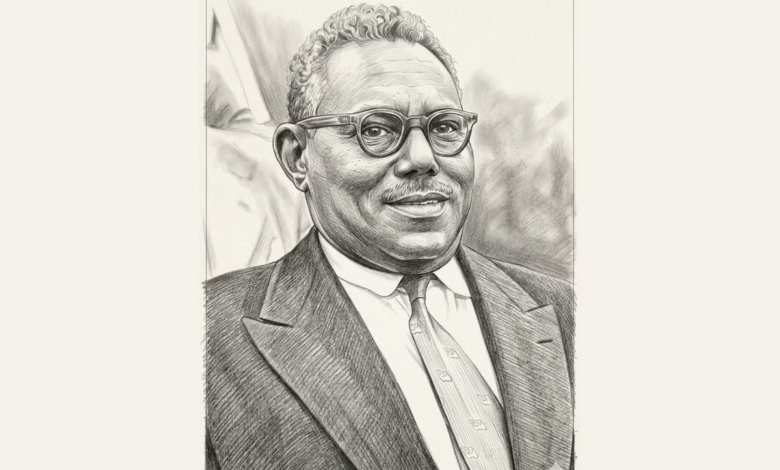
In the mid-1950s, Sudan stood at the most dangerous crossroads in its modern history: either dissolving into the entity of its northern neighbor under the umbrella of the “Unity of the Nile Valley,” or holding fast to an independent identity and an entity of pure sovereignty. In the midst of that grinding political and intellectual battle, bullets were not the only weapon; rather, the word and the document were the first line of defense. From here stems the exceptional importance of the book “Sudan for the Sudanese: Greed, Conflict, Leap, and Struggle,” whose facts and documents were compiled by Mr. Abdel Rahman Ali Taha, to serve as the political manifesto and the irrefutable historical argument for the independence current.
This valuable book reemerged thanks to the sober academic effort exerted by Dr. Fadwa Abdel Rahman Ali Taha, who undertook the verification and re-issuance of the book in its second edition in 1992, after its first edition saw the light in 1955 through the Khartoum University Press. The verification of this book was not merely the restoration of an old text, but rather the deconstruction of a sensitive phase of Sudan’s history during the Condominium period extending from 1899 to 1956.
Context of Publication: The Battle for Survival and Independence
To understand the historical value of this book, we must place it in its precise temporal context. The book’s verifier points out that the first edition was published in May 1955. This date was not random; it came at the peak of the transitional period that followed the first parliamentary elections in November 1953. That phase was limited to a maximum of three years, ending with the election of a constituent assembly that would place the Sudanese before two fateful options with no third alternative: either union with Egypt in any form, or complete independence. This entitlement was stipulated in Article Twelve of the Self-Government and Self-Determination Agreement.
In that charged atmosphere, where the elections resulted in the victory of the National Unionist Party and its formation of the government, the Umma Party was placed in the opposition trench. Here, the role of this book emerged as an intensive mobilization and propaganda tool launched by the Umma Party to promote the option of complete independence and confront the sweeping tide of Egyptian propaganda aimed at swaying the Sudanese toward the union option. The book, in its timing and content, was akin to an intellectual shell fired in the arena of a raging political battle, as self-determination knocked violently on the doors.
The Slogan “Sudan for the Sudanese”: From a Colonial Tactic to a National Doctrine
Perhaps one of the most controversial issues profoundly raised by the book is the story of the slogan “Sudan for the Sudanese.” This glittering slogan was not born in a vacuum; it appeared in political life since the 1920s and acquired a special shine and luster in the 1940s. The historical paradox highlighted by the book is that the British administration was the first to raise this slogan, as a kind of political tactic to win the loyalty of the Sudanese to its policy aimed at gradual self-rule, while the underlying goal was to remove Egyptian influence from Sudan so that Britain could rule it exclusively.
This dual British tactic—which allowed the promotion of the slogan “Sudan for the Sudanese” while simultaneously fighting the propaganda supporting union with Egypt—created a state of deep skepticism among the class of Sudanese intellectuals and graduates. The vast majority of these graduates thought that true independence could be wrested through cooperation with Egypt, considering it a Muslim, Arabic-speaking neighbor, and more importantly, that it shared their suffering of subjugation to foreign rule.
But how did this slogan, whose early proponents’ intentions were doubted, turn into a national doctrine? The book clarifies that the slogan found a strong echo and response among the Ansar sect led by Sayyid Abdel Rahman Al-Mahdi. This alignment did not arise out of nowhere; it stemmed from a principled position of the sect that categorically rejected any attempt to impose Egyptian sovereignty over Sudanese soil. Although the slogan initially found acceptance with Sayyid Ali Al-Mirghani, leader of the Khatmiyya sect, who in turn rejected Egyptian influence, the personal rivalry between the two leaders, and Sayyid Ali’s feeling that the British administration was supporting Sayyid Abdel Rahman’s influence, later pushed him to throw himself into the Egyptian embrace and reject the slogan.
The Historical Roots of Sovereignty: From the Mahdiya of 1885 to Karari 1898
The author does not begin his narrative from the corridors of politics in the 1950s but takes the reader back to the deep roots of national sovereignty. The book opens its first pages by going back to 1885, venerating the establishment of the “Free Independent Sudan.” The author views the Mahdist Revolution as the first embodiment of the rejection of foreign colonialism and the founding of a purely national entity, describing how Imam Al-Mahdi was able to create Sudan’s international entity and prove to the world the existence of Sudan as an independent nation.
The writer does not see the events of 1898 and the Battle of Karari as merely a military defeat in the face of the Anglo-Egyptian war machine, but rather describes those fighters as “heroes of liberation.” He reviews how Khalifa Abdallahi and the Ansar faced artillery fire with their bare chests and primitive weapons, writing with their blood the most magnificent epics in defense of the land’s sovereignty. This historical grounding was not in vain; it was necessary for the author to prove that the conflict over Sudan is not the product of twentieth-century agreements, but an extended historical struggle between attempts at invasion and the will to liberation.
The Condominium Agreement (1899): Dissecting Complicity and Marginalization
The book moves to dissect the core of the crisis: the Anglo-Egyptian Condominium Agreement of 1899. The author presents a scathing critical reading of this agreement, explaining how it stripped Sudan of its sovereignty and placed it at the mercy of the ambitions of two colonial powers.
The author reveals how this agreement was essentially a political settlement for dividing the spoils; Britain, which exploited the funds of the Egyptian treasury to finance the invasion campaign, seized actual military and civil authority. In return, interests clashed fiercely; Egypt viewed Sudan as a vital extension, coveted securing the flow of the Nile waters to meet its growing agricultural needs, and considered Sudanese lands a demographic outlet for its increasing population. Meanwhile, England aimed to keep Sudan as a fragmented state, control its resources, and turn it into a massive cotton farm to serve the Lancashire factories, while securing a strategic location in the heart of Africa.
This clash of interests, founded upon the “greed” of the two states as the book’s title indicates, is what generated the continuous “conflict” that pushed the Sudanese to undertake a “leap” towards a political “struggle” to attain independence.
Dissecting “Greed”: The Conflict of Interests over the Sands of the Nile
When the author Abdel Rahman Ali Taha speaks of “greed” in his book, he is not using an emotional term, but rather putting his finger on the primary engine of the international political machine of that era. Sudan, in the imagination of the two conflicting powers, Britain and Egypt, represented an invaluable geographical space, but for almost entirely contradictory reasons. The book elaborates on documenting how Britain, the imperial power on which the sun never sets, viewed Sudan as a vital strategic link securing its route to India, while simultaneously preventing any rival European influence, especially French, from controlling the sources of the Nile. For London, Sudan was not just land; it was a matter of imperial national security and a promising source of long-staple cotton needed by the textile mills in Lancashire to compete in global markets.
On the other side of the river, Cairo saw Sudan as a natural and historical extension that could not be severed. The book critically analyzes the “Egyptian doctrine” towards Sudan at that time, as Egyptian policy stemmed from the principle of the “Unity of the Nile Valley” as an inherited historical right from the Khedivial era. For Egypt, the matter was life or death; the Nile is the artery of survival, and controlling Sudan meant controlling the key to the water valve that feeds the Delta and Upper Egypt. Here, the book highlights documents proving how Egyptian interests continually collided with British apprehensions; Britain feared that Egypt’s stability in Sudan might grant it major negotiating power in the Suez Canal file and other outstanding issues between the two countries.
The 1899 Agreement: Crafting the Sovereignty Impasse
The historical narrative in the book transitions us to the moment of signing the Condominium Agreement in January 1899, the document the author describes as the “legal birth of the crisis.” The agreement was a strange legal synthesis previously unknown to international law; it did not recognize Egypt’s full sovereignty, nor did it declare Sudan an official British colony, but kept it in a gray area under two flags and two administrations. The book explains how Lord Cromer, the British Consul-General in Egypt, was the true architect of this system, seeking to create a legal situation that prevented other European countries from demanding privileges in Sudan as was the case in Egypt, while simultaneously distancing Sudan from the authority of the Mixed Courts and the complex Egyptian judicial system.
That agreement, as analyzed by Abdel Rahman Ali Taha, was essentially a complete marginalization of the Sudanese human being. It was signed between “two masters” disputing ownership, while the true owner of the land was entirely absent from the scene. The book reviews texts from the agreement granting the Governor-General of Sudan, always a Briton, absolute powers exceeding even those of the British monarch in his colonies, turning Sudan into an “administrative fiefdom” subordinate to the British Foreign Office, while Egypt contented itself with paying the financial bills and providing minor administrative cadres and soldiers. This glaring disparity in power within the colonial “partnership” is what later generated the sparks of conflict between the two partners, a conflict the Sudanese later capitalized on to forge their path toward independence.
Deconstructing the Administration Structure: Illusion and Interest
In this part of the book, we find rich material on how the country was administered in the first decades of the twentieth century. The author brilliantly describes how the British administration practiced a “divide and rule” policy softly, working to weaken the cultural and political ties between Sudan and Egypt through strict laws, such as the Closed Districts Ordinance, which isolated southern Sudan from its north and prevented the entry of Arab and Islamic influences into the southern provinces. This was not merely an administrative measure, but a long-term social engineering attempt to create a distorted Sudanese identity subordinate to the British Crown and severed from its natural surroundings.
The book reveals exciting documents regarding the financial budgets of that period, as the author proves with facts and figures that Egypt bore the greatest burden of administrative and military expenses in Sudan, while Britain reaped the political and strategic fruits. This structural imbalance was a source of constant grumbling among the Egyptian elite and fertile ground for the national press in Cairo, which decried the “British deception.” However, while the conflict intensified between London and Cairo, a “new consciousness” was forming beneath the surface in Khartoum, Wad Madani, and El-Obeid; a consciousness beginning to realize that Sudan’s interest lay not in aligning with either of the conflicting poles, but in breaking out of both their orbits together.
The Emergence of the National Personality: From Shock to Crystallization
The book addresses the shock of the Sudanese following the defeat of the Mahdiya, and how that shock transformed over time into an overwhelming desire for self-recovery. The author focuses on the role of education, specifically the “Gordon Memorial College,” which the British intended to produce obedient clerks and employees, only for it to transform into a laboratory hatching revolutionaries and thinkers. These graduates, who drank from Western culture without forgetting their Sudanese roots, began to ask themselves: If the English and the Egyptians are disputing over us, why shouldn’t we be the rightful owners to manage our own affairs?
Here, the features of the “leap” began to appear. It was not a military leap initially, but a cultural and social leap represented in the founding of literary societies, the issuance of newspapers and magazines, and heated discussions in the homes of the graduates. The book documents how these youths began formulating the concept of “Sudan for the Sudanese” as an alternative to the “Unity of the Nile Valley” project promoted by the Unionists, and as an alternative to British colonialism promoted by some collaborators. This slogan was the lifeline that would save the country from fading into the identities of others, which the book elaborates on by reviewing the positions of national figures who adopted this line, headed by Sayyid Abdel Rahman Al-Mahdi, whom the author sees as the most prominent symbol of transforming the Mahdist combat energy into a calm, influential diplomatic political energy capable of confronting the empire’s cunning.
The conflict between Britain and Egypt over sovereignty in Sudan was the gap through which the Sudanese national will penetrated. Because the two partners failed to agree on who owned the land, a legal and political vacuum remained that the Sudanese, with intelligence and patience, managed to fill with their continuous demands for self-determination. In these sections, the book does not narrate dry facts, but paints an artistic tableau of the clash of wills, where greed breeds conflict, conflict grants the opportunity for the leap, and the leap ultimately leads to the sacred national struggle for freedom.
The Dawn of Organized Consciousness
Mr. Abdel Rahman Ali Taha’s book moves us to the most vital phase in the Sudanese national conscience, which is the phase of the “leap.” This leap, as depicted in the book, was not merely an emotional reaction, but a structural shift in how the Sudanese dealt with their national cause, shifting the weight from the traditional armed resistance that ended in “Karari” and “Umm Diwaykarat” to organized civil and political resistance.
The author recounts how the 1920s represented the difficult labor pains. While the Condominium authorities were trying to solidify their foothold, the “White Flag League” emerged in 1924 to constitute the first real tremor in the wall of colonialism. The book analyzes this moment as the first attempt to break the silence and unite the ranks between the military and civilians. Although the movement was suppressed by force of arms, it left a profound lesson in the collective memory: that sovereignty is not granted as a gift, but is wrested as a right. This first “leap” was the spark that paved the ground for the more mature and impactful union and political work that would follow.
The Graduates’ Congress: The Political Laboratory of the Nation
The book moves to 1938, the year that witnessed the founding of the “Graduates’ General Congress.” The author attaches utmost importance to this entity, not only as a platform for the educated elite, but as a legitimate national alternative that began to fill the void left by the sovereignty dispute between Cairo and London. The book describes how the Congress transformed from an entity seeking to improve employee conditions and provide social services into a “popular parliament” placing fateful issues on the international table.
In one of the most important documents of the book, the famous “Graduates’ Memorandum” of 1942 is reviewed. This memorandum was not just administrative requests, but a mature political declaration demanding the right to self-determination immediately after the end of World War II. Abdel Rahman Ali Taha analyzes the arrogant British reaction to the memorandum, and how this response was the “fuel” that shifted political work from the phase of the “leap” to the phase of comprehensive national “struggle.” The Sudanese realized then that the empire which sought their help in the war effort was not prepared to grant them freedom voluntarily, and from here began the real clash that moved from the corridors of offices to the streets, clubs, and societies.
The Division of the Elite: Unity of the Valley or Complete Independence?
The book does not stop at documenting successes but dives into the complexities of the internal scene and the conflict of political identities. The author analyzes the process of division that occurred within the ranks of the national movement between two major currents: the “Unionists” who saw unity with Egypt as a means to get rid of British colonialism, and the “Independentists” who raised the slogan “Sudan for the Sudanese” and rejected any form of foreign subordination.
The book clarifies how this division was not merely a difference of viewpoints, but reflected divergent strategic visions for the future of the state. The author reviews the arguments presented by each side, explaining that the independence current feared that “unity” would turn into a disguised “occupation,” while the unity current feared that “independence” under British patronage would lead to the permanent retention of English influence. This bitter intellectual conflict, which the book describes as an “internal dispute,” was the true test of the Sudanese ability to manage their affairs before attaining actual independence, which distinguished the Sudanese experience by making it a democratic and pluralistic experience from the cradle.
The Diplomacy of Sayyid Abdel Rahman Al-Mahdi: Mahdiya in its Modern Garb
The book devotes ample space to the role of Imam Sayyid Abdel Rahman Al-Mahdi, not only as the spiritual leader of the Ansar sect, but as a brilliant political architect who managed to transform the revolutionary Mahdist legacy into a calm and influential political and diplomatic force. The author documents how Sayyid Abdel Rahman was able to convince international circles, especially in London, that Sudan possessed a national leadership capable of managing a modern, independent state.
The book reveals the details of the negotiations and trips undertaken by the “Independence” delegation abroad, and how these moves disturbed the Egyptian authorities who insisted that Sudan was an integral part of the Egyptian Crown. Here, the author highlights the brilliance of the “Sudan for the Sudanese” slogan; it was not just a rejection of the other, but an affirmation of the “national self” possessing the constituents of full sovereignty. This orientation is what brought the cause of Sudan out of the framework of a “regional dispute” to become an internationally recognized “national liberation” cause, which later paved the way for internationalizing the issue in the United Nations and the Security Council.
Enemy Partners and Last-Minute Maneuvers
As the end of the 1940s approached, the book describes the state of “confusion” that struck the two Condominium states. Britain, weakened by the war, began to realize that remaining in Sudan had become politically and militarily costly, and Egypt, undergoing stormy political transformations, was trying to hold on to its last cards in the Valley. The book reviews with an engaging narrative how London and Cairo exchanged roles in an attempt to contain the Sudanese national movement; sometimes promising self-rule, and other times threatening to impose unilateral sovereignty.
The “struggle” embodies itself in this stage in the Sudanese ability to play on the contradictions of the two superpowers. The book documents how the Legislative Assembly of 1948, despite the initial criticisms directed at it, transformed into a national platform for wresting further powers. The Sudanese in that moment were practicing the “art of the possible,” exploiting every inch of available freedom to broaden the base of national participation, proving to the world that the people described as “lazy” or “subordinate” in colonial literature are, in truth, a people possessing political genius that enabled them to defeat two empires simultaneously without widespread bloodshed.
The “Leap then Struggle” phase was the most inspiring chapter in the book, where Sudan transformed from an “object” in a colonial sentence into a “subject” writing its history with its own hand. In the next part, we will expand on the details of the “moment of truth”: how the dream of “Sudan for the Sudanese” turned from the pages of this book into a shining reality under the sun of independence.
Zero Hour: From the 1953 Agreement to the Parliament Podium
The historical journey documented by Mr. Abdel Rahman Ali Taha in his book “Sudan for the Sudanese” reaches its decisive station with the occurrence of the radical shift in Egyptian policy following the July 1952 revolution, a shift that confounded the British administration’s calculations and placed Sudan on an irreversible path toward self-determination. The Self-Government Agreement signed in February 1953 was the “password” that moved the issue from the realm of the bilateral dispute between Cairo and London to the realm of strict national implementation, clearly stipulating a transitional period not exceeding three years, aimed at liquidating the colonial administration (“Sudanization”) and paving the way for self-determination.
In this part, the author analyzes how the Umma Party, which saw the book as its political manifesto, shifted from the opposition trench after the 1953 elections won by the National Unionist Party, into a pressure group that managed to change the course of history. Although the elected government led by Ismail al-Azhari initially leaned towards the option of “unity with Egypt,” the pressure of the pro-independence street, and the intellectual momentum provided by the slogan “Sudan for the Sudanese,” made the government realize that complete sovereignty was the uncompromising demand. The book at that moment served as the reference from which the Sudanese negotiator drew his historical argument to prove that foreign “greed” in Sudan had not ceased, and that independence was the sole guarantee against the repetition of past tragedies.
The Necessary Alliance: When the Will Unites Behind the Slogan
In its final chapters, the book reveals the behind-the-scenes of the rapprochement that occurred between the Ansar and Khatmiyya sects, a rapprochement many considered impossible given the historical and personal rivalry between Sayyid Abdel Rahman Al-Mahdi and Sayyid Ali Al-Mirghani. The author explains that the sense of national responsibility toward the fateful moment of self-determination compelled the two leaders to transcend deep differences, so that everyone could stand behind a single goal. This union was not merely a fleeting political consensus, but the grand “leap” mentioned in the title, as all forces realized that complete independence required a solid internal front that would not allow external propaganda to penetrate it.
The book reviews how Egyptian propaganda began to gradually lose its impact in the face of the growing pure national sentiment, and how the Umma Party invested the book “Sudan for the Sudanese” as a mobilization tool in the provinces and cities to educate the masses about the danger of dissolving into an external political entity. The documents included in the book regarding the Anglo-Egyptian “conflict” acted as a mirror revealing to the Sudanese that they had always been a “prize” in an international struggle, thereby increasing their adherence to Sudan belonging exclusively to its children.
The Declaration from Within: An Independence that Does Not Wait for a Referendum
The book reaches its dramatic climax on December 19, 1955. Here, the author highlights the genius of the Sudanese political maneuver; while the 1953 agreement stipulated holding a popular referendum for self-determination, national forces realized the referendum might open the door to foreign interventions and political money. Inspired by the national spirit infused by the slogan “Sudan for the Sudanese,” the Sudanese parliament decided to cut off all possibilities by declaring independence from within the dome and by the consensus of all political blocs.
This moment was not just a legal procedure, but the embodiment of the triumph of the political “struggle” waged by the pioneering generation. The author concludes his vision by emphasizing that the raising of the independent Sudan flag on January 1, 1956, was not the end of the line, but the beginning of a major responsibility falling on the shoulders of the Sudanese to preserve this sovereignty wrested with the patience of years and the wisdom of documents.
Conclusion of the Book: The Trust of Verification and the Continuity of Generations
This book cannot be read in isolation from the immense effort exerted by Dr. Fadwa Abdel Rahman Ali Taha in verifying it and re-presenting it to new generations. Since the publication of its first edition in May 1955 by the Khartoum University Press, the book has remained the most important reference for the history of the national movement during that critical period. Thanks to the verified second edition in 1992, the contemporary reader has been able to understand the complex contexts that surrounded the Condominium Agreement and the subsequent conflicts.
The book “Sudan for the Sudanese” remains a living document reminding us that independence was not a geographical coincidence, but the product of an intellectual and political awareness that managed to transform foreign “greed” into a driving force for freedom. It is the record of the journey of a nation that refused to be subordinate, choosing to wade through “conflict” to reach the “leap,” and then the “struggle” that culminated in the sovereignty of the contemporary Sudanese state. It is the story of a homeland that forged its identity from the womb of challenge, leaving for future generations a manifesto that remains valid for reading and reflection at every historical turning point the country passes through.


