
Sudan caught between “war and resilience”
A thorough overhaul of the collapsing economy... and a roadmap for recovery from the rubble

The Roots of the Crisis, the Collapse of the Political Settlement, and Elite Capture of the Economy
In mid-April 2023, Sudan slid into one of the most violent humanitarian and economic crises in its modern history following the outbreak of armed conflict between the Sudanese Armed Forces (SAF) and the Rapid Support Forces (RSF). This confrontation was not merely a fleeting struggle for power, but rather the culmination of decades of structural distortions and the complete collapse of a fragile political settlement that could not withstand the ambitions of military and economic elites. In this complex context, the book “War and Resilience: The Multifaceted Impacts of Sudan’s Conflict and Pathways to Recovery”, published by the International Food Policy Research Institute (IFPRI), emerges as a highly significant research document. The book, edited by Khalid Siddig, Oliver K. Kirui, and Paul Dorosh, delves into a precise dissection—supported by rare field data—of the war’s impacts on the macroeconomy, food security, and agricultural systems, while shedding light on the survival mechanisms devised by the Sudanese people amidst the ruins of the state.
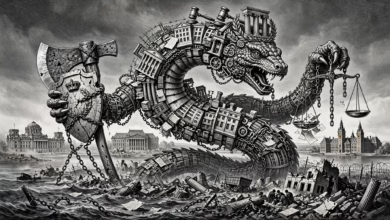
Reading this monumental research work requires a methodological deconstruction of the historical and economic narrative that led to the explosion. The book argues that the current crisis is deeply rooted in structural political and economic dynamics that have shaped conflict in the region for decades. Sudan, the analysis indicates, has developed one of the most complex versions of what is known as the “political marketplace,” a system in which political power is tradable, militarized, and sustained through the buying and selling of loyalties rather than institutional governance. In this market, oil revenues, and more recently gold, created elite patronage networks that fueled armed competition and fragmented state authority, leaving it vulnerable to recurring cycles of continuous violence.
To understand the nature of the explosion witnessed in Sudan’s major metropolis, one must return to the roots. The book points out that previous civil wars devastated the economically marginalized and socially outcast regions in the South and West, but the current war has brought the conflict to the geographical and economic center of the country. The footprint of death and destruction has expanded from Khartoum, Al Jazirah, and Sennar, only to return and strike Darfur and Kordofan once again. The very same historical, economic, political, and ethnic factors that fueled previous conflicts are playing their role today as the warring factions seek to control the country’s resources. After the SAF and the RSF worked together to halt democratic transition efforts, they turned on each other, each seeking absolute control over the state’s “kleptocratic” (rule by thieves) system.
This complex kleptocratic system was fundamentally established and entrenched during the era of former President Omar al-Bashir (1989-2019), who transformed Sudan’s political economy into a blend of military control, ideology, and economic favoritism. The regime used violence to maintain control over national wealth, distributing its revenues to inner circles of power at the expense of rural and peripheral populations. This system, deeply embedded within state institutions and the security apparatus, survived the fall of al-Bashir in April 2019, and its influence remains overwhelming to this day.
From this standpoint, the book moves to analyze the collapse of the political settlement that led to open warfare, postulating that failed states are the product of a breakdown in the distribution of power within society. In the Sudanese case, the collapse of the political settlement between the army and the RSF was the primary cause of the war. Following the overthrow of the civilian transitional government in the 2021 coup, both Army Commander Abdel Fattah al-Burhan and RSF Commander Mohamed Hamdan Dagalo (Hemedti) viewed each other as an existential threat to their political authority and economic influence.
Here emerges one of the book’s most important contributions: highlighting the “elite capture” of Sudan’s agrifood system. The analysis explains how these forces transformed their political influence into vast commercial empires. The SAF and the RSF employed parallel yet distinct strategies to build their empires. The al-Bashir era granted these factions access to lucrative economic resources, such as the export of gold, gum arabic, and sesame, and the import of fuel and wheat. Substantial control over state-owned enterprises was concealed behind companies operating under the army’s “Military Industry Corporation,” which evolved to include highly lucrative commercial agricultural companies.
On the other hand, the roots of the RSF empire trace back to Hemedti’s control over the Jebel Amer gold mines in Darfur, and his family’s ownership of the “Al Junaid” company, which expanded to encompass multiple sectors including banking, agriculture, and transport. Most of the agricultural companies affiliated with the RSF were concentrated in the livestock and oilseed sectors.
The book details with astonishing precision how these forces infiltrated agricultural value chains. In the livestock sector—which is the largest contributor to the agricultural gross domestic product and a major source of foreign exchange—the SAF focused on the cattle trade and processed meat exports through modern slaughterhouses like the Al-Kadro slaughterhouse. Conversely, thanks to its deep ties to pastoral areas in Darfur and Kordofan, the RSF dominated the exports of sheep, goats, and camels to the Gulf states. What is striking in this analysis is the indication that the involvement of these forces in the sector did not yield significant benefits for pastoral communities or improvements in veterinary infrastructure; rather, it was closer to “rent extraction” mechanisms, as these forces lacked the incentive to invest in traceability systems or quality improvement as long as profit margins remained high.
As for the wheat milling sector, which is characterized by relatively low technical complexity and massive urban demand, the SAF adopted a strategy of “unfair competition.” Through the “Seen” Flour Mills company (formerly affiliated with the National Intelligence and Security Service before being transferred to the army), the military establishment benefited from tax exemptions and preferential access to subsidized foreign currency from the Central Bank. This support allowed the company to dominate the market, corner its private sector competitors, and utilize its political leverage to undermine major private enterprises.
This dominance extends even to the horticulture sector (vegetables and fruits), a sector highly intensive in skills and resources. The book notes that “Zadna,” a massive agricultural and construction conglomerate linked to the army (which, in a rare paradox, included Hemedti’s brother on its board of directors), invested heavily in horticulture and advanced pivot irrigation, exploiting the absence of effective private sector competition in this high-cost field.
This part of the analysis draws a bitter conclusion: The penetration of these armed actors into the arteries of the economy, and their pursuit of off-budget resources to ensure their financial independence, was not only the cause of suffocating the private sector and hindering development, but it was also the primary driver that ultimately led to the devastating armed clash when each side felt the other threatened its economic and political empire.
Satellite Eyes Monitor the Collapse, and the Tearing of Food and Trade Chains
When the language of official numbers falls silent, and statistical agencies and state institutions break down under the weight of bullets and artillery shells, there is an urgent need for alternative and innovative means to read the collapsing economic landscape. In the context of complex conflicts, traditional data collection methods, such as government statistics and household surveys, become unreliable or entirely impractical due to security risks, massive displacement, and institutional collapse. Here, the book “War and Resilience” transports us in its fourth chapter to outer space, where researchers utilize satellite imagery and remote sensing technologies as an impartial, real-time lens to measure the scale of economic devastation that has befallen Sudan.
Researchers used emission data, specifically nitrogen dioxide (NO2), and nighttime lighting as proxy indicators for economic and industrial activity. Through a precise comparison between the pre-war period (April 2023) and the ensuing weeks and months, satellite maps reveal a tale of total collapse in the heart of the capital. Khartoum, Khartoum North (Bahri), and Omdurman witnessed the largest drop in NO2 concentrations, where levels plummeted by 33% to 44% in Khartoum, and by 20% to 22% in Khartoum North, reflecting the complete paralysis that struck the country’s largest commercial, industrial, and administrative center. This sharp decline is not merely a reflection of factories halting operations; it is the embodiment of mass civilian evacuations, the cessation of transport, the closure of markets, and the collapse of supply networks.
In a tragic paradox highlighted by these satellite maps, while Khartoum was plunging into darkness and its industrial emissions declining, other remote cities unaffected by direct fighting, such as Kassala, Ed Damazin, and Kadugli, recorded stabilization or even a slight increase in these indicators. This rise does not reflect an economic renaissance but rather translates to waves of mass displacement; these cities transformed into temporary reception centers for internally displaced persons fleeing the inferno of the capital, leading to a temporary surge in human activity, emergency transport movement, and immense pressure on limited local resources.
From space, the book brings us back down to earth, specifically to the farmers’ fields engulfed by the flames of division. In Chapter Five, researchers dissect how the war reshaped the geography of agricultural production, tearing apart Sudan’s food basket. Food security in Sudan has long relied on grain production, particularly sorghum, millet, and wheat, but the conflict created a sharp economic and geographical divide between areas under SAF control and those under RSF control.
The data demonstrates a catastrophic drop in national agricultural production; national production of sorghum, millet, and wheat for the 2023/2024 season was estimated to have declined by 46% compared to the previous year, and 40% below the five-year average. In areas controlled by the RSF, such as vast parts of Darfur, Kordofan, and Al Jazirah state, the collapse was resounding. Al Jazirah state, once considered a stronghold for irrigated wheat production, saw a sharp decline in its production share due to damages to irrigation infrastructure and logistical constraints imposed by the conflict. In Darfur, which relies heavily on traditional rain-fed agriculture, West Darfur state recorded zero millet production, reflecting a complete halt of agricultural activities as a result of insecurity and widespread displacement.
Conversely, states under SAF control in the East and North demonstrated relative resilience. States like Al Qadarif and Sennar maintained reasonable productivity in the semi-mechanized agricultural sector, with Al Qadarif alone contributing 38.4% of sorghum production and 40.6% of millet in army-controlled areas. However, this production was insufficient to bridge the national gap; skyrocketing transport costs across unsafe routes, coupled with informal fees levied at numerous checkpoints, caused wheat prices in western cities like El Fasher and El Obeid to more than quintuple compared to pre-war levels, placing food far out of reach for millions of starving people.
This internal rupture, in turn, reflected on Sudan’s trade movement with the world. Chapter Six of the book addresses the paradox of wartime trade using the economic “gravity” model to analyze the performance of Sudanese agricultural exports. While economic logic would predict a complete collapse of exports, the data presented a more complex and resilient picture. Exports of products primarily grown in SAF-controlled areas actually increased significantly in 2023; these products included sesame, peanuts, cotton, and other oilseeds. In contrast, exports of products geographically linked to RSF-controlled areas, led by livestock and sorghum, declined.
The book explains this disparity through one decisive factor: control over export infrastructure and seaports. The SAF’s retention of control over Port Sudan, the main port and the country’s sole maritime outlet, enabled producers and merchants in the East and North to continue export operations, while western producers found themselves completely isolated from global markets due to the severing of strategic routes and the inability to access the port. This analysis puts forth a crucial conclusion in war economics: the impact of internal conflicts on trade is tied not only to the destruction of production but is geographically governed by the ability to access strategic infrastructure.
To complete the picture of this great collapse, Chapter Seven takes us to read the scene from a macroeconomic perspective using Computable General Equilibrium (CGE) models. International financial institutions anticipate—and the book’s analysis supports—severe contractions in Sudan’s GDP. IMF estimates, incorporated by the researchers into their modeling, indicate an 18.3% contraction in 2023, followed by a deeper 20% contraction in 2024, with a projected continued decline of 10% in 2025 if the war persists. This sharp contraction does not merely represent a loss in numbers; it translates to the direct erasure of national wealth, as the GDP lost approximately 30% of its value compared to pre-war scenarios, dropping from $24.6 billion in 2023 to an estimated level of only $17.6 billion in 2025.
The contraction hit all sectors of the economy relentlessly. The agricultural sector collapsed by 25% in 2023, while the industrial sector recorded a 22.2% decline in the same year due to the systematic destruction of infrastructure and manufacturing. The inevitable result of this economic hemorrhage was an explosion in poverty and food insecurity rates. The book’s models indicate that the number of poor people will rise sharply from 5.7 million in 2023 to surpass the 11.2 million mark by 2030 if immediate intervention is not taken, with the vast majority of these new poor concentrated in rural areas that have lost their means of survival.
Through this meticulous observation, the book confronts the reader with the reality that the war in Sudan was not merely a military conflict, but a systematic dismantling of the economic lifelines; from the crop markets in Al Qadarif, to the destroyed factories of Khartoum, all the way to export ports cut off from the wounded heart of the country.
The Human Toll, the Collapse of Human Capital, and Possible Pathways to Revival
Beyond the dryness of macroeconomic figures and GDP contraction, the harshest face of Sudan’s war manifests in empty dining tables, abandoned schools, and collapsing hospitals. In this part of our reading of “War and Resilience”, we delve into the daily details of suffering, where survival turns into a daily battle, and we explore with the researchers the complex pathways that might lead the country from the edge of the abyss to the dawn of recovery.
The in-depth field analysis of food consumption data, upon which the book’s chapters are based, revealed a horrifying deterioration in the quality and quantity of food available to the Sudanese household. By early 2024, one in three Sudanese households suffered from inadequate food consumption, representing a dramatic increase of eleven percentage points compared to 2023. This hunger did not strike randomly; it was fiercely concentrated in the conflict-torn states. West Darfur state recorded the highest rate of households suffering from poor food consumption, exceeding 50%, followed by South Kordofan and Central Darfur.
What makes the scene even bleaker is the gendered nature of this deprivation. The war strikes women with double severity. Data indicates that female-headed households suffer from significantly worse levels of food insecurity, with inadequate food consumption in these households reaching nearly 48%, compared to 30% for male-headed households. Moreover, the overwhelming majority of women of childbearing age (approximately 84%) failed to meet the minimum acceptable dietary diversity in 2024, alongside a sharp decline in the consumption of micronutrient-rich foods; 37% of households reported not consuming iron-rich foods at all. This severe deficiency reflects directly on future generations, as Global Acute Malnutrition (GAM) rates among children under five exceeded the emergency threshold set by the World Health Organization, reaching 19%.
Faced with this economic and nutritional storm, the Sudanese people did not stand idly by; they devised harsh survival strategies. The book monitors how both urban and rural households resorted to painful coping mechanisms, such as reducing the number of meals, decreasing portion sizes, shifting to cheaper and lower-quality foods, and even prioritizing feeding children over adults. Many households resorted to selling productive and household assets to secure cash liquidity, representing an “erosive coping” that destroys future recovery capacity. On the other hand, financial remittances from abroad emerged as a vital lifeline; the percentage of urban households receiving these remittances jumped from 3% before the war to over 14% during it, forming an alternative safety net amidst a near-total absence of government support and weak official humanitarian interventions.
In a striking paradox worth pausing at, the book raises the question of how to deliver humanitarian aid amid this devastation. Despite the fragility of telecommunications infrastructure, surveys showed that 57% of urban households prefer receiving aid in the form of digital cash transfers (via banking apps or mobile airtime transfers), compared to physical cash or in-kind assistance. Researchers explain this interesting preference as a rational response to the conflict environment; digital money offers protection from the risks of looting and armed robbery that in-kind aid and hard cash are exposed to, and it grants households the flexibility to make purchasing decisions away from the pressures of extortion, despite the costs associated with cashing out these digital funds.
If hunger ravages bodies, the war is destroying the minds and future of the Sudanese nation through the systematic destruction of human capital, represented in the health and education sectors. The book clearly indicates that these sectors were already fragile prior to the conflict, but the war pushed them toward total collapse. In the health sector, approximately 70% of health facilities in conflict zones were destroyed or forcibly closed, leaving 11 million people in desperate need of medical assistance. International organizations have documented the killing of dozens of medical personnel and the occupation and looting of hospitals, which accelerated the “brain drain” of medical professionals to the Gulf states and elsewhere, leaving behind a health system incapable of confronting outbreaks of epidemics like cholera and dengue fever, let alone meeting the basic needs for maternal and child care.
The greater catastrophe is evident in the education sector, where over ten thousand schools closed their doors, leaving nineteen million Sudanese children outside school walls, thereby recording the worst educational crisis in the world in Sudan. Thousands of schools turned into shelters for displaced persons, while teachers’ salaries stopped entirely. The book’s surveys show that complete school dropout rates exceeded 80% in states like Khartoum and Darfur. This prolonged suspension of education does not solely mean the loss of knowledge; it carries terrifying gender implications, as the risk of sexual exploitation and underage marriage rises for girls who drop out of school, threatening to create a “lost generation” incapable of leading the engine of recovery in the future.
Despite this exceedingly grim picture, the creators of this book do not leave us in a tunnel of despair, but dedicate the final section to outlining the contours of the “Way Forward.” The researchers argue that ending the war and building lasting peace cannot be achieved through the usual power-sharing agreements between warlords (or what is known as negative peace), which have historically proven to be a dismal failure in Sudan. Instead, the book advocates for a comprehensive “participatory peace” that includes civilian and community forces, backed by decisive international and regional intervention. The researchers propose the necessity of a robustly mandated, hybrid international-regional peacekeeping force, not only to maintain security but to secure development pathways and safeguard strategic infrastructure that paves the way for recovery.
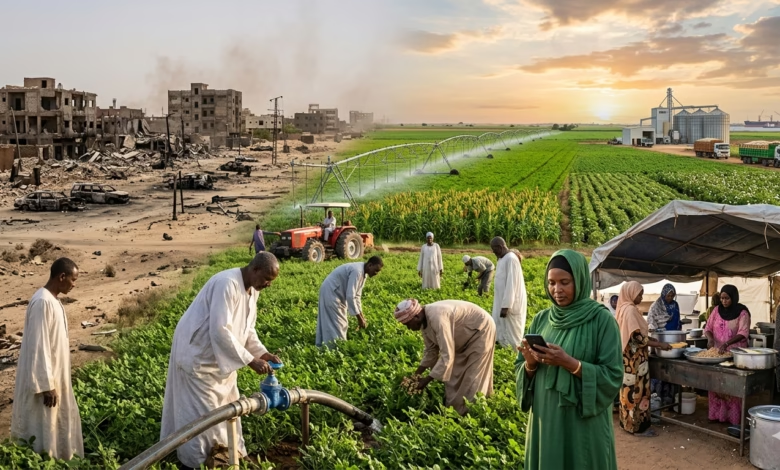
The cornerstone of the Sudanese revival plan, as presented by the book, lies in a strategy of “agriculture-led transformational growth.” The researchers view the agricultural sector as the largest magnet capable of attracting investments, noting that Sudan possesses immense potential to become a regional and global food basket, provided this sector is linked to agro-processing. To achieve this leap, the book proposes an ambitious developmental model based on the establishment of 14 geographically distributed “agro-industrial growth corridors” across Sudan, from Merowe and Dongola in the north, to El Geneina and Zalingei in the west, and from Port Sudan in the east to the White Nile in the south. These corridors aim to integrate the comparative advantages of each region with infrastructure and manufacturing industries, ensuring balanced growth that mitigates the developmental marginalization that was one of the roots of the conflict.
However, for this dream to become a reality, the book estimates that Sudan will need massive investments amounting to $186 billion during the first decade of the post-conflict phase to achieve accelerated economic growth (at a rate of 10% annually). This requires a significant international effort to relieve Sudan of its accumulated debts, assist in recovering looted assets, and support the democratic transition. This would create a conducive environment for the emergence of political coalitions that believe in development and derive their legitimacy from economic achievement rather than the distribution of military rent and corruption.
“Emergency Response Rooms” and Digital Transfers: Features of Popular Resilience in the Heart of Chaos
While the official institutions of the Sudanese state were collapsing like houses of cards under the weight of the conflict, there were other networks, invisible to traditional planners but deeply rooted in the Sudanese conscience, building their own lines of defense. In its advanced chapters, “War and Resilience” transitions from analyzing “macroeconomics” to probing the depths of the “economy of resilience,” where survival is no longer contingent upon the decisions of the Central Bank or the Ministry of Finance, but rather on the ability of local communities to invent solutions out of nothingness.
The book highlights the role of “Emergency Response Rooms” (ERRs) and grassroots committees as a unique phenomenon in the context of contemporary wars. These entities, born from the womb of resistance committees and voluntary work, transformed into service-oriented “shadow governments” in besieged neighborhoods. The analysis points out that these rooms were not merely a conduit for distributing aid; they were the vital nerve center that managed communal kitchens (Takaya), organized medical evacuations, and maintained a minimum level of social cohesion in areas completely cut off from all means of employment and production. The strength of these networks derived its effectiveness from the high “social capital” of the Sudanese people, where traditional values of “Nafeer” (collective community action) were summoned and clothed in modern organizational attire commensurate with the challenges of urban warfare.
Parallel to this resilience on the ground, the book observes a revolutionary shift in the “financial infrastructure of resilience.” When banks were subjected to systematic looting in Khartoum, paper clearing stopped, and a crushing cash liquidity crisis emerged, the economy did not completely halt; rather, it “digitized” itself with astonishing speed. The researchers highlight the pivotal role of banking applications (such as “Bankak” and “Fawry”), which transformed from mere banking tools into an “alternative national currency.” These digital platforms allowed the continuous flow of funds from expatriates directly to their families, and enabled merchants to conduct transactions in local markets without the need to transport huge sums of cash through dangerous checkpoints. This “digital leap forward” represents one of the most important features of resilience documented by the book, confirming that when technology merges with urgent necessity, it creates survival pathways that transcend institutional state failure.
However, this digital and social resilience faces structural challenges that the book dissects deeply, particularly regarding “cash crop value chains.” While digital transfers succeeded in providing liquidity, “physical logistics” remained the greatest obstacle. The book dedicates significant space to analyzing the transport crisis; the cost of transporting crops from production areas in Kordofan and Al Qadarif to ports or consumption centers skyrocketed by astronomical percentages. The cause was not solely the rising fuel prices, but the “economy of tolls” imposed by armed militants along the highways. The book describes how national roads morphed into informal “collection points,” eroding farmers’ profits and permanently driving up prices for the starving urban consumer. This precise characterization clarifies how war not only destroys production but “poisons” distribution arteries, rendering food present in warehouses yet missing from dining tables.
Furthermore, the book touches upon the issue of “water and environmental security” as a missing element in standard war narratives. The researchers indicate that the destruction of power stations and the disruption of spare parts supply chains led to the stoppage of thousands of water pumps in irrigated agricultural schemes. This collapse in the irrigation system not only threatens current crops but jeopardizes the “soil” itself through increased salinization and the neglect of routine maintenance for canals and drains. This means that returning to production post-war will not happen at the push of a button, but will require a comprehensive rehabilitation of the hydraulic infrastructure that took decades to build.
In the context of the search for “pathways to recovery,” the book presents a critical vision of international aid. The researchers argue that the classic “emergency relief” model (distributing food cartons) is no longer sufficient in Sudan’s complex case. Instead, the book advocates for “Investing in Resilience” by supporting local markets rather than bypassing them. The book proposes that international organizations purchase crops from local Sudanese farmers (who have surpluses in certain areas but cannot transport them) and distribute them in affected areas, thereby killing two birds with one stone: supporting the income of the local producer, and providing food to the needy at a lower cost than cross-border importation.
This “market-based” approach to relief aligns with the book’s findings regarding the resilience of the small and medium-sized private sector. Despite the destruction that befell major factories in Khartoum, small workshops and local mills in the states demonstrated an amazing capacity for adaptation. The book views these small entities as the nucleus that will form the core of “transformational growth” in the future, provided they find legal protection and accessible financing, far from the encroachment of military institutions and monopolistic corporations that dominated the scene before the war.
In this sense, “recovery” in the book’s vision becomes not merely a return to pre-April 15, 2023, but a “completely different rebuilding.” It is a process that demands decoupling the historical link between weapons and wealth, and empowering the “people’s economy” that has proven its effectiveness in the darkest of circumstances, in contrast to the “elite’s economy” that led the country to collective suicide.
The Geopolitics of Food and Future Scenarios: Will Sudan Rise from the Ashes?
The Sudan crisis cannot be read in isolation from its regional and international surroundings, a reality well recognized by the authors of “War and Resilience” as they dedicate the concluding chapters to analyzing the “geopolitics of food.” Sudan is not just a country suffering from a civil war; it is a cornerstone of food security for the Middle East and East Africa region. The stability of Sudan means the flow of meat, grains, and oilseeds to global and regional markets, whereas its collapse means the export of instability, waves of displacement, and a direct threat to cross-border food supply chains.
The book transitions us into the language of forward-looking economic modeling to outline three potential pathways for Sudan’s future up to 2030—pathways that do not speak to emotion but rely on Computable General Equilibrium (CGE) equations. The first and bleakest pathway assumes the continuation of the current “no-peace,” where the country remains divided between warring military factions. In this scenario, the book predicts a continued bleeding of the GDP and an expansion of poverty to encompass more than two-thirds of the population. Sudan would transition into a “functionally failed state” surviving on sporadic humanitarian handouts, leading to the final erosion of whatever remains of its agricultural and industrial infrastructure.
The second pathway is what the book terms “negative peace” or “elite power-sharing agreements.” While this path might halt the whizzing of bullets, economic modeling reveals its shortcomings. Agreements based on dividing spoils and resources among military commanders without structural reform will result in fragile and slow growth, failing to attract the major international investments necessary for reconstruction. The authors argue that this type of peace preserves the “rentier economy” that fueled the war, and may ultimately trigger a new cycle of violence the moment the partners disagree over cutting the economic pie.
Here, the book presents the third pathway, the only one capable of saving the Sudanese nation: “Comprehensive Peace and Transformational Growth.” This path requires bold investment in the fourteen “agro-industrial growth corridors” that represent the backbone of the book’s vision for recovery. These corridors are not merely lines on a map, but an integrated strategy to connect areas of intense production (such as Al Qadarif, Al Jazirah, and the Blue Nile) with manufacturing hubs and ports. The success of this model depends on the “localization of value addition”; instead of exporting sesame, cotton, and livestock as raw materials, the book suggests building manufacturing industries (oils, textiles, meat canning) within these corridors. This would create millions of job opportunities for youth and returning displaced persons, reducing the historical developmental disparity between the center and the peripheries.
However, for this engine of growth to move, the book places the international community before its historical responsibility. The figure of “$186 billion” proposed by the book as an investment need for the coming decade may seem astronomical, but it becomes logical when compared to the cost of continuing the war or the cost of unending humanitarian interventions. The book emphasizes that the “key to the financial solution” begins with relieving Sudan of its external debts, which exceeded $60 billion, through the “HIPC” (Heavily Indebted Poor Countries) initiative, providing sovereign guarantees for private investments in the energy and telecommunications sectors, and directing technical support to rebuild the Central Bank and statistical institutions destroyed by the war.
In a related context, the book highlights the “regional role” as a crucial element. Sudan requires economic integration with its neighbors, particularly in the areas of electricity interconnection and the grain trade. Restoring Sudan’s role as a food producer rather than an aid consumer demands coordination with neighboring countries to open trade corridors and facilitate the movement of labor and goods. This would transform Sudan from a “weak point” in regional security into a “strategic partner” in the continent’s stability.
The book concludes its chapters with a powerful message: “Resilience is not merely survival, but the ability to transform.” The Sudanese people, who have demonstrated legendary steadfastness through emergency response rooms, digital transfers, and social solidarity networks, deserve a political and economic system that parallels this resilience. The authors conclude that the current war, despite its tragedy, represents a “cruel opportunity” for a final break with the system of military cronyism, and for building a new social contract that places “agriculture and rural development” at the heart of the new Sudanese state’s identity.
(War and Resilience: The Multifaceted Impacts of Sudan’s Conflict and Pathways to Recovery)