
Sudan’s future lies between a sun that never sets and a Nile that overflows.
Will the environment become a ticking time bomb or a bridge to sustainable peace?

A Reading in the Book of Sudanese Nature: The First State of Environment and Outlook Report 2020… A Document for Transition and Peace
The intersections of politics, economics, and the environment in Sudan stand at a historic crossroads, a reality profoundly and clearly embodied by the “First State of Environment and Outlook Report 2020.” This report, bearing the slogan “Environment for Peace and Sustainable Development,” cannot be viewed merely as dry scientific or statistical monitoring; rather, it is a grand national narrative that documents geographical transformations, demographic challenges, and the scars of conflicts etched deeply into the body of the Sudanese land. Prepared in collaboration between the United Nations Environment Programme (UNEP) and the Higher Council for Environment and Natural Resources, this report arrives at a defining moment as Sudan feels its way forward, placing both the decision-maker and the citizen before a mirror that reflects the environmental reality in all its harshness and challenges.
The Geopolitical Earthquake and Demographic Shifts
Perhaps the most crucial entry point for understanding this documentary tome is realizing the magnitude of the geopolitical and environmental earthquake that struck the country in 2011. The secession of South Sudan was not merely a redrawing of maps; it was an ecological and economic amputation that altered the face of life in the north. Sudan’s area shrank by nearly a quarter, settling at 1.88 million square kilometers, thereby losing its status as the largest African nation. This geographic contraction came at a heavy cost, swallowing 68% of the country’s forests and woodlands, and nearly half of its natural reserves teeming with wildlife. The losses did not stop there, extending to include 57% of oil reserves, which led to a sharp collapse in GDP per capita and pushed the economy into suffocating inflationary spirals. In the blink of an eye, the proportion of land classified as arid jumped from 65% to 90%, leaving Sudan face-to-face with a harsh desert reality.
At the heart of these violent environmental shifts, the report paints a demographic picture pulsing with anxiety. We are looking at a youthful nation with a rapidly growing population, currently estimated at around 44 million, with projections to touch the 57 million mark by 2030. This population explosion, where youth and children constitute the overwhelming majority, generates immense pressure on steadily diminishing natural resources. One of the most dangerous manifestations of this pressure is the phenomenon of unchecked urban sprawl, where cities—chiefly the capital, Khartoum—creep outwards, swallowing land and depleting services. The malignant growth of the capital is not the product of economic prosperity, but essentially forced migration dictated by waves of drought and desertification, exacerbated by the scourges of armed conflicts in regions like Darfur and Kordofan. Today, Khartoum alone absorbs more than 40% of the country’s urban population.
The Poverty-Environment Nexus and Structural Challenges
The report delves into the organic and tragic relationship between poverty and the environment. In a country where nearly half the population lives below the poverty line, resorting to the depletion of natural resources becomes an unavoidable matter of survival. This depletion manifests in its ugliest forms through an over-reliance on biomass—specifically firewood and charcoal—to meet household energy needs. The report issues a clear warning that this reliance, which provides over half of the country’s energy, is driving forests toward systematic annihilation. Annual firewood consumption is expected to jump to 30 million cubic meters by 2030, a figure that represents a death sentence for the remaining vegetative cover unless decisive policies intervene to alter this trajectory.
This depletion is accompanied by structural challenges within the architecture of environmental administration and governance. Although Sudan enjoys a federal system of government that distributes power between the center and the states, the report reveals deep gaps in coordination and a chronic weakness in law enforcement. Statutory legislation intertwines with local customs and traditions—especially concerning land ownership and grazing routes—creating a complex legal environment that is often a focal point for conflicts, particularly between settled farmers and nomadic pastoralists. It has become evident that reforming environmental governance and clarifying land usufruct rights are not mere administrative requirements, but the foundational pillars of any national project aiming to establish sustainable peace.
Climate Geography and Ecological Degradation
Sudan’s environmental narrative is incomplete without pausing extensively at its atmosphere, this vast expanse that harshly dictates the details of daily life and shapes the rhythm of agriculture and grazing in the country. The report confronts us with a strict climatic reality; Sudan sits at the northern edge of the low-pressure belt known as the Intertropical Convergence Zone (ITCZ). It lacks vast inland water bodies to moderate its climate, instead drawing its moisture from southern maritime winds blowing from distant oceans like the Indian and the Atlantic. This climatic geography creates a sharp contrast that reshapes the socio-economic map. While northern regions, such as Wadi Halfa, stand on the brink of eternal thirst with almost non-existent rainfall and summer temperatures touching 45°C, southeastern regions like Ad-Damazin enjoy a rainy season extending for eight months with precipitation rates reaching 692 millimeters annually.
Between these two extremes lies the livelihood of millions of Sudanese who are hostage to the whims of the sky. However, this sky is no longer as generous as it once was. Climate change is no longer an intellectual luxury debated in conference halls, but a daily reality crushing the bones of farmers and pastoralists. Data spanning from 1980 to 2016 monitors a disturbing rise in maximum and minimum temperatures across most observation stations, alongside a decline in rainfall rates and increased volatility in their patterns. This violent climatic shift is pushing agro-climatic zones steadily southward, threatening northern lands with gradual exclusion from agricultural viability. It threatens the collapse of staple crop yields like sorghum and millet, as well as the contraction of the Gum Arabic belt, a vital economic artery. The repercussions of climate change do not stop at food security but extend to foreshadow horrific health disasters. Studies indicate that rising temperatures in regions like Kordofan could dangerously expand the spread of malaria by 2060, creating an incubating environment for other diseases such as meningitis and leishmaniasis.
The Land, Agriculture, and Pastoralism Crisis
From the sky down to the earth, the report dissects the body of the Sudanese landmass, 72% of which is swallowed by the desert. In the remaining areas, Sudan theoretically possesses about 68.2 million hectares of arable land, but the painful paradox lies in the fact that what is actually cultivated does not exceed 20 million hectares. These lands, whose soils vary between heavy clay in the central plains and fragile sandy soils (Qoz) in Kordofan and Darfur, are subjected to systematic depletion.
Rain-fed mechanized agriculture, introduced in the 1940s and extending today over an area exceeding 6.7 million hectares, has turned into a tool of environmental destruction. The absence of crop rotation, monocropping, the use of heavy machinery that compacts the soil, alongside indiscriminate tree felling, are all factors that have made mechanized agriculture an unsustainable practice that drains soil fertility and drives it toward desertification. The picture grows bleaker upon realizing that vast tracts of these mechanized schemes, such as in Sennar State where unregulated projects account for 70%, operate outside the umbrella of government oversight and planning, thereby deepening the earth’s wounds.
This territorial hemorrhage is not confined to agriculture but extends to the complexities of nomadic pastoralism. Sudan hosts one of the largest concentrations of traditional pastoralists in Africa, making up about 13% of the population and possessing a massive livestock wealth exceeding 108 million head of camels, sheep, goats, and cattle. These herders, who cross hundreds of kilometers along historic routes in search of pasture and water, find themselves today trapped between the hammer of mechanized agricultural expansion and the anvil of drought and pasture degradation. The closure of grazing routes and the decline of available pastoral lands have ignited bloody conflicts with settled farmers—conflicts that take on a catastrophic character in regions like Darfur and Kordofan, further complicating the security and social landscape.
Deep within all these conflicts lies a structural flaw in land tenure laws. Sudan experiences a state of legal schizophrenia between statutory state legislations—such as the Unregistered Land Act of 1970 and the Civil Transactions Act of 1984, which grant the state absolute ownership over fallow lands and forests while considering individuals mere usufructuaries—and customary laws and tribal traditions that grant local communities a historic right to manage their lands and resources. This collision between state authority and tribal legitimacy has created an institutional vacuum exploited in large-scale land grabs. The government has opened the doors of agricultural investment to foreign companies from regional and international states, conceding millions of hectares in moves that often ignore the rights of local communities, yielding further marginalization and conflict. This proves that land in Sudan is not merely mud and sand, but a repository of identity, sovereignty, and survival.
Water, Coasts, and Biodiversity
If the land suffers from depletion and dispute, water in Sudan lives the paradox of scarcity in the presence of abundance. Although the Nile River runs through the country, providing 73% of its fresh water, and despite abundant rainfall and groundwater—such as the great Nubian Sandstone Aquifer shared with neighboring countries—the report classifies Sudan as a country suffering from noticeable water stress. The annual per capita share of water does not exceed 700 cubic meters, a figure that falls below the internationally recognized water scarcity threshold of 1,000 cubic meters. This paradox stems from weak infrastructure, poor resource management, the loss of massive quantities of water due to evaporation in dams, and the crisis of accumulated silt, which has caused vital reservoirs, like Roseires, Sennar, and Khashm el-Girba, to lose more than half of their design capacity for water storage. Even seasonal water bodies (streams and wadis) that flow abundantly during the autumn season go to waste or cause devastating floods due to the lack of adequate mechanisms for harvesting and utilizing them.
On its eastern front, Sudan overlooks the Red Sea with a coastline stretching for about 853 kilometers, embracing a priceless marine wealth of coral reefs, mangrove forests, and immense fish diversity. These coasts encompass globally recognized natural reserves such as:
-
Sanganeb Marine National Park: The only coral atoll in the Red Sea.
-
Dungonab Bay and Mukkawar Island Marine National Park: Safe havens for sharks, marine turtles, dugongs, and migratory birds.
However, these marine treasures are not immune to the grip of threats. Unplanned urban sprawl around Port Sudan, pollution from commercial shipping traffic and industrial waste, overfishing, and the destruction of coastal habitats all place this unique ecosystem on the brink of peril. The threats do not stop at direct human interventions; climate change menaces the Red Sea coasts with rising sea levels, increased water salinity, and intensified storms, threatening to suffocate coral reefs and displace coastal communities, thereby adding a new chapter of environmental challenges that do not stop at the land’s edge.
Moving from water resources and coasts to the heart of the landmass, the report opens a file of no less gravity and importance: biodiversity, which represents the strategic reserve for life in Sudan. With its unique location as a natural bridge between Sub-Saharan Africa and the Arab world, Sudan harbors a staggering biological diversity that stretches from resilient desert flora in the north to tropical rainforests in the far south and southeast. However, this reserve is undergoing a silent and horrifying erosion. Wildlife that once roamed the Sudanese plains in massive numbers—such as elephants, giraffes, lions, and antelopes—found itself trapped in a pincer movement: systematic poaching on one side, and the destruction of natural habitats due to agricultural expansion and armed conflicts on the other. The report warns that many species have already disappeared from their historical distribution ranges, and that existing natural reserves, despite their importance, suffer from a severe lack of funding and qualified human cadres, often reducing them to “paper parks” lacking actual protection on the ground.
In this context, Sudan’s forests stand out as one of the most damaged ecosystems, with the country having lost vast tracts of its tree cover in recent decades. The role of the forest in Sudan is not limited to producing timber and Gum Arabic; rather, it is the first line of defense against desert encroachment, a carbon sink that moderates the climate, and a source of food and medicine for local communities. Yet, the report reveals a painful energy paradox: Sudan, which possesses oil reserves and hydroelectric generation capacities, still relies on biomass (firewood and charcoal) for over 70% of its household energy needs. This extreme reliance places forests under unbearable pressure, as millions of trees are felled annually for cooking, in a depletion process that outpaces the forests’ capacity for natural regeneration. “Energy poverty” in Sudan is not merely a service provision issue; it is a fundamental driver of environmental degradation, where impoverished families, especially in rural areas and IDP camps, are forced to destroy their environmental surroundings to survive, creating a vicious cycle of poverty and environmental ruin.
Urban Collapse and the Gold Rush
The challenges do not stop at the borders of the countryside and forests but extend to urban centers experiencing a terrifying deterioration in the quality of life. The report paints a bleak picture of the environmental reality in Sudanese cities, where sanitation and waste infrastructure suffer from near-total collapse. In the capital, Khartoum, home to millions, the sewage network covers only a minuscule fraction of the population, while the vast majority relies on septic tanks that leak into shallow groundwater, threatening to contaminate the aquifer from which the city drinks. The solid waste file has evolved into a national crisis; informal dumps proliferate in residential neighborhoods, sorting and recycling systems are absent, and accumulated plastics choke waterways and pollute the soil. The lack of proper urban planning and the influx of displaced persons to the margins of cities have created belts of misery lacking the most basic environmental and health necessities, rendering urban dwellers highly vulnerable to epidemics and mounting environmental risks.
From another angle of the complex environmental landscape, the report highlights the “gold rush” phenomenon that has swept Sudan over the past decade. Traditional (artisanal) gold mining has become a massive economic activity involving over 2 million people and spreading across most of the country’s states. Despite the quick financial returns, the report warns of a long-term environmental and health catastrophe resulting from this activity. The indiscriminate and excessive use of mercury, and recently cyanide, in gold extraction is conducted without the slightest safety standards, leading to the poisoning of soil, groundwater, and air, and threatening the lives of miners and their surrounding communities. This “gold curse” not only destroys public health but also leads to the bulldozing of vast tracts of agricultural and pastoral lands and creates socio-economic conflicts over land ownership and water resources. This proves that the immediate economic gains of mining may easily dissipate before the exorbitant costs of repairing the environment and treating future generations.
Conflict, Governance, and the Institutional Maze
The most painful chapter in the report is the one addressing the reciprocal relationship between conflict and the environment. For decades, Sudan has been a theater for devastating civil wars where the environment was simultaneously a victim and a tool. On one hand, conflicts led to the displacement of millions of people to camps lacking services, placing explosive pressure on the natural resources surrounding those camps, such as water and forests. On the other hand, natural resources were used as fuel for wars, whether through funding militias with timber and mineral revenues or by destroying water sources and farms as a military strategy to subjugate opponents. The report asserts with unequivocal clarity that no peace agreement in Sudan will achieve success and continuity unless it places at its core the issue of “environmental justice,” the rehabilitation of damaged ecosystems, and ensuring the equitable distribution of natural resources among local communities, far removed from the policies of marginalization and monopolization that fueled past wars.
The trajectories of the environmental reality in Sudan cannot be understood without diving into the institutional and legislative “maze” that governs this file, to which the report dedicates a broad and profound analytical space. Environmental management in Sudan is not merely a technical issue, but a reflection of the state’s structure and political evolution. Since the establishment of the “Higher Council for Environment and Natural Resources” in 1991, Sudan has sought to create an overarching coordinating body to unify scattered efforts among the ministries of agriculture, irrigation, forestry, and mining. However, the report boldly exposes the “power gap”: while the Council holds a broad theoretical mandate, it frequently lacks the executive authority and sufficient financial resources to enforce environmental standards on powerful and influential economic sectors. This institutional fragmentation leads to overlapping jurisdictions, where states sometimes find themselves confronting the center over who holds the right to grant mining licenses or allocate land, making the environment the biggest loser in bureaucratic struggles.
On the legislative front, the report analyzes the “Environment Protection Act of 2001,” which represented a qualitative leap in its time but has today become inadequate to keep pace with emerging challenges. The penalties stipulated in current laws are often not a deterrent for major corporations, and “Environmental Impact Assessment” mechanisms suffer from loopholes that allow environmentally destructive projects to pass under the guise of economic development. The report emphasizes the necessity of harmonizing national laws with the Constitutional Document that governed the transitional period, which explicitly stipulated the citizen’s right to a healthy and sustainable environment. Reforming the legal system requires shifting from a limited “punitive approach” to a comprehensive “preventative approach” that integrates the environmental dimension into every economic or political decision, and ensures genuine participation of local communities in protecting their resources, rather than marginalizing them in favor of power centers.
In a bright spot amidst these challenges, the report highlights the vital role Sudan plays in international forums. Despite years of political isolation, Sudan has remained an active party and signatory to the most important global environmental agreements, from the Paris Climate Agreement to the Convention on Biological Diversity and the Convention to Combat Desertification. The report views these agreements not merely as paper commitments, but as “Sudan’s gateway” to the international community to access green finance and modern environmental technology transfer. Sudan’s engagement in mechanisms like the Green Climate Fund and the Global Environment Facility represents a historic opportunity to finance climate change adaptation projects, reforest lands, and develop renewable energies. This contributes to alleviating pressure on local natural resources and places the country on the path of sustainable global development.
Future Scenarios and the Roadmap to Sustainability
The most concerning and forward-looking section of the report relates to the “future scenarios.” Experts present Sudan with two exclusive options:
-
The “Business as Usual” Scenario: Here, weak oversight, over-reliance on biomass, and poorly planned agricultural expansion persist. Sudan faces a dark future characterized by accelerated desertification, the complete loss of forest cover in some states by 2040, and exacerbated food and water crises. This will inevitably lead to massive waves of human displacement and bloody conflicts over remaining resources.
-
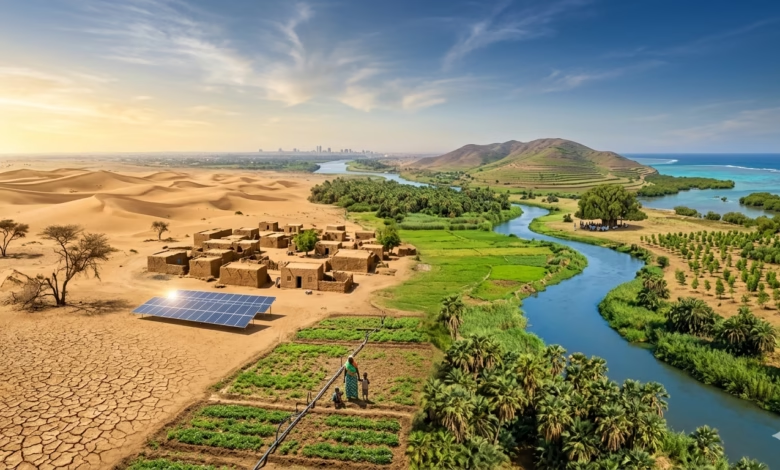
The “Sustainability” Scenario: This requires a solid political will capable of implementing the desired “Environmental Revolution.” This is a revolution dependent on transitioning to solar and wind energy, applying conservation agriculture, reforesting millions of hectares, and restoring the health of ecosystems, thereby ensuring balanced economic prosperity that safeguards the rights of future generations.
The report concludes its chapters with a set of recommendations that represent a “roadmap” to save Sudanese nature. These recommendations do not stop at technical solutions but extend to encompass structural reforms in the architecture of the state and society. The report calls for the establishment of a “Comprehensive National Environmental Information System” that bridges the current data gap and provides decision-makers with accurate, updated figures. It also emphasizes the importance of “Environmental Education” to integrate environmental awareness into school curricula and build the capacities of youth and women as essential actors in environmental protection.
The final message of the report is that “peace and environment are two sides of the same coin”; there can be no sustainable peace in Sudan without equitable and sustainable management of land and water, and no environmental protection in the shadow of wars and turmoil.
Sudan First State of Environment and Outlook Report 2020