
Environment, Conflict and Peace in Sudan: A Reading of a Report That Reveals What the Smoke Has Hidden

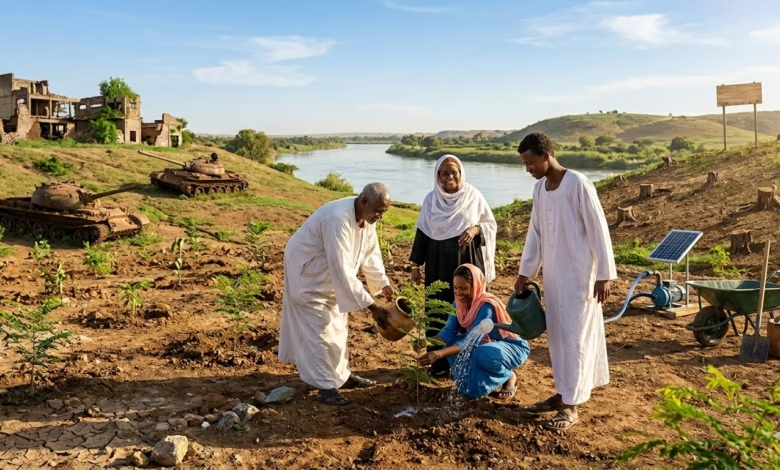
When the Earth Becomes a Party to the War
There is an entrenched illusion residing in the minds of many engaged in humanitarian affairs, which dictates that war revolves around humans, and that nature is a silent witness to what unfolds, not an active party in the equation. The report “Environment, Conflict and Peace in Sudan: From Response to Recovery,” issued in October 2025 by the Conflict and Environment Observatory (CEOBS) in collaboration with the Conflict Sensitivity Facility (CSF), arrives to demolish this illusion from its foundation. It proves that the earth, water, forest, and pasture are not merely a backdrop to the scene, but rather parties to the conflict, tools in the hands of the belligerents, and silent victims whose wounds accumulate across generations.
The report does not merely describe the Sudanese environmental landscape in times of war; it delves deeper into what is more profound and unsettling. It approaches the relationship between environmental degradation and the eruption of conflict, illustrating how decades of depletion policies, elite looting, and the systematic neglect of local structures have paved the ground for the humanitarian catastrophe we witness today—a catastrophe unparalleled in scale anywhere else on Earth. At the same time, it refrains from falling into the attractive trap of oversimplification which claims that climate is the sole driver of the conflict, warning that such framing temptingly absolves political elites of responsibility and shifts the entire burden onto nature.
This reading is not merely a faithful summary of what was stated in the report, but rather an analytical interrogation of its findings, approaches, and implications, both in terms of understanding the nature of the Sudanese conflict and in terms of what peace and recovery strategies ought to be in a country that hoards immense wealth beneath its soil while its people starve and perish in war.
First: The Environment is Not a Margin — The Context and the Hidden Paradox
When the world speaks of Sudan today, attention is focused on the terrifying displacement figures that have surpassed twelve million internally displaced persons, on the scenes of famine in Darfur, Al Jazirah, and Kordofan, and on the complete collapse of health, water, and electricity systems. These figures are painful and real, but the report we are reading poses a troubling question: Can we truly comprehend this humanitarian catastrophe without understanding the land upon which it takes place?
The answer is no. This is because what the report terms “the environment” is not merely trees, water, and soil; it is the vessel in which the livelihoods of eighty percent of the population exist. It is the fabric in which relationships of identity, belonging, and ownership intertwine among hundreds of distinct ethnic groups, and it is the grazing ground that the fangs of political and military elites have torn into for decades. A forest is not just delightful greenery; it is the sole source of firewood and fodder for entire families, and it is what the mass displacement fleeing bullets is driven toward, only to fall into the trap of destitution. A pasture is not merely wasteland; it is a space for negotiation, conflict, and coexistence between herders and farmers since time immemorial.
The report asserts with striking boldness that the environment and natural resources in Sudan must be a recognized element in aid, stabilization, and peacebuilding strategies, rather than remaining an intellectual luxury postponed until after the war ends. The paradox is that the war itself will not end unless its intertwined environmental and resource-based roots are addressed.
However, there is a genuine epistemological tension that the report manages well: the tension between the urgency of immediate humanitarian response and the necessity of long-term environmental planning. It is impossible, indeed morally offensive, to tell a person dying of hunger to reflect on the ecological balance of their diet. Yet, the true impossibility lies in feeding them today without protecting the land that will feed them tomorrow. Between these two impossibilities, the report attempts to chart a third path.
Second: The Legacy of Depletion — How the Ground was Prepared for Disaster
It is impossible to understand what is happening in Sudan today without tracing the trajectory of policies implemented against it over decades. The report reveals that the current environmental degradation is not a product of the wartime moment, but rather the outcome of systematic accumulations whose roots extend to the pre- and post-independence eras.
The beginning traces back to the Unregistered Land Act in the 1970s, which stripped local communities of what they had built their existence upon for generations, transferring its ownership to the state. Then came the Civil Transactions Act of 1984, which granted the right of usufruct but retained sovereignty for the state—a legal distinction precise in its drafting but devastating in its application. This was followed by the abolition of the Native Administration, dismantling the traditional structures that managed resources and resolved disputes, leaving communities facing a terrifying institutional vacuum filled by corruption and conflict.
The most dangerous aspect of this trajectory is that it was not random. A careful reading reveals a clear political intent to dismantle the self-capacity of local communities to manage their resources, transforming this land into an open space for national and foreign private investment under the banner of developmental ambition and turning Sudan into a “regional breadbasket.” Agricultural and mining companies benefited from this shift, while smallholder farmers and herders lost their lands, their identities, and sometimes their lives.
The climate pressures, escalating year after year, thus found a land whose capacity for absorption and adaptation had already been weakened. Communities that historically dealt with severe climate volatility through sophisticated resilience systems—from nomadic pastoralism to traditional water management to crop diversification—found these systems eroded and sabotaged from within. They were thus exposed to droughts and floods far more severely than before. Here, the report issues an unequivocal warning: this fragility must not be reduced merely to climate change, lest we absolve local policies and ruling elites of their responsibility. Climate change is a real driver, but it operates on ground prepared by poor governance, not on pristine land.
Perhaps the most painful statement in the report is a description from one of the interviews: when elderly farmers are asked what their lands looked like in their youth, they fall silent for a moment, then speak. What they recount is another world. Forests that were once here. Rivers that used to flow. Bounties that provided satiation. The picture they paint with their words is agonizingly alien to the current landscape. This environmental decline is not a natural fate; it is the result of systematic human decisions.
Third: Oil and Gold — The War Economy and the Looting State
One of the most dense and heavy chapters of the report deals with the role of high-value natural resources in the political economy of the conflict. There is a recurring dynamic in Sudan’s history: natural resources are discovered, elites rush to control them, local communities are marginalized or displaced, revenues fund weapons and militias, and producing areas turn into flashpoints of conflict and civilian targeting.
Oil was the first manifestation of this dynamic. Since its discovery and the construction of the first pipeline in the late 1990s, oil became a dual fuel: fuel for the economy, and fuel for war. Extensive investigations documented how oil-producing regions witnessed mass killings and ethnic cleansing, while foreign companies colluded with a regime built on crushing those living atop this wealth. When the 2023 war broke out, control over refineries and pipelines returned to the forefront of military strategies, carrying with it the destruction of infrastructure whose environmental damage will extend for decades.
As for gold, some analysts have described it as the curse that befell Sudan after losing three-quarters of its oil resources following the secession of the South in 2011. What distinguishes the gold economy from oil is its lesser need for heavy infrastructure, making it accessible to a wider spectrum of actors in the conflict—from the regular army to the Rapid Support Forces to international smuggling networks. While reports indicate that official gold exports reached one and a half billion dollars during the first ten months of 2024, actual production is believed to be much higher, as gold bleeds across borders through smuggling to the UAE and other countries.
The fundamental point established by the report is that these resources are not merely explained as causes of conflict, but as shapers of the entire political structure. The elites controlling oil and gold do not want a strong institutional state that holds them accountable; they want organized chaos that keeps revenues flowing into their pockets unchecked. This explains the eloquent sentence from one of the interviews: “The problem is not our lack of natural resources in Sudan, for we have plenty of them; the issue lies in how they are distributed.” The epicenter of the crisis is not a scarcity of wealth, but its broken distribution system.
The picture deepens further when the report exposes the international dimensions of this political economy. Saudi Arabia, the UAE, Qatar, and Kuwait have collectively acquired nearly half a million hectares of Sudanese land since the turn of the millennium. The Red Sea, bordered by the Sudanese coast, is an arena of intense international and strategic influence competition. Revenues from gum arabic—of which Sudan produces seventy percent of the global need—have plummeted by fifty percent due to the war. The waters of the Nile and the dams managing them represent a vital resource issue intersecting with ongoing regional tensions.
This international entanglement does not mean the Sudanese war is solely a foreign creation, but it does mean that any settlement failing to account for these external interests will remain inadequate. From this, we understand why all mediation efforts have thus far failed to achieve a true ceasefire: the intersecting and conflicting interests of regional and international powers make every party keen to keep its cards in play.
Fourth: The War and its Direct Environmental Impact — Pollution Accumulating in Silence
While the preceding sections describe the structural roots and preludes of the crisis, the report also pauses at the direct environmental impact left by the ongoing war since April 2023 on the body of the Sudanese land. It is an impact that clarifies slowly, partly because field access is nearly impossible, and partly because no one thinks to monitor the environment when people are dying.
The destroyed industrial infrastructure is a primary source of pollution: refinery fires, chemical spills, and the mixture of fuel from damaged facilities with soil and groundwater. In Khartoum, residents are exposed to highly toxic substances such as Polychlorinated Biphenyls (PCBs) found in electrical transformer oils. Pesticide warehouses in Al Jazirah state represent ticking chemical time bombs. Landmines and explosive remnants of war will cast a shadow over local communities for years, preventing access to their lands and water resources.
Internal displacement—exceeding ten million people—generates immense environmental pressure on host areas. The need for energy, warmth, and cooking translates into deforestation at a terrifying rate in a country whose deforestation rate was already among the highest globally at 2.4 percent annually. Deforestation does not just mean losing trees; it means soil degradation, a drop in groundwater levels, and biodiversity losses that will be difficult to replace in generations.
Even nature reserves have not been spared. Radom National Park in South Darfur, an area equal in size to Lebanon, is experiencing a severe loss in biodiversity not from direct violence, but from the collapse of administrative capacity and the spread of unregulated mining that uses mercury, cyanide, and thiourea—highly hazardous substances that poison the earth, water, and air.
The bitter conclusion drawn by the report is that the true extent of environmental damage inflicted on Sudan remains obscure, most likely exceeding all estimates, and its consequences will continue to interact and multiply for decades to come. Herein lies a dual challenge: the immediate humanitarian challenge for those suffering now, and the deferred environmental challenge whose burden will be borne by future generations.
Fifth: The Simplification Trap — When the Environment is Used as a Pretext
A precise critical tone in the report stands out regarding how climate discourse is sometimes weaponized to explain the Sudanese conflict. Researchers warn that simplistic narratives citing climate change as the direct cause of the war may sometimes be used to divert attention from the political elites’ mismanagement and exploitation of resources.
This is a highly important warning. Blaming the climate alone for the war cements a form of environmental determinism that exempts political actors from accountability, turning wealthy decision-makers into victims of nature. This reframes the crisis as a technical climate issue requiring technical climate solutions, rather than a political and governance issue demanding accountability and the redistribution of power and wealth.
The most profound point the report raises in this regard is that the relationship between climate and conflict is not a direct causal one, but rather a relationship of conditioning and mediation. Climate exacerbates pressures, but it does not automatically produce war. What produces war is the political, economic, and institutional framework that transforms scarcity and pressure into armed conflict. Other communities on Earth face similar climate pressures and do not slide into war because they possess conflict-resolution institutions and systems that address scarcity through cooperation, not violence. In Sudan, these institutions were systematically dismantled.
This critique extends to how international climate finance mechanisms operate, tending toward top-down approaches and relying on state institutions to implement adaptation projects. In a country where barely a single government institution functions, this approach simply means excluding Sudan and other fragile states from the climate recovery system precisely when the need is greatest.
Sixth: What the Sudanese do in the Dark — Mutual Aid and “Nafeer”
Among the most illuminating and uplifting chapters of the report, amid the general gloom, is the one highlighting what Sudanese communities have achieved through their own strength despite everything.
Mutual aid, or “Nafeer,” as a deeply rooted social practice in Sudanese culture, has been summoned back in this ordeal with surprising momentum. Volunteer networks, Women’s Response Rooms, and neighborhood committees were often the only thread keeping communities intact when all else stopped. Soup kitchens (Takaya) provide food. “Nafeer” networks repair water infrastructure. Women’s groups address the needs of women and girls typically marginalized in emergency contexts.
What the report clearly highlights is that this local response was often more streamlined, faster to adapt, and possessed a deeper knowledge of the local environmental context than the international response. The local responder knows that a specific valley floods during the rainy season, that a certain soil is unsuitable for building a camp, and that one community has strained relations with another. This knowledge is precious, rare, and cannot be imported.
The report acknowledges that the traditional international aid system has been slow to adapt to this reality, often continuing to operate with tools and approaches designed for other contexts. Funding arrives slowly. Partnerships with local organizations remain largely secondary and fragile. Sudanese first responders are drowning in work without sufficient resources while decisions are made far away on how the “humanitarian intervention” in their country is managed.
However, the report does not dishearten with critique; rather, it builds practical recommendations upon it: the necessity of rebuilding the aid system to make local communities and Sudanese civil society organizations true partners, not passive beneficiaries. This requires a fundamental change in funding structures, partnership mechanisms, and power distribution within the humanitarian response system.
Seventh: Environmental Peace — A Concept or an Illusion?
The report posits the concept of “environmental peacebuilding,” or what is sometimes called “environmental peace” in literature, presenting it not as a romantic ideology but as a pragmatic tool. Shared natural resources—land, water, and pasture—which are often a source of conflict, can under the right conditions transform into a source of cooperation and bridge-building.
In Darfur, years of field work produced practical agreements between herders and farmers, and between Arab and non-Arab communities, to guarantee the free movement of livestock, protect pre-harvest crops, and facilitate trade in regional markets. These agreements did not end the war, but they kept lines of communication and mutual interest alive even at the height of the conflict.
In Abyei, local peace mechanisms helped manage the tense relations between the Dinka Ngok and the Misseriya over seasonal migration—relations laden with the weight of history, identity, and interest.
What the report deduces is that managing shared natural resources can be a genuine entry point for local peace processes because it deals with what people actually share in terms of daily needs, rather than abstract political concepts that seem distant from their lives.
But the report warns that narratives matter. Framing natural resources as “inevitable sources of conflict” entrenches a confrontational vision that fulfills its own prophecy. Conversely, framing them as “shared interests” that can unite communities opens up different possibilities. Geography does not decide the fate of human relations; policies, narratives, and institutions are what decide that.
Eighth: Post-War — Green Rebuilding or Reproducing Misery?
The report seriously questions the so-called “green recovery,” borrowing lessons from other contexts like Ukraine, where international institutions early on established frameworks to ensure reconstruction is an opportunity to transition to a more sustainable economic structure, not merely a rehabilitation of the model that produced the crisis in the first place.
In Sudan, green recovery means tangible things: addressing the pollution inherited from the war, demining and restoring agricultural lands, rehabilitating uprooted forests, investing in renewable energy as an alternative to reliance on firewood that accelerates the depletion of the remaining tree cover, and reforming nature reserves and environmental governance systems.
But a true green recovery cannot be reduced to technical projects. It primarily requires reforming the system that produced the catastrophe. Reforming the governance of the natural resources sector and wresting it from the grip of military-security networks. Empowering local communities to manage their resources instead of managing them on their behalf. Ensuring that oil and gold revenues return to the public treasury and to recovery and development, not to the pockets of belligerents and their international partners.
Here, the hardest question surfaces, one that many avoid asking explicitly: Can any true recovery happen without accountability? Without dismantling the kleptocratic structures described by one interviewee as a “military-industrial complex”? Without prosecuting those who intentionally destroyed the environment and used it as a weapon of war?
The report does not provide a definitive answer to this question, perhaps because a definitive answer is unavailable. But it concedes that the “pre-war” era was not a model to be emulated and returned to, and that rebuilding without correcting the deep structural imbalances will merely be setting the stage for the next round of war.
Ninth: Who Owns Knowledge? — The Dilemma of Research and Awareness
Sudan suffers from a severe knowledge gap regarding the environment: data is scarce, field research is nearly impossible under war conditions, and institutional research capacities have collapsed due to the displacement of experts and the shutdown of universities. In this vacuum, ignorance makes decisions masquerading as informed choices.
Yet, the report refuses to surrender to this reality and proposes innovative alternatives: participatory citizen science, where community members themselves document environmental changes in their areas, transitioning from surveyed subjects to partners in knowledge production. Remote sensing using satellite technologies to identify patterns of change in inaccessible areas. And developing communication networks between Sudanese experts in the diaspora and their colleagues who remain inside the country.
The deeper challenge, however, is not merely about research tools, but about the structures of knowledge distribution. The report notes the phenomenon it calls “knowledge gatekeeping,” where universities produce knowledge that remains confined within their walls and never reaches the communities, and where authorities rarely listen to the analyses generated by people on the ground. This epistemic disconnect is not technical but fundamentally political: it reflects who the system deems worthy of producing knowledge and who it does not.
Real change requires restoring epistemic dignity to local communities, and acknowledging that a farmer’s knowledge of their land or a herder’s knowledge of their routes is not mere folklore but accumulated expertise that no mathematical model can replace.
Tenth: Inclusion from the Bottom Up — On Women, Youth, and the Marginalized
The report repeatedly returns to the issue of inclusivity, not content with passing, decorative references to it. Three-quarters of Sudan’s population are under thirty years old. These young people bear the heaviest brunt of the war, displacement, and collapse, yet are simultaneously excluded from decision-making processes regarding their future. As one interviewee put it in a condensed phrase: “Youth can serve as engines of stability in society; if you reach them, you reach an entire society.”
Women bear a double burden: they are the most reliant on natural resources for managing household and family affairs, the least able to access land ownership and decision-making power, the most severely affected by the collapse of food and water security, and the most vulnerable to violence when the journey to water and firewood sources lengthens. Nevertheless, they remain absent from most planning and negotiation frameworks.
Women’s Response Rooms and leading civil society organizations in this regard have proven exceptional competence in addressing needs long neglected in the midst of emergencies. What the report asserts is that integrating this voice into decision-making structures is not an act of charity but a condition for effectiveness: peace strategies that neglect half the population are doomed to fail.
Conclusion: When the Earth is Not Separated from Humans
This report stands against an entrenched current that tends to treat the Sudanese crisis exclusively as a human crisis—a struggle for power, human starvation, and human displacement—as if the land upon which all this is fought is merely a theatrical stage that can be ignored. The report establishes systematically and with documentation that this disregard not only fails to reflect reality, but it harms the response itself, as interventions ignoring the environmental dimension often entrench the very damages they seek to mitigate.
What makes this report worthy of a careful reading is not only its documentary and analytical richness, but its balanced tone between realism and ambition. It promises no easy solutions, nor does it present the environment as a magic key that unlocks everything. But it insists: unless the environment is integrated into the core of response, peace, and recovery strategies, these strategies will not be on par with the crisis they confront.
And the crisis, as the report describes it, is the worst humanitarian disaster in the world today. As such, it deserves the very best of human knowledge in terms of tools, frameworks, and approaches, including those that know how to listen to what the Earth is saying.